






Antibody Sequencing for Legacy Research Reagents: How to Restore Reproducibility Across Labs
Antibody sequencing can often recover enough heavy chain and light chain information from a legacy research reagent to support recombinant re-expression, but the first question is whether the starting material can realistically support that path. Archived hybridoma material usually gives the clearest route to full VH and VL recovery. A purified antibody vial may still be workable, but the result depends much more on sample integrity, purity, monoclonality, and how interpretable the sequence data are.
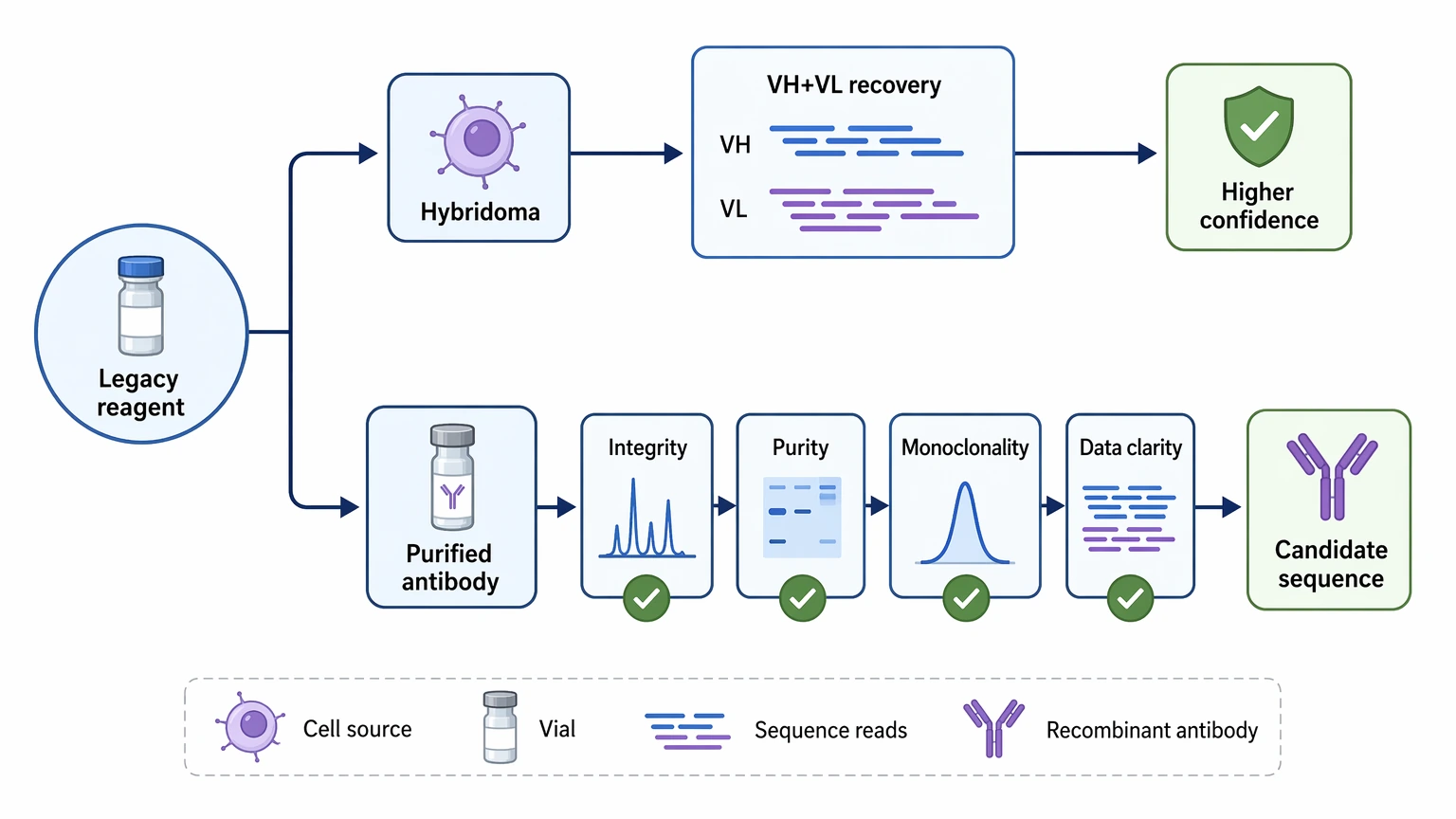
For labs focused on reproducibility, sequence text by itself is not the endpoint. What matters is a recovery result with enough confidence in the variable region, chain pairing, and any remaining ambiguity to support reagent replacement planning and fit-for-purpose validation. If the remaining stock is mixed, degraded, heavily formulated, or poorly documented, antibody sequencing may still yield a candidate sequence, but the risk to assay continuity goes up.
Key Takeaways
- The most important early triage question is the sample source: hybridoma, purified antibody, plasmid, ascites, and serum-derived material do not support the same recovery path.
- Full VH and VL variable region recovery is usually more useful than CDR-only output when the goal is recombinant re-expression.
- Purified antibody projects depend strongly on peptide coverage, chain pairing confidence, and evidence that the sample is truly a monoclonal antibody.
- Sequence recovery does not by itself prove functional equivalence across western blot, ELISA, IP, IF, IHC, flow cytometry, or cell-based binding assays.
- Cross-lab reproducibility improves most when recovered sequences are followed by side-by-side fit-for-purpose validation against retained legacy stock.
Why Legacy Research Reagents Create Reproducibility Problems
A legacy research reagent is an antibody that still matters scientifically even though its provenance, clone history, or supply chain is no longer under tight control. Common examples include inherited freezer vials, discontinued commercial antibodies, unstable hybridoma lines, or reagents that were relabeled across several projects.
These reagents usually become reproducibility liabilities quietly. One site keeps using the original stock. Another site switches to a later lot or a nominally similar replacement. The labels may match, but the variable region may not. Once that happens, cross-lab reproducibility gets hard to defend, especially in long-running workflows such as western blot, immunoprecipitation, immunofluorescence, immunohistochemistry, ELISA, or flow cytometry.
Antibody sequencing helps close that gap by turning an undocumented reagent into a defined molecular hypothesis. If the heavy chain and light chain variable region can be recovered with enough confidence, the lab has a basis for recombinant re-expression, structured reagent replacement, and more consistent assay continuity across sites.
What Antibody Sequencing Can Actually Recover
In this setting, antibody sequencing aims to recover the information needed to reconstruct the antibody variable region, especially VH and VL, including the CDRs / complementarity-determining regions and framework regions. That sequence recovery may come from nucleic acid in a hybridoma or from protein-level inference using purified antibody.
Not every project needs the same output. CDRs alone may help show whether a reagent resembles a known clone family, but recombinant re-expression usually calls for fuller variable region definition. In legacy rescue projects, the most actionable deliverable is usually a VH and VL sequence set with explicit notes on peptide coverage, unresolved residues, and chain assignment confidence.
That distinction matters. A useful sequence recovery package should say not only what was recovered, but also where uncertainty still sits and whether the data are enough for construct design.
The Starting Material Determines the Recovery Route
Hybridoma Material Usually Offers the Clearest Path
If viable hybridoma cells, frozen pellets, or recoverable RNA still exist, transcript-based recovery is usually the strongest option. RACE, targeted amplification, and NGS can recover antibody transcripts in biological context, which usually improves heavy chain and light chain assignment and supports full variable region reconstruction.
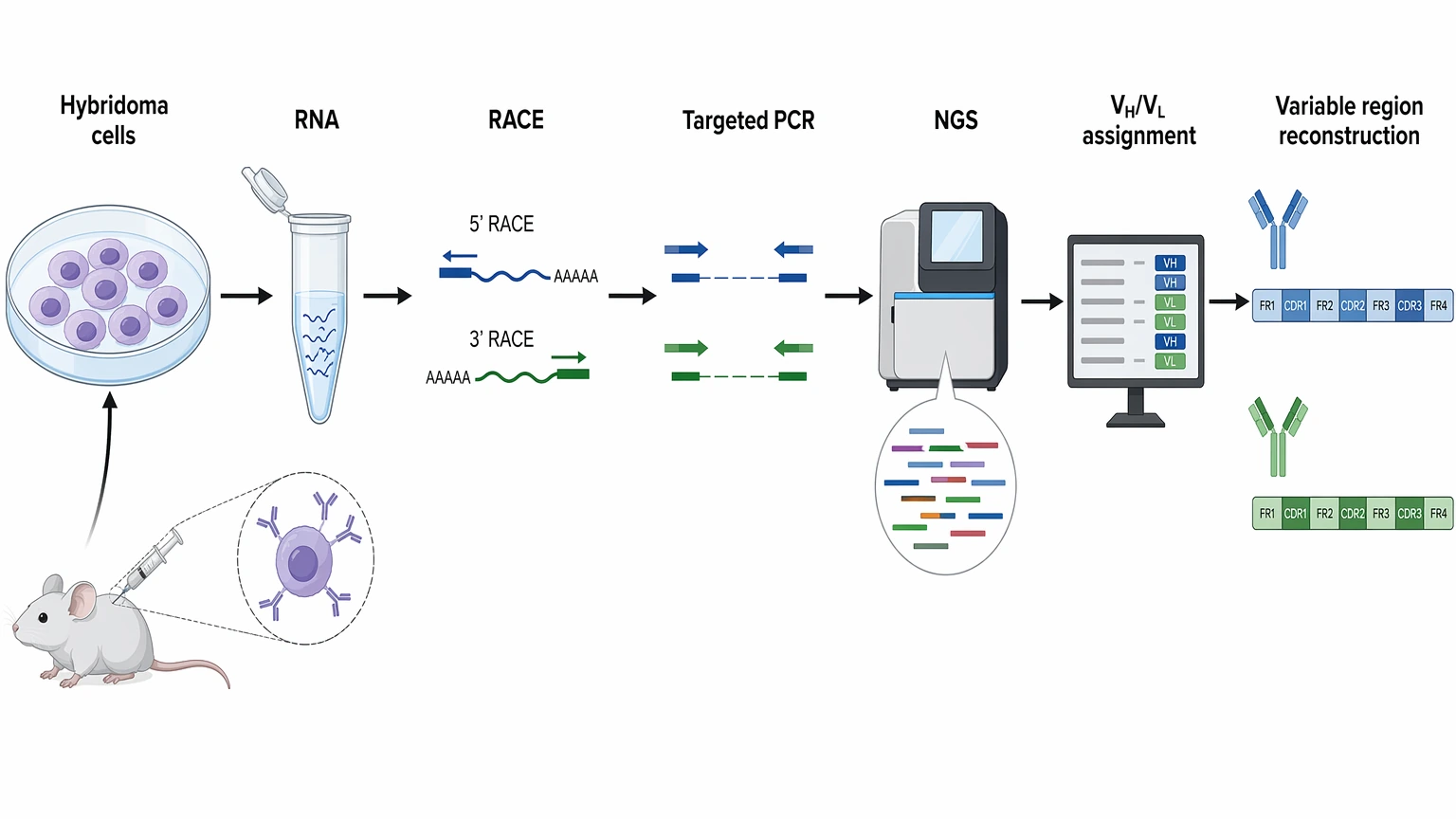
Hybridoma is not automatically clean, though. Mixed populations, transcript artifacts, or line instability can still complicate interpretation. Even with those caveats, hybridoma-derived material often provides the highest-confidence path toward recombinant re-expression readiness in legacy reagent rescue.
Purified Antibody Can Still Be Useful
A purified antibody sample is often the only asset left in older labs. In that situation, mass spectrometry and de novo sequencing become the practical route for sequence recovery. This can work well, but it relies on peptide coverage across both framework regions and CDRs, along with credible separation of target-derived peptides from co-purified background immunoglobulins.
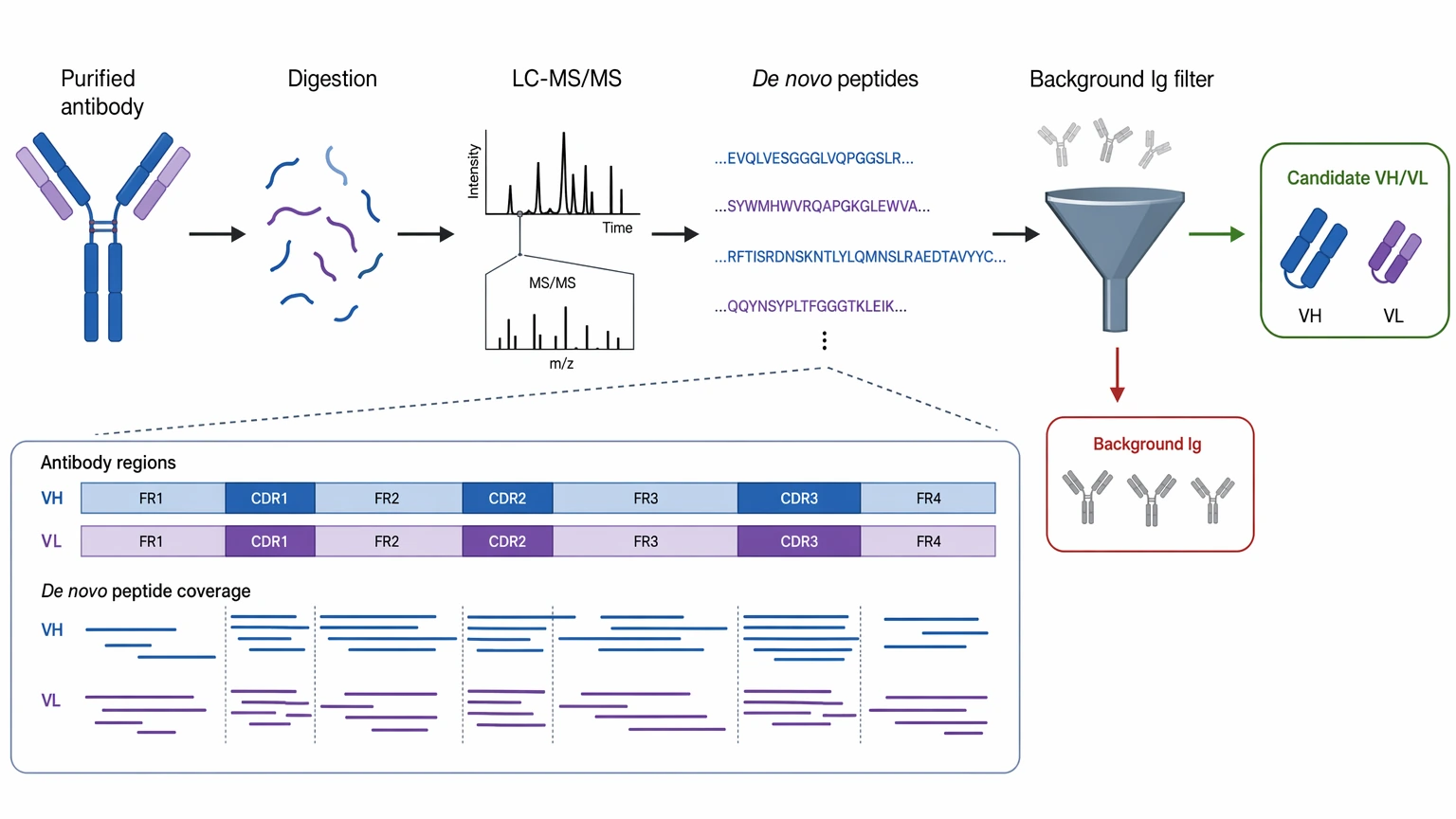
Formulation matters too. Stabilizers, carrier proteins, fragments, or trace contamination can make interpretation harder. A tube labeled “purified antibody” is not always a simple input for mass spectrometry-based reconstruction.
Mixed or Poorly Documented Material Raises Interpretation Risk
The hardest projects are not always the oldest. They are often the samples with unclear provenance. A stock may have started as a monoclonal antibody, then gone through relabeling, pooling, repeated freeze-thaw cycles, or partial contamination. In those cases, antibody sequencing may recover plausible heavy chain and light chain candidates without showing which chain pairing actually drove the historical assay.
If your group is deciding whether to rescue or retire a legacy reagent, submit your requirements for a feasibility review tied to sample type, intended assay, and remaining stock before scarce material is consumed.
A Practical Feasibility Comparison
Before launching a project, it helps to compare sample types by recovery logic rather than by platform name alone.
| Starting material | Typical recovery route | Main strength | Main limitation | Re-expression readiness |
|---|---|---|---|---|
| Hybridoma cells or RNA | RACE, targeted amplification, NGS | Direct transcript recovery of VH and VL | Mixed or unstable clone populations | Often strongest |
| Purified antibody | Mass spectrometry, de novo sequencing | Works without cells or plasmids | Sequence ambiguity and background immunoglobulins | Moderate if peptide coverage is strong |
| Expression plasmid or archived construct | Direct DNA sequencing | Clear sequence definition | May not match the final historical reagent lot | High |
| Ascites or crude antibody prep | Mixed workflow, often protein-first | May preserve the target antibody | High contamination burden | Variable |
| Serum-derived antibody fraction | Limited protein inference | May be the only remaining material | Polyclonal background usually blocks clone-level rescue | Usually low |
What a Useful Sequence Report Should Include
For a legacy research reagent, a useful report needs to do more than list amino acids or transcripts. It should help the lab decide whether reagent replacement is scientifically realistic.
Look for these elements:
- full or near-full VH and VL sequence recovery when possible
- CDRs / complementarity-determining regions and framework regions clearly annotated
- peptide coverage or transcript coverage described in interpretable terms
- explicit handling of sequence ambiguity, including unresolved or isobaric positions
- confidence language around heavy chain and light chain assignment
- a statement about whether the recovered sequence is suitable for recombinant re-expression design
- warnings if monoclonality or chain pairing remains uncertain
That kind of reporting is what separates raw sequence inference from a real rebuilding plan.
What Sequence Recovery Cannot Prove on Its Own
Even a strong sequence result has limits.
First, sequence recovery does not prove that a recombinant replacement will behave identically in every assay. Western blot may bridge successfully while IHC, IF, IP, or conformational cell-based binding assays remain more sensitive to expression context, folding, or assay conditions.
Second, incomplete coverage leaves real uncertainty. In protein-based workflows, some residues may stay ambiguous. In hybridoma-derived workflows, more than one candidate transcript may need to be resolved. Those issues do not always stop a project, but they should shape how confidently a team moves into re-expression.
Third, the surviving stock may not fully represent the original historical standard. If a freezer vial has been repeatedly thawed, relabeled, or stored without clear records, the recovered sequence may describe the present sample more accurately than the reagent used in earlier publications.
For groups planning a cross-site transition, MtoZ Biolabs can evaluate whether the available material supports antibody sequencing alone or whether the project should be framed from the start as sequencing plus assay-bridging work. That is a practical point to contact us and evaluate your project before using the last retained aliquots.
Validation Is What Restores Cross-Lab Reproducibility
The reproducibility gain comes from what happens after sequence recovery. Once a candidate VH and VL pair is selected and recombinant re-expression is completed, the rebuilt reagent should be compared with retained legacy stock in the assay that matters most.
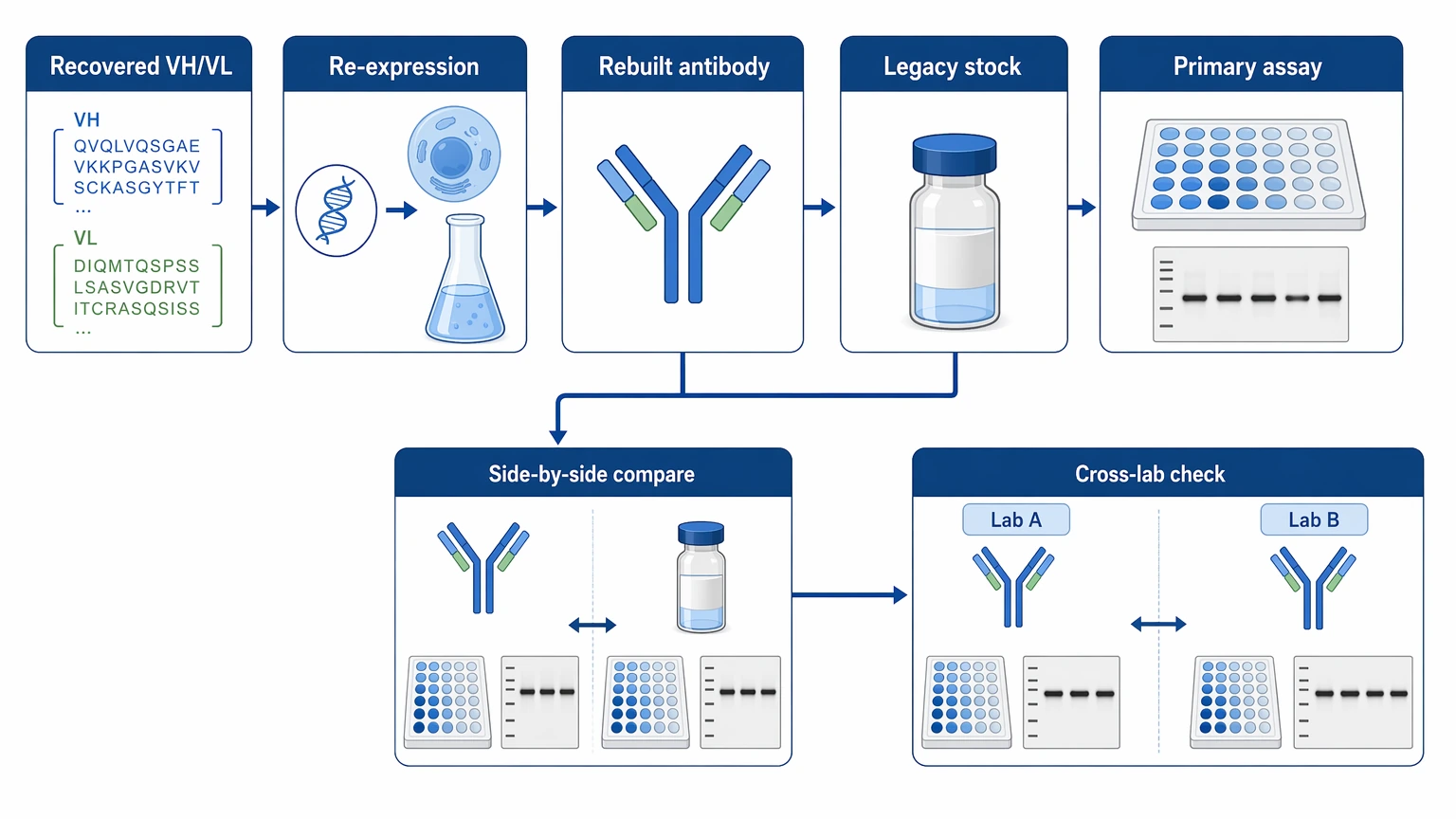
A focused validation plan usually starts with:
- side-by-side testing in the primary assay
- predefined similarity criteria before broader rollout
- extra caution for epitope-sensitive applications such as IHC, IF, and IP
- testing at more than one site if cross-lab reproducibility is the main goal
- retention of a reference stock until the replacement reagent is operational
This is also where scope should stay realistic. The first target is usually assay continuity in a defined use case, not universal equivalence across every historical application.
Conclusion
Antibody sequencing is often the most direct way to stabilize a legacy research reagent when the available material can support credible variable region recovery, chain pairing assessment, and recombinant re-expression planning. Hybridoma-derived inputs usually provide the strongest path, while purified antibody remains workable when peptide coverage, sample purity, and monoclonality risk are understood early. For academic core facilities, translational labs, and multi-site studies trying to preserve assay continuity, the best next step is a project-specific review that links the sample source, expected sequence deliverable, and fit-for-purpose validation plan. If you are preparing for reagent replacement, assay transfer, or cross-lab standardization, contact MtoZ Biolabs to discuss the sample history, intended assay, and validation goals so the sequencing strategy matches the real reproducibility question.
FAQ
Can antibody sequencing work if the antibody concentration is unknown?
Sometimes, yes. Unknown concentration does not automatically disqualify a sample, but it does make feasibility triage harder. An estimate of volume, storage buffer, and visible precipitation can still help determine whether the sample is more suitable for mass spectrometry-based de novo sequencing or whether concentration assessment should come first.
Does recovering VH and VL confirm the original epitope?
No. VH and VL sequence recovery supports reagent reconstruction, but it does not directly prove epitope identity. Epitope-sensitive applications may still need binding studies or assay-specific comparison against retained reference material.
Is a recombinant replacement always preferable to keeping the last legacy stock?
Not always. If the legacy reagent is used rarely and enough validated stock remains, a lab may choose controlled short-term use instead of immediate rebuilding. Recombinant re-expression becomes more attractive when the assay must be transferred, scaled across sites, or sustained beyond the remaining inventory.
What is the biggest warning sign that a purified antibody project may be difficult?
A sample described only as “purified” with no clone history, no formulation record, and uncertain monoclonality is a common warning sign. In that setting, background immunoglobulins and unclear chain pairing can limit how confidently the variable region can be reconstructed.
Should a lab sequence multiple historical lots or only one?
If lot drift is already suspected, sequencing more than one retained lot can be informative. It may show whether the reproducibility problem comes from a true sequence difference, a formulation change, or a later substitution that no longer matches the original reagent.
What records are most useful before starting a rescue project?
The most useful records are application history, source species, isotype if known, purification method, storage conditions, prior lot changes, and any side-by-side notes showing when performance began to drift.
How to order?




