






Antibody Repertoire Sequencing vs Antibody Sequencing: Different Questions, Different Outputs
Choose antibody repertoire sequencing when the project asks how a B-cell population is organized across many clonotypes, such as clonal expansion, V gene / J gene usage, CDR3 distribution, or somatic hypermutation patterns. Choose antibody sequencing when the project needs sequence recovery for one defined antibody, such as a hybridoma product or purified monoclonal antibody, so the result can support recombinant re-expression, engineering, or clone documentation.
These requests often get grouped under the same vendor label, but the outputs are not the same. Antibody repertoire sequencing gives you population-level profiling of an immunoglobulin repertoire. Antibody sequencing, as used here, is aimed at recovering a full-length variable-region sequence or a close sequence package for one antibody, with chain pairing and re-expression readiness front and center. The right choice starts with the biological question, not the platform name.
Where This Decision Usually Starts
This decision usually shows up during project planning: the team has antibody-related material, but the goal is still described too broadly as “antibody sequencing.” Once you look at the sample type and the downstream use, it becomes clear that two different workflows are being collapsed into one label.
One group may have PBMCs, sorted B cells, or lymphoid tissue and want to characterize the immunoglobulin repertoire after vaccination, infection, tumor exposure, or autoimmune activity. Their questions center on clonotype structure, clonal expansion, V(D)J recombination patterns, V gene / J gene usage, complementarity-determining region features, and somatic hypermutation across a cell population. Another group may have a legacy hybridoma, unstable clone-derived material, or a purified monoclonal antibody and need the actual heavy chain and light chain variable-region sequences for recombinant re-expression.
That distinction matters because each route leaves blind spots the other cannot fix. A clonotype abundance table does not automatically give you a recombinant-ready monoclonal sequence. A recovered monoclonal sequence does not tell you how the broader B-cell response is distributed across clonotypes. If your team is about to outsource the work, define the output first, then send the sample.
The Comparison That Actually Changes the Decision
Four dimensions usually decide whether antibody repertoire sequencing or antibody sequencing is the better fit:
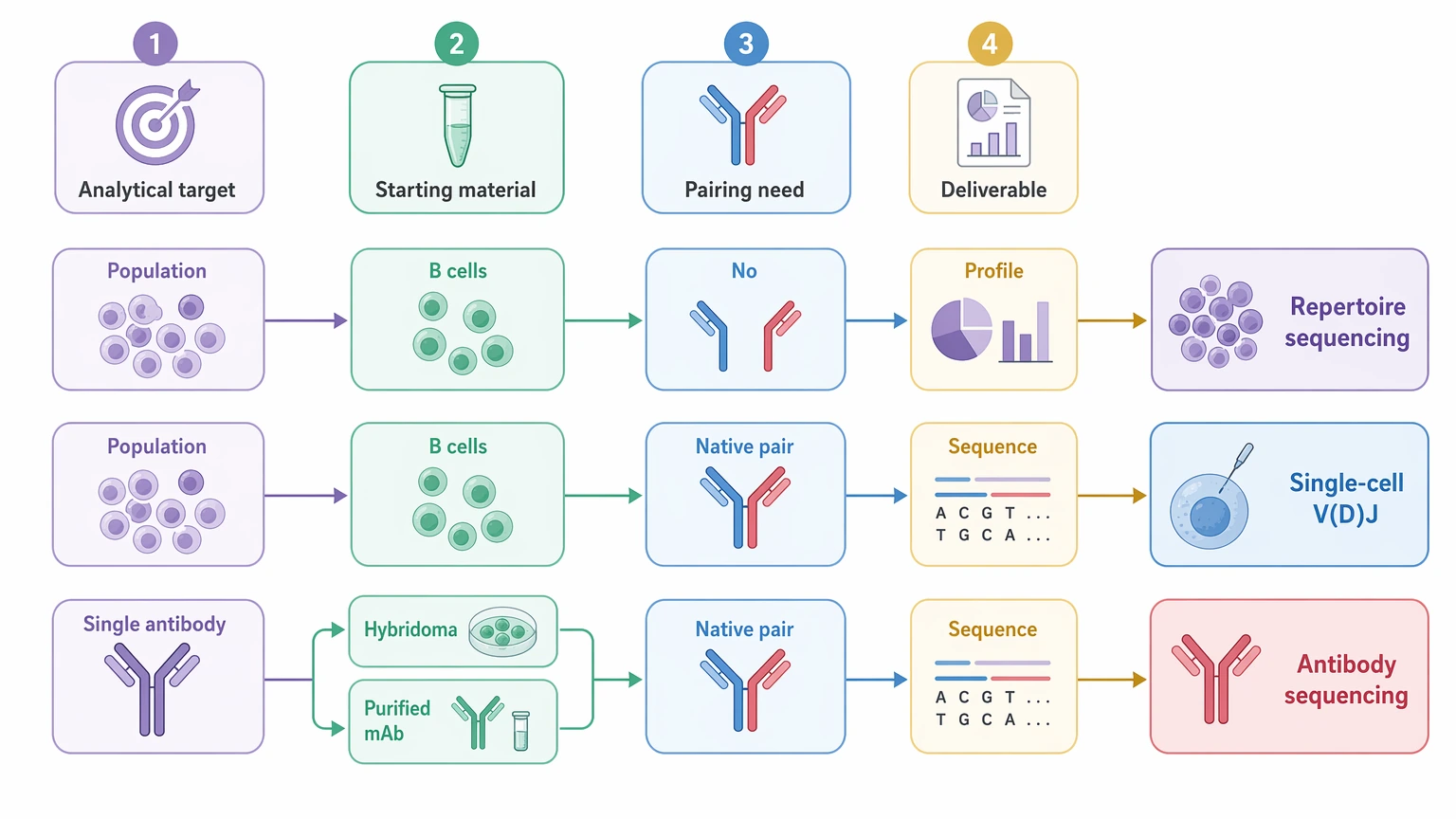
-
Analytical target
Are you profiling a B-cell population or recovering one antibody sequence? -
Starting material
Do you have B cells and usable RNA, or only clone-defined material or antibody protein? -
Chain pairing and sequence scope
Do you need native heavy chain/light chain pairing and a full-length variable-region sequence, or are repertoire-level metrics enough? -
Downstream deliverable
Do you need population statistics, or a sequence package that can support recombinant re-expression and validation?
The table below sums up the split.
| Dimension | Antibody repertoire sequencing | Antibody sequencing |
|---|---|---|
| Main question | How is the B-cell population responding? | What is the sequence of this one antibody? |
| Analytical object | Many clonotypes within an immunoglobulin repertoire | One defined antibody molecule or clone |
| Typical input | PBMCs, sorted B cells, lymphoid tissue | Hybridoma cells, supernatant, purified monoclonal antibody |
| Common methods | bulk repertoire sequencing, single-cell V(D)J | 5' RACE, clone cDNA approaches, LC-MS/MS, de novo antibody sequencing |
| Chain pairing | Often unresolved in bulk; preserved in single-cell V(D)J | Must be assigned or recovered for the target antibody |
| Main output | clonotype abundance, V(D)J recombination patterns, CDR3 and SHM metrics | consensus sequence or full-length variable-region sequence for heavy chain and light chain |
| Best downstream use | population-level profiling | recombinant re-expression, clone rescue, engineering |
Analytical Target: Population-Level Profiling vs Sequence Recovery
Antibody repertoire sequencing is a form of B-cell receptor sequencing or BCR-seq that looks at many immunoglobulin transcripts at once. The main readout is a repertoire-level view of clonotypes, relative abundance, V gene / J gene usage, CDR3 composition, lineage relationships, and somatic hypermutation patterns. That makes it the right choice when the project asks how a B-cell response is organized or how it changes over time.
Antibody sequencing answers a different question. Here, the goal is not to describe a population but to recover the variable region sequence of one defined antibody. The success standard is therefore much closer to chain-specific assignment, sequence recovery, and re-expression planning than to diversity metrics.
A common planning mistake is to treat an expanded clonotype as though it were already a finished monoclonal antibody candidate. Expansion can help prioritize candidates, but by itself it does not establish a verified heavy chain/light chain pair suitable for construct design.
Starting Material: What You Have Often Narrows the Choice
Input material often narrows the choice before method details do.
| Starting material | Better-fit route | Why |
|---|---|---|
| PBMCs | antibody repertoire sequencing | Supports population-level BCR-seq |
| Sorted antigen-specific B cells | antibody repertoire sequencing or single-cell V(D)J | Retains biological context and may support paired candidate recovery |
| Lymphoid tissue | antibody repertoire sequencing | Suitable for immunoglobulin repertoire profiling |
| Hybridoma cells | antibody sequencing | Clone-defined cellular source for sequence recovery |
| Hybridoma supernatant | antibody sequencing | Supports clone-focused recovery routes |
| Purified monoclonal antibody | antibody sequencing | Direct target for LC-MS/MS or de novo antibody sequencing |
If nucleic acid from a defined clone is available, 5' RACE or related cDNA approaches may recover the heavy chain and light chain variable region efficiently. If the starting point is protein rather than cells, LC-MS/MS and de novo antibody sequencing are usually the more relevant options. That divide is basic but important: repertoire workflows start with B-cell populations, while protein-based antibody sequencing starts with the secreted molecule.
Chain Pairing: The Technical Detail That Often Decides the Workflow
Chain pairing is one of the clearest reasons these two service categories should not be treated as interchangeable.
In bulk repertoire sequencing, heavy chain and light chain information is often generated in separate pools. That setup works well for measuring clonal expansion, V(D)J recombination patterns, and CDR3 distributions across a population, but it usually does not preserve native pairing. For immune-response profiling, that may be acceptable. For recombinant re-expression, it is often a real limitation.
Single-cell V(D)J sits in the middle. It still belongs on the repertoire side because it starts from B cells and supports population-level profiling, but it may retain cell-resolved heavy chain/light chain pairing. That can make it a workable option when a study needs both repertoire context and candidate-level follow-up from the same biological sample.
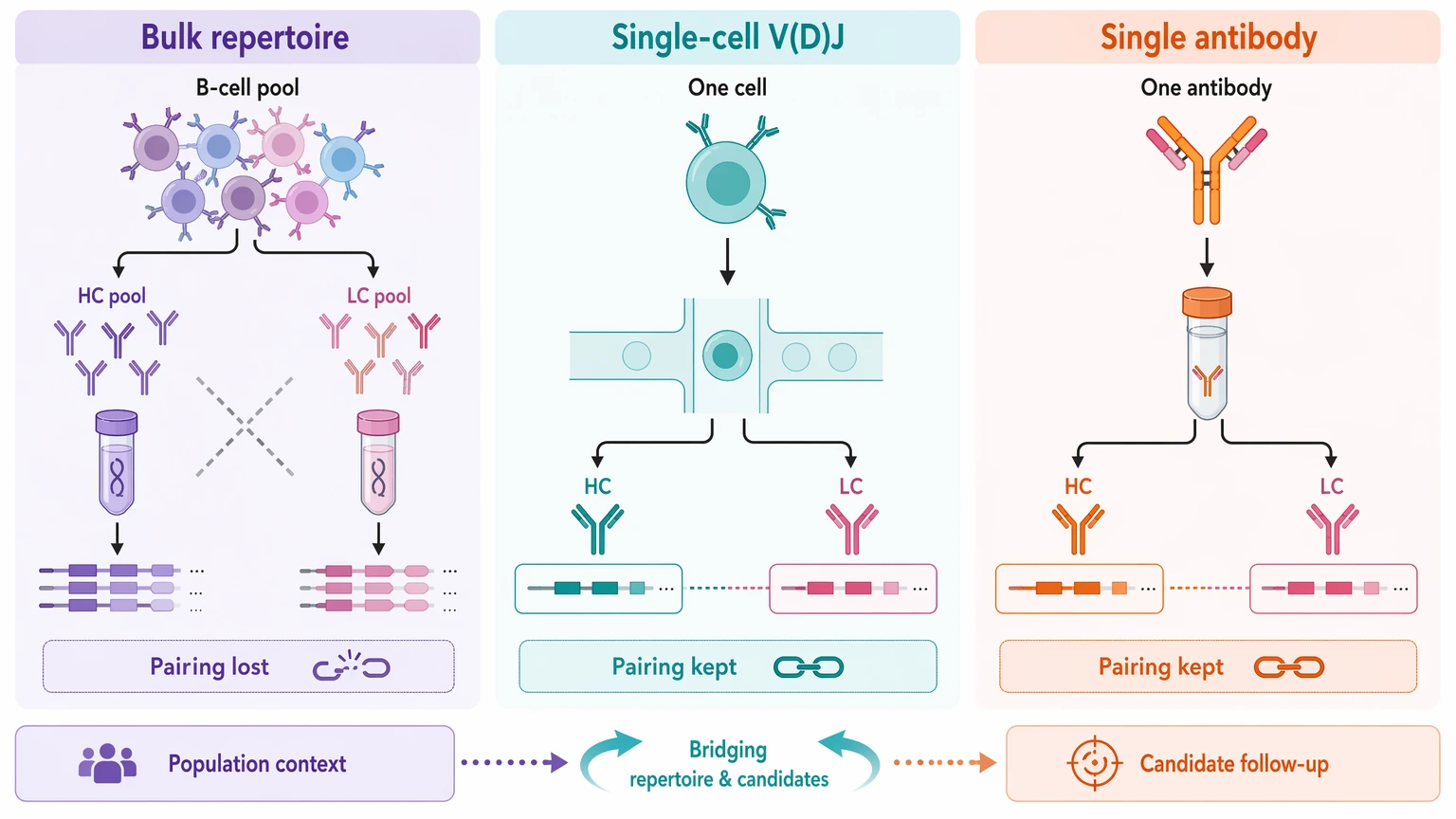
By contrast, single-antibody sequencing has to resolve the target antibody at the clone level. With hybridoma-derived nucleic acid, chain assignment may come directly from the clone. With a purified monoclonal antibody, pairing may need to be inferred from protein evidence and then checked with orthogonal confirmation. If pairing accuracy is central to the project, spell that out early in the outsourcing discussion.
If the goal is to move quickly toward construct design, submit your requirements before shipment and specify whether native pairing is mandatory; teams at MtoZ Biolabs can evaluate the sample type against pairing needs and the expected output instead of routing the project under a generic antibody sequencing label.
Deliverables: What You Can Use Next
The most practical difference is the final deliverable.
A repertoire report usually contains:
- clonotype abundance tables
- V(D)J recombination summaries
- V gene / J gene usage
- CDR3 length or motif distributions
- somatic hypermutation patterns
- diversity or clonal expansion summaries
A single-antibody sequencing report should instead focus on:
- heavy chain variable-region sequence
- light chain variable-region sequence
- chain assignment notes
- consensus sequence interpretation
- unresolved positions or ambiguity notes
- suitability for recombinant re-expression or follow-up validation
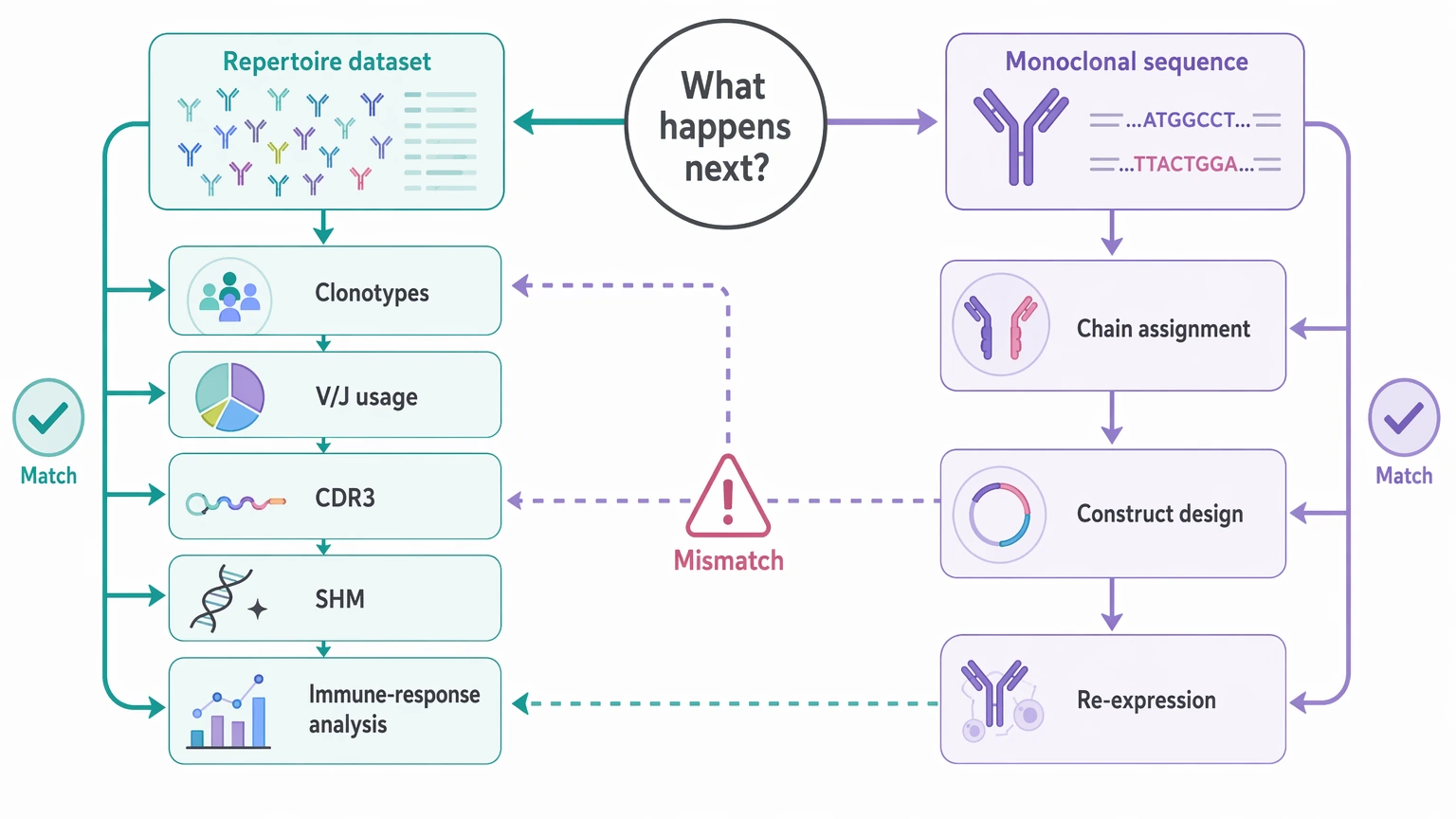
That difference changes what you can do next. A team that needs clone rescue may find a repertoire dataset biologically informative but still not enough for expression construct design. A team studying vaccination response patterns may receive a strong monoclonal sequence package and still not have an answer to the original population-level question.
Which Route Fits Which Project Goal?
Choose antibody repertoire sequencing when the objective is immune-response structure: repertoire diversity, clonotype shifts, clonal expansion, V gene / J gene usage, CDR3 features, or somatic hypermutation across a B-cell population.
Choose antibody sequencing when the objective is sequence recovery for one antibody from a clone-defined source or a purified protein sample, especially when the endpoint is recombinant re-expression, engineering, archival documentation, or clone comparison.
Choose single-cell V(D)J when you need a bridge between those goals: B-cell-derived input, repertoire context, and cell-resolved chain pairing in the same study design.
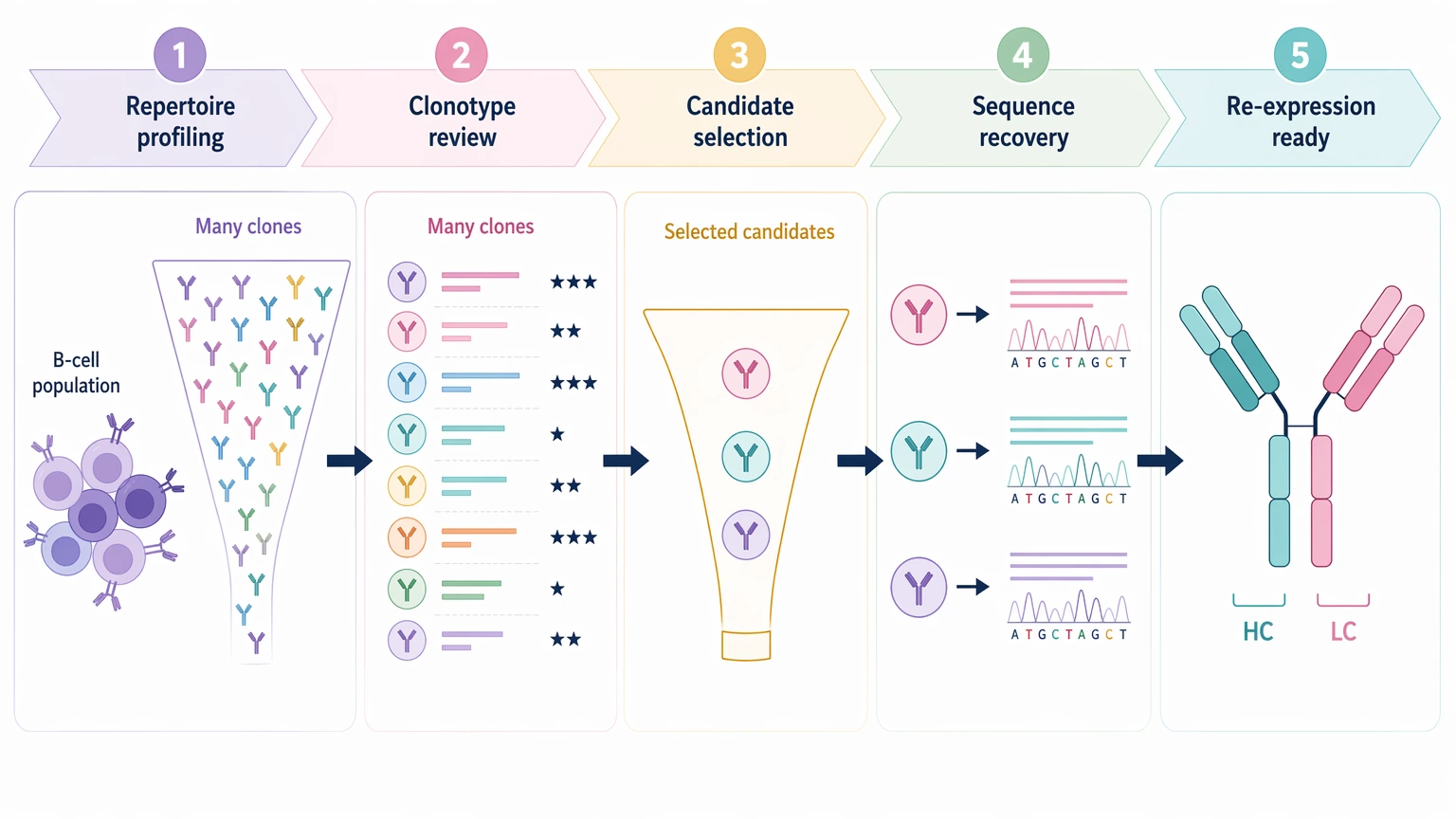
Use a staged plan when the project genuinely has two endpoints. A discovery program, for example, may start with repertoire profiling to identify biologically interesting clonotypes and then move selected candidates into clone-focused sequence recovery. That is not redundant. It is a way to match each question to the output that can actually answer it.
What to Prepare Before You Contact a Provider
Before you start an external discussion, prepare four decisions in plain language:
-
What is the output object?
A repertoire profile or one antibody sequence? -
What is the sample source?
PBMCs, sorted B cells, lymphoid tissue, hybridoma cells, supernatant, or purified monoclonal antibody? -
Is chain pairing required?
Nice to have, inferred, or mandatory for downstream work? -
What happens after sequencing?
Immune-response interpretation, clone nomination, clone confirmation, or recombinant re-expression?
Providing those answers shortens method selection and lowers the chance of getting a technically correct but decision-misaligned report. If you are comparing outsourcing paths, contact MtoZ Biolabs to evaluate your project and discuss sample type, pairing requirements, and validation planning before you commit limited material.
Comparison Summary and Consultation Guidance
Antibody repertoire sequencing and antibody sequencing are not interchangeable labels for the same service. One is built for population-level profiling of a B-cell response; the other is built for sequence recovery of one defined antibody. The better choice depends on the biological question, the starting material, the required level of chain pairing, and the deliverable needed for the next step. For projects involving PBMCs, sorted B cells, hybridoma material, or purified monoclonal antibody, the most useful next move is to align the sample with the output you actually need, then request workflow review with that endpoint in mind. That is especially helpful when the project will move into clone confirmation or recombinant re-expression after sequencing.
FAQ
If I recover only a heavy chain sequence from repertoire data, can I still build the antibody?
Usually not in a confident way. Recombinant re-expression normally requires both the heavy chain and the correctly assigned light chain. Repertoire data may nominate candidate chains, but pairing still has to be established or confirmed.
Does serum antibody sequencing count as antibody repertoire sequencing?
Not usually. Serum or purified antibody fractions are protein-centered inputs and do not preserve the same cellular context as B-cell receptor sequencing. Those projects are more aligned with LC-MS/MS-based or de novo antibody sequencing strategies.
When is a consensus sequence not enough for re-expression work?
A consensus sequence may still leave unresolved residues, uncertain chain assignment, or incomplete coverage near critical regions. If the endpoint is construct design, ask whether the report includes ambiguity notes and what confirmation step is recommended before expression.
Can single-cell V(D)J replace hybridoma sequencing?
Only in some study designs. Single-cell V(D)J starts from B cells and can preserve pairing, but it does not replace clone-defined sequencing when the material of interest is already a hybridoma or an isolated monoclonal product.
What validation step is most useful after single-antibody sequence recovery?
That depends on the downstream goal, but common next steps include clone-to-sequence comparison, targeted confirmation, or recombinant expression testing to check whether the recovered heavy chain and light chain support the expected antibody product.
How to order?




