






Antibody Protein Sequencing Service: What Samples, Deliverables, and Decision Criteria Matter Most
An antibody sample is usually a good candidate for an antibody protein sequencing service when the team needs protein-level sequence evidence, the material is reasonably purified, and enough sample is available for reduction and alkylation, enzymatic digestion, and at least limited repeat work. The risk goes up when the sample is a mixture, heavily degraded, or loaded with formulation components that interfere with LC-MS/MS.
Decision snapshot
Use de novo sequencing when: the antibody sequence is unknown, incomplete, undocumented, or needs independent protein-level confirmation.
Use a database-supported identification workflow when: a reliable reference sequence already exists and the main goal is identity confirmation rather than sequence reconstruction.
Escalate the risk review before outsourcing when: the sample contains multiple antibody species, strong glycosylation-related complexity, visible degradation, or very limited remaining material.
Approve the project only if the report will include: chain assignment, peptide coverage across heavy chain and light chain regions, confidence annotation, unresolved position reporting, PTM notes, and access to raw data.
This short screen usually gets to the real buying question faster than comparing instrument names.
Where teams get stuck before outsourcing
The main pre-purchase issue is not whether a lab owns current mass spectrometers. It is whether a specific antibody can produce sequence evidence that is usable for the next technical decision. That question usually comes up when a legacy monoclonal antibody has incomplete records, a hybridoma-derived antibody lacks reliable DNA documentation, or a reformulated sample needs protein-level confirmation after transfer, stress, or recovery.
Procurement reviews often slow down for four practical reasons. First, the team is unsure whether the current sample format is suitable for de novo peptide sequencing. Second, a proposal promises a final sequence without explaining how heavy chain and light chain evidence will be separated and reviewed. Third, stakeholders assume every residue in the variable region will be supported equally, even though fragmentation spectrum quality is uneven in a real antibody dataset. Fourth, vendor screening tends to focus on platform names instead of report transparency.
Why the right service path is not always de novo sequencing
De novo sequencing and database-supported identification answer different questions. De novo sequencing reconstructs sequence information from tandem mass spectrometry evidence instead of relying only on a reference database. That makes it useful when the sequence is unknown, disputed, or not represented clearly enough in available records.
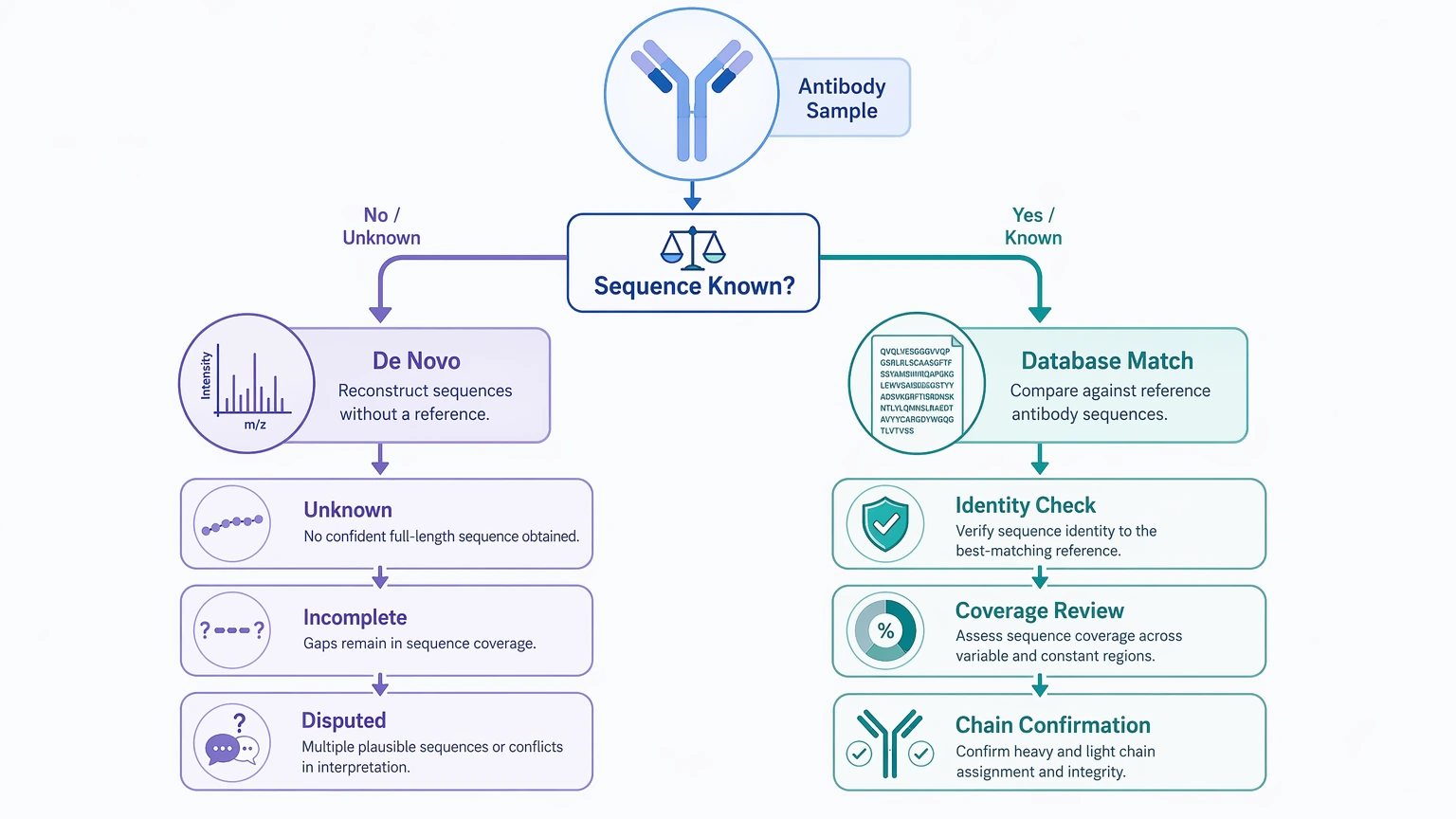
A database-supported route is often the better fit when the antibody sequence is already known and the team mainly needs identity support, peptide coverage, or targeted confirmation of specific regions. Buyers should settle that distinction before requesting quotes. “Sequence the antibody” is too broad for a procurement decision. A better brief states whether the team needs unknown sequence reconstruction, chain confirmation, complementarity-determining region review, or follow-up evidence for redevelopment.
Step 1: Check whether the sample is fit for antibody de novo sequencing
Sample fit is the first gate. A purified monoclonal antibody is usually the cleanest starting point because it makes chain assignment easier and reduces interpretation noise. Recombinant antibodies can also work well when independent protein-level confirmation is needed rather than reference-only matching. Hybridoma-derived antibodies are a common de novo use case, but lower purity or hidden heterogeneity can reduce usable peptide evidence.
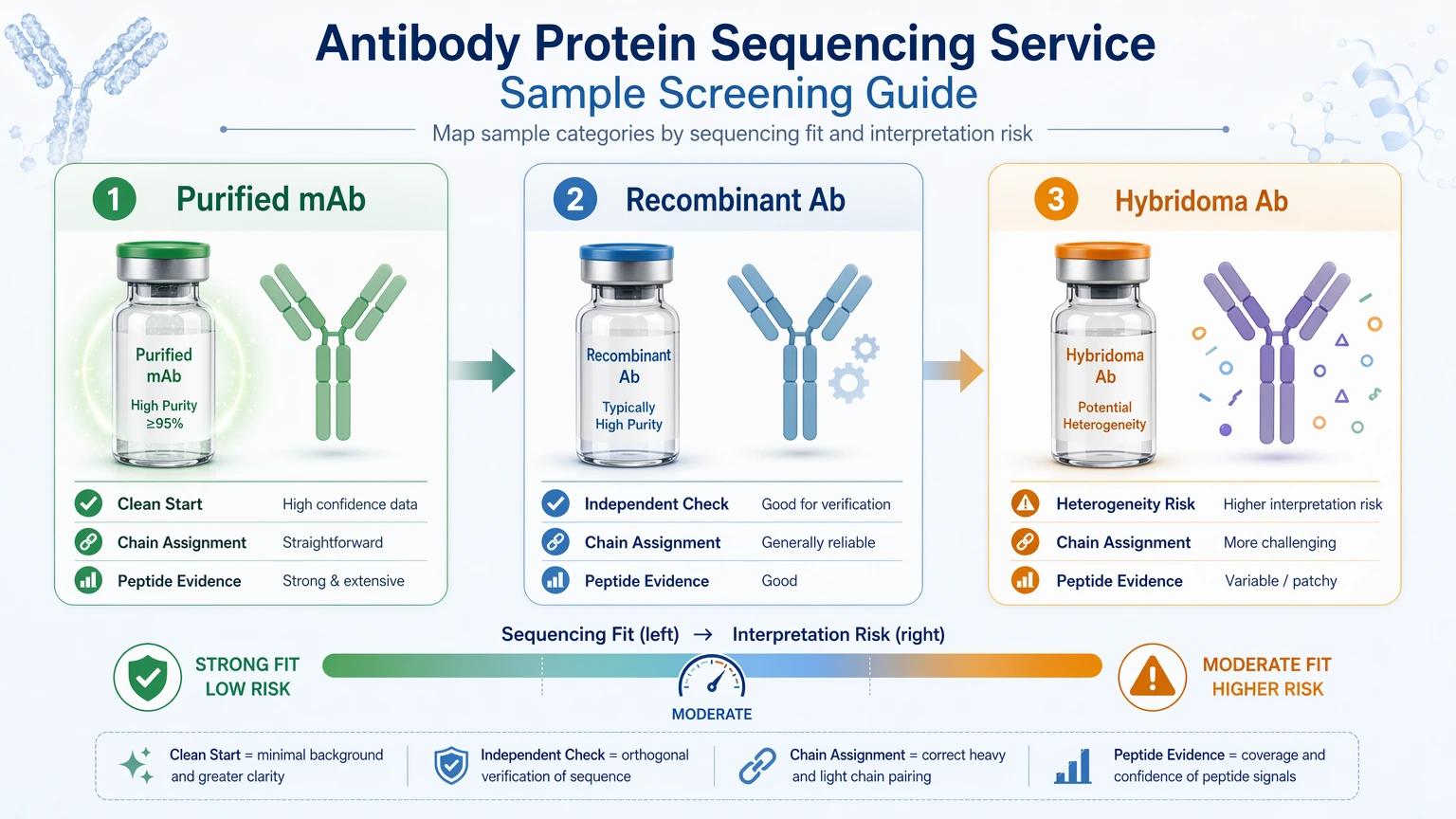
Formulated antibodies fall somewhere in the middle. They may still be workable, but surfactants, stabilizers, and salts can suppress digestion performance or complicate chromatographic separation. Mixed antibody samples are the highest-risk category because overlapping homologous peptides can blur heavy chain and light chain assignment.
Purity matters just as much as sample type. Aggregation, clipping, oxidation, deamidation, and glycosylation can reduce local sequence coverage or break peptide overlap. Disulfide bond complexity can also limit interpretation when reduction and alkylation or digestion planning does not match the sample condition.
| Sample type | Best fit | Main constraint | Best next step |
|---|---|---|---|
| Purified monoclonal antibody | Strong starting material for de novo sequencing | Residual excipients or aggregation may still interfere | Share concentration, buffer, and purity notes |
| Recombinant antibody | Useful for independent protein-level confirmation | Expected sequence bias can affect review | Request evidence-based reporting |
| Hybridoma-derived antibody | Good use case when DNA records are missing | Purity and heterogeneity may reduce clean spectra | Discuss cleanup and repeat digestion options |
| Formulation-buffer sample | Sometimes workable after cleanup | Excipients may affect digestion or LC-MS/MS | Provide the full formulation composition |
| Mixed antibody sample | Usually poor fit for de novo reconstruction | Chain evidence can overlap across species | Purify first or consider an alternative workflow |
Takeaway: sample form does not decide the project on its own, but it is a strong predictor of whether the final report will be straightforward to use.
Service Routes to Consider
For this project scenario, readers usually compare these service routes before requesting a quote or submitting samples.
Step 2: Confirm that sample amount supports evidence building
A credible project usually needs enough material for more than one analytical pass. The question is not only whether one digestion can be run. It is whether enough sample remains for repeat enzymatic digestion, cleanup loss, and focused follow-up if ambiguous positions remain.
Before sending an inquiry, prepare a short technical package with:
- antibody type and source
- concentration and total available volume
- buffer or formulation composition
- known purity concerns or visible heterogeneity
- prior reduction, chain separation, or stress history
- replicate availability
- downstream goal, such as full reconstruction, partial confirmation, or CDR-focused evidence
This is also the right point for a service discussion. If your team needs a pre-submission review of sample fit, report depth, or validation options, submit your requirements to MtoZ Biolabs so the project can be evaluated against the right antibody protein sequencing service workflow before purchase.
Step 3: Compare deliverables, not marketing claims
A useful antibody sequencing report is more than a proposed amino acid sequence. Buyers should ask whether the deliverable keeps the underlying evidence traceable for technical review.
At minimum, the report should contain:
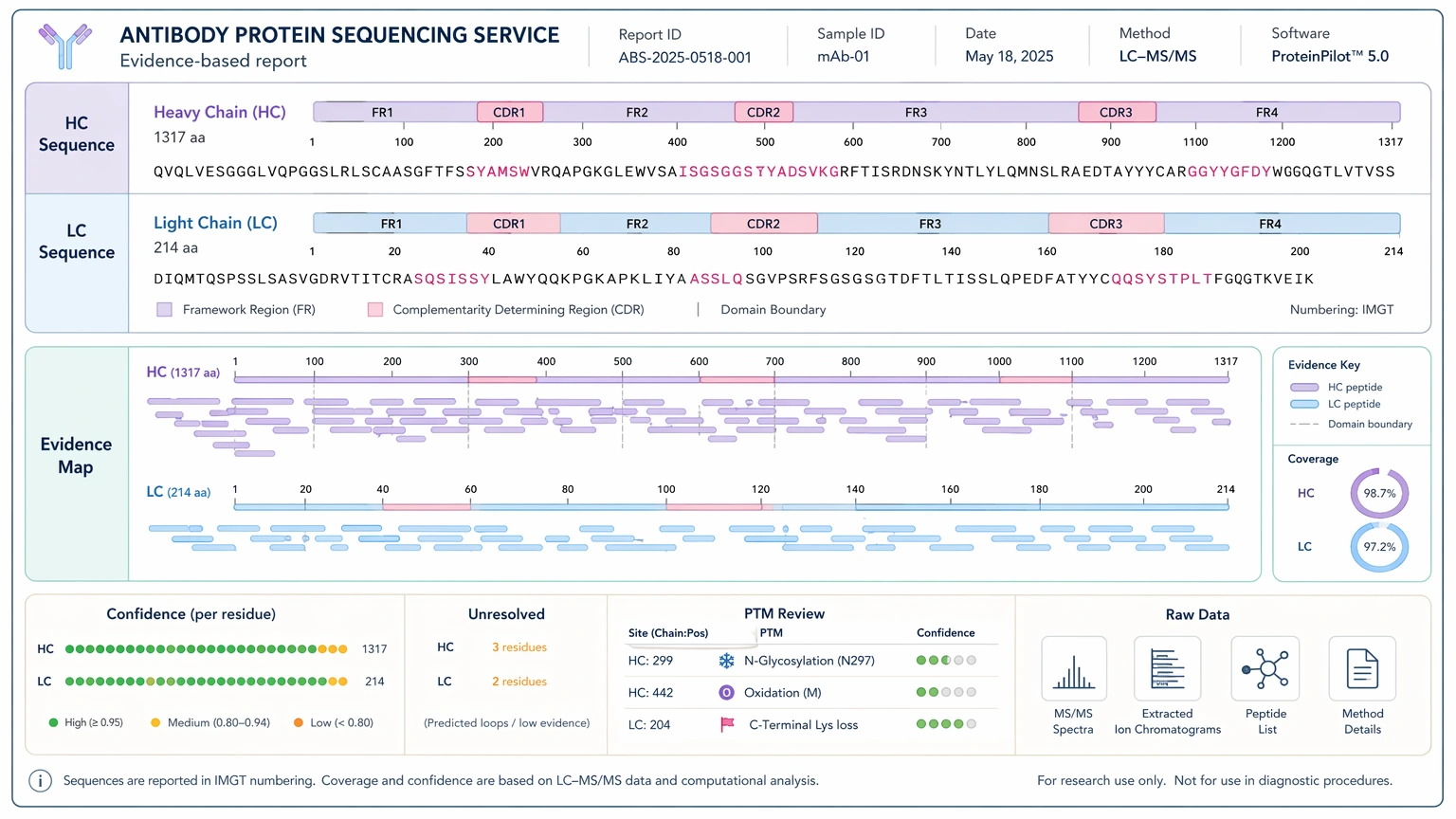
- a chain-level sequence proposal for the heavy chain and light chain
- an evidence map linking peptides to sequence regions
- peptide coverage and sequence coverage summaries
- confidence annotation for well-supported and weakly supported regions
- explicit unresolved residue or unresolved position reporting
- PTM annotation, including glycosylation, clipping, oxidation, or deamidation notes
- raw data availability for internal review
- method and interpretation notes
The main limitation is sequence confidence, not presentation quality. A polished final sequence line is not enough if the provider does not show where the evidence is strong, weak, or incomplete. This matters most in the variable region, especially in the complementarity-determining region, where missing overlap or PTM-related interference can affect downstream redevelopment decisions.
A second limitation should be stated plainly in any antibody de novo project: isoleucine/leucine ambiguity remains a known MS-based interpretation boundary unless additional evidence is available. PTM-rich regions, homologous framework peptides, and database-search limits can also leave localized uncertainty even when overall chain assignment is strong.
Step 4: Screen vendors for antibody-specific interpretation quality
Vendor review should focus on antibody-specific interpretation, not generic proteomics capacity. Useful screening questions include:
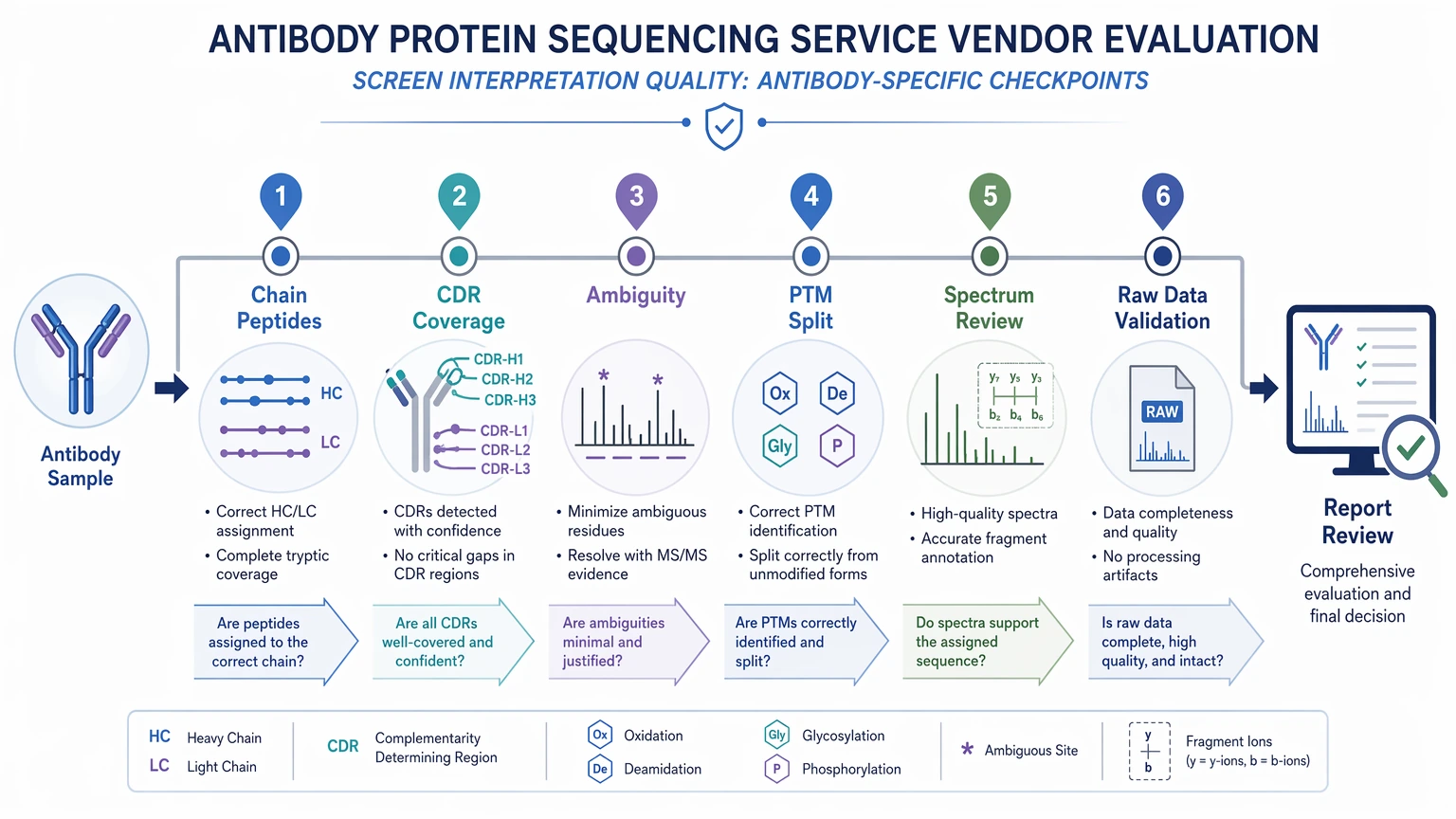
- How do you assign chain-specific peptides when homologous regions overlap?
- What is your plan for maximizing CDR coverage?
- How do you report amino acid ambiguity and unresolved positions?
- How do you separate sequence variation from post-translational modification effects?
- Will peptide-spectrum match review or fragmentation spectrum examples be included?
- What raw data and evidence map files are provided?
- When do you recommend orthogonal validation after the first report?
Strong answers usually show that the provider understands chain assignment, ambiguity reporting, and practical interpretation limits. Weak answers tend to sound certain without explaining how confidence is actually established.
Expected results and validation methods
An initial report should deliver immediate project outputs that help the team decide what to do next. Those outputs usually include a proposed heavy chain and light chain sequence, region-level peptide coverage, confidence annotation, PTM notes, and a list of unresolved residues or ambiguous calls.
Follow-up confirmation is a separate stage. If the output will support recombinant expression, redevelopment, intellectual property review, or sequence-critical CMC decisions, the team should ask for an orthogonal validation plan. That may include targeted LC-MS/MS confirmation, terminal sequencing support, or focused site-level checks on regions affected by glycosylation, clipping, or low-confidence fragmentation.
A good validation section in the report should separate what was directly observed from what still needs confirmation. It should not suggest that one de novo interpretation step resolves every uncertainty.
Key cautions and practical limits
Sample quality and amount set real limits on what can be concluded. Low-purity preparations, multiple antibody species, and substantial degradation may still produce useful partial evidence, but they often narrow sequence coverage and increase amino acid ambiguity. Limited material also reduces the chance of repeating digestion or adding orthogonal validation.
Controls and repeat expectations matter. A project with no reserve material leaves less room to investigate disputed calls. If multiple lots or stressed samples are involved, batch history should be disclosed because oxidation, deamidation, clipping, or formulation differences can change interpretation.
Contamination and batch mixing are also real risks. Even modest carryover from another immunoglobulin species can complicate chain assignment in homologous regions. Buyers should ask how the provider screens for mixture risk and whether the report will flag evidence that does not fit a clean monoclonal model.
Interpretation has boundaries. A proposed sequence does not prove biological function, binding behavior, or therapeutic equivalence. When the sample is clearly mixed, when a reference sequence already exists, or when the real goal is identification rather than reconstruction, another method may be the better next step. In those cases, a database-supported identification workflow, peptide mapping, or outside support for purification may be more useful than full de novo sequencing.
Conclusion
An antibody protein sequencing service is most useful when the sample is sufficiently clean, the project truly calls for de novo sequencing, and the report is built for evidence review rather than display. That fit is strongest for purified monoclonal antibodies, hybridoma-derived assets with incomplete records, and samples that need independent protein-level confirmation before redevelopment or comparability work. If that matches your project context, gather the sample form, formulation details, available material, and intended decision use, then contact MtoZ Biolabs to evaluate your project and discuss the most suitable workflow and validation path.
FAQ
Can a reduced heavy chain and light chain preparation improve sequencing success?
Sometimes, yes. Separate chains can simplify chain assignment, but prior handling may also introduce loss, oxidation, or incomplete recovery. Providers should review how the chains were prepared and stored before treating separation as an advantage.
What report feature most often separates a usable result from a hard-to-defend result?
Region-level confidence annotation. A sequence proposal without clear confidence boundaries is much harder to use in redevelopment, procurement review, or internal technical signoff.
Are PTMs always identified in the same run that supports sequence reconstruction?
Not completely. Some post-translational modification signals can be annotated in the same workflow, but PTM-rich regions may still need follow-up confirmation if the modification pattern affects interpretation or project decisions.
Should a buyer ask for raw data even without an internal mass spectrometry team?
Yes. Raw data preserves the option for later technical review by another group, consultant, or regulatory-facing team if sequence questions come back later.
When does purification become a better investment than sequencing immediately?
When the sample contains more than one antibody species, strong background proteins, or formulation components that dominate preparation risk. In that situation, cleaner input often improves decision value more than moving straight into sequencing.
Does incomplete CDR coverage make the whole project unusable?
No. It may still support chain-level confirmation or partial reconstruction. The real question is whether the missing CDR evidence affects the downstream use case enough to require orthogonal validation.
How to order?




