






Antibody Protein Sequencing Service: Sample Requirements, Deliverables, and When to Outsource
If the only material left is a purified antibody sample, an antibody protein sequencing service is often the most workable path to sequence recovery. The decision usually comes down to three things: whether the sample can support clean peptide assignment, whether heavy chain (HC) and light chain (LC) sequences can be reported with defensible chain assignment, and whether the final output will help with recombinant re-expression planning rather than just documenting what was found.
This option matters most when no hybridoma, plasmid, RNA, or other nucleic-acid template is available. At that point, the question is not whether some sequence information can be produced. The real question is whether the expected sequence recovery will be strong enough to move the project forward with fewer open variables.
The Real Project Pain Point
Teams usually make this call under time pressure. A legacy monoclonal antibody may have been transferred without molecular records. A partner may send only purified protein. An internal program may need to preserve an asset before transfer, reformulation, or redevelopment, even though no cells or nucleic acid remain.
The uncertainty is usually practical, not theoretical. You may know the concentration, species, or isotype, but still not know whether the buffer contains interfering excipients, whether contaminants will reduce peptide coverage, or whether the CDR3 regions will be supported well enough to justify gene synthesis and follow-up testing.
That is why this is a planning problem, not just a methods question. If the sample is marginal, sending it out without a clear scope can burn limited material. If the sample is usable but the deliverables are loosely defined, the project may end with a sequence list that does not support the downstream decision you actually need to make.
What Most Often Drives a Good or Poor Outcome
For purified-antibody-only outsourcing decisions, four categories usually matter most.
1. Sample condition sets the ceiling for interpretation
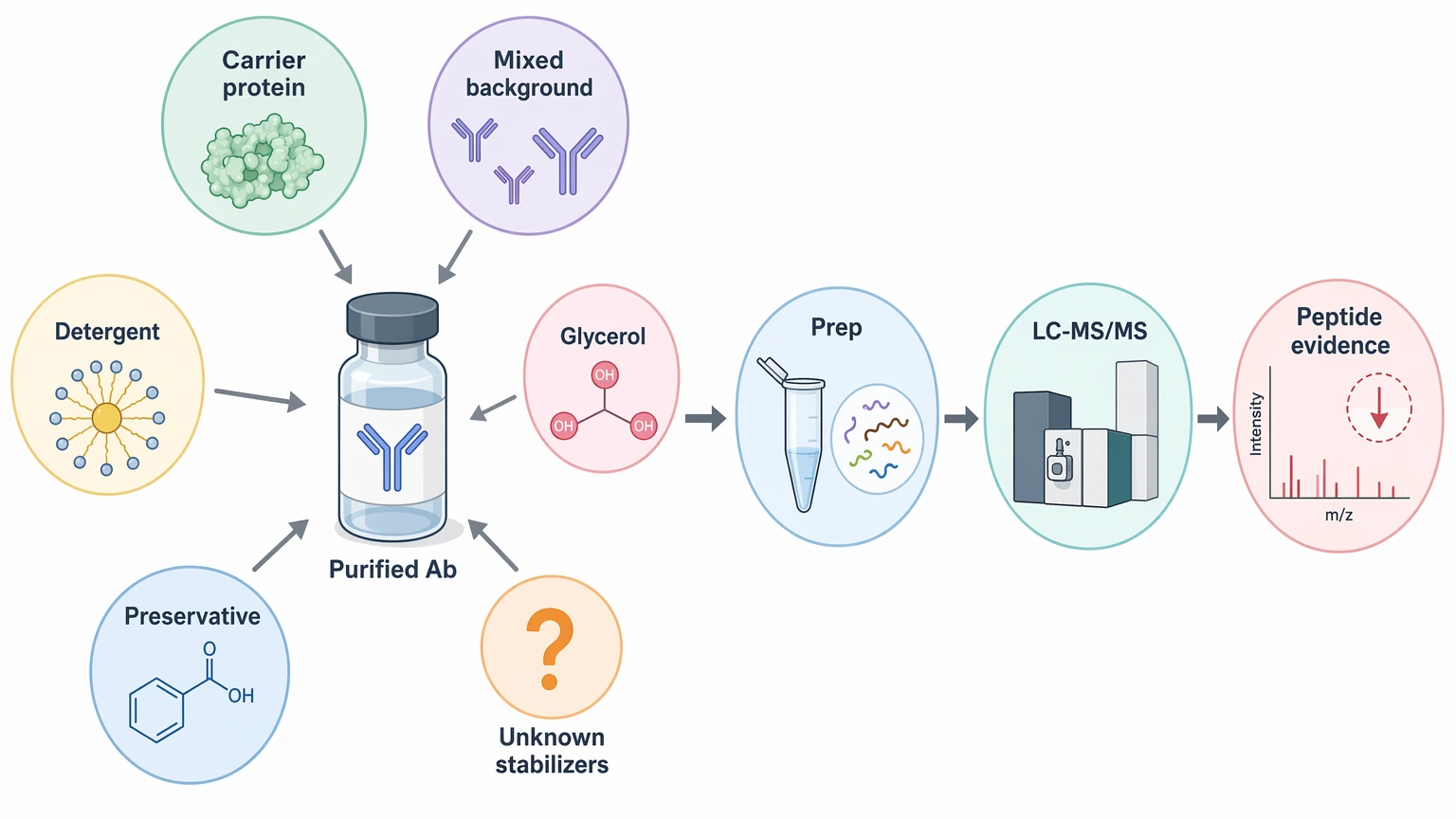
A sample can be labeled as purified and still be hard to sequence productively. Carrier proteins, mixed antibody background, detergents, glycerol, preservatives, or unknown stabilizers may interfere with preparation and reduce clean peptide evidence in LC-MS/MS or mass spectrometry-based sequencing.
2. Molecule format affects how realistic the deliverable is
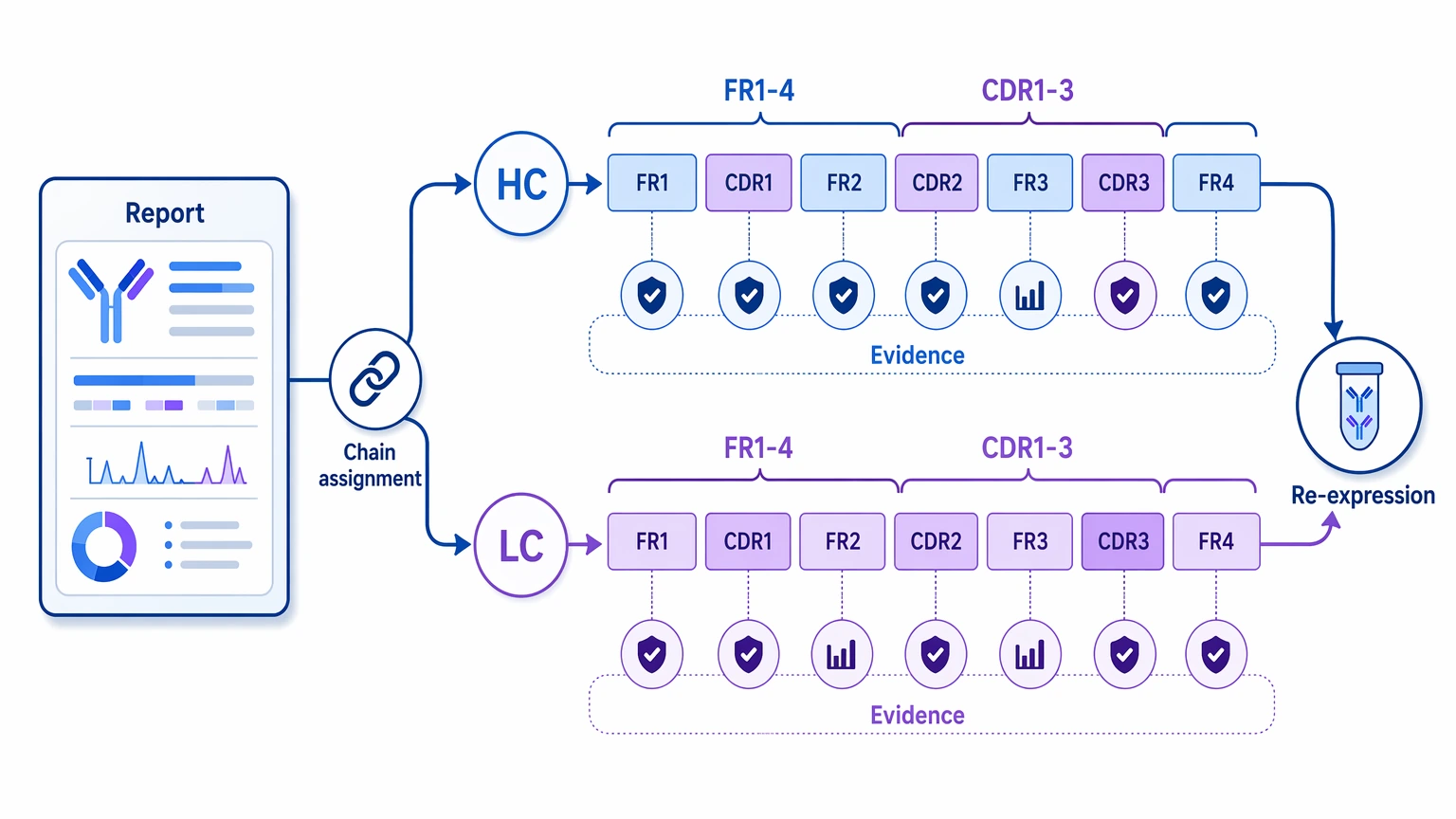
A conventional IgG is usually easier to scope than a heavily engineered or modified format. Fragments, bispecific-derived material, unusual glycosylation, and other post-translational modification (PTM) patterns can complicate assembly across the variable region, even when the target protein is present.
3. Useful reports may still include sequence ambiguity
A scientifically useful result does not always mean every residue is resolved. De novo antibody sequencing can still include flagged positions, especially leucine/isoleucine ambiguity, PTM-related uncertainty, or weak support in certain peptide segments. What matters is whether those ambiguous positions are clearly annotated and limited enough for downstream testing.
4. The team may be choosing between the wrong recovery routes
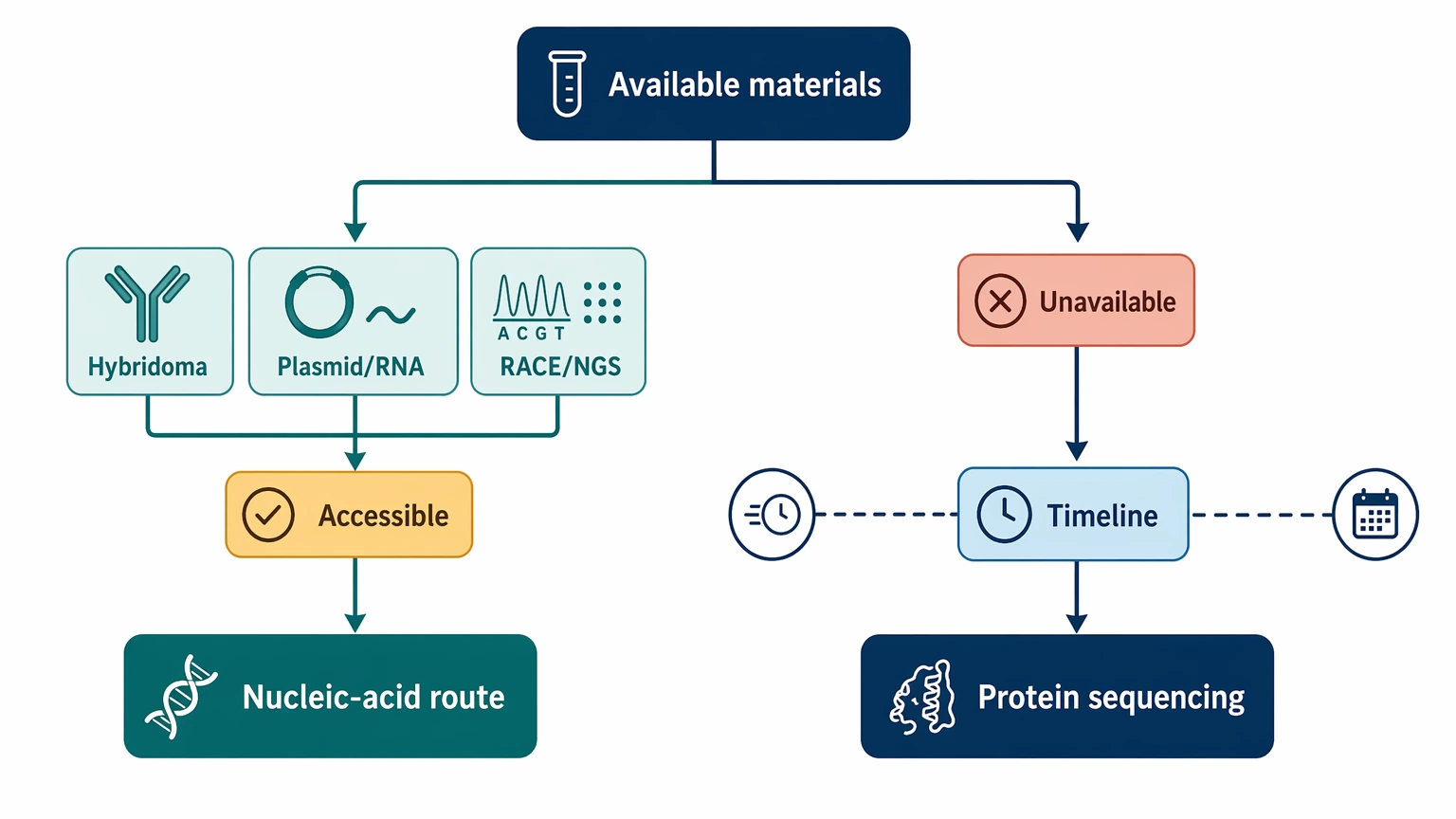
If viable hybridoma material, plasmid, RNA, RACE, or NGS access still exists, a nucleic-acid route may still be worth checking. But when those materials are unavailable or out of reach on the project timeline, continuing to hunt for them can delay a decision that protein-level sequencing could already support.
How to Decide Whether to Outsource Now
For this topic, the most useful structure is straightforward: define the decision, qualify the sample, specify the deliverables, choose the route, and plan validation before work begins.
Step 1. Define what the sequence report must enable
Start with the downstream use case. Are you trying to archive the asset, prepare for recombinant re-expression, compare binding after rescue, or maintain continuity for a legacy program?
That distinction matters. A dataset that works for documentation may not be enough for re-expression planning. If the report will feed construct design, ask for evidence tied to HC and LC candidates, with clear support across the framework region (FR) and complementarity-determining region (CDR) segments.
Step 2. Qualify the sample package before shipment
A useful scoping package should answer a few technical questions up front.
| Factor | What to provide | Why it matters |
|---|---|---|
| Sample type | Intact IgG, fragment, or engineered antibody format | Sets expectations for digestion and sequence assembly |
| Total protein amount | Total mass available, not only concentration | Affects discovery work and confirmatory analysis options |
| Purity | SDS-PAGE, SEC, or vendor purity notes if available | Contaminants can reduce clean peptide assignment |
| Buffer composition | Salts, glycerol, detergents, BSA, preservatives, stabilizers | Some components interfere with preparation or interpretation |
| Molecule context | Species, isotype, and any known sequence or FR references | Supports HC/LC mapping and framework interpretation |
| Existing analytics | Intact mass, prior peptide mapping, binding data, PTM notes | Helps interpret results and plan orthogonal checks |
This package does not have to be perfect. It does need to cut down avoidable uncertainty before limited material is consumed.
Step 3. Request deliverables that are useful for decisions
A common purchasing mistake is asking for a “full sequence” without defining what evidence should come with it. For most biologics teams, the more useful request is an evidence-backed report.
Ask for deliverables such as:
| Deliverable | What it should include | Why it matters |
|---|---|---|
| HC and LC candidate sequences | Separate or clearly mapped chain outputs | Supports chain-specific rescue planning |
| Variable-region mapping | Peptide support across FR and CDR segments | Shows whether critical regions are actually covered |
| CDR coverage summary | Support for CDR1, CDR2, and especially CDR3 | Helps judge binding-relevant sequence confidence |
| Sequence ambiguity list | Annotated uncertain residues | Prevents overconfidence in unresolved positions |
| Peptide-spectrum evidence | Mapped support for sequence calls | Helps internal technical review |
| PTM annotation | Glycosylation, oxidation, deamidation, pyroglutamate, disulfide bond context | Distinguishes sequence from modification effects |
| Re-expression readiness notes | Limits, caveats, and next-step recommendations | Connects the report to development planning |
If you are comparing vendors, define this structure before approval. For a purified-antibody-only project, MtoZ Biolabs can evaluate your project around sample condition, expected report structure, and downstream recombinant re-expression goals before you commit scarce material.
Step 4. Decide whether protein sequencing should be the primary route
Use a simple rule.
- Choose an antibody protein sequencing service as the primary route when the only accessible starting material is a purified protein sample.
- Keep a nucleic-acid route under review when hybridoma, RNA, plasmid, RACE, or NGS access is still realistic within the project timeline.
- Move sooner when the asset must be preserved, documented, or reconstructed and the missing-template problem is unlikely to change soon.
The absence of cells alone does not make every sample a good outsourcing candidate. A better question is whether the available sample and the requested output fit a realistic protein-level recovery plan.
Step 5. Plan orthogonal validation before the report arrives
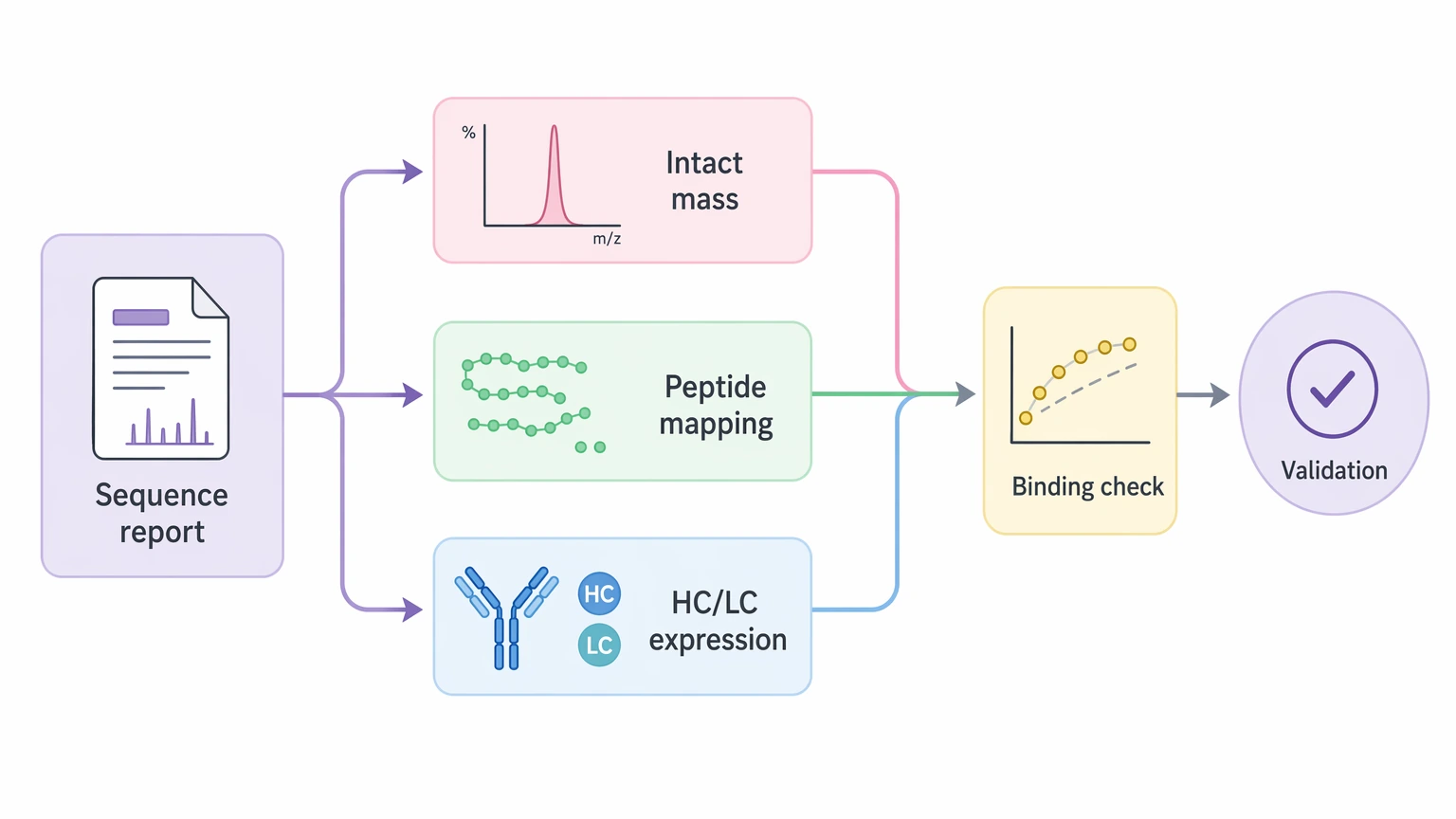
A sequence report is easier to act on when the follow-up checks are already defined. Depending on the project, orthogonal validation may include intact mass, confirmatory peptide mapping, or expression of candidate HC and LC constructs followed by binding comparison.
This matters most when the report includes isolated sequence ambiguity. Ambiguity outside key binding regions may be manageable. Ambiguity inside a short variable region peptide with limited support may call for additional candidate testing or a narrower interpretation of what the report can support.
What a Decision-Useful Result Looks Like
A useful outcome should let the team answer three questions: what HC and LC sequences are being proposed, how strong the peptide evidence is across the variable domains, and where unresolved positions remain.
Signs of a decision-useful report include:
- separate HC and LC reporting rather than a mixed peptide list
- visible FR and CDR mapping
- clear handling of leucine/isoleucine ambiguity
- explicit notes on PTMs that could affect interpretation
- a defined path to orthogonal validation
What the report should not imply is that sequence recovery by itself confirms biological equivalence. After recombinant re-expression, binding, expression behavior, and PTM state still need experimental confirmation.
Practical Cautions Before You Outsource
Low sample quantity creates tradeoffs. If material is scarce, confirm how much may be consumed by preparation, discovery work, and any confirmatory analysis.
Formulation history matters too. A vial that has been repeatedly thawed, reformulated, or stored in a buffer with carrier proteins can introduce more interpretation risk than the concentration alone suggests.
Context data should be shared even when incomplete. Prior binding results, purification notes, partial isotype information, and older intact mass records can all improve interpretation.
Finally, keep some route flexibility. If archived plasmid or viable cells become available later, it may still make sense to compare the protein-derived sequence package with a nucleic-acid-based recovery route.
Conclusion
For purified-antibody-only projects, outsourcing makes sense when the sample is clean enough to support interpretable peptide evidence and when the requested deliverables are built around HC/LC recovery, CDR support, ambiguity annotation, and validation planning. In practice, the goal is not an unqualified claim that every residue will be resolved. The goal is a sequence package strong enough to guide the next step for a legacy antibody, transferred research material, or another asset with no remaining nucleic-acid template. If that matches your situation, contact MtoZ Biolabs to submit your requirements and discuss sample condition, report expectations, and validation plans before shipment.
FAQ
Can sequence recovery still work if the antibody concentration is high but the sample volume is very small?
Sometimes, but the decision should be based on total recoverable protein rather than concentration alone. A small volume can limit repeat digestion, confirmation work, or cleanup after buffer exchange.
Does knowing the species or isotype materially improve interpretation?
Yes, it can. Species and isotype context may help with framework expectations and candidate review, especially when peptide evidence in some regions is incomplete.
Are antibody fragments suitable for the same workflow as intact IgG?
They can be, but the project scope should reflect the format. Fab, scFv-derived material, or engineered fragments may require a different interpretation strategy than a full-length monoclonal antibody.
Should we buffer-exchange the sample before sending it out?
Only if the cleanup step is controlled and you are confident it will not lose too much material. When excipients are unknown, it is often better to discuss the current formulation first and decide on preprocessing as part of project scoping.
What makes CDR3 support more important than broad overall coverage?
Broad coverage can look reassuring, but rescue planning depends heavily on the binding-relevant parts of the sequence. If CDR3 evidence is weak, the report may still be informative, yet less useful for confident re-expression design.
When does a partially ambiguous report still justify gene synthesis?
Usually when the ambiguous sites are limited, clearly flagged, and manageable through candidate design or follow-up testing. In that case, the report can still narrow the decision space enough to justify the next experiment.
How to order?




