






Antibody Amino Acid Sequencing for Unknown Antibodies: When Protein-Level Recovery Is the Right Choice
When the original cell line, plasmid, or nucleic acid record is gone, antibody amino acid sequencing is often the most workable recovery path if you still have a reasonably intact antibody sample and need a sequence you can use for redevelopment. The real question is not simply whether mass spectrometry can generate peptide calls. It is whether the remaining protein can support chain assembly with enough sequence confidence to justify recombinant re-expression and follow-up confirmation.
Quick decision guide
Start protein-level recovery now if you have a mostly monoclonal antibody sample, enough material for multi-enzyme digestion and confirmatory work, and a clear redevelopment goal.
Proceed with caution if the sample is formulated, partly degraded, or only partially purified.
Pause or change strategy if the material is mixed, highly contaminated, or too limited to support both discovery and orthogonal validation.
The Core Problem: You Have the Antibody, but Not the Sequence Source
This situation usually comes up in legacy redevelopment work rather than early discovery. A team may inherit a purified IgG, a stored research reagent, or a historical in-house binder, while the hybridoma, plasmid, or trusted sequence file is no longer available. The antibody still matters to the project, but the usual nucleic acid recovery route is no longer usable.
That creates a real bottleneck. Without a defensible sequence, teams cannot move ahead with confidence on clone rebuilding, codon design, lot bridging, or side-by-side comparison with recombinant material. Archive review may still be worth doing, but once it cannot produce a verified template tied to the antibody actually in hand, it is no longer the main path.
When Protein-Level Recovery Is the Right Choice
Protein-level recovery is usually the right choice when three conditions line up.
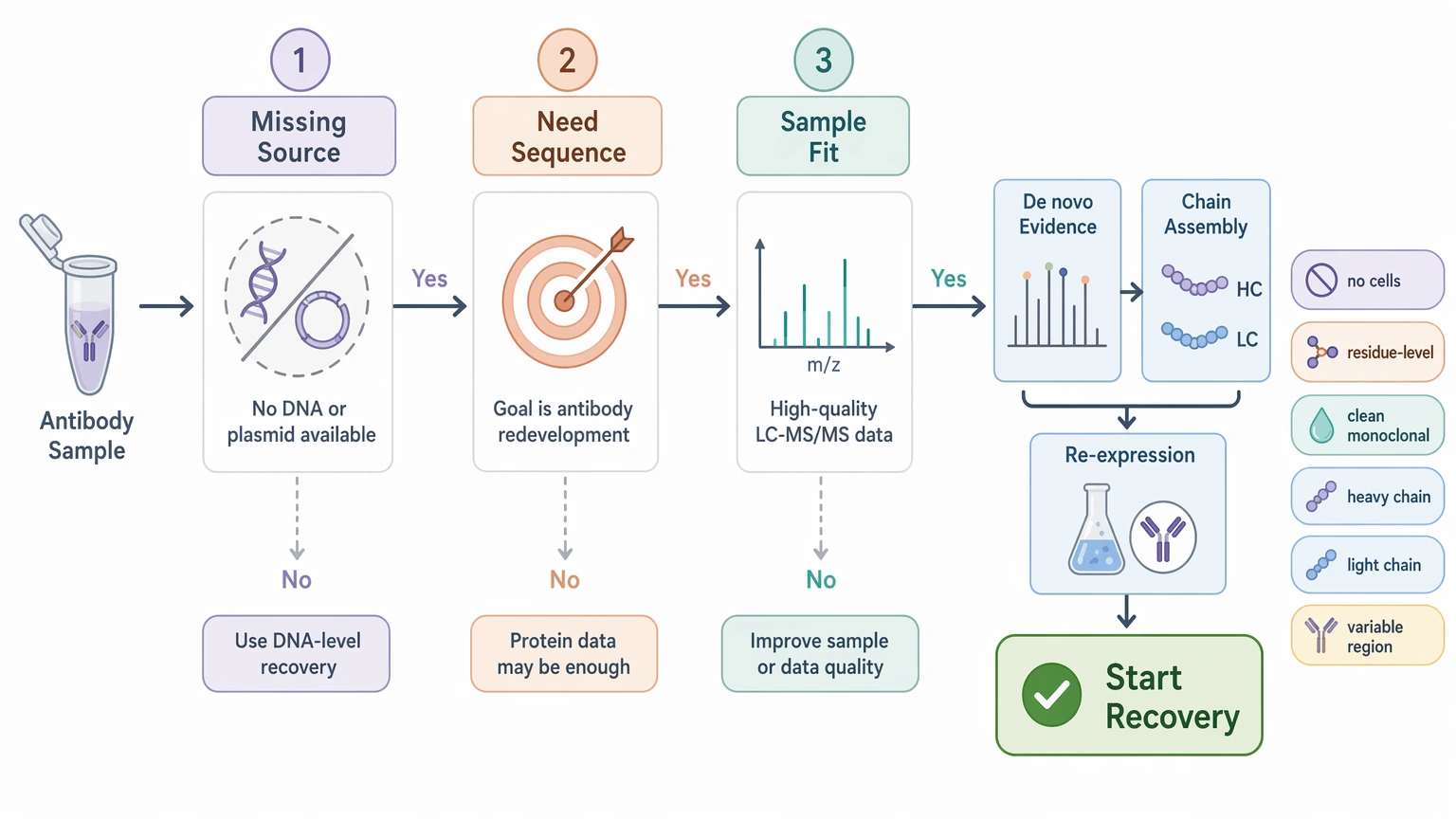
First, the missing source material cannot be recovered on a timeline that still helps the project. If no viable cells, plasmids, or verified records remain, de novo sequencing from the protein is the most direct way to generate sequence evidence.
Second, the project needs more than identity confirmation. Standard characterization can support purity, mass, or glycosylation review, but it does not replace residue-level sequence recovery. If the next step is recombinant rebuilding or sequence verification, antibody amino acid sequencing addresses the actual decision in front of the team.
Third, the sample still has enough useful information to analyze. A reasonably clean monoclonal preparation is very different from a mixed, heavily stressed, or carrier-rich sample. The method is most informative when LC-MS/MS data can support peptides across the heavy chain, light chain, and at least part of the variable region with overlap that can be interpreted cleanly.
A Project-Planning Workflow for Unknown Antibodies
For an unknown antibody, the most useful structure is not a generic linear protocol. It is a planning sequence that starts with the redevelopment goal, checks sample fit, sets realistic deliverables, and plans validation before the sample is consumed.
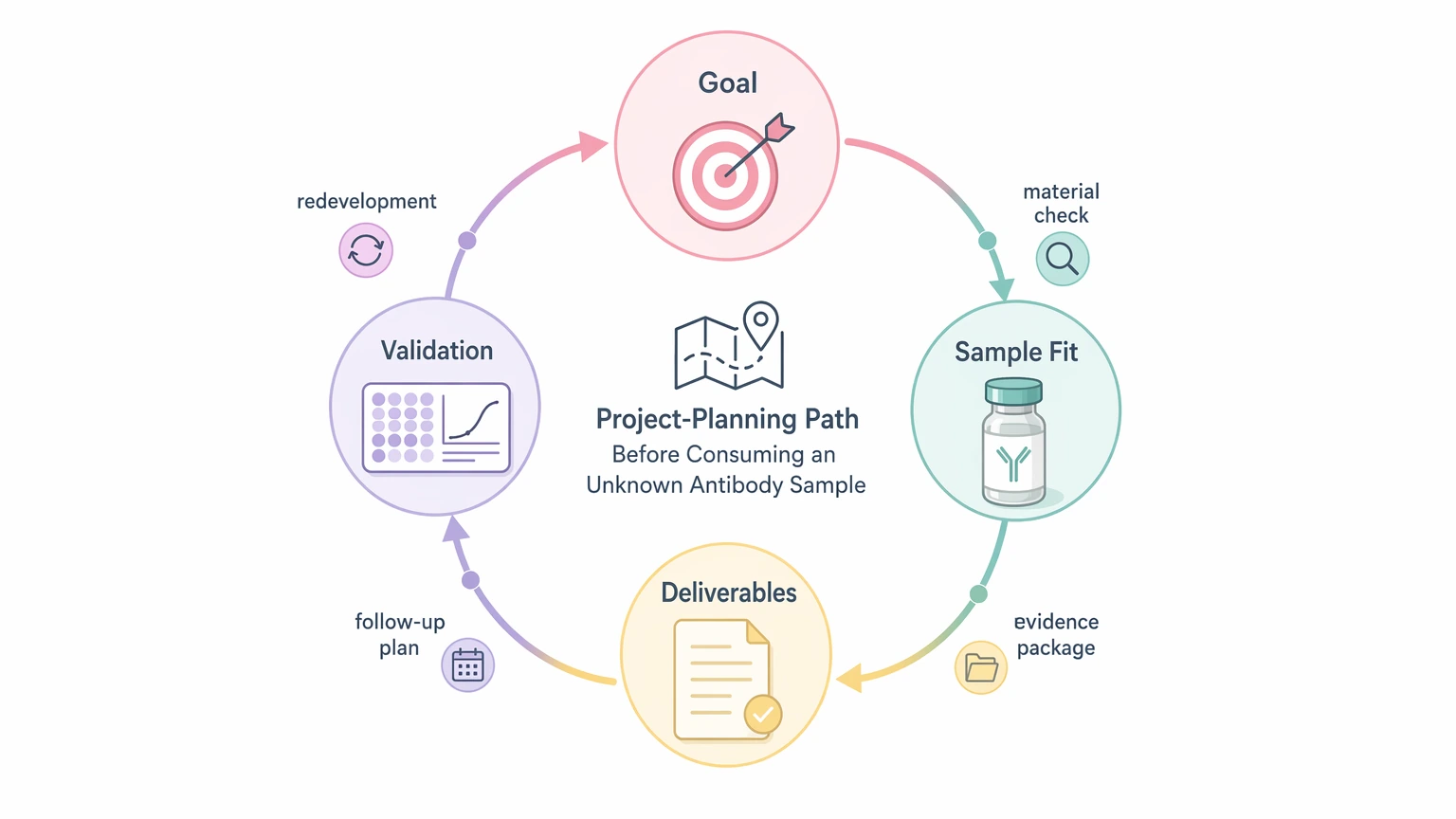
Step 1: Define what “usable recovery” means for your project
A usable sequence is not always a fully unquestioned residue list. In redevelopment work, the practical question is whether the recovered evidence is actionable enough to support clone design and experimental follow-up.
Typical goals include:
- rebuilding the antibody for recombinant re-expression
- checking whether a legacy lot matches an assumed sequence
- recovering a sequence for engineering or epitope follow-up
- creating an internal sequence record with evidence notes and ambiguity tracking
If the real need is lot comparison only, a full sequencing program may not be necessary. If the next decision is re-expression or redevelopment, protein-level recovery becomes much more relevant.
Step 2: Judge sample suitability before committing limited material
Sample fit shapes the value of the project more than any single instrument setting. Purity, formulation burden, amount, and degradation state all affect tandem mass spectrometry interpretability and downstream chain assembly.
Use the table below as a first-pass screen.
| Scenario | Recommended workflow | Main limitation | Likely next check |
|---|---|---|---|
| Purified monoclonal IgG in simple buffer | Start protein-level recovery | Some residue ambiguity may remain | Intact mass analysis |
| Formulated antibody with low background protein | Clean up matrix, then sequence | Excipients can suppress peptide signals | Peptide mapping |
| Partially purified antibody | Improve cleanup before full sequencing | Background proteins complicate assignment | Subunit analysis |
| Stressed or degraded antibody | Start only if redevelopment urgency is high | Clipping and PTMs may reduce confidence | Expanded orthogonal validation |
| Mixed antibody preparation | Poor fit for single-sequence recovery | Multiple sequence populations blur interpretation | Additional purification or alternate route |
Takeaway: if the sample is mostly one antibody species and enough material remains for confirmation, the project is usually worth serious consideration.
Service Routes to Consider
For this project scenario, readers usually compare these service routes before requesting a quote or submitting samples.
Step 3: Plan the analytical scope as an evidence package
Teams often ask for “the sequence” as if it were a single output. In practice, it is more useful to think in terms of an evidence package with several layers of support.
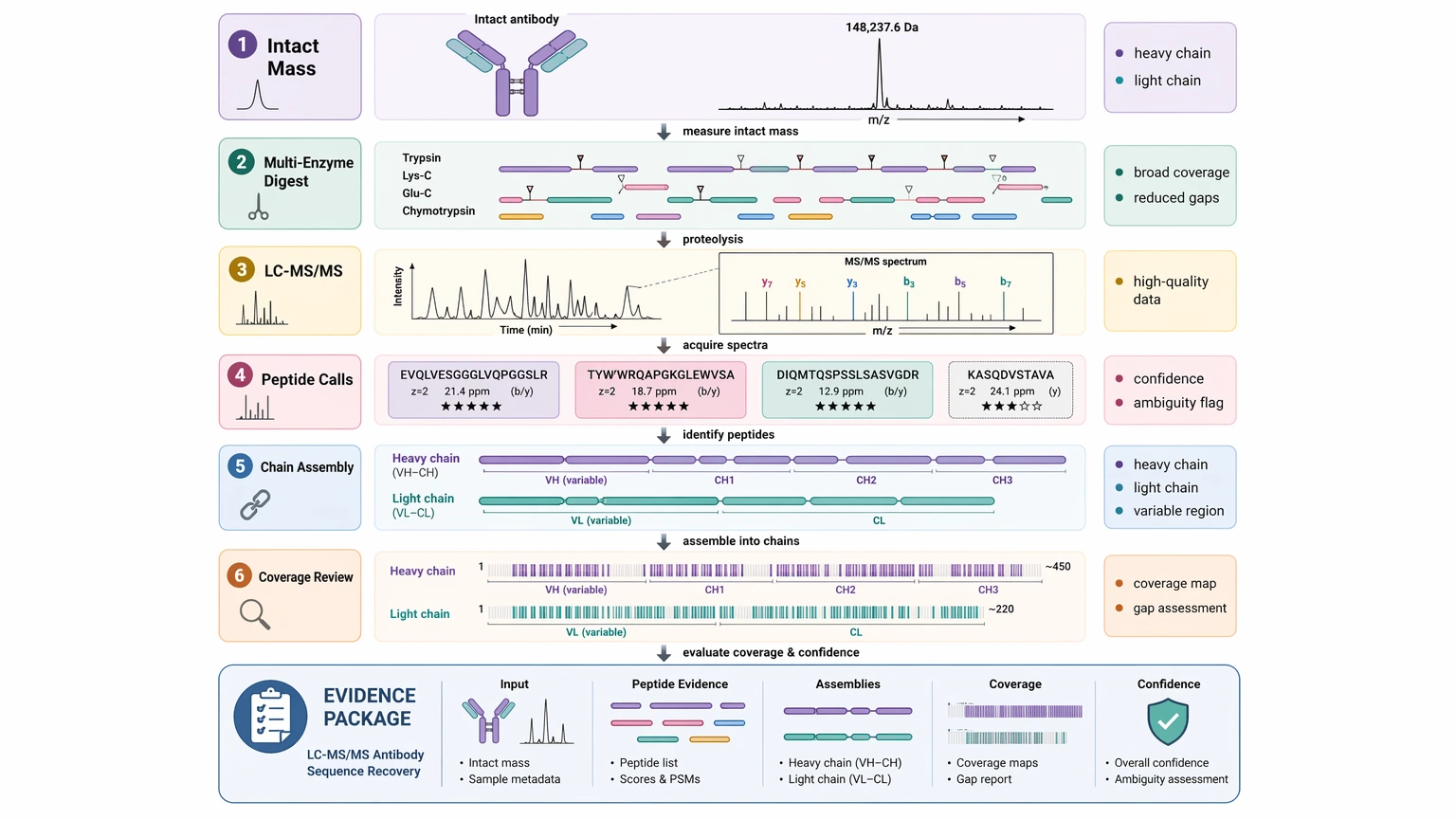
A practical workflow often includes:
- intact mass analysis or subunit analysis to assess overall molecule state
- reduction and digest planning with multi-enzyme digestion
- LC-MS/MS acquisition for rich fragment evidence
- peptide interpretation and heavy/light chain assembly
- review of sequence coverage, local gaps, and residue ambiguity
- validation planning before recombinant rebuilding
That structure matters because different regions do not carry the same level of confidence. Constant-region peptides are often easier to support than CDR-rich variable-region segments. The complementarity-determining region (CDR) and the framework region (FR) should not be read as though they carry equal evidence depth.
Step 4: Decide whether the known limitations are acceptable
Often the answer is yes, but only when the limits fit the redevelopment goal. Standard MS-based workflows can leave leucine/isoleucine ambiguity unresolved at some positions. Post-translational modification (PTM) burden can make residue calling harder, especially around glycosylated or chemically altered peptides.
One limitation should be stated plainly: LC-MS/MS-based de novo sequencing can support a strong sequence proposal, but it may not assign every residue with equal certainty, particularly in modified regions or at leucine/isoleucine positions. That does not make the project unusable. It means the sequence should be treated as a fit-for-purpose proposal that may need targeted confirmation after clone construction.
If your team already knows that a small number of ambiguous positions can be tested experimentally, protein-level recovery remains a reasonable path. If every position must be locked down before any downstream work starts, the decision threshold should be higher.
What a Practical Sequencing Deliverable Should Look Like
A good redevelopment deliverable is more than a peptide export. It should make it easier for the team to judge whether the recovered sequence is solid enough to move forward.
| Evidence type | What it supports | What it does not prove by itself |
|---|---|---|
| Heavy chain peptide evidence | Broad chain identity and continuity | Full certainty in every variable-region residue |
| Light chain peptide evidence | Cleaner support for light chain assignment in many cases | Automatic confirmation of binding behavior |
| Variable region peptide support | Redevelopment relevance | Equal confidence across all CDR positions |
| CDR-focused evidence | Likely binding-region reconstruction | Functional equivalence without follow-up testing |
| Ambiguity annotations | Honest reporting of uncertain sites | Resolution of all uncertain residues |
| Intact or subunit mass consistency | Molecular-level support for the proposed structure | Site-by-site sequence assignment |
A short service-planning checkpoint is useful here. If you need to decide whether the remaining vial can support both sequence recovery and later confirmation, submit your requirements early so project scope, sample consumption, and validation planning can be aligned before work begins.
Expected Results and Validation Methods
The immediate outcome of antibody amino acid sequencing is usually a supported sequence proposal, not a final declaration of equivalence. That distinction helps set realistic expectations.
Immediate deliverables
A well-scoped project can usually produce:
- assembled heavy chain and light chain sequence proposals
- peptide-level evidence across constant and variable regions
- a map of stronger and weaker sequence coverage
- notes on residue ambiguity, including leucine/isoleucine ambiguity
- interpretation of major PTMs that affect confidence or assembly
Follow-up confirmation after the initial report
The next layer of confirmation often includes:
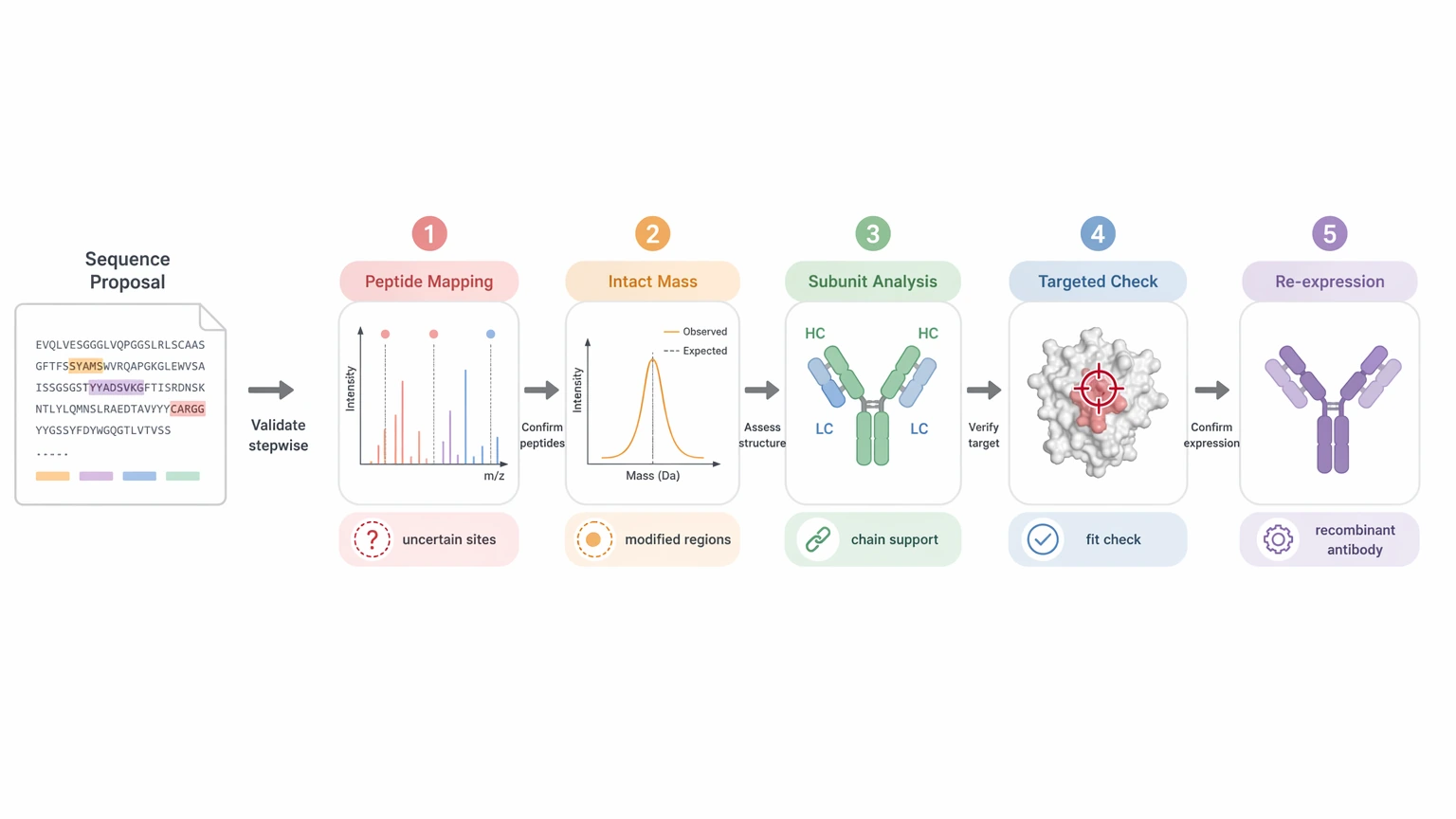
- peptide mapping to test consistency across the proposed sequence
- intact mass analysis to compare expected and observed molecular composition
- subunit analysis to strengthen chain-level interpretation
- targeted checks for uncertain sites or modified regions
- recombinant re-expression followed by binding or fit-for-purpose comparison
If your redevelopment decision depends on whether a specific CDR assignment is correct, plan that follow-up from the start rather than treating it as an optional add-on.
Key Cautions and Practical Limits
This workflow can be very useful, but only when its boundaries are clear.
Sample quality and sample amount limits
Poor purity, severe degradation, or very low material can reduce the value of the project quickly. Enough sample should remain for both discovery work and at least one confirmatory step. If the sample is nearly exhausted, the project may answer fewer questions than the redevelopment team actually needs.
Controls and repeat expectations
If matrix cleanup, chain separation, or targeted confirmation is likely, build that into the plan up front. A single discovery pass may identify the most likely sequence, but repeat or orthogonal checks are often needed before operational use.
Batch effects and contamination risk
Carrier proteins, serum background, excipients, or mixed antibody populations can interfere with peptide assignment. These issues do more than lower sensitivity. They can distort chain assembly and make a one-sequence interpretation misleading.
Interpretation boundaries
A recovered sequence proposal can support redevelopment planning, but it does not by itself prove full biological equivalence. The variable region, especially the CDR, may carry a different confidence level from the constant region. PTMs, clipping, and unresolved leucine/isoleucine sites can leave a narrow but important band of uncertainty.
When another method or outside support is the better next step
If the preparation is mixed, highly contaminated, or too limited for both sequencing and confirmation, additional purification or a narrower analytical question may be better than forcing full recovery. If the redevelopment goal is high stakes and the sample history is unclear, contact MtoZ Biolabs to evaluate your project scope, remaining material, and validation priorities before committing the last usable aliquots.
Conclusion
Protein-level recovery is the right choice when an unknown antibody still exists as usable protein but the original genetic source no longer provides a trusted way forward. In that setting, the decision should rest on sample fitness, expected sequence confidence, likely ambiguity burden, and whether the resulting evidence will be strong enough to support recombinant re-expression and confirmation. This route fits legacy monoclonal antibodies, bridging materials, and redevelopment projects that still have analyzable protein but no reliable nucleic acid template; if that matches your situation, gather your sample details, formulation information, remaining amount, and redevelopment goal, then contact MtoZ Biolabs to submit your requirements and evaluate your project before sequence recovery and validation planning begin.
FAQ
Can formulated antibodies still be used for antibody amino acid sequencing?
Often yes, if the antibody is still the dominant protein species. Excipients may need to be removed first, and some formulations leave less material available for confirmation work.
Why is leucine/isoleucine ambiguity such a recurring issue?
Standard MS fragmentation usually cannot distinguish leucine from isoleucine directly because they have the same mass. In many projects, those positions are handled through sequence context, targeted follow-up, or recombinant candidate testing.
Are heavy chain and light chain usually recovered with the same confidence?
Not always. The light chain is often simpler to interpret, while the heavy chain can be complicated by glycosylation, clipping, or more difficult peptide behavior in the variable region.
When should a team stop pushing for full recovery and switch to cleanup first?
If background proteins or mixed antibody species prevent confident assignment of peptides to one heavy chain and one light chain, additional cleanup is usually a better next step than deeper de novo interpretation.
Does a strong sequence proposal mean the rebuilt antibody will behave the same way?
No. Sequence recovery can justify clone construction, but binding or other fit-for-purpose testing is still needed to show that the recombinant material matches the original project use.
Is archive searching still worth doing after sequencing starts?
Yes, if the records might clarify provenance or uncertain residues. Protein-level recovery and archive review can run in parallel, but redevelopment should not rely on undocumented records alone.
How to order?




