






Why AP-MS Results Contain Background Proteins: Controls, Replicates, and Filtering Strategies for Confident Interaction Analysis
Introduction
AP-MS datasets often surprise first-time users. The bait is recovered, yet the protein list also contains cytoskeletal proteins, ribosomal subunits, heat-shock proteins, and other abundant species that appear in many unrelated enrichments. A collaborator may treat every identified protein as an interactor. A reviewer may ask which proteins survive control comparison. A project team may struggle to decide which candidates deserve orthogonal validation.
Background proteins appear in AP-MS because affinity enrichment is imperfect. Beads, tags, antibody surfaces, and abundant lysate proteins can enter the eluate alongside true partners. Confident interaction analysis therefore depends less on eliminating every contaminant and more on using controls, replicates, and filtering strategies that separate bait-specific enrichment from shared background. This article explains why background proteins appear, how to diagnose their sources, and how to filter AP-MS results for more reliable interaction claims.
Why Background Proteins Appear in AP-MS Results
Background is an expected feature of enrichment proteomics, not only a failed experiment.
Common sources include proteins that bind beads or resin nonspecifically, proteins that stick to epitope tags or antibody surfaces, and highly abundant cellular proteins that remain after incomplete washing. Soft lysis and gentle washes preserve weak true interactors, but they also increase contaminant carryover. Overexpressed baits can create crowded local environments that pull in sticky neighbors. Deep LC-MS/MS then detects both specific and nonspecific proteins with high sensitivity.
The practical problem is interpretation. Without a background model, abundant contaminants can dominate candidate lists and hide lower-abundance partners that are biologically relevant.
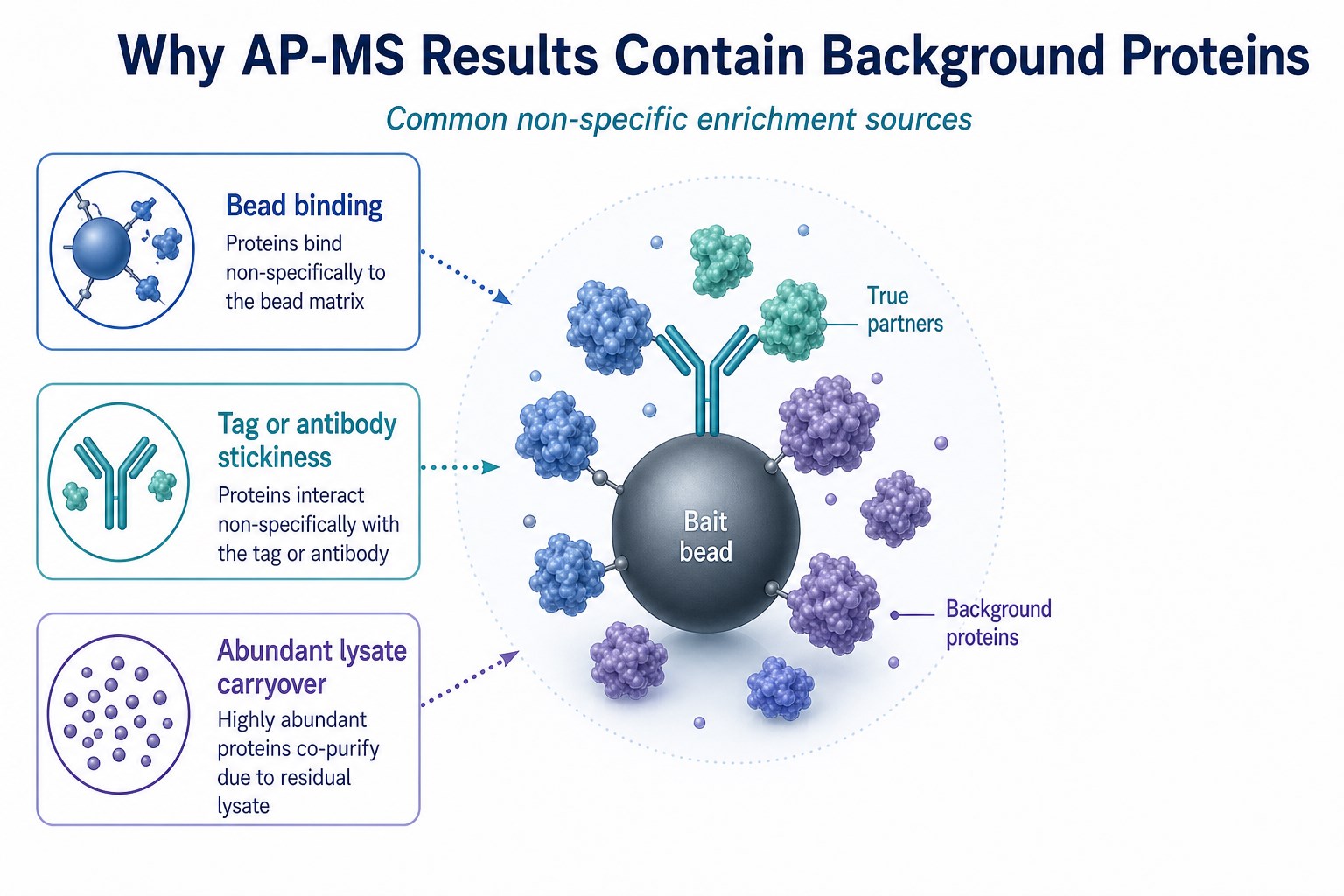
Figure 1. Background proteins commonly arise from bead binding, tag or antibody stickiness, and carryover of abundant lysate proteins.
Root Causes to Check Before Reinterpreting the List
Capture chemistry and wash stringency
If washes are too mild, sticky proteins survive into the eluate. If washes are too harsh, true weak partners disappear while some contaminants may still remain. Wash design should be matched to the interaction question, not copied from an unrelated protocol.
Missing or mismatched negative controls
Empty-tag lines, bead-only IPs, or unrelated baits define which proteins appear without the intended bait biology. If controls are absent, every identification looks like a candidate. If controls use different expression levels or bead lots, background subtraction becomes unreliable.
Insufficient replication
Single enrichments cannot distinguish reproducible bait-specific signals from random carryover. Biological and technical variability both contribute to unstable prey lists.
Filtering that is either too weak or too aggressive
No filter leaves contaminants in the shortlist. Over-aggressive filters can remove real partners that are low abundance or condition-specific. Filtering thresholds must be tied to control distributions and project goals.
Step-by-Step Strategy for Confident Interaction Analysis
Step 1. Define the claim before filtering
State whether the project needs a discovery shortlist, a differential interaction map, or confirmation of a few expected partners. The claim decides how strict the filter should be.
Step 2. Build matched negative controls
Use controls that share the same tag system, expression context, bead chemistry, and processing workflow. Empty-tag and bead-only designs are common starting points. Unrelated bait controls can also expose proteins that bind many tagged proteins nonspecifically.
Step 3. Run replicates that support ranking
Include biological replicates for each bait and control arm whenever possible. Reproducible enrichment across replicates is one of the strongest practical filters against sporadic background.
Step 4. Quantify enrichment relative to background
Compare prey abundance or spectral evidence in bait samples versus controls. Fold enrichment, statistical testing, or empirical Bayes-style scoring frameworks are commonly used to rank candidates. The goal is not zero background. The goal is ranked specificity.
Step 5. Apply project-appropriate filters
Combine control enrichment thresholds with replicate support and, when useful, frequency filters against known contaminant lists. Review remaining candidates for biological coherence, but do not replace quantitative filtering with pathway storytelling alone.
Step 6. Reserve orthogonal assays for priority edges
Western blot, reciprocal enrichment, proximity labeling, or pairwise binding assays should focus on proteins that survive filtering and carry the biological claim.
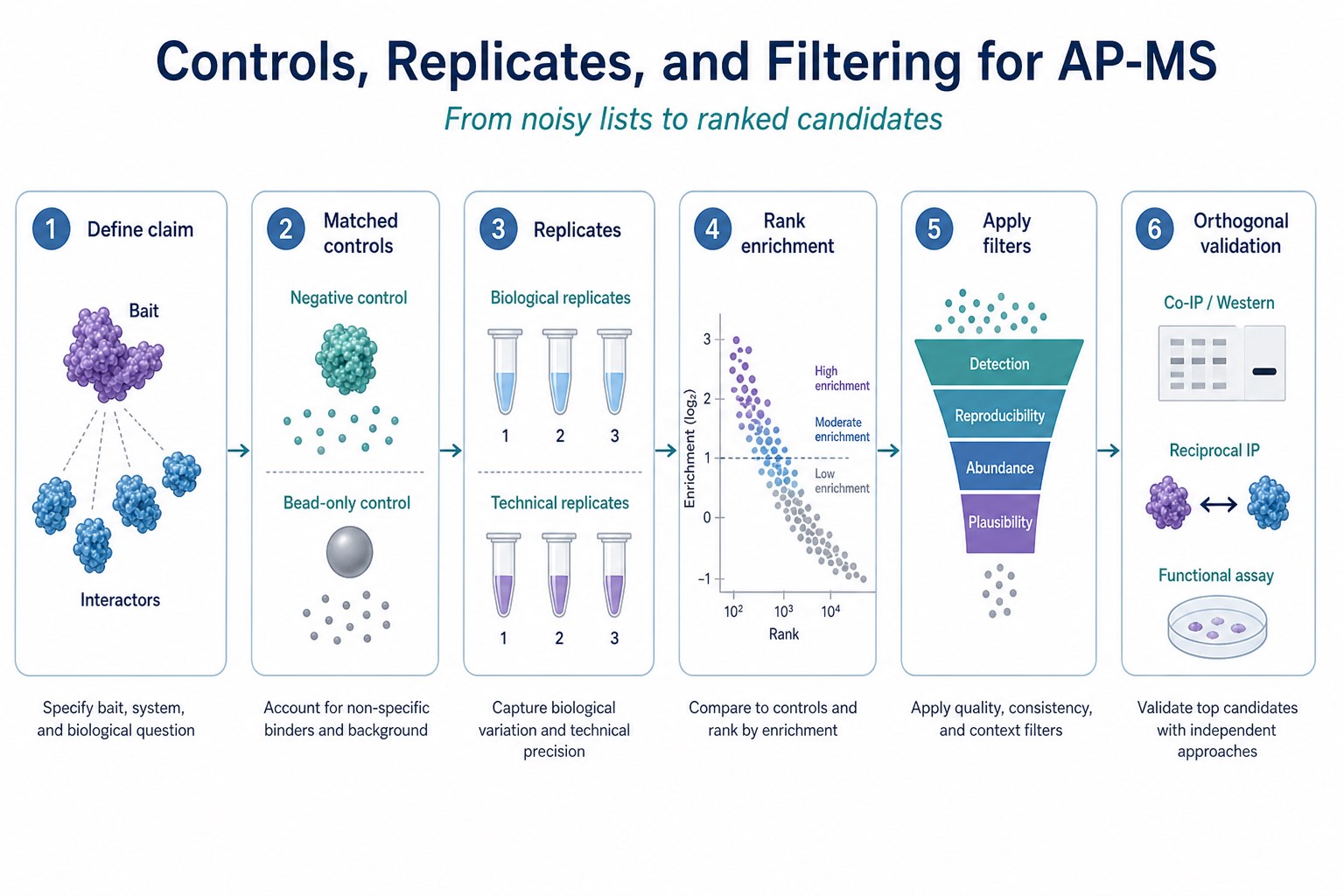
Figure 2. Confident interpretation uses matched controls, replicates, and enrichment ranking to separate candidate interactors from shared background.
What Improved Filtering Should Deliver
A stronger analysis plan should reduce the number of proteins that appear in every enrichment regardless of bait. Candidate lists should become shorter, more reproducible, and easier to prioritize for validation.
Bait recovery should remain visible after filtering. If the bait itself is unstable across replicates, background cleanup cannot rescue the experiment. Differential designs should show that condition-specific candidates are supported by matched controls rather than by unequal bait amounts alone.
These outcomes improve confidence. They do not convert every retained prey into proven direct binders.
Related Services
Affinity Purification-Mass Spectrometry Service
MS-Based Protein-Protein Interaction Analysis Service
IP-MS Protein Interactomics Analysis Service
Co-Immunoprecipitation Protein Interaction Analysis Service
Pull Down based Protein Analysis Service with Mass Spectrometry
Protein Identification Service
Researchers dealing with high-background interaction lists can consult MtoZ Biolabs to review control design, replicate structure, and filtering options for the current enrichment project stage.
Precautions That Protect Interpretation
Do not interpret raw identification counts as interaction evidence. Presence in one bait eluate is not specificity.
Do not change wash conditions between bait and control arms that will be compared. Matched chemistry is required for meaningful enrichment scores.
Do not ignore bait recovery metrics. Unequal bait capture creates false differential partners and unstable background ratios.
Do not treat contaminant databases as a complete substitute for experimental controls. Public contaminant lists help, but matched controls remain the primary evidence for specificity.
Do not overclaim direct binding from filtered shortlists. Orthogonal assays remain necessary for high-stakes interaction claims.
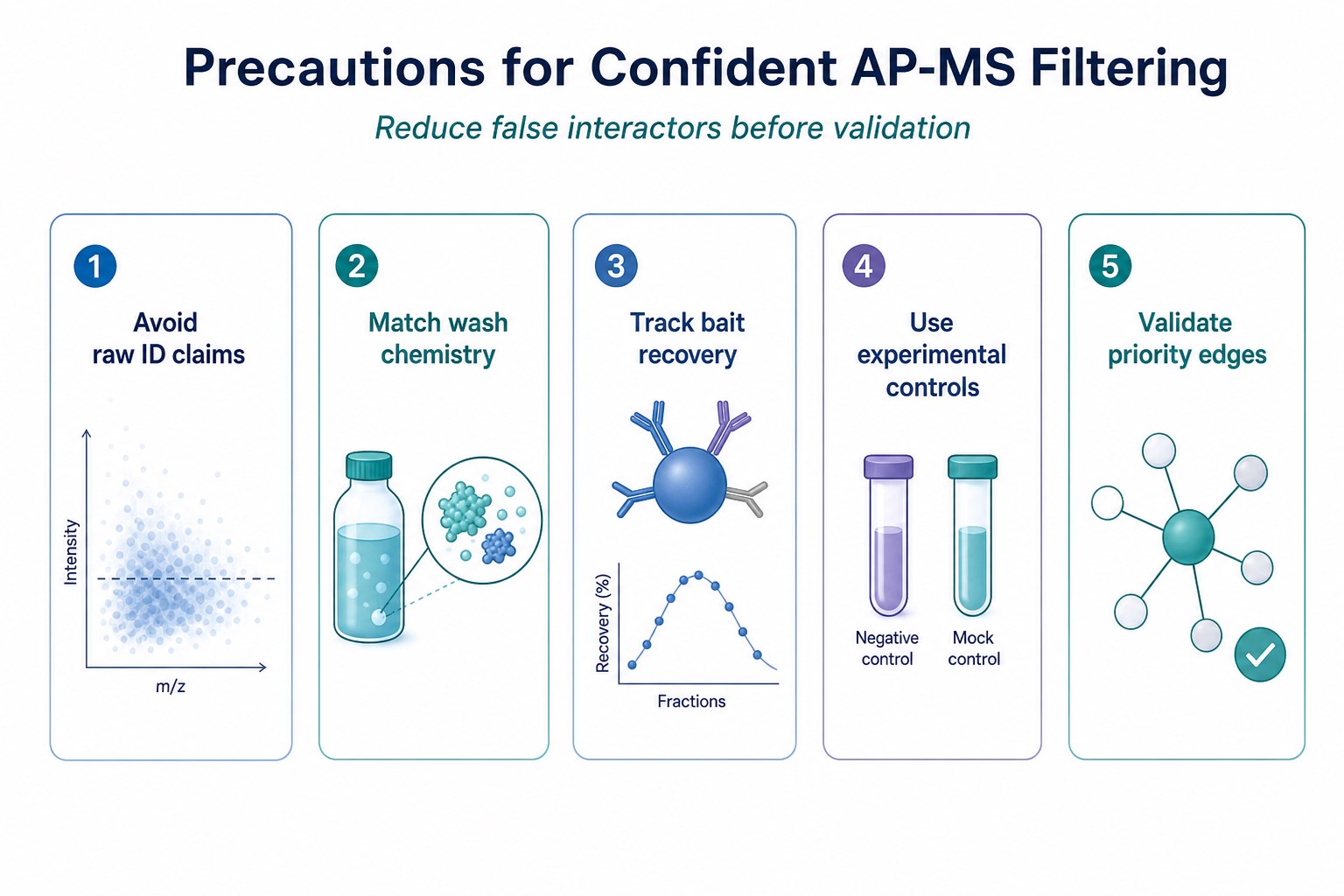
Figure 3. Practical precautions include matched controls, stable bait recovery, replicate support, and cautious shortlist claims before validation.
For projects that need help redesigning controls or filtering noisy prey lists, MtoZ Biolabs can help align enrichment chemistry with interaction-confidence goals.
Frequently Asked Questions
1. Why do enrichment results contain background proteins even when the bait is recovered?
Affinity enrichment is incomplete. Beads, tags, and abundant lysate proteins can enter the eluate with true partners, especially under gentle wash conditions.
2. What control is most useful for background filtering?
A matched negative control that uses the same tag, expression system, and bead chemistry as the bait arm is usually the most informative starting point.
3. How many replicates are needed for confident filtering?
Biological replicates improve reproducibility assessment. Exact numbers depend on design complexity, but single-shot enrichments are rarely enough for confident ranking.
4. Can filtering remove all contaminants?
No. Filtering reduces false candidates and ranks specificity. Some background may remain, and overly strict filters can remove real low-abundance partners.
5. When should orthogonal validation begin?
After candidates survive control comparison and replicate support, prioritize proteins that carry the biological claim rather than validating the entire unfiltered list.
Conclusion
Background proteins appear in AP-MS because enrichment chemistry recovers both specific and nonspecific proteins, and sensitive MS detects both. Confident interaction analysis depends on matched controls, adequate replicates, and filtering strategies that rank bait-specific enrichment instead of treating every identification as an interactor.
The most reliable path is practical: define the claim, build matched controls, quantify enrichment, filter with replicate support, and validate priority edges orthogonally. Teams preparing or troubleshooting AP-MS interaction projects can contact MtoZ Biolabs to review whether the current control and filtering plan is sufficient for confident candidate selection.
How to order?




