





Co-Immunoprecipitation Protein Interaction Analysis Service
What Is Co-IP Protein Interaction Analysis?
Co-immunoprecipitation coupled with mass spectrometry (Co-IP-MS) combines antibody-based enrichment with LC-MS/MS protein identification.
While conventional Co-IP followed by Western blot is commonly used to examine predefined candidate proteins, Co-IP-MS enables broader identification of proteins recovered with the target-containing complex. It is therefore suited to interaction partner discovery, protein complex characterization, and comparison of target-associated protein profiles across biological conditions.
Service at MtoZ Biolabs
MtoZ Biolabs provides Co-IP-MS analysis for protein interaction studies centered on a known target protein.
Projects may begin with original biological samples when a suitable IP-grade antibody is available or with IP/Co-IP material prepared by the client. For full-process projects, target protein Western blotting can be incorporated to confirm successful enrichment before downstream MS analysis.
Protein identification is performed using Orbitrap series high-resolution mass spectrometry. MS data are processed with MaxQuant against the UniProt reference proteome or a customer-provided protein database.
When Co-IP-MS Is a Good Fit
Co-IP-MS is a good choice when the study starts with a known target protein and aims to identify proteins associated with its native complex.
This approach is particularly suitable when:
- Unknown interaction partners need to be discovered around a known target protein
- Protein complex composition needs to be characterized under native or near-native conditions
- Co-IP followed by Western blot is too limited because broader protein identification is required
- Target-associated protein profiles need to be compared across treatments, mutations, disease states, or other biological conditions
- An endogenous target is being studied and a suitable IP-grade antibody is available for enrichment
Co-IP-MS is generally less suitable when the target lacks a usable IP antibody, the interaction is extremely weak or transient, or the primary objective is to demonstrate direct binding between purified proteins. Depending on the research question, AP-MS, Pull-Down, Proximity Labeling, or biophysical binding assays may provide a more suitable alternative.
Co-IP-MS vs AP-MS
Co-IP-MS and AP-MS can both be used to identify proteins associated with a target, but they differ mainly in how the target protein is enriched.
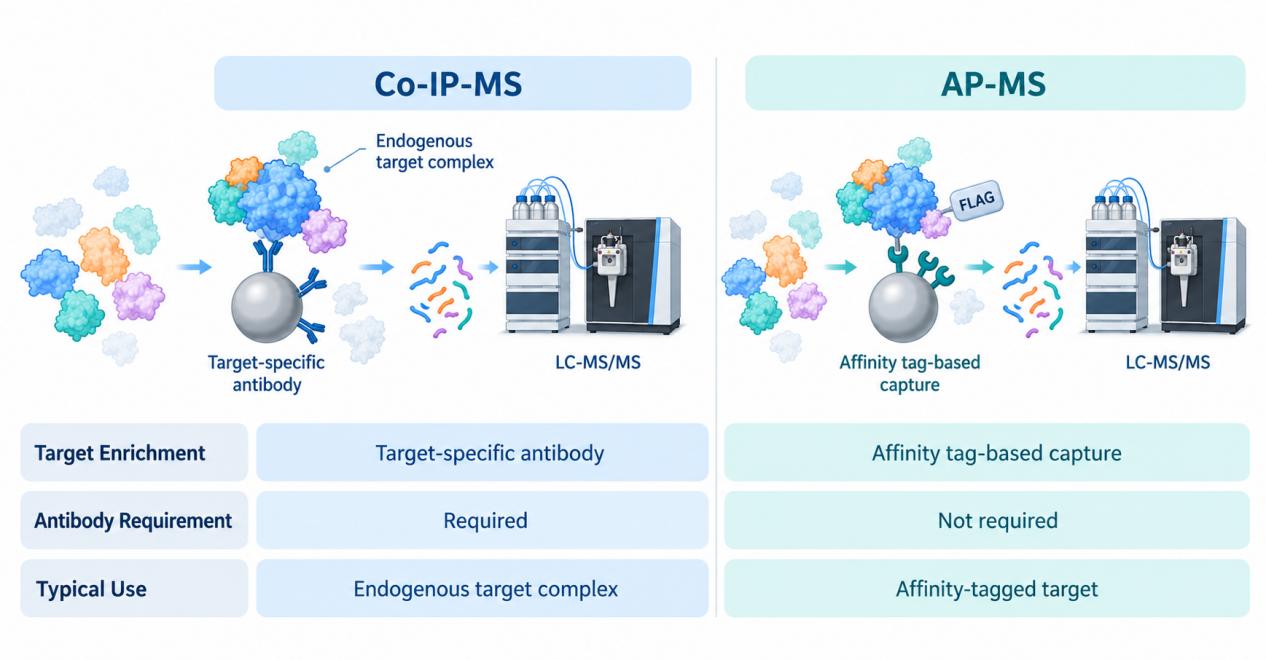
Neither method alone establishes direct binary binding. When a suitable IP-grade antibody is unavailable, affinity-tag-based AP-MS may provide a practical alternative for interaction partner discovery.
Co-Immunoprecipitation Protein Interaction Analysis Workflow
1. Project Assessment
Review the target protein, biological system, antibody, controls, replicates, sample format, and comparison groups.
2. Co-IP Enrichment
Enrich the target-containing protein complex or receive prepared IP/Co-IP material for downstream analysis.
3. Protein Digestion
Perform reduction, alkylation, tryptic digestion, and C18 desalting.
4. LC-MS/MS Analysis
Separate peptides by nano-LC and acquire high-resolution mass spectrometry data.
5. Protein Identification and Comparison
Search the MS data against the selected protein database and evaluate protein identification and relative abundance patterns where applicable.
Service Advantages
1. Interaction-Focused Proteomic Analysis
Co-IP enrichment and mass spectrometry are integrated to examine proteins associated with a defined target-containing complex rather than the general proteome.
2. High-Accuracy Protein Identification
Orbitrap high-resolution mass spectrometry with mass accuracy <5 ppm supports confident peptide and protein identification in complex Co-IP samples.
3. Control-Based Data Evaluation
Negative controls and biological replicates provide an important basis for evaluating reproducible enrichment and non-specific background.
4. Comparative Complex Profiling
Co-IP-MS can compare target-associated protein profiles across treatments, mutations, disease models, or other experimental conditions.
5. Flexible Project Entry
Projects may begin with original biological samples or with IP/Co-IP material already prepared for downstream MS analysis.
6. One-Time Charge
Our pricing is transparent, with no hidden fees or additional costs.
Sample Submission Suggestions
|
Sample Format |
Submission Guidance |
Storage / Shipping |
|
Animal or Plant Tissue |
May be used for full-process Co-IP when a suitable IP-grade antibody is available |
Contact us for sample-specific recommendations |
|
Cells or Microorganisms |
Suitable for Co-IP enrichment and downstream MS analysis |
Contact us for sample-specific recommendations |
|
Body Fluid Samples |
Acceptance depends on target abundance and sample characteristics |
Contact us before shipment |
|
IP/Co-IP Magnetic Beads |
Can be submitted directly for downstream MS processing |
Freeze rapidly and ship on dry ice |
|
Protein Eluate |
Suitable when buffer composition is compatible with MS analysis |
Freeze and ship on dry ice |
|
SDS-PAGE Gel Band |
The band should be clearly visible by eye |
Room temperature or cold-pack shipment |
|
Protein Solution |
Recommended total protein ≥20 μg and concentration >0.5 μg/μL |
Freeze and ship on dry ice |
For downstream MS analysis, SDS should be below 0.1%. Severely degraded samples or samples containing substantial levels of salt or strong detergents are not recommended for direct analysis.
Please provide the organism or relevant protein reference database information. UniProt reference proteomes or customer-provided databases can be used for protein identification.
Contact us for project-specific recommendations on sample amount, buffer compatibility, storage, and shipping.
Deliverables
Standard project outputs may include:
1. Raw MS Data
Original mass spectrometry files
2. Protein and Peptide Identification Results
Protein IDs, identified peptides, sequence coverage, scores, and intensity values
3. Comparative Results
Relative abundance comparisons when included in the experimental design
4. Result Tables
Excel-formatted protein and peptide identification data
5. Project Report
PDF report summarizing the analytical workflow and results
Case study
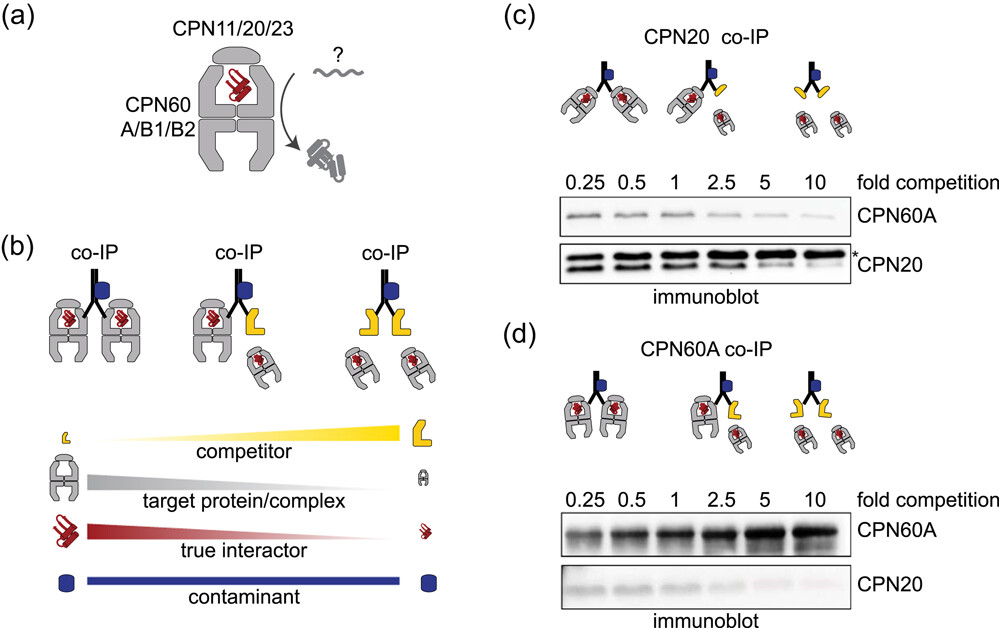
A competition Co-IP-MS strategy was applied to identify interactors of the chloroplast CPN60 chaperonin machinery in Chlamydomonas reinhardtii. By introducing increasing amounts of isotope-labeled competitor during co-immunoprecipitation, the study distinguished specific interactors from nonspecific background proteins. The approach confirmed known partners and substrates while revealing multiple high-confidence novel interactors, demonstrating the value of quantitative Co-IP-MS for improving interaction specificity and discovering biologically relevant protein partners.
Ries, F., Weil, H.L., et al.. Plant, Cell & Environment. 2023.
Figure 1. Setup of Competition Co-Immunoprecipitation (co-IP) for CPN20 and CPN60A
FAQ
Q1: Can prepared Co-IP samples be submitted directly for mass spectrometry?
Yes. IP/Co-IP magnetic beads, eluates, visible gel bands, and suitable protein solutions can be submitted directly for downstream LC-MS/MS analysis.
Q2: What controls are recommended for Co-IP-MS?
Negative controls are important for evaluating non-specific background. Depending on the experimental system, IgG controls, beads-only controls, or other matched controls may be considered together with biological replicates.
Q3: What if there is no suitable IP-grade antibody for my target protein?
If a suitable antibody is unavailable, Pull-Down or affinity-tag-based AP-MS may provide a more appropriate route for interaction partner analysis. Method selection depends on the available material and research objective.
Contact Us
Share your target protein, biological system, antibody information, control design, sample format, and research objective with MtoZ Biolabs. Our team can help determine whether Co-IP-MS is suitable for interaction partner discovery, protein complex characterization, or comparative interaction analysis.
Supporting Antibody Products for Protein Interaction Studies
MtoZ Biolabs offers antibody products for IP, Co-IP, IP-MS, and related protein interaction workflows, complementing protein interaction analysis services and supporting target enrichment and downstream mass spectrometry analysis.
IP-MS Validated Antibodies
Explore antibodies evaluated for target enrichment and downstream mass spectrometry applications, with product information available to support antibody selection.
View IP-MS Validated AntibodiesOther Supporting Products
How to order?