



Parallel reaction monitoring (PRM) cost is project-based because the work rarely stops at a single LC-MS injection. Price usually tracks assay development depth, panel size, matrix difficulty, cohort load, and the reporting standard required for the final claim (Lange et al. 2008; Peterson et al. 2012). The guide below explains those cost drivers for budgeting. It is not a fixed price list, not a PRM principle encyclopedia, and not a disease-application catalog.
PRM schedules high-resolution isolation of a closed peptide list and extracts fragment chromatograms for relative comparison, or for peptide amount when a matched stable isotope-labeled internal standard (SIS) is present (Gerber et al. 2003). In MtoZ Biolabs offerings, named proteins are typically followed by PRM when high-resolution fragment spectra are needed, with multiple reaction monitoring (MRM) when a scheduled triple-quadrupole panel already exists. Cost still separates method build from cohort acquisition.
What Drives PRM Project Cost
Five drivers usually explain why two "PRM" requests receive different quotes.
Assay development scope. New panels need proteotypic peptide selection, isolation-window tuning, fragment selection, LC scheduling, and matrix testing. A transferred method that already works in the same matrix costs less than building a panel from discovery leads.
Panel size and duty cycle. More precursors raise scheduling pressure and development time. Unstable peptides or hard matrices add integration review.
Sample matrix. Cell lysate, tissue, plasma, and formulation differ in digestion, cleanup, suppression, and interference risk. Complex matrices often need more pilot work before cohort runs.
Cohort analysis load. Sample count, replicates, QC insertions, and multi-day batches dominate instrument time once the assay exists.
Reporting and claim unit. An exploratory peak table costs less than a package with SIS calibration, precision notes, interference review, and validation-oriented documentation. Relative ratios and SIS amounts are different claims.
PRM cost is shaped by development depth and cohort load first; sample count alone is a weak quote basis.
Researchers who need the scheduled-isolation principle behind the cost drivers above can refer to Principle of Targeted Proteomics.
Shared Workflow Steps That Add Cost
A PRM project usually moves through scoping, peptide and window design, pilot acquisition in the study matrix, cohort acquisition, integration review, and reporting. Cost rises where steps are new or repeated.
- Confirm targets, matrix, group map, and relative versus SIS amount claim.
- Select unique peptides and draft isolation windows and LC schedule.
- Digestion and cleanup matched across the pilot set.
- Pilot PRM acquisition and fragment integration QC.
- Freeze the panel, then acquire the cohort with declared QC samples.
- Review failed targets, interference, and the deliverable format.
Where money is spent changes by route. Analysis-only work starts after a usable method already exists. Full development adds peptide selection and matrix pilots before large batches. SIS amount work adds calibrant assignment and calibration review. Late panel expansion often forces a second scheduling and duty-cycle check.
Order errors create hidden cost. Running the full cohort before windows are tested in matrix, expanding the panel without revisiting cycle time, or buying analysis-only pricing when method build is still required often leads to rework.
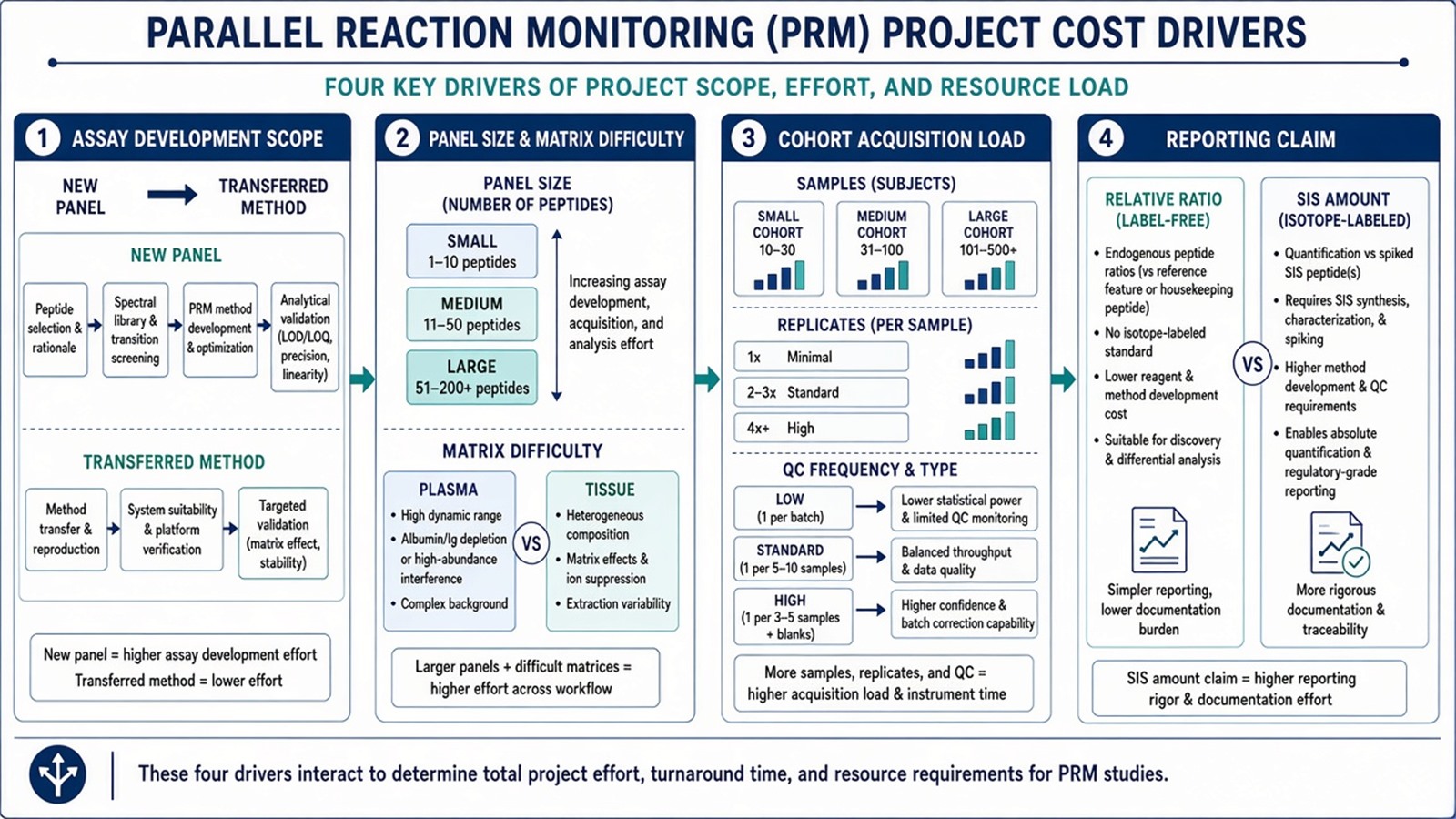
Figure 1. PRM project cost usually tracks development depth, panel and matrix difficulty, cohort load, and reporting standard.
Parameters That Change the Quote
Parameter |
Why it changes cost |
Failure mode if ignored |
|---|---|---|
Development vs transferred method |
Sets whether peptide and window work is included |
Analysis-only quote used for a new panel |
Protein and peptide count |
Raises scheduling and review effort |
Panel longer than one duty cycle |
Matrix type |
Changes cleanup, suppression, and pilot needs |
Plasma treated like clean lysate |
Sample and QC count |
Scales instrument and batch time |
Under-budgeted multi-day runs |
SIS and calibration |
Adds reagents and amount review |
Relative peaks read as concentration |
Report depth |
Sets interpretation and documentation load |
Exploratory table used as validation package |
Limits follow the same table. A low quote that excludes development does not become a full plasma panel later without a scope change. PRM does not survey an open proteome, so late "add all discovery hits" requests change both science and budget. Instrument brand names and published CV percentages are not reliable cost proxies without a matched matrix and panel.
Researchers comparing closed-list trade-offs after cost scoping can refer to Advantages and Disadvantages of Targeted Proteomics.
Limits of Cost Comparisons Across Quotes
Quotes are comparable only when scope items match. "PRM for ten samples" is not the same request as "develop a fifteen-peptide plasma panel, then analyze two hundred cohort samples with SIS calibration."
Common non-comparable pairs include transferred method versus new development, relative peak areas versus SIS amounts, lysate pilot versus plasma validation, and exploratory tables versus validation-oriented reports. Vendor comparisons that omit those axes usually understate the true budget.
PRM also does not replace discovery when names are still unknown. Discovery follow-up has to freeze candidates first. Moving every failed MRM transition to PRM without ranking targets can inflate cost without improving decisions.
How to Scope a PRM Project Before Budgeting
Use list status, method status, and claim unit to choose a scope tier before requesting a quote.
Project need |
Scope that often fits |
Recheck before committing |
|---|---|---|
Small pilot, method already exists |
Analysis-only PRM on a short panel |
Matrix differs from the original method |
New peptides in a clean matrix |
Limited development plus pilot, then small cohort |
Panel still open after discovery |
New panel in plasma or tissue |
Full development, matrix pilots, then staged cohort |
Cohort booked before window QC |
Relative confirmation of named peptides |
Closed PRM or MRM without SIS |
Amount wording in the report request |
Mass or molar unit for named peptides |
Targeted assay plus matched SIS and calibration |
Relative peaks treated as concentration |
Open protein list still unknown |
Discovery first, then PRM |
PRM priced as an open survey |
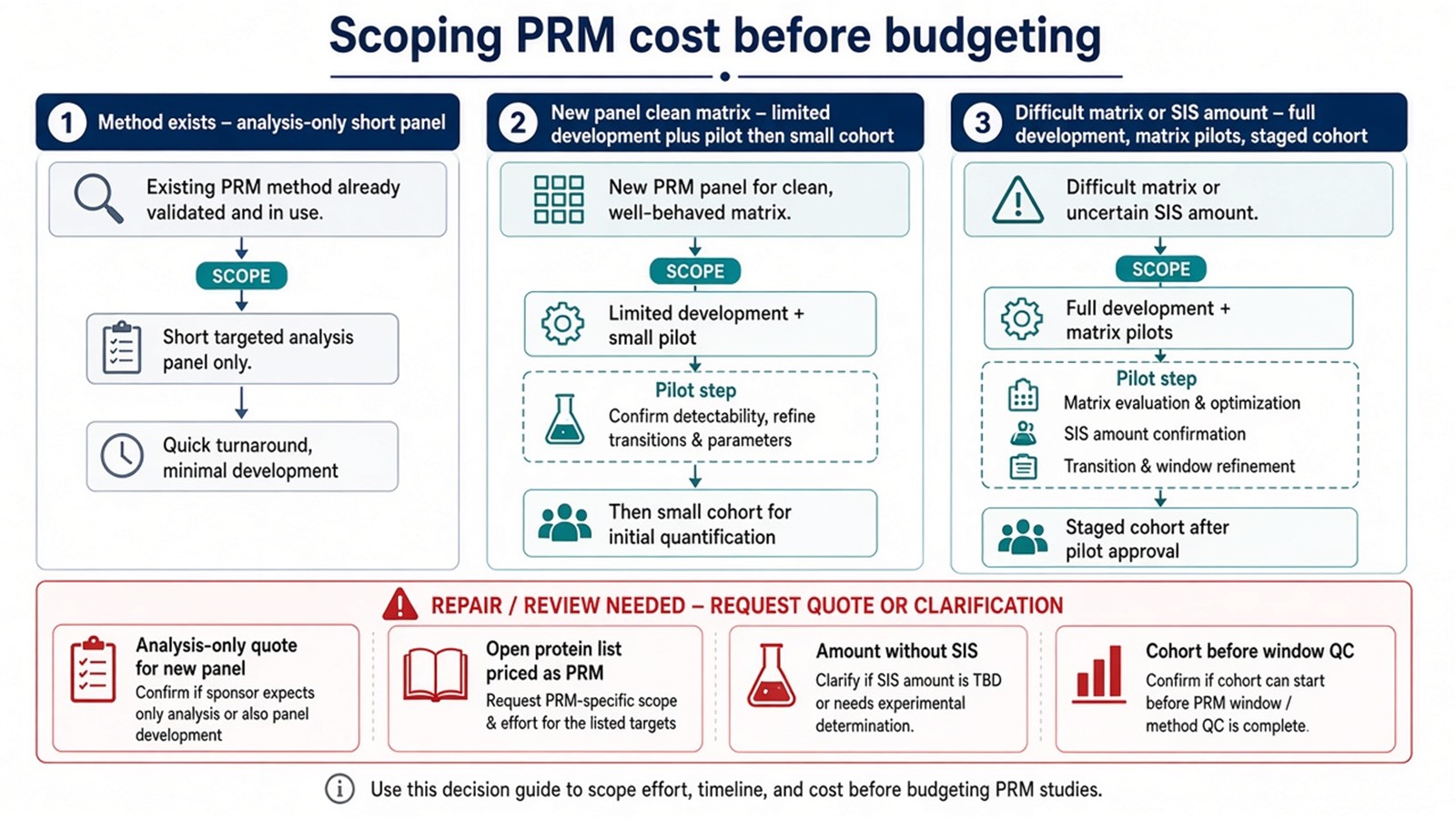
Figure 2. Match budget to method status and claim unit; analysis-only pricing and amount-without-SIS requests need repair before quote comparison.
Lower-scope work more often fits transferred methods and small pilots. Moderate-scope work more often fits new panels with basic QC in cell or tissue matrices. Higher-scope work more often fits difficult matrices, SIS amounts, and large cohorts with deeper documentation. Exceptions exist when a tiny validated panel never needed discovery, or when only a subset of failed MRM transitions needs high-resolution rescue.
Teams that already have target list, matrix, cohort size, method status, and reporting need can also review the MtoZ Biolabs Targeted Proteomics Service for project-specific scoping. For assay setup after the budget frame is clear, see Protein Targeted Quantification.
Frequently Asked Questions
1. Is there a standard price for PRM quantitation?
No. PRM cost is usually project-based because development scope, panel size, matrix, sample number, and reporting requirements vary.
2. What usually increases PRM cost the most?
Full assay development in a complex matrix and large cohort acquisition with deeper documentation are often the largest drivers. Instrument time alone is rarely the whole story.
3. Can cost be reduced without dropping the scientific claim?
Yes. Freeze the minimum panel, run a matrix pilot before full cohort acquisition, separate development from analysis in the quote, and match report depth to the real decision need.
4. Is assay development always required?
No. If a validated method already exists for the same matrix and panel, the project may focus on batch acquisition. New targets, new matrices, or unstable integration usually need development.
5. What information should be shared before a quote?
Share targets, matrix, sample and replicate counts, whether development is needed, relative versus SIS amount goal, prior discovery or MRM data if available, and the intended use of the report.
MtoZ Biolabs can support PRM scoping across transferred methods, new panel development, and cohort acquisition when sample type, study design, and the intended claim are available.
If further evaluation of panel size, matrix pilots, SIS needs, or staged development versus analysis-only pricing is needed, project details can be submitted for a feasibility review.
Reference
- S.A. Gerber, J. Rush, O. Stemman, M.W. Kirschner, S.P. Gygi (2003). Absolute quantification of proteins and phosphoproteins from cell lysates by tandem MS. Proc. Natl. Acad. Sci. U.S.A., 100, 6940-6945. https://doi.org/10.1073/pnas.0832254100
- V. Lange, P. Picotti, B. Domon, R. Aebersold (2008). Selected reaction monitoring for quantitative proteomics: a tutorial. Mol. Syst. Biol., 4, 222. https://doi.org/10.1038/msb.2008.61
- A.C. Peterson, J.D. Russell, D.J. Bailey, M.S. Westphall, J.J. Coon (2012). Parallel reaction monitoring for high resolution and high mass accuracy quantitative, targeted proteomics. Mol. Cell. Proteomics, 11, 1475-1488. https://doi.org/10.1074/mcp.O111.013698
