






VirScan and PhIP-Seq: How Viral Peptide Libraries Support Immune History and Serology Studies
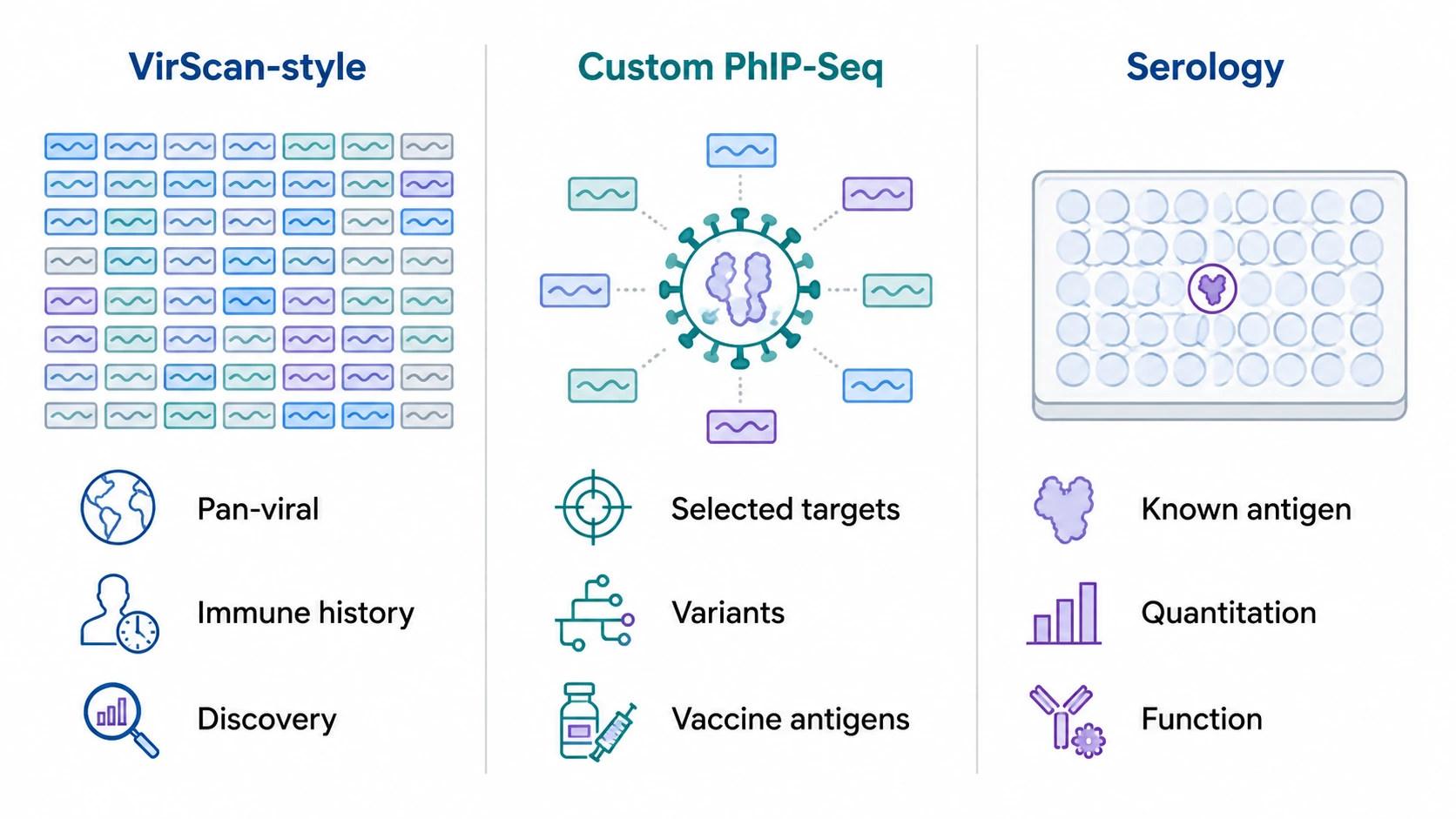
For viral immune history or broad pathogen exposure history, a VirScan-style viral peptide PhIP-Seq library fits studies that need discovery across many viral antigens. A custom peptide library usually makes more sense when the question is narrower: selected viruses, variants, vaccine antigens, or conserved peptide motifs. ELISA, multiplex serology, recombinant antigen assay, and neutralization assay formats are still better choices when the endpoint is validated antigen-specific quantitation or functional antibody activity.
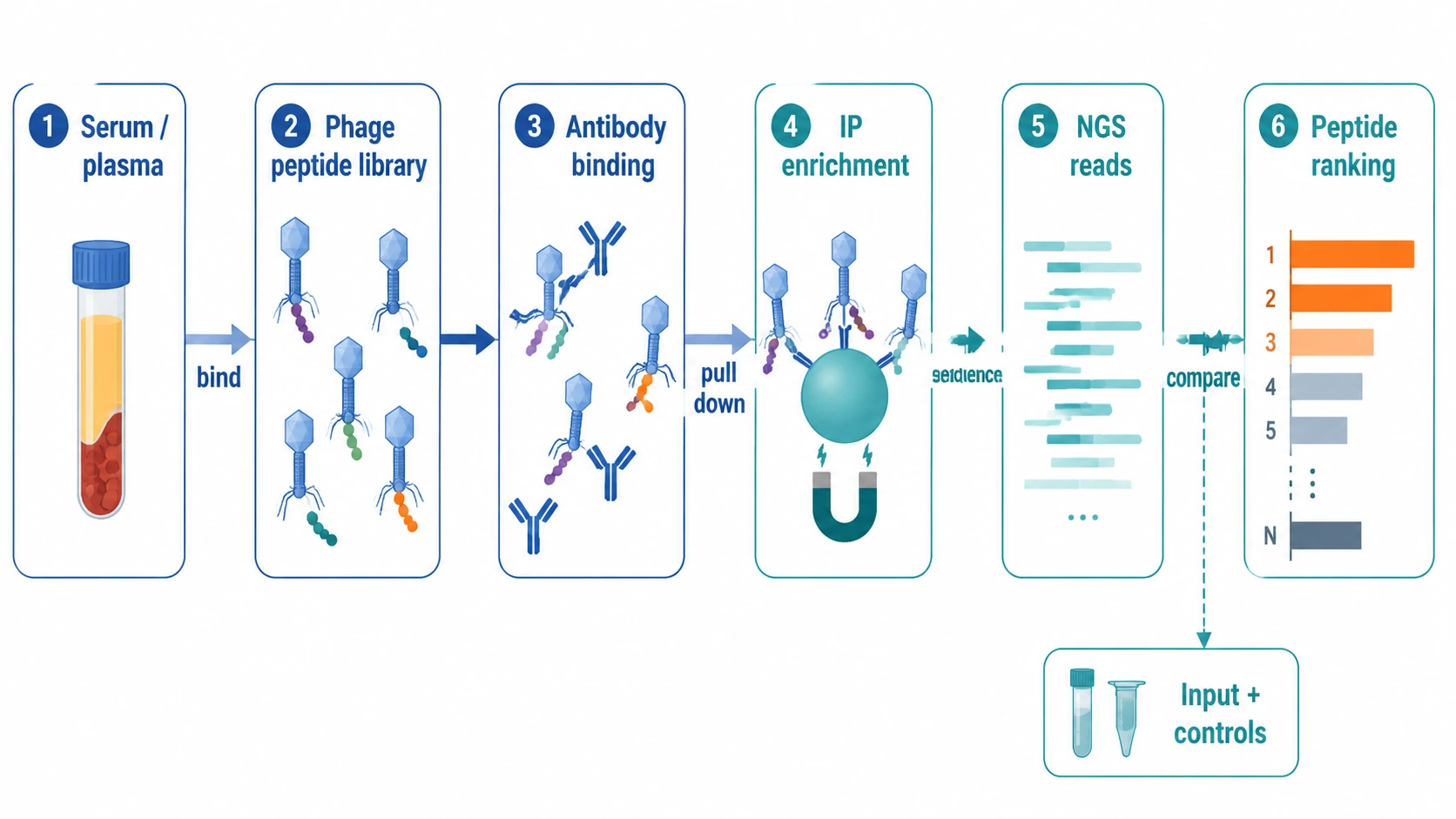
VirScan and PhIP-Seq are related, but they are not the same term. PhIP-Seq means phage immunoprecipitation sequencing. The platform combines a phage-displayed peptide library, antibody-mediated immunoprecipitation, and next-generation sequencing. VirScan is a viral peptide library implementation of PhIP-Seq that profiles antibody binding across many viral peptide sequences. The practical question is not which term sounds broader. It is whether broad viral proteome coverage, targeted peptide design, or conventional serology fits the biological question and validation plan.
Common Decision Scenarios in Viral Serology Research
This decision often comes up before sample submission, cohort expansion, or assay budgeting. A virology team may have serum or plasma from a case/control cohort, pre/post-vaccination samples, longitudinal sampling, or an exposure-defined group. Instead of measuring antibodies against one viral antigen, the team wants peptide-level reactivity patterns across many viral proteins.
The platform changes what the study can say. A broad viral peptide library can rank enriched peptides and show cohort-level antibody repertoire profiling patterns, but it does not prove active infection, protective immunity, or clinical diagnosis on its own. A targeted PhIP-Seq design can make viral antigen discovery easier to interpret when the virus family, variant, or vaccine construct is already known. Conventional serology gives more direct antigen-specific readouts. Neutralization assay formats are better when functional blocking activity is the main endpoint.
A mismatch can leave a team with awkward data. A pan-viral library may produce more discovery signals than the project can realistically validate if the real need is calibrated antibody concentration. ELISA alone may miss unexpected cross-reactivity when peptide-level discovery matters. The comparison should be made before samples, controls, and sequencing depth are fixed.
Key Comparison Dimensions
Library Scope and Biological Question
Library scope determines whether the assay surveys broad viral proteome space or focuses on a defined antigen set. A pan-viral library supports immune history mapping and exploratory pathogen exposure history. A custom peptide library supports strain-specific, variant-focused, or vaccine antigen questions with tighter biological framing. Conventional serology usually tests selected antigens rather than large peptide collections.
Peptide Design and Epitope Representation
PhIP-Seq libraries often use overlapping peptides with defined peptide tiling, step size, and proteome coverage. These designs fit linear epitope discovery and conserved peptide motif analysis. They are less suitable for antibodies that recognize conformational epitopes, glycosylation-dependent epitopes, or quaternary structures that need native protein folding.
Sample, Control, and Sequencing Design
Serum or plasma volume, antibody abundance, cohort size, longitudinal sampling points, negative controls, mock IP controls, replicate strategy, and batch layout all affect interpretation. Sequencing depth must support detection of read count enrichment above the input library distribution and background signals. Without the right controls and background correction, enriched antibody-bound phage clones can be hard to separate from nonspecific binding or library representation bias.
Data Interpretation and Validation Path
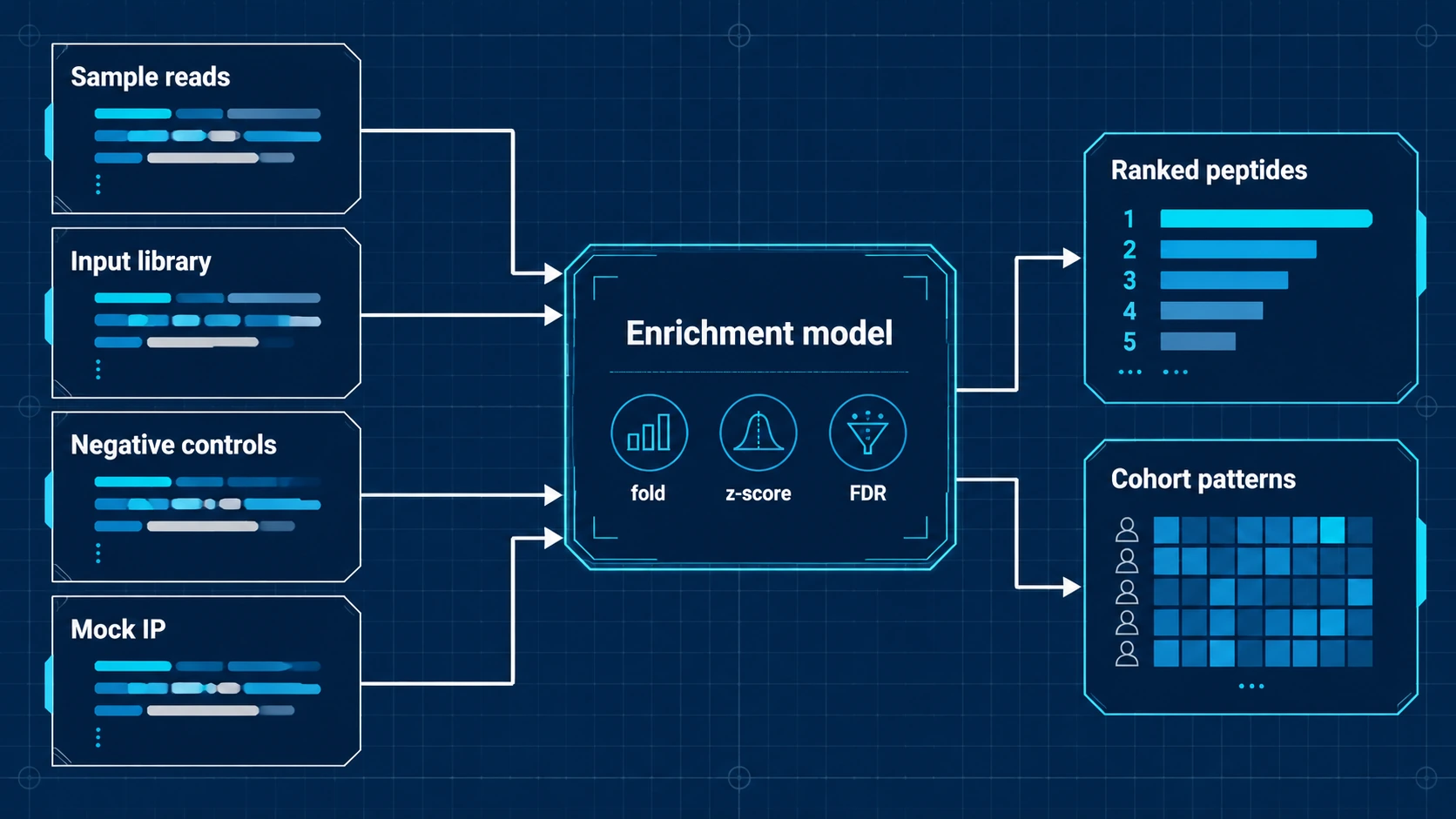
PhIP-Seq produces peptide-level enrichment signals, often summarized by fold enrichment, z-score models, background correction, multiple-testing control, protein mapping, and cohort comparison. These results support candidate ranking. They are not final biological proof. ELISA, peptide array, recombinant antigen assay, Western blot, or neutralization assay may be needed to validate candidate reactivity, antigen specificity, or functional relevance.
Related Services
Main Service
Supporting Services
- High-Throughput Peptide Epitope Mapping Service
- Antibody Epitope Mapping Service
- Viral Infection Mechanisms Research Service
Validation Services
- Peptide Array-Based Epitope Mapping Service
- Protein Array Analysis Service
- Antibody-Antigen Interactions Characterization Service | HDX-MS
Alternative Service
Objective Comparison by Decision Dimension
| Dimension | VirScan-Style Viral Peptide PhIP-Seq | Custom Pathogen-Focused PhIP-Seq | Conventional Serology Platforms |
|---|---|---|---|
| Library scope | Broad viral peptide library, often pan-viral in intent | Selected viruses, strains, variants, or antigen families | Selected recombinant proteins, peptides, or assay antigens |
| Best fit | Immune history, exploratory serology research, exposure-associated patterns | Vaccine-response profiling, focused viral antigen discovery, variant comparison | Known antigen testing, calibrated or semi-quantitative follow-up, functional antibody assays |
| Main output | Enriched viral peptides and cohort-level reactivity profiles | Enriched designed peptides tied to a defined hypothesis | Antigen-specific signal, titer, band, array intensity, or neutralization endpoint |
| Main limitation | Broad results may include cross-reactivity and ambiguous viral assignment | Narrow design may miss unexpected exposures or unrelated viral reactivity | Limited discovery breadth compared with peptide-library screening |
| Validation need | Orthogonal validation for prioritized peptides or proteins | Orthogonal validation for selected candidates | May still need confirmatory assays depending on study use |
VirScan-style screening is strongest when the research question benefits from broad viral proteome representation. It can reveal antibody reactivity patterns that point to prior exposure, shared motifs among related viruses, or cohort-level differences. The tradeoff is interpretation. Cross-reactivity can occur when unrelated or related viruses share a conserved peptide motif, so enrichment should not be assigned to a single infection event without more evidence.
Custom pathogen-focused PhIP-Seq reduces some of that ambiguity by narrowing the library around defined targets. A vaccine study may include tiled peptides from vaccine antigens, variant sequences, and conserved viral proteins. A viral antigen discovery project may compare overlapping peptides across strains to identify recurrent linear epitope signals. The limitation is design dependence: peptides absent from the library cannot be discovered, and conformational antibody binding may remain underrepresented.
Conventional serology answers a different layer of the question. ELISA and recombinant antigen assay formats fit known antigen binding and calibrated or semi-quantitative measurement when standards and validation support that use. Peptide array methods can validate or expand peptide-level binding patterns. A neutralization assay is the better option when the central question is whether antibodies block viral entry or infection in the assay system.
How the PhIP-Seq Readout Should Be Interpreted
In a viral peptide library PhIP-Seq experiment, antibodies in serum or plasma bind phage-displayed peptides. Immunoprecipitation enriches antibody-bound phage, and next-generation sequencing identifies which peptide-encoding clones increase relative to the input library and control samples. Read count enrichment and fold enrichment support candidate identification, but they are not calibrated antibody concentration.
A higher enrichment signal may reflect stronger binding, higher antibody abundance, better peptide display, lower background, or library-specific effects. Analysis therefore compares sample reads with input abundance, negative controls, mock IP controls, and cohort-level background. Statistical enrichment models and multiple-testing control help prioritize signals more likely to reflect sample-associated antibody binding.
Interpretation also needs viral biology. A peptide mapping to a conserved protein region may generate signals across related viruses. In vaccine-response profiling, an enriched peptide after vaccination may represent vaccine-associated reactivity, pre-existing cross-reactivity, or boosting of memory antibodies. Pre/post-vaccination samples and longitudinal sampling make these patterns easier to separate than a single time point.
Decision Guidance by Research Goal
If the Goal Is Broad Immune History Mapping
Use a VirScan-style viral peptide PhIP-Seq strategy when the study needs broad viral antigen coverage and the cohort question is exploratory. This approach fits comparisons of exposure-associated peptide signatures across groups or searches for unexpected viral reactivity patterns. The study should include negative controls, cohort metadata, and a validation plan for the most relevant signals.
If the Goal Is Vaccine-Response Profiling
Use custom pathogen-focused PhIP-Seq when the vaccine antigen, strain, or variant set is known. A custom peptide library can include overlapping peptides from vaccine antigens, variant regions, and conserved viral proteins. The main risk is overinterpreting peptide enrichment as protection. Pair candidate signals with ELISA, recombinant antigen assay, or neutralization assay when the study needs antigen-level quantitation or functional interpretation.
To evaluate your project, researchers can submit your requirements to MtoZ Biolabs for PhIP-Seq library selection, immunoprecipitation and sequencing plan review, enrichment analysis discussion, and validation strategy matching.
If the Goal Is Viral Antigen or Linear Epitope Discovery
Use a viral peptide library or custom peptide library that captures the proteins, strains, and peptide tiling needed for candidate discovery. PhIP-Seq can rank enriched peptides, reveal shared motif patterns, and support antigen prioritization. Follow-up with peptide array, ELISA, Western blot, or recombinant antigen assay helps confirm whether the signal is reproducible outside the phage display context.
If the Goal Is Known Antigen Quantitation or Functional Activity
Choose conventional serology when the endpoint is a defined antigen-specific signal. ELISA or multiplex serology can be more direct for known targets, while neutralization assay formats are more appropriate for functional blocking activity. PhIP-Seq may still be useful upstream to discover which peptides or proteins deserve targeted validation.
Comparison Summary and Consultation Guidance
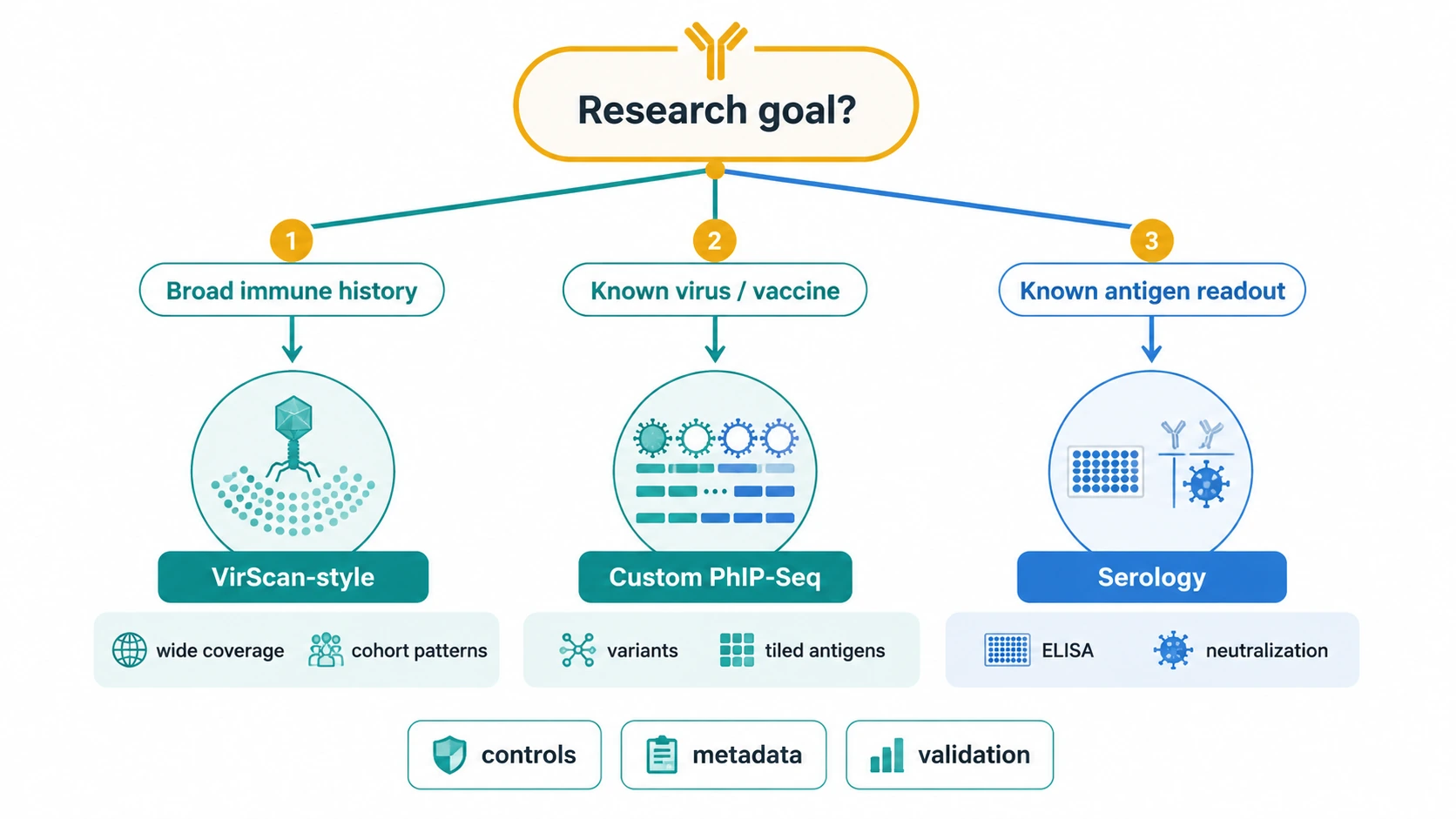
VirScan-style PhIP-Seq, custom pathogen-focused PhIP-Seq, and conventional serology answer different viral antibody questions. VirScan-style screening fits broad immune history and exploratory pathogen exposure history studies. Custom PhIP-Seq fits defined viral families, variants, vaccine antigens, and linear epitope discovery. ELISA, recombinant antigen assay, peptide array, Western blot, and neutralization assay formats remain important when researchers need validation, antigen-level measurement, or functional antibody evidence.
A practical project request should describe the sample type, serum or plasma availability, cohort design, target viruses or vaccine antigens, longitudinal sampling plan, expected output, and preferred validation route. For studies comparing broad screening with targeted viral peptide libraries, contact us to discuss how MtoZ Biolabs can support PhIP-Seq antibody analysis, peptide library planning, read count enrichment analysis, candidate reporting, and orthogonal validation planning without treating the assay as a standalone diagnostic test.
FAQ
Is VirScan the same as PhIP-Seq?
No. PhIP-Seq is the broader phage immunoprecipitation sequencing platform. VirScan refers to a viral peptide library application of PhIP-Seq for profiling antibody reactivity across many viral peptide sequences.
Can VirScan or PhIP-Seq prove that a person currently has a viral infection?
No. Peptide enrichment can support serology research and immune history analysis, but it does not prove active infection by itself. Clinical, molecular, timing, and orthogonal serological evidence would be needed for that type of conclusion.
When should a custom peptide library replace a pan-viral library?
Use a custom peptide library when the study already has a defined virus family, vaccine construct, variant panel, or antigen-discovery hypothesis. A narrower design can improve interpretability, but it will not detect targets omitted from the library.
Does read count enrichment equal antibody concentration?
No. Read count enrichment reflects relative enrichment of peptide-displaying phage after immunoprecipitation and sequencing. Calibrated antibody concentration requires additional assay design, standards, and validation, often through ELISA or related methods.
How should cross-reactive viral peptide signals be handled?
Cross-reactive signals should be mapped for sequence similarity, conserved peptide motif patterns, and cohort distribution. Researchers should avoid assigning a signal to one virus when related viruses share similar peptide regions unless supporting evidence is available.
Which validation assay should follow PhIP-Seq discovery?
The validation choice should match the claim. Use peptide array or ELISA for peptide or antigen binding confirmation, recombinant antigen assay for protein-level recognition, Western blot for antigen band confirmation, and neutralization assay when functional blocking activity is the question.
How to order?




