






Single-Cell Antibody Sequencing vs Hybridoma Sequencing: Which Route Fits Rare B-Cell Discovery Programs?
Single-cell antibody sequencing is usually the better starting point when a rare B-cell discovery program begins with scarce, low-frequency antigen-specific B cells and the team needs native heavy/light chain pairing for recombinant re-expression. Hybridoma sequencing is often the better fit when productive hybridoma clones already exist or when the program deliberately wants sequence recovery only after clone-based selection.
The distinction is not just about format. It comes down to where sequence recovery sits in the biological workflow. Single-cell antibody sequencing recovers VH and VL sequences directly from individual B cells after single B-cell isolation. Hybridoma sequencing recovers variable region information after cell fusion, hybridoma clone establishment, and selection of an antibody-secreting clone. In rare B-cell discovery, that upstream difference often decides whether valuable biology is captured early or filtered out before sequencing even starts.
Where This Choice Usually Becomes Critical
Teams usually run into this decision after they have identified or enriched antigen-specific B cells but before they lock in a recovery strategy. The starting material may be sorted B-cell subsets from human PBMCs, lymphoid tissue cells, plasma-cell enriched fractions, or B cells from immunized animals. At that stage, three constraints usually drive the discussion:
- the low-frequency B-cell population may contain only a small number of relevant clonotypes
- sample input may be limited or impossible to replace
- downstream work may require paired VH and VL sequences that are ready for recombinant re-expression
That mix shifts the decision logic. A route that works well for abundant biology can be a poor fit for rare-cell programs if it introduces heavy attrition before sequence recovery. On the other hand, if the lab already has a stable hybridoma clone in hand, direct single-cell recovery may add complexity without improving the practical deliverable.
What Each Route Means in a Discovery Context
Single-cell antibody sequencing
Here, single-cell antibody sequencing means recovering antibody variable region information from individual antigen-specific B cells, ideally while preserving native heavy/light chain pairing. The workflow centers on single B-cell isolation, transcript capture, and reconstruction of paired heavy chain and light chain sequences from the same cell.
For rare B-cell discovery, this route is appealing because sequence recovery happens close to the original biology. That makes it easier to compare clonotypes, review consensus sequence quality, and choose candidates for recombinant re-expression without first pushing the biology through expansion or fusion.
Hybridoma sequencing
Hybridoma sequencing means sequencing the antibody variable region from a productive hybridoma clone after cell fusion and clone establishment. The resulting sequence package reflects the antibody-secreting clone that made it through fusion, expansion, screening, and maintenance.
This route can be very practical when those upstream steps are already done. If the real project asset is a stable hybridoma clone, hybridoma sequencing can offer a direct path to VH and VL sequences, confirmation of variable region content, and follow-up validation planning.
The Decision Criteria That Matter Most for Rare B-Cell Discovery
A useful comparison should stay tied to the rare-cell decision rather than drift into broad platform descriptions. Four criteria usually matter most.
1. Native heavy/light chain pairing
When recombinant re-expression is the next step, native heavy/light chain pairing often becomes the first screen. Single-cell antibody sequencing is built around preserving the pairing seen in individual antigen-specific B cells. That can lower downstream uncertainty when the goal is to re-express the original antibody rather than rebuild possible combinations later.
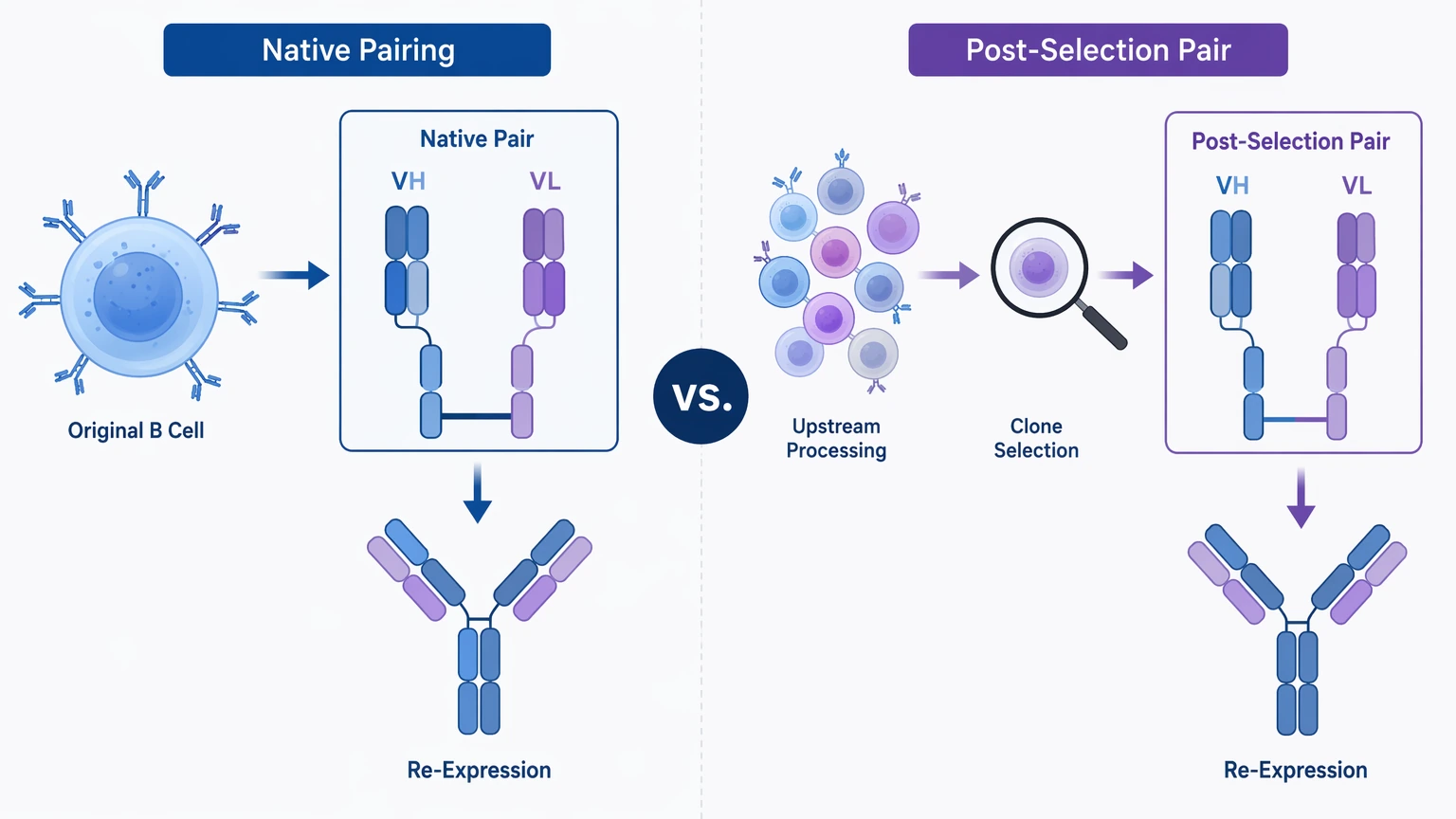
Hybridoma sequencing can still provide functionally relevant paired sequences, but the pairing reflects the established hybridoma clone rather than the original pre-fusion B-cell pool. If the key question is whether the original rare clonotype survives the path to a productive clone, that difference matters.
2. Risk of losing rare biology before sequence recovery
Rare programs are especially sensitive to pre-sequencing loss. Hybridoma-based recovery depends on cell fusion, outgrowth, clone selection, and continued stability. Each step can narrow the biology that remains represented. That narrowing is not automatically a problem; in some workflows it is the point. The concern is whether that filtering happens before the team has captured the sequence information it actually needs.
Single-cell antibody sequencing reduces that dependence on expansion. It does not remove technical risk, but it shifts the main challenge toward cell quality, transcript recovery, and sequence interpretation rather than clone survival.
3. Starting material, sample input, and viability
Single-cell antibody sequencing usually requires viable or well-preserved cells that can support single B-cell isolation and mRNA recovery. Poor viability or damaged cells can cut into usable sequence recovery, especially when transcript abundance is low.
Hybridoma sequencing fits a different sample situation. If the starting material is already cultured hybridoma material, the viability question is less about fragile primary B cells and more about clone purity and productive growth. In practical terms:
- scarce primary antigen-specific B cells usually favor single-cell antibody sequencing
- established hybridoma clone material usually favors hybridoma sequencing
4. Readiness for downstream validation and re-expression
Sequence presence alone is not enough for discovery decisions. Teams often need full variable region coverage, confidence in VH and VL sequences, clonotype grouping, and a validation plan that supports candidate ranking.
Single-cell antibody sequencing is often stronger when the team wants multiple candidate sequences from a low-frequency B-cell population and wants to keep native heavy/light chain pairing through selection. Hybridoma sequencing is often stronger when the project already has a defined antibody-secreting clone and needs clean sequence confirmation from that clone state. If your team is weighing outsourced support at this stage, submit your requirements early so the recovery route can be matched to the actual downstream deliverable rather than to a platform label.
Side-by-Side Comparison
The table below keeps the comparison focused on sequence recovery, not general antibody screening.
| Decision Dimension | Single-Cell Antibody Sequencing | Hybridoma Sequencing |
|---|---|---|
| Native heavy/light chain pairing | Directly aligned with individual antigen-specific B cells | Reflects the productive hybridoma clone after cell fusion and selection |
| Low-frequency B-cell population recovery | Better suited to preserving scarce biology before expansion | More vulnerable to losing rare clonotypes during fusion and clone establishment |
| Starting material | Sorted or enrichable primary B cells with acceptable viability | Established hybridoma clone or cultured antibody-secreting clone material |
| Upstream dependency | Lower dependence on successful culture before sequence recovery | High dependence on cell fusion, outgrowth, and clone stability |
| Clonotype breadth | Can sample a broader set of single cells if capture succeeds | Usually narrowed to the clones that survive and are selected |
| Recombinant re-expression readiness | Strong when paired VH and VL sequences are recovered completely | Strong when clone purity is high and variable region confirmation is straightforward |
| Common constraints | Cell quality, low transcript abundance, and sequence completeness | Mixed clones, clone instability, and loss of original diversity |
When Each Route Is Usually Favored
Single-cell antibody sequencing is usually favored when:
- antigen-specific B cells are genuinely rare
- the sample cannot be replaced
- native heavy/light chain pairing is required
- the team wants to preserve a broader candidate set for clonotype review
- recombinant re-expression will be used to compare multiple candidates
This route becomes less attractive when cell viability is poor, single B-cell isolation is unreliable, or the material that now matters most is no longer primary B cells but already established hybridoma clones.
Hybridoma sequencing is usually favored when:
- the program already has a stable hybridoma clone
- sequence recovery is intended to follow functional clone selection
- the valuable biological asset is an antibody-secreting clone rather than the broader B-cell population
- the team wants clone-linked variable region confirmation from cultured material
This route is less attractive when the decision still depends on preserving a low-frequency B-cell population before cell fusion and expansion reshape it.
A Practical Route-Selection Framework
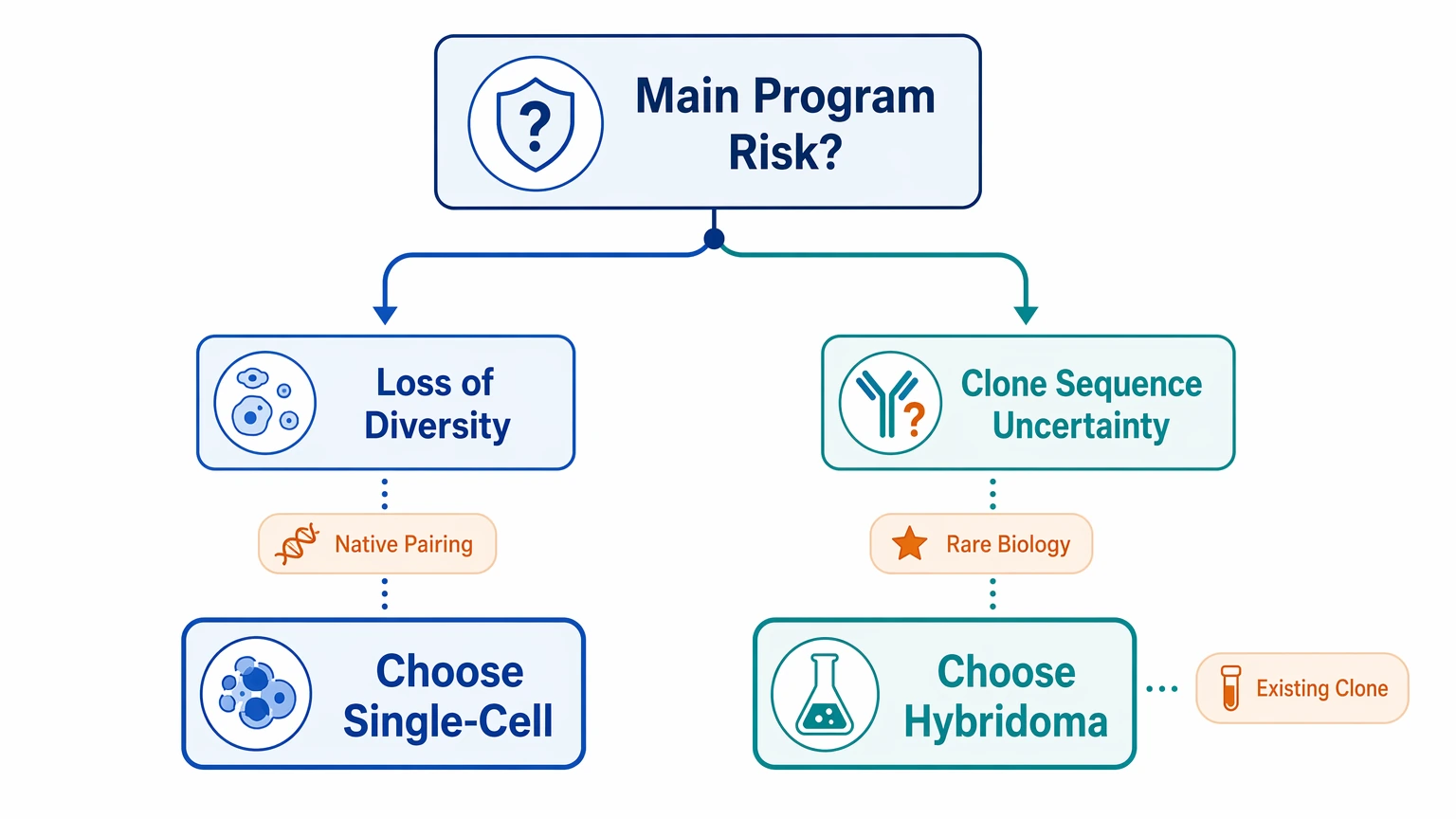
One simple way to decide is to ask which event would damage the program more: losing native pairing at the single-cell stage, or losing rare biology during clone generation.
If the bigger risk is loss of original diversity, prioritize single-cell antibody sequencing. If the bigger risk is not biological loss but uncertainty around the sequence of an existing hybridoma clone, prioritize hybridoma sequencing.
If the answer is still not obvious, a short pre-project review is usually more useful than defaulting to habit. At that point, teams should gather:
- sample source and sample input
- viability status
- whether cells are primary B cells or established hybridoma clones
- expected number of candidates needed
- whether full variable region recovery or only CDRs are needed
- plans for recombinant re-expression
- any orthogonal confirmation needs, such as consensus sequence review, Sanger confirmation, or protein-level confirmation
For teams comparing outsourced workflows, this is also the right time to evaluate the project against deliverable needs rather than against a preferred platform name. In rare-cell programs, MtoZ Biolabs can review sample-fit and deliverable-fit details before sequencing begins, especially when paired-chain recovery and validation planning will shape downstream clone progression.
What to Prepare Before External Workflow Selection
External sequencing support works best when the decision is framed around the deliverable, not just the assay name. A consultation is usually more productive when the team can describe:
- how rare the antigen-specific B cells are expected to be
- whether native heavy/light chain pairing is mandatory
- whether the sample is fresh, frozen, sorted, or already a hybridoma clone
- how many clonotypes or candidate antibodies need to move forward
- whether the required output is consensus sequence only or clone-ready VH and VL sequences
- what the validation plan looks like after sequence recovery
Those details help turn a broad method comparison into a route choice that fits the actual program constraint.
Comparison Summary and Next-Step Guidance
For rare B-cell discovery, single-cell antibody sequencing is often the better default when the project starts with scarce antigen-specific B cells and the value of the study depends on native heavy/light chain pairing, broad clonotype capture, and readiness for recombinant re-expression. Hybridoma sequencing remains a strong option when stable hybridoma clones already exist or when clone-based biological selection is intentionally built into the recovery path. If your program falls between those two cases, the most useful next step is to match sample state, pairing requirements, and validation plan to the route before committing resources; if needed, contact MtoZ Biolabs to discuss the sample scenario, submit your requirements, and evaluate your project around usable sequence recovery rather than around a generic platform preference.
FAQ
If our sorted cells are limited but viability is only moderate, does that automatically rule out single-cell antibody sequencing?
Not automatically. Moderate viability raises recovery risk, but it does not make the route unusable by definition. The more important question is whether the remaining intact cells can still support single B-cell isolation and paired transcript recovery.
Can hybridoma sequencing detect a mixed hybridoma clone?
It can raise that concern if sequence data show competing VH or VL signals, but sequencing alone may not settle every mixture question. Follow-up confirmation is often useful before treating the clone as monoclonal.
Is full variable region recovery always necessary for early ranking?
Not always. If the near-term goal is only motif review or early CDR comparison, partial information may still support triage. If recombinant re-expression is likely, full variable region recovery becomes much more important.
How does clonotype information help after single-cell recovery?
Clonotype grouping helps teams see whether candidates reflect repeated biology or isolated events. That can change which sequences move forward for re-expression and which ones need extra confirmation.
Would it make sense to start with single-cell recovery and later sequence hybridoma-derived clones from the same campaign?
Yes. Some programs use single-cell antibody sequencing to preserve early rare biology, then use hybridoma sequencing later for comparison, clone confirmation, or follow-up work on antibody-secreting clone material generated in parallel.
What is the most common planning mistake before outsourcing either route?
Treating the request as “sequence this sample” instead of defining the required output. Teams usually make better decisions when they state whether they need paired VH and VL sequences, clonotype context, confidence annotation, and a validation plan for recombinant re-expression.
How to order?




