






RACE Antibody Sequencing for Clone Recovery: When to Choose It Before Outsourcing
If antibody-producing cells or other transcript-derived material still exist, RACE antibody sequencing is often the most defensible first move for clone recovery. It is especially useful when a hybridoma is becoming unstable, sequence records are incomplete, and the project needs heavy chain (VH) and light chain (VL) information soon enough to support recombinant re-expression planning.
RACE is usually the wrong place to start when usable cellular material is gone, when only purified antibody remains, or when the actual goal is repertoire-scale discovery rather than rescue of one known clone. In those cases, LC-MS/MS antibody sequencing, NGS, or targeted RT-PCR with known primer anchors may fit the sample reality better. The choice is not really about which method a team prefers. It comes down to whether the available starting material can still support informative cDNA recovery.
When the Clone Recovery Decision Gets Urgent
This choice usually shows up after risk has already built up. A legacy antibody may still matter scientifically or commercially, but the original variable region sequence is missing, documentation is incomplete, or the stored clone no longer behaves in a predictable way. A few cryovials may be left, viability may be slipping, and another thaw may not be easy to justify.
At that stage, the project does not just need “a sequence.” It needs a sequence-ready deliverable that is credible enough for archive rebuilding, CDR review, or handoff into recombinant reconstruction. If RNA-bearing material is still on hand, waiting too long to choose a route can narrow the odds of recovering an interpretable full-length variable-region sequence from both chains. If the first method burns through scarce material without clarifying chain identity, the team can lose time and options at the same moment.
What Usually Makes RACE a Good Fit
For clone rescue, RACE works best when four conditions line up.
Cellular starting material still exists
RACE is a transcript-based strategy. It becomes realistic when the team still has viable cells, a frozen cell pellet, extracted RNA, or usable cDNA. That does not guarantee success, but it does mean the project still has the biological substrate that 5' RACE and 3' RACE require.
Primer knowledge is incomplete
Standard antibody RT-PCR works well when framework or constant-region anchors are already known. RACE becomes more attractive when the exact variable region sequence is missing and primer dependency is the main obstacle.
The project needs chain-specific recovery, not just a fragment
A rescue program usually needs more than a short sequence patch. In most cases, the aim is recovery of VH and VL candidates with enough continuity to review framework context, CDR boundaries, reading frame, and likely productivity.
Timing matters because the clone is at risk
When a hybridoma is aging or limited, a route that can start from the remaining transcript-derived material may be easier to defend than waiting for a broader workflow that does not match the immediate sample constraint.
The Main Reasons Teams Misjudge RACE Fit
Most weak outsourcing decisions in this area come back to a few recurring planning mistakes.
Starting material is described too loosely
“Cells available” is not enough. Viable cells, a frozen pellet, low-quality RNA, and old degraded nucleic acid are very different inputs. The practical issue is whether RNA integrity and transcript abundance still look strong enough to support interpretable amplification.
The target deliverable is not defined
Some teams only need CDR confirmation against old records. Others need a full-length variable-region sequence that can move into construct design. RACE may support either goal, but the evidence bar changes quickly. A partial amplicon may help triage a rescue project, while a re-expression program usually needs stronger chain completeness and sequence validation.
Transcript interpretation risk is underestimated
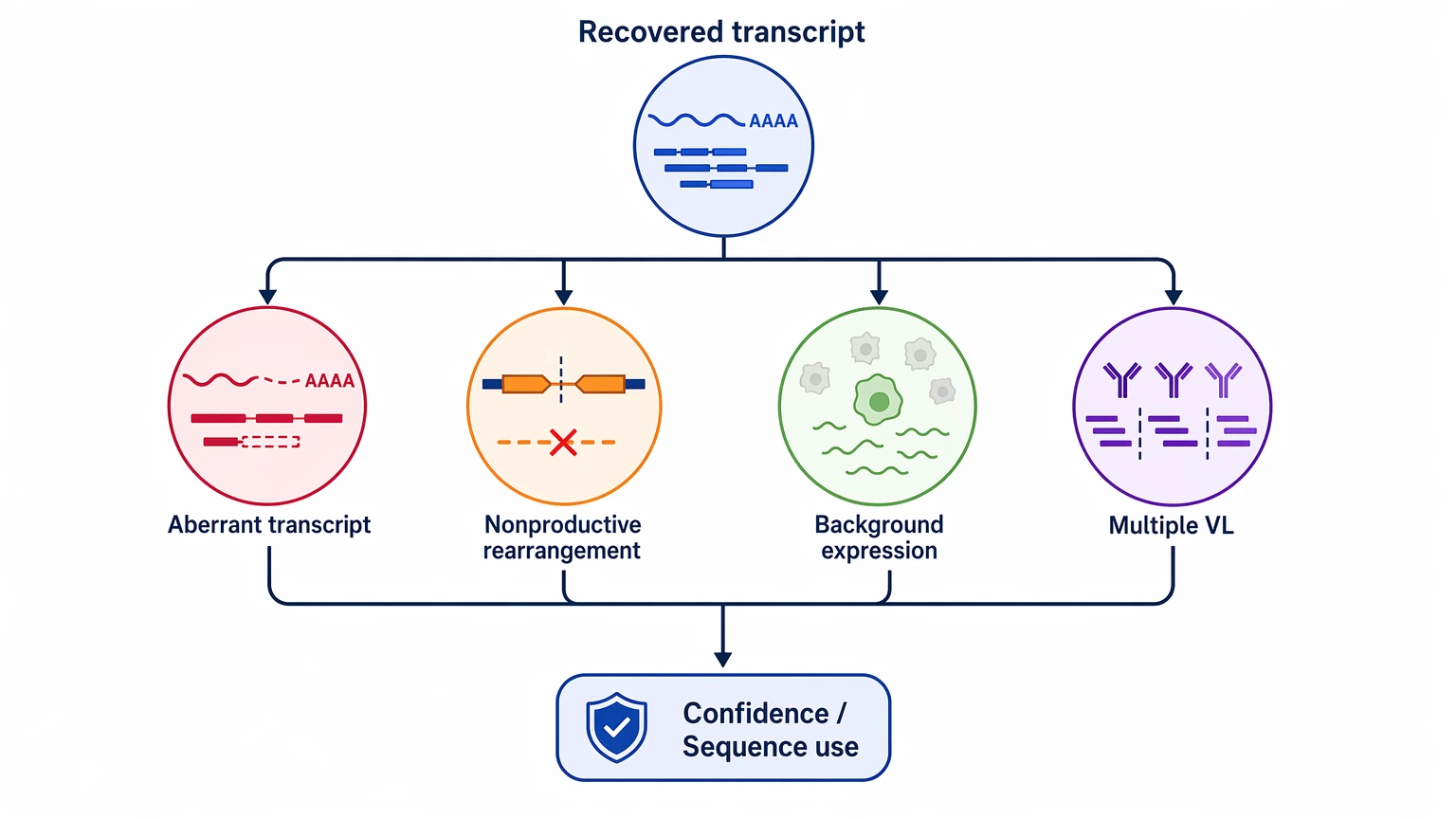
A recovered antibody-related transcript is not automatically the final functional sequence. Older hybridoma lines may show an aberrant transcript, a nonproductive rearrangement, background expression, or more than one apparent light chain (VL). Those issues do not rule out RACE, but they do affect how confidently a sequence can be used downstream.
Method familiarity overrides sample logic
Teams often fall back on the method they know best. In rescue settings, that can be expensive. Targeted RT-PCR may feel simpler but still depends on workable primer anchors. NGS may sound broader but can be unnecessary for a single-clone recovery question. Protein-based recovery may feel like a last resort, yet it becomes the rational first path when only purified antibody remains.
A Practical Method-Selection Path Before Outsourcing
This article is really about method selection, so a planning sequence is more useful than a generic lab workflow.
Step 1: Define the sequence endpoint first
Before comparing methods, specify what the project must produce.
| Project goal | Minimum sequence outcome | Why it changes method choice |
|---|---|---|
| Rescue triage | Antibody-related sequence evidence, sometimes partial | Helps decide whether the clone is still worth pursuing |
| CDR confirmation | Reliable VH and VL CDR assignment | Supports record checking or portfolio review |
| Recombinant rebuild planning | Interpretable heavy chain (VH) and light chain (VL) candidates | Needed for vector design and reconstruction planning |
| Archive rebuilding | Sequence plus defined sequence validation logic | Reduces handoff risk for unstable assets |
If the endpoint is only triage, partial recovery may still be useful. If the endpoint is recombinant re-expression, the project should expect a higher bar for chain completeness, candidate ranking, and Sanger confirmation.
Step 2: Match the method to the real starting material
The freezer inventory usually matters more than the theoretical strengths of any sequencing method.
| Starting material | RACE fit | When another route may be stronger |
|---|---|---|
| Viable hybridoma cells | Strong | Targeted RT-PCR if anchors are already known |
| Frozen cell pellet | Often strong enough if RNA integrity is workable | Targeted RT-PCR or NGS for different project scopes |
| Extracted RNA | Good when quality supports full cDNA capture | Targeted amplification if sequence anchors exist |
| Existing cDNA | Often suitable | Direct targeted PCR from the same cDNA |
| Purified antibody only | Weak | LC-MS/MS antibody sequencing |
| Mixed B-cell material | Limited for clone-specific rescue | NGS when repertoire context matters |
If transcript-bearing material still exists but the variable-region sequence is unknown, RACE antibody sequencing usually deserves serious consideration. If only protein remains, RACE is no longer solving the main bottleneck.
Step 3: Compare RACE with nearby alternatives
RACE vs targeted RT-PCR
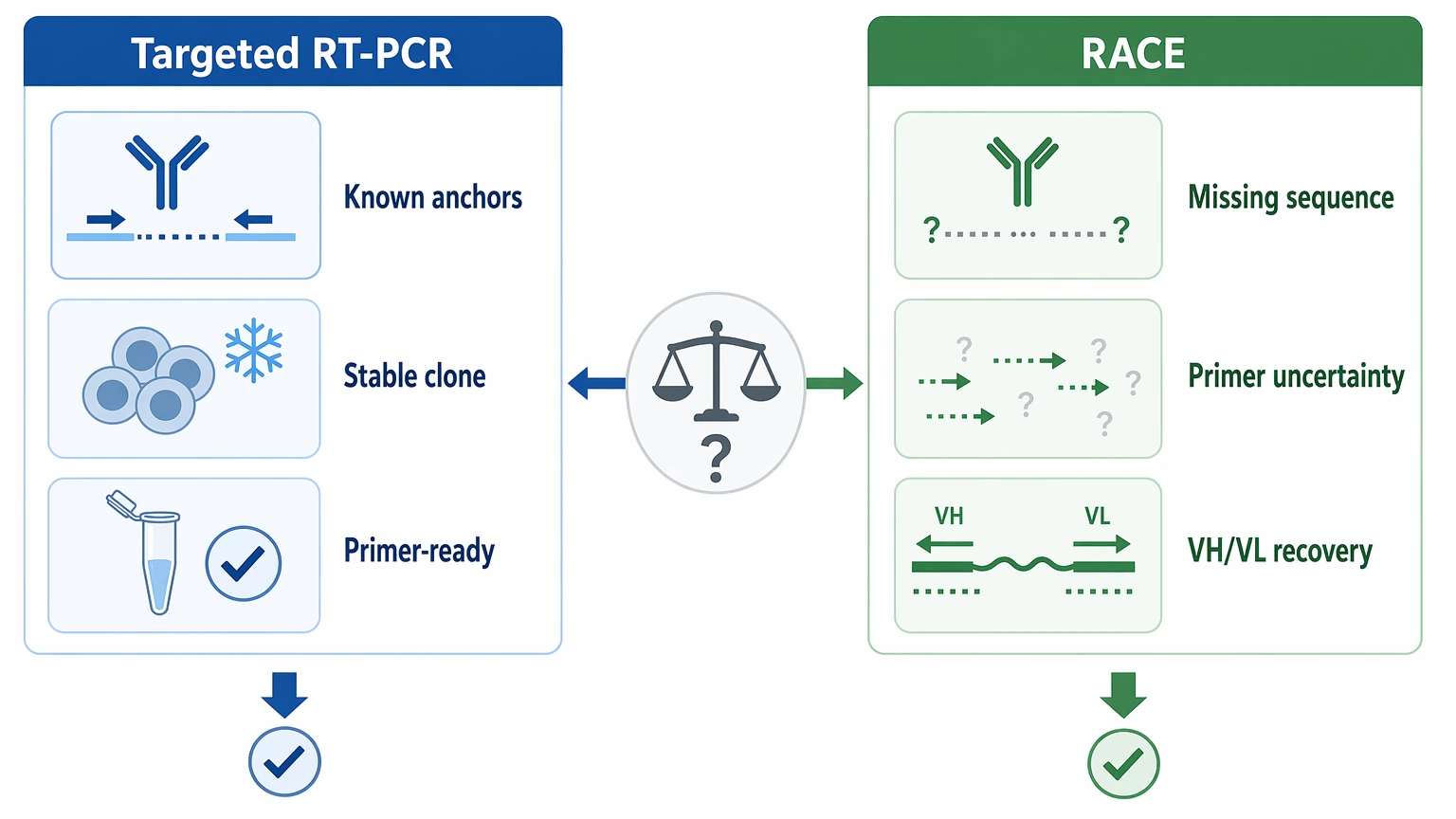
Choose targeted RT-PCR first when conserved anchors are already available and the clone is stable enough that primer dependency is not the main problem. Choose RACE when missing sequence information makes targeted primer design uncertain.
RACE vs NGS
Choose NGS when the project needs broader discovery, diversity context, or evaluation of multiple competing chains across a mixed population. Choose RACE when the task is recovery of one at-risk antibody asset rather than repertoire profiling.
RACE vs LC-MS/MS antibody sequencing
Choose LC-MS/MS antibody sequencing when no useful cells, RNA, or cDNA remain. It is also a better fit when the only preserved asset is archived purified antibody and the cell line has already been lost.
Step 4: Decide whether RACE can produce a sequence-ready deliverable
Before outsourcing, ask four direct questions:
- Is recovery of both VH and VL still biologically plausible from the available sample?
- Does the project need a partial readout, or a full-length variable-region sequence?
- Is there enough material for repeat amplification or orthogonal review?
- Is chain pairing ambiguity likely to remain even if transcripts are recovered?
Projects with favorable answers to the first three questions often justify a RACE-first plan. If chain ambiguity is likely to stay high, RACE may still help with triage, but it should not be the only evidence base for reconstruction. At this stage, teams can contact MtoZ Biolabs to evaluate your project and submit your requirements around sample type, remaining material, expected VH/VL coverage, and downstream confirmation needs.
Step 5: Build sequence validation into the plan
Recovery and validation are not the same thing. A strong outsourcing plan should spell out how candidate sequences will be judged before they move into re-expression work.
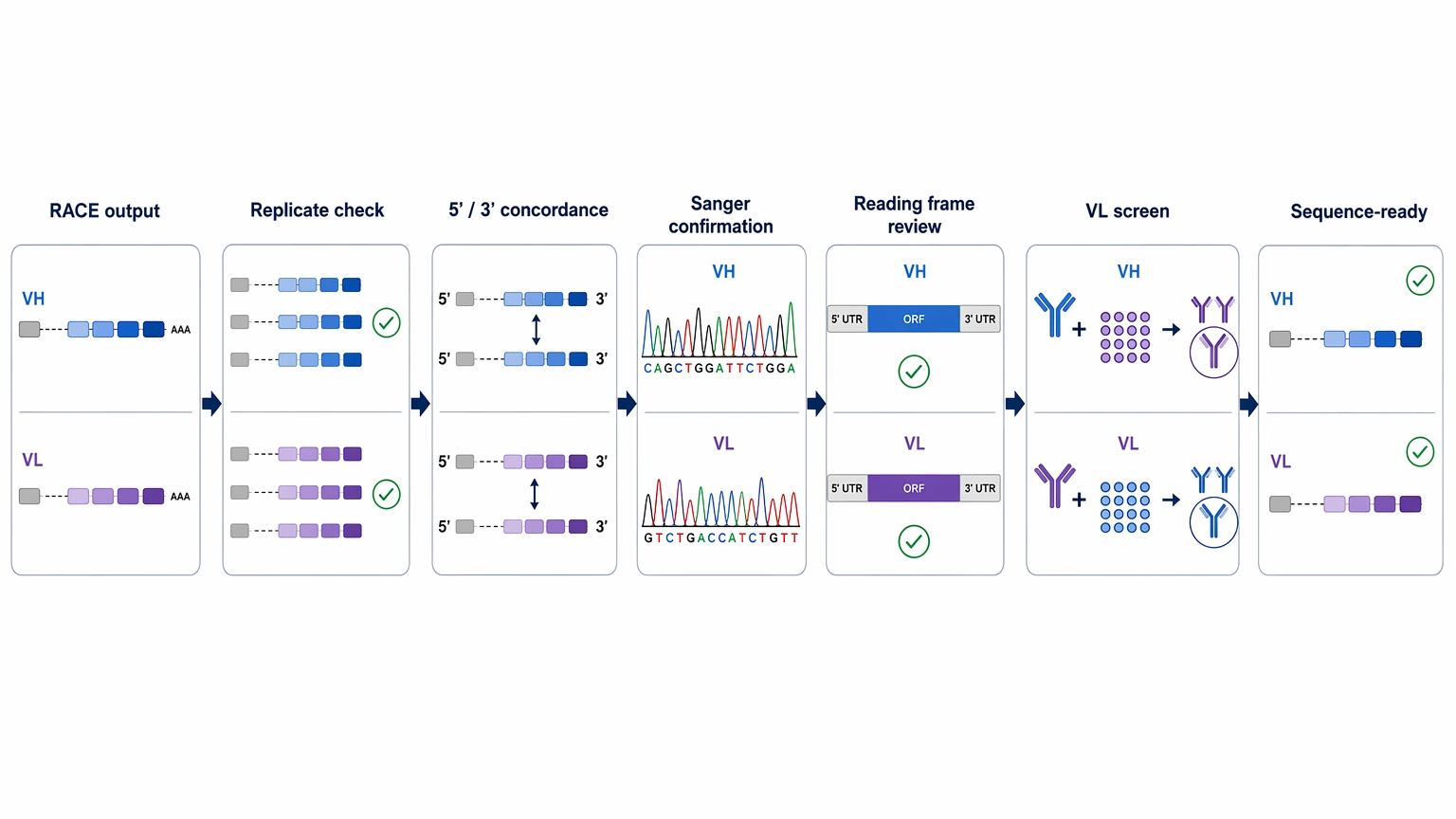
Useful confirmation layers may include:
- replicate amplification where material permits
- comparison across independent 5' RACE and 3' RACE outputs
- Sanger confirmation of selected amplicons
- review of productive reading frames
- screening for an aberrant transcript or alternate VL candidates
- follow-up protein or functional checks if recombinant reconstruction is planned
That kind of validation path does not remove uncertainty, but it does make the resulting sequence set easier to defend.
What a Good RACE Outcome Looks Like
A useful result is not simply “an antibody-like amplicon was found.” For clone rescue, a meaningful near-term outcome is recovery of interpretable VH and VL candidates with enough continuity to assess framework context, CDR placement, reading frame, and likely productive transcript status.
For rebuilding programs, the stronger outcome is a sequence-ready deliverable that includes chain-specific candidates, confidence notes, and a stated basis for sequence validation, such as replicate recovery and Sanger confirmation. That still does not guarantee final recombinant performance, but it does give the team a workable starting point for codon optimization, vector design, and controlled re-expression studies.
What to Prepare Before You Outsource
A short preparation package can make the first technical discussion more useful and reduce method drift. Include:
- sample type: viable cells, frozen pellet, RNA, cDNA, or purified antibody
- storage history and whether repeat extraction is possible
- urgency: for example, whether the hybridoma may be lost soon
- desired endpoint: CDR check, full VH/VL recovery, or reconstruction support
- tolerance for ambiguity: whether multiple chain candidates can be handled downstream
- expected confirmation level before recombinant work begins
If a program needs a side-by-side decision on RACE, targeted PCR, NGS, or LC-MS/MS antibody sequencing, a scoped project discussion is often more productive than starting with a default method. In that setting, MtoZ Biolabs can evaluate your project, discuss the sample scenario, and help define a practical recovery path before material is consumed.
Conclusion
For urgent clone recovery, RACE antibody sequencing is often the best first outsourcing route when transcript-derived starting material still exists, primer knowledge is incomplete, and the near-term need is recoverable VH and VL sequence information. It becomes less persuasive when the sample is protein-only, when RNA integrity is unlikely to support informative cDNA capture, or when unresolved chain pairing risk outweighs the advantages of a transcript-based rescue route.
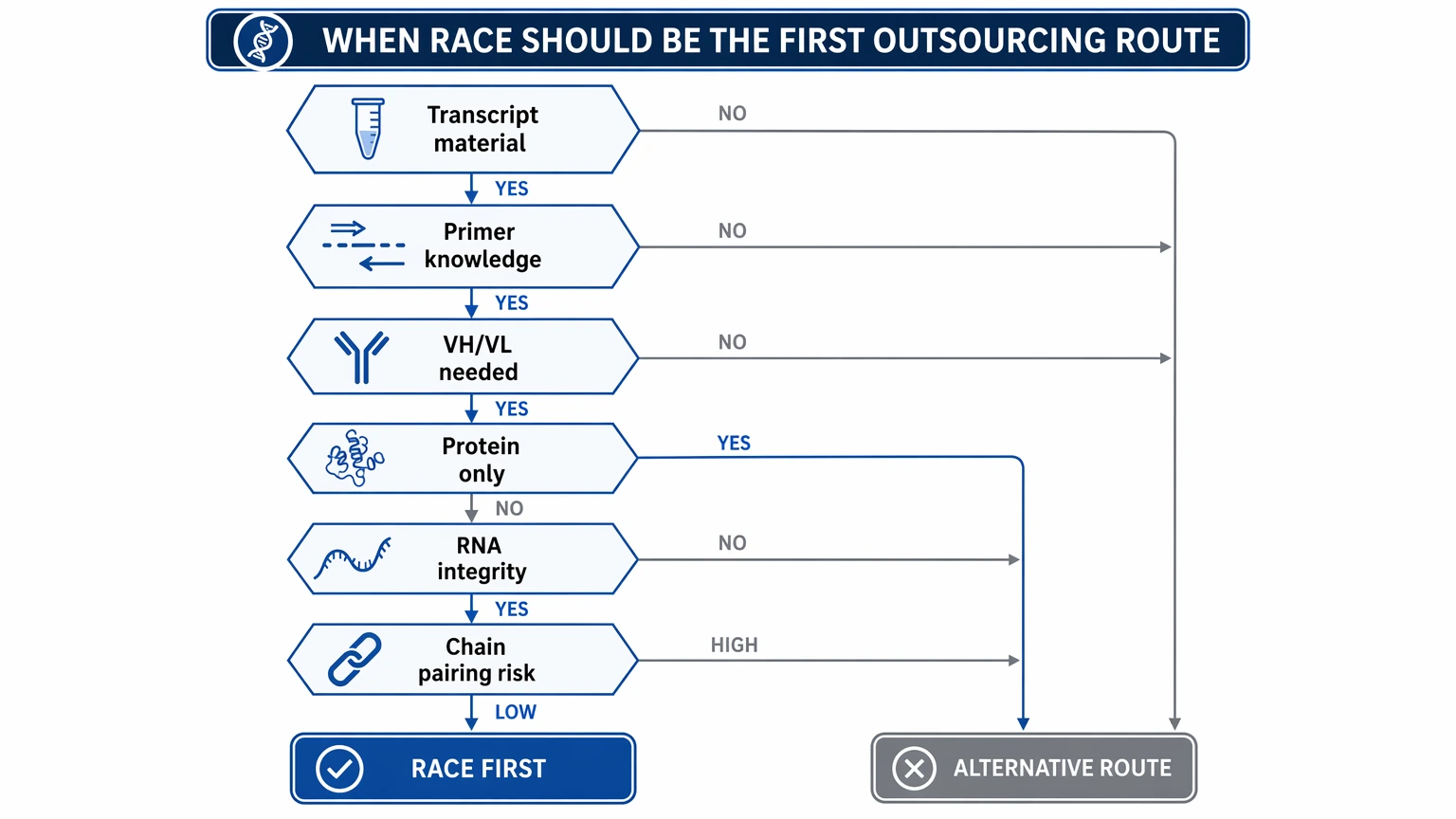
That judgment matters most for unstable hybridoma assets, limited cryovial inventories, legacy antibodies with missing sequence records, and rebuild programs that need a technically credible path into sequence validation and recombinant reconstruction. If that matches your project context, organize the sample facts, define the expected deliverable, and contact us to discuss the study, evaluate your project, and decide whether RACE is the right first move before outsourcing.
FAQ
How much sequence certainty is enough before starting recombinant re-expression?
For planning purposes, teams usually want chain-specific VH and VL candidates with readable frameworks, defined CDR boundaries, and Sanger confirmation on prioritized sequences. If multiple candidates remain unresolved, additional validation may be more prudent before vector design.
Does RACE work well from archived RNA, or is fresh material usually required?
Archived RNA can still support RACE antibody sequencing if degradation is limited and the antibody transcript remains recoverable. The real issue is not whether the RNA is fresh, but whether it still supports informative cDNA synthesis and specific amplification.
Why can a hybridoma yield more than one light-chain candidate?
Some hybridoma lines express extra transcripts that are not the final functional VL. Mixed populations, background expression, or an aberrant transcript can all produce extra candidates, so multiple VL reads should be treated as an interpretation issue rather than an automatic project failure.
If I only need CDR information, should I still ask for full chain recovery?
Often yes, because partial reads can be harder to interpret on their own. Even when the immediate question centers on CDR content, broader VH/VL context can help distinguish a true productive transcript from misleading sequence artifacts.
What is the biggest warning sign that RACE should not be the lead method?
The clearest warning sign is the absence of usable cell-derived material. If the project no longer has viable cells, a pellet with recoverable RNA, extracted RNA, or workable cDNA, RACE is unlikely to be the most defensible starting route.
Can a team outsource RACE first and keep a backup method in reserve?
Yes. That is often a sensible choice when material is scarce but not completely exhausted. A RACE-first plan can be paired with a predefined fallback, such as LC-MS/MS antibody sequencing, if transcript recovery does not produce a credible full-length variable-region sequence.
How to order?




