






Protein Disulfide Bond Formation Identification Service
Protein disulfide bond formation identification based on mass spectrometry is a critical method for studying protein integrity and stability. Disulfide bonds, formed by oxidation of cysteine thiols, are covalent linkages widely present in tertiary and quaternary protein structures. They ensure correct folding and stabilize higher-order conformations essential for normal function. Disruption or mispairing of disulfide bonds can alter activity, leading to dysfunction or disease.
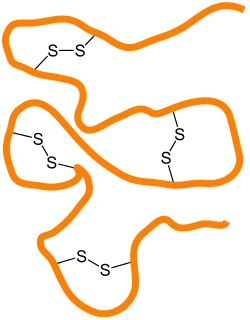
Figure 1. Disulfide Bonds in Proteins
As structural modifications, disulfide bonds are also critical quality attributes (CQAs) in biopharmaceuticals. According to ICH Q6B guidelines, the number and position of disulfide bonds and free thiols must be well defined. Accurate identification and mapping support studies of protein folding, quality control in biopharma, disease mechanism research, and new drug development. MtoZ Biolabs delivers high-sensitivity Protein Disulfide Bond Formation Identification Service using Thermo Fisher Q Exactive HF, Orbitrap Fusion, and Orbitrap Fusion Lumos mass spectrometers with Nano-LC systems. Our service supports projects from fundamental research to applied development.
Analysis Workflow
1. Sample Preparation: Alkylation and deglycosylation to reduce interference.
2. Enzymatic Digestion: Non-reducing proteolysis (trypsin, Glu-C) to maintain disulfide integrity.
3. LC-MS/MS Detection: High-resolution MS to analyze intact disulfide-linked peptides.
4. Data Analysis and Reporting: Automated workflows to map sites and linkage patterns.
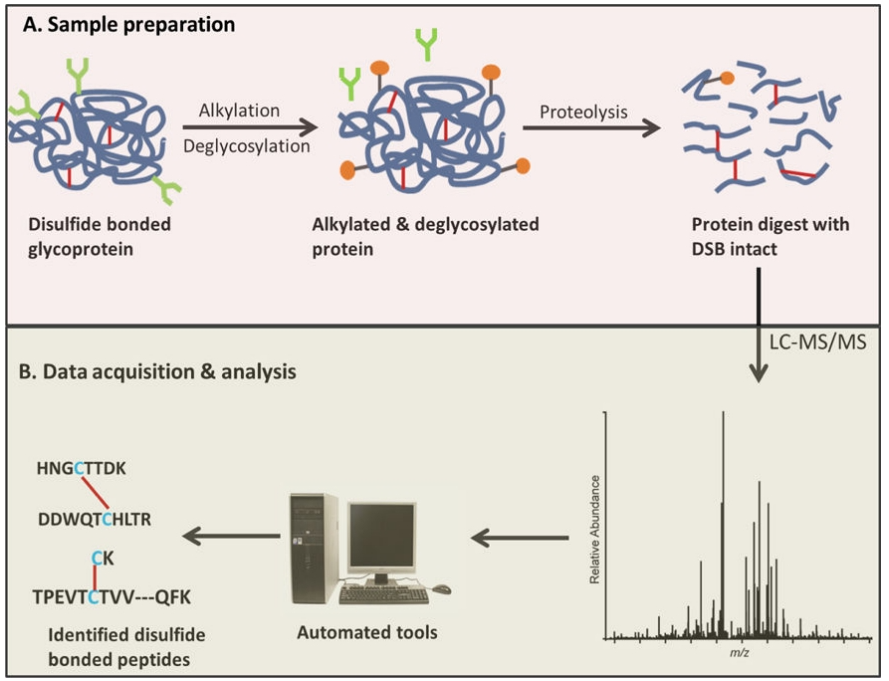
Lakbub, J. C. et al. Anal Bioanal Chem. 2018.
Figure 2. Disulfide Bond Analysis Workflow
Why Choose MtoZ Biolabs?
✅ Advanced Mass Spectrometry Platforms: Orbitrap series combined with Nano-LC enables high-resolution and high-accuracy identification.
✅ High Sensitivity and Reliability: Optimized sample preparation and non-reducing digestion strategies minimize false positives and enhance coverage.
✅ Comprehensive Disulfide Bond Detection: Capable of identifying conventional, adjacent, and mismatched disulfide linkages in complex structures.
✅ Broad Sample Applicability: Suitable for cells, tissues, purified proteins, recombinant proteins, and biopharmaceutical products.
✅ High-Throughput Analysis: Parallel processing supports large-scale research and quality control studies.
Sample Submission Suggestions
· Cells: ≥1×10⁷ cells
· Microbes: >200 mg dry weight
· Tissues: >1 g animal tissue; >200 mg plant tissue
· Biofluids: >1 mL blood; >0.2 mL serum; >2 mL urine
· Protein solutions: ≥50 μg with ≥80% purity; ≥1 mg with ≥1 μg/μL for mixtures
· Storage: Store at –80°C, ship on dry ice, avoid freeze-thaw cycles
Note: Provide details on sample collection and handling. If you need further details, our technical support team is happy to assist and provide comprehensive guidance on sample submission.
What Could be Included in the Report?
1. Detailed experimental records
2. Materials, instruments, and methods
3. High-quality spectra and visualized charts
4. Site mapping and linkage analysis
5. Bioinformatics interpretation
6. Raw data files
MtoZ Biolabs Protein Disulfide Bond Formation Identification Service provides high-confidence data to map disulfide bonds, verify folding and stability, and evaluate their roles in structural biology, disease mechanisms, and drug development. With advanced platforms and an expert team, we help researchers clarify structure–function relationships and provide essential references for quality control and therapeutic design.
In addition to disulfide bond analysis, MtoZ Biolabs offers comprehensive PTM profiling services including phosphorylation, acetylation, methylation, ubiquitination, SUMOylation, and glycosylation. Contact us today to accelerate your PTM research and drive both scientific and industrial success.
Related Services
Disulfide Bond Analysis Service
Protein Disulfide Bonds Identification and Quantitative Analysis Service
How to order?




