






Polyclonal Antibody Sequencing: How to Assess Feasibility for Mixed or Complex Samples
A mixed or complex sample is a realistic candidate for polyclonal antibody sequencing only when the sequencing goal lines up with what is actually in the sample. If the material contains a dominant species and yields informative complementarity-determining region (CDR) peptides, de novo sequencing by LC-MS/MS can support dominant-sequence reconstruction. If the sample contains many related antibodies at similar abundance, the more defensible outcome is partial variable region recovery or peptide-level characterization.
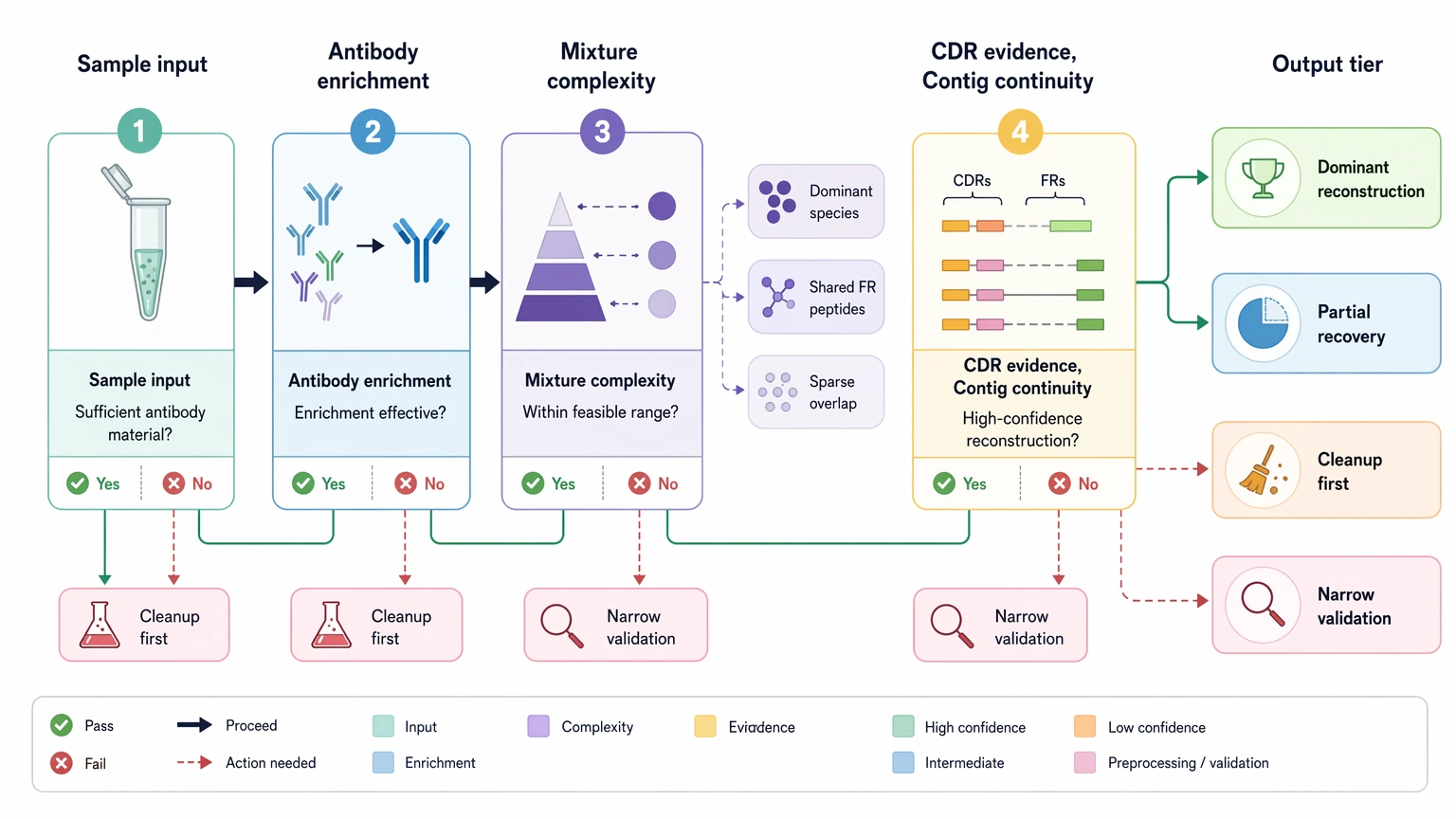
Before work begins, it helps to define success as an output tier rather than a simple yes-or-no call. The most useful early checks are usually antibody enrichment, mixture complexity, CDR peptide evidence, and the level of continuity required for contig assembly. When those signals are weak, cleanup, enrichment, or a narrower validation plan is often a better choice than trying to support a full-sequence claim from ambiguous mixed-sample data.
Quick feasibility decision block
- Proceed toward sequence reconstruction when the sample is antibody-enriched, shows a plausible dominant species, and produces overlapping CDR-containing peptides.
- Proceed with a narrower scope when antibody signal is strong but the heterogeneous mixture limits clone-level interpretation.
- Change sample strategy first when background proteins, glycosylation heterogeneity, or sparse unique peptides prevent useful sequence coverage.
- Key limitation: in mixed antibody samples, tandem mass spectrometry data can support peptide evidence and partial reconstruction, but they do not automatically prove complete clonotype resolution or direct heavy chain/light chain pairing.
Where This Problem Usually Appears
This question usually comes up when a team has antibody-containing material but no reliable sequence record. Common examples include historical antisera, affinity-purified polyclonal reagents, serum-derived fractions, and legacy stocks passed between groups without clone documentation. The reagent may still bind its target, but redevelopment, reproducibility review, or IP clarification now requires sequence information that was never captured.
The warning signs often show up before deep sequencing starts. Intact mass analysis may show broad heterogeneity instead of one dominant mass pattern. In bottom-up proteomics, many peptides may map to shared immunoglobulin framework region (FR) sequence, while CDR-containing peptides stay weak, modified, or absent after a single proteolytic digest. A peptide-spectrum match workflow may return partial immunoglobulin hits, but those hits can miss novel variable-region content or blur differences among related clonotypes.
So the real decision is not whether the sample is “sequenceable.” The more useful question is whether the sample can support the level of sequence confidence the project actually needs.
Why Feasibility Breaks Down in Mixed Samples
For this topic, four cause categories usually shape the outcome.
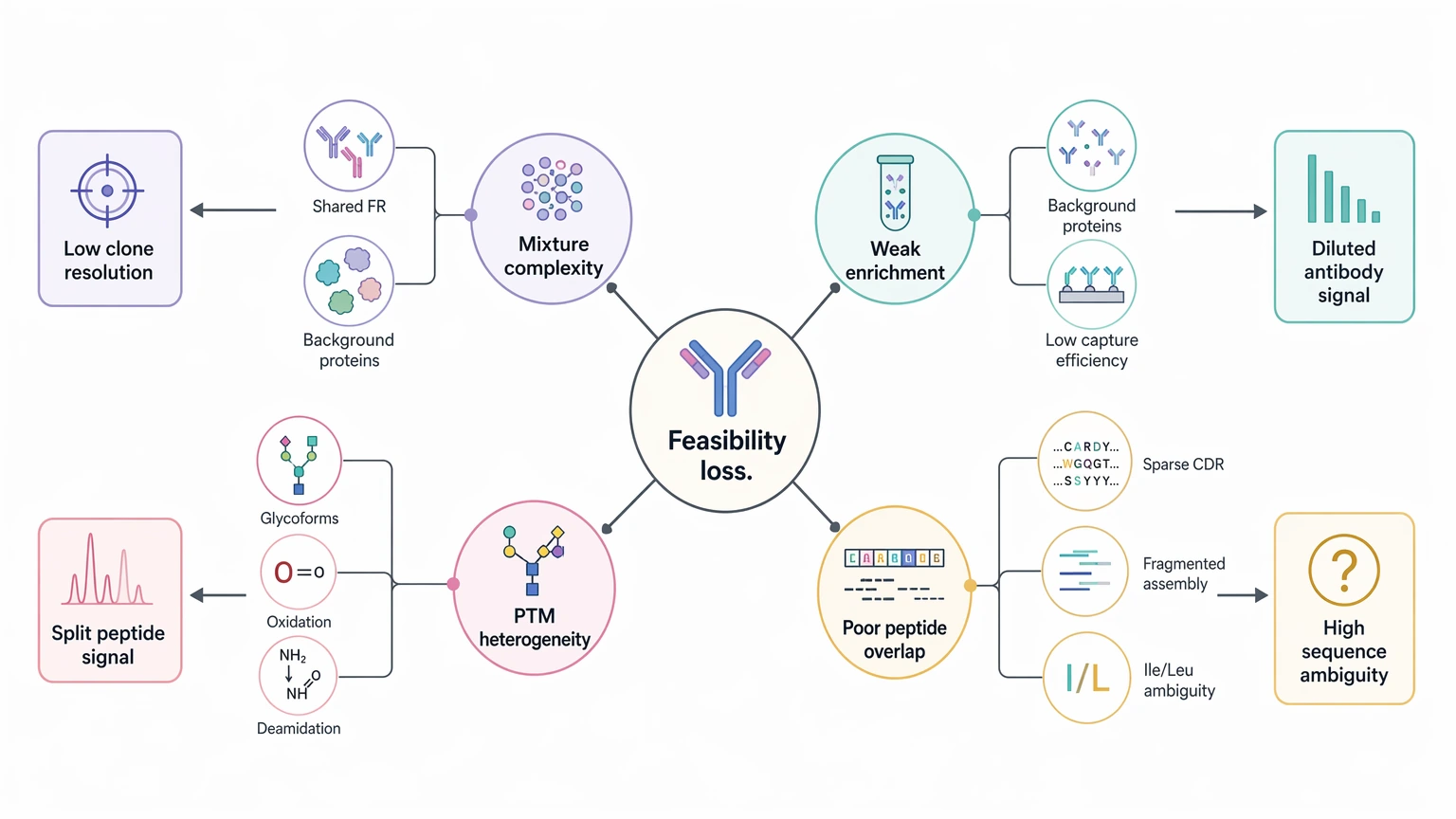
1. Mixture complexity hides clonotype-specific information
A polyclonal preparation contains multiple related antibodies rather than one defined molecule. Shared FR peptides accumulate quickly, but they rarely resolve individual clonotype structure. If abundance is distributed across many species, local sequence calls may still be possible while global assembly stays fragmented.
2. Weak enrichment dilutes antibody-derived signal
Serum proteins, albumin, host proteins, and formulation components can dominate spectra and suppress informative antibody peptides. Even strong MS/MS data become much less useful when too few scans come from the antibody population of interest.
3. PTM heterogeneity reduces interpretability
Glycosylation, oxidation, deamidation, pyroglutamate formation, and incomplete disulfide reduction and alkylation can split signal across multiple peptide forms. Low-abundance CDR peptides are usually hit first, and overall sequence confidence drops with them.
4. Poor peptide overlap limits assembly
Useful reconstruction depends on overlapping de novo peptides across the variable region. If digestion produces redundant shared peptides but too few unique overlaps, sequence ambiguity stays high. One limit is worth keeping in view: isoleucine/leucine ambiguity often cannot be resolved by MS evidence alone, so some residue assignments may remain provisional even when the surrounding peptide call looks strong.
A Project-Planning Guide for Feasibility Assessment
Step 1: Define the output tier before choosing the workflow
Teams often combine several different goals into one request. Separate them first:
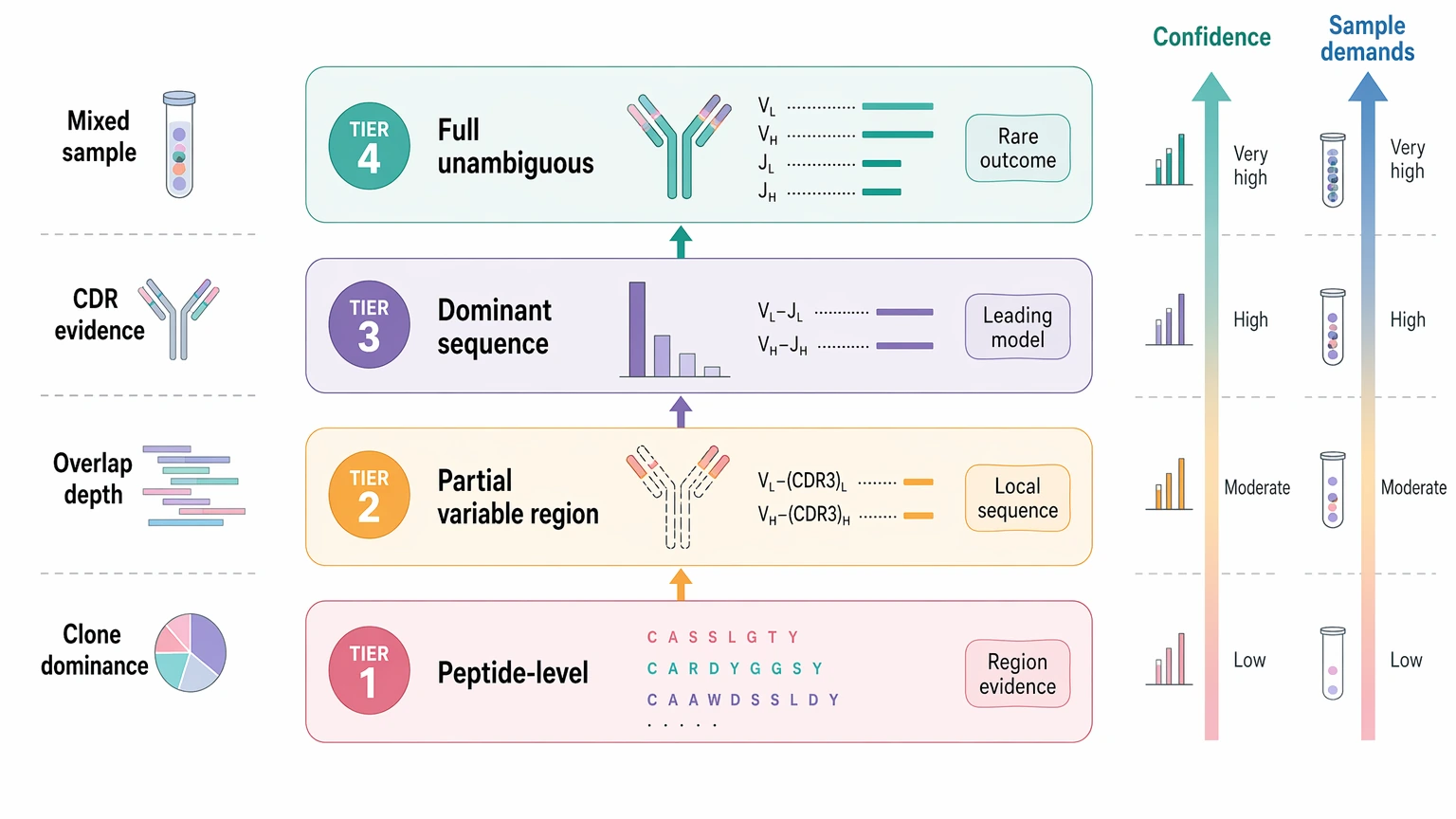
- Peptide-level characterization: confirms antibody-derived content and some region-specific evidence
- Partial variable-region recovery: supports local sequence interpretation, often with limited CDR information
- Dominant-sequence reconstruction: supports a leading sequence model for the most abundant antibody species
- Full unambiguous sequence recovery: uncommon for a broad mixed sample using standard bottom-up data alone
A sample may be good enough for the first or second goal and still be too weak for the third. That distinction should shape both budget and sample use.
Step 2: Triage the sample by source, purity, and expected diversity
The table below links sample type to a realistic starting objective.
Use this triage table to set expectations before deeper analysis.
| Sample type | Best fit | Main constraint | Best next step |
|---|---|---|---|
| Affinity-purified polyclonal material with a visible dominant pattern | Dominant-sequence reconstruction or partial variable-region recovery | Mixed heavy chain and light chain populations may still overlap | Add intact mass analysis and multi-enzyme digestion |
| Antibody-enriched serum fraction | Partial variable-region recovery | Background protein burden remains substantial | Add affinity enrichment or subfractionation |
| Crude serum or antiserum | Peptide-level characterization first | Severe non-antibody interference | Purify immunoglobulins before LC-MS/MS |
| Formulated legacy reagent | Partial recovery if antibody integrity is preserved | Excipients and PTM dispersion complicate interpretation | Desalt, assess heterogeneity, then redesign digestion |
| Highly diverse immune mixture with no dominant signal | Limited characterization | High peptide redundancy and poor assembly continuity | Narrow the goal or isolate a smaller fraction |
The main point is straightforward: highly diverse, weakly enriched material usually benefits more from sample refinement than from immediate deep de novo analysis.
Service Routes to Consider
For this project scenario, readers usually compare these service routes before requesting a quote or submitting samples.
Step 3: Match the workflow to the main bottleneck
One standard antibody workflow does not fit every mixed sample. The design should follow the dominant failure mode.
| Scenario | Recommended workflow | Main limitation | Follow-up check |
|---|---|---|---|
| Good enrichment, moderate heterogeneity | Bottom-up proteomics with multi-enzyme digestion plus de novo sequencing | Direct heavy chain/light chain pairing remains unresolved | Targeted LC-MS/MS on key peptides |
| Broad glycoform dispersion | Intact mass analysis plus subunit analysis before deep peptide work | Mass heterogeneity can still obscure sequence continuity | Compare native and deglycosylation states |
| Weak CDR peptide yield after one digest | Expand digestion design and optimize reduction/alkylation | Added sample consumption and analysis complexity | Reacquire CDR-rich fractions |
| High serum background | Affinity enrichment before LC-MS/MS | Some non-antibody carryover may persist | Compare pre- and post-enrichment profiles |
| Ambiguous assembly despite good spectra | Combine de novo interpretation with cautious sequence-context support | Homologous immunoglobulin regions can overfit | Validate unresolved sites orthogonally |
This workflow choice also sets expectations for what database tools can and cannot do. Database support is useful for context, but a major database-search limitation here is that shared immunoglobulin regions can inflate apparent confidence without resolving unknown or novel CDR sequence.
Step 4: Improve the chance of informative CDR recovery
For complex samples, the project often rises or falls on whether unique CDR peptides can be recovered and connected by overlap. Practical levers include:
- stronger affinity enrichment
- cleaner buffer conditions
- careful disulfide reduction and alkylation
- selective deglycosylation
- multi-enzyme digestion
- fractionation or subunit analysis to reduce spectral crowding
If your decision hinges on whether a sample can support dominant-sequence reconstruction or only partial recovery, you can submit your requirements to MtoZ Biolabs and evaluate your project against available workflows, sample constraints, and likely reporting boundaries before committing scarce material to a broad sequencing run.
Step 5: Choose one of three action paths
After triage, workflow matching, and CDR planning, most projects land in one of three paths:
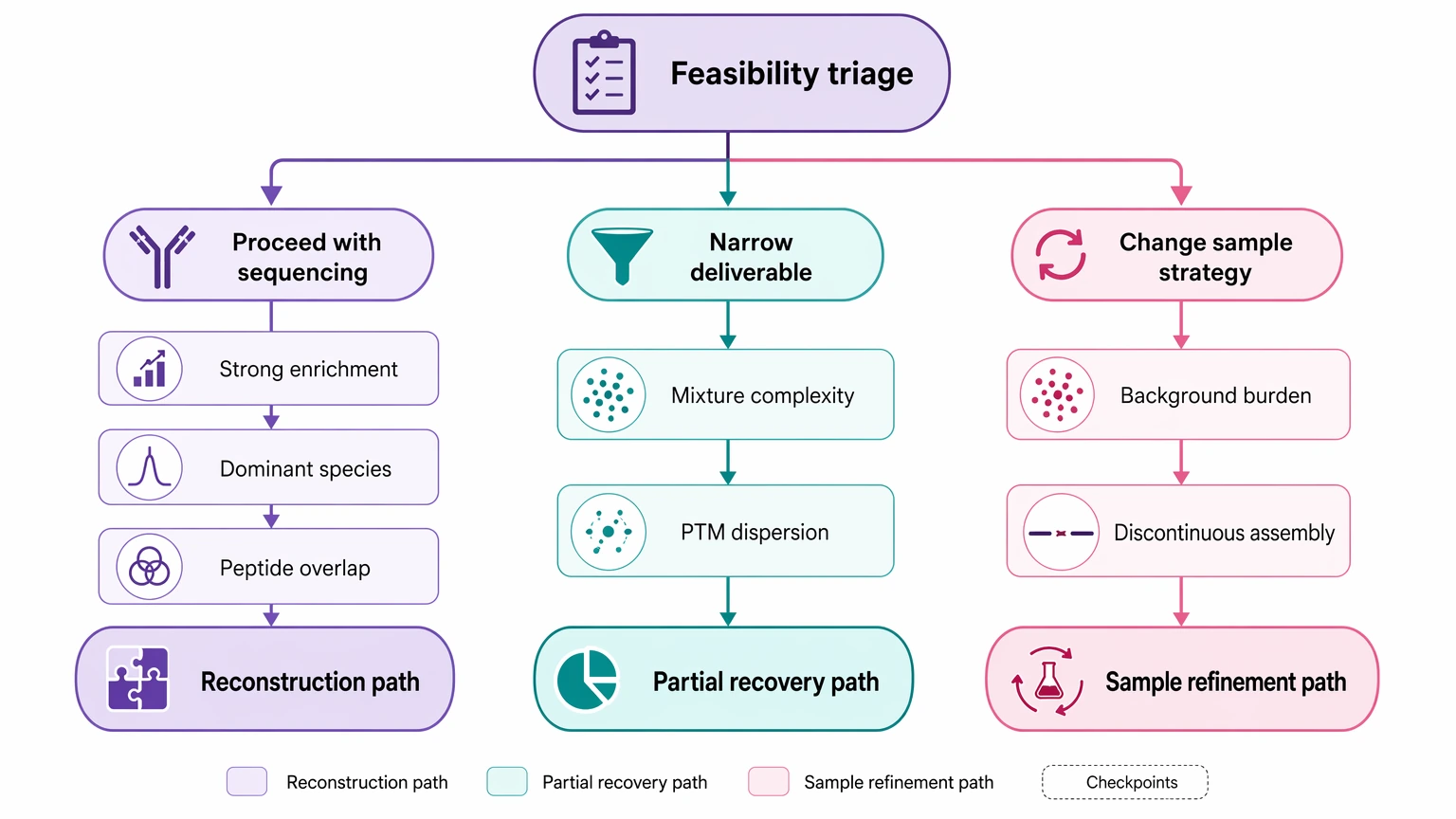
- Proceed with sequencing when enrichment is strong, a dominant species is plausible, and peptide overlap can support useful assembly.
- Proceed with a narrowed deliverable when antibody signal is present but mixture complexity limits high-confidence reconstruction.
- Change sample strategy first when background burden, PTM dispersion, or discontinuous assembly makes interpretation too weak to support the project goal.
Expected Results and Validation Methods
A well-matched workflow usually improves interpretability before it improves completeness. Early progress often shows up as cleaner antibody-derived spectra, better fragmentation of informative peptides, and more continuous local overlap across the variable region.
Immediate deliverables from a mixed-sample project may include:
- peptide lists with de novo assignments
- mapped evidence across constant region and variable region segments
- candidate CDR-containing peptides
- a summary of sequence coverage, ambiguity hotspots, and assembly continuity
- a bounded statement about whether dominant-sequence reconstruction is supported
Those deliverables are not the same as final confirmation. Follow-up confirmation should test the parts of the interpretation that matter most downstream. Suitable orthogonal validation options include targeted LC-MS/MS for candidate peptides, comparison of reconstructed components with intact mass analysis or subunit analysis, and recombinant verification after candidate sequence generation. When ambiguity remains, the report should state exactly where it remains and why.
Key Cautions and Practical Limits
Sample quality still sets the ceiling. Low concentration, heavy contamination, degraded material, or very limited sample amount can restrict how many digestion conditions or repeat measurements are realistic. A scarce sample may support a focused validation question but not a broad reconstruction campaign.
Controls and repeat expectations should be defined before launch. Process blanks, digestion controls, and technical repeat acquisitions help separate reproducible antibody signal from carryover or stochastic low-abundance events. In mixed materials, one weak CDR observation is usually not enough to support a high-confidence sequence claim.
Batch effects and contamination risk matter even more when informative peptides are already rare. Keratins, residual affinity ligands, serum carryover, or excipients can distort peptide ranking and assembly logic. It is much easier to manage that risk early than to explain it after interpretation.
Interpretation also has hard boundaries. Shared FR peptides do not establish unique clonotype identity. Standard bottom-up data do not directly solve heavy chain/light chain pairing in a heterogeneous mixture. MS/MS interpretation can remain uncertain around modified residues, closely homologous sequence segments, and isoleucine/leucine positions.
Another method may be the better next step when the real need is direct clone isolation, definitive chain pairing, or confirmation of a small number of candidate regions rather than broad exploratory reconstruction. In those cases, further enrichment, narrower fractionation, targeted validation, or outside support for a redesigned workflow may save time compared with extending a low-yield de novo project.
Conclusion
For mixed antibody materials, feasibility is best judged by the type of sequence claim the sample can support, not by whether a sequencing workflow can be started at all. Antibody enrichment, clonotype distribution, CDR peptide evidence, PTM burden, and assembly continuity together shape whether the likely outcome is dominant-sequence reconstruction, partial variable-region recovery, or limited peptide-level characterization.
This planning framework fits legacy antisera, affinity-purified polyclonal reagents, serum-derived fractions, and redevelopment programs with missing sequence records. If you need to narrow the goal, compare workflow options, or map a validation plan around the likely deliverable, contact us at MtoZ Biolabs to review the sample context, sequence-confidence limits, and the most defensible next step for the project.
FAQ
Can partial sequence recovery still be useful if full reconstruction is not possible?
Yes. Partial recovery can still support reagent comparison, redevelopment triage, epitope-related follow-up, or candidate-region validation, especially when the main question is whether the sample contains a recoverable dominant antibody signal.
Should heavy chain and light chain be analyzed together or separately?
If the sample and preparation allow it, separate or subunit-level evidence is often easier to interpret. In highly mixed material, combined bottom-up data can confirm antibody-derived peptides without resolving which heavy chain pairs with which light chain.
When is deglycosylation worth adding to the plan?
It is most useful when intact or peptide data suggest broad glycoform dispersion, missing coverage near glycosylated regions, or signal splitting across modified peptide forms. It is less useful when the main limitation is severe non-antibody background.
What is the biggest sign that a project goal is too ambitious?
A common sign is strong immunoglobulin identification with very little unique variable-region overlap. That pattern often means the sample supports identity-level or region-level evidence but not confident clonotype reconstruction.
Can a highly heterogeneous sample still justify de novo sequencing?
Sometimes, yes, if the goal is limited and explicit. For example, the project may still justify de novo work when the team needs dominant peptide evidence, partial CDR recovery, or a feasibility readout for later purification rather than a full sequence claim.
What information should be prepared for a feasibility review?
Prepare the sample origin, purification history, buffer or excipient details, estimated amount and concentration, any SDS-PAGE or intact-mass observations, and a clear statement of whether you need peptide evidence, partial reconstruction, or a dominant-sequence model.
How to order?




