






PEAKS De Novo Sequencing: When Software-Centered Analysis Is Enough and When Expert Review Still Matters
PEAKS de novo sequencing is often enough when the LC-MS/MS data include a clean tandem mass spectrum, continuous fragment ion series, stable local confidence across most residues, and only limited post-translational modification (PTM) ambiguity. It is usually not enough on its own when the sequence call relies on broken ion ladders, poor precursor isolation purity, co-fragmentation, modification-heavy interpretation, or a residue-level assignment that will drive an expensive downstream decision.
Quick decision block
- Use PEAKS-centered analysis alone when the MS/MS spectrum is clean, the sequence tag is well supported by b ions and y ions, and the result will be used for exploratory or lower-risk decisions.
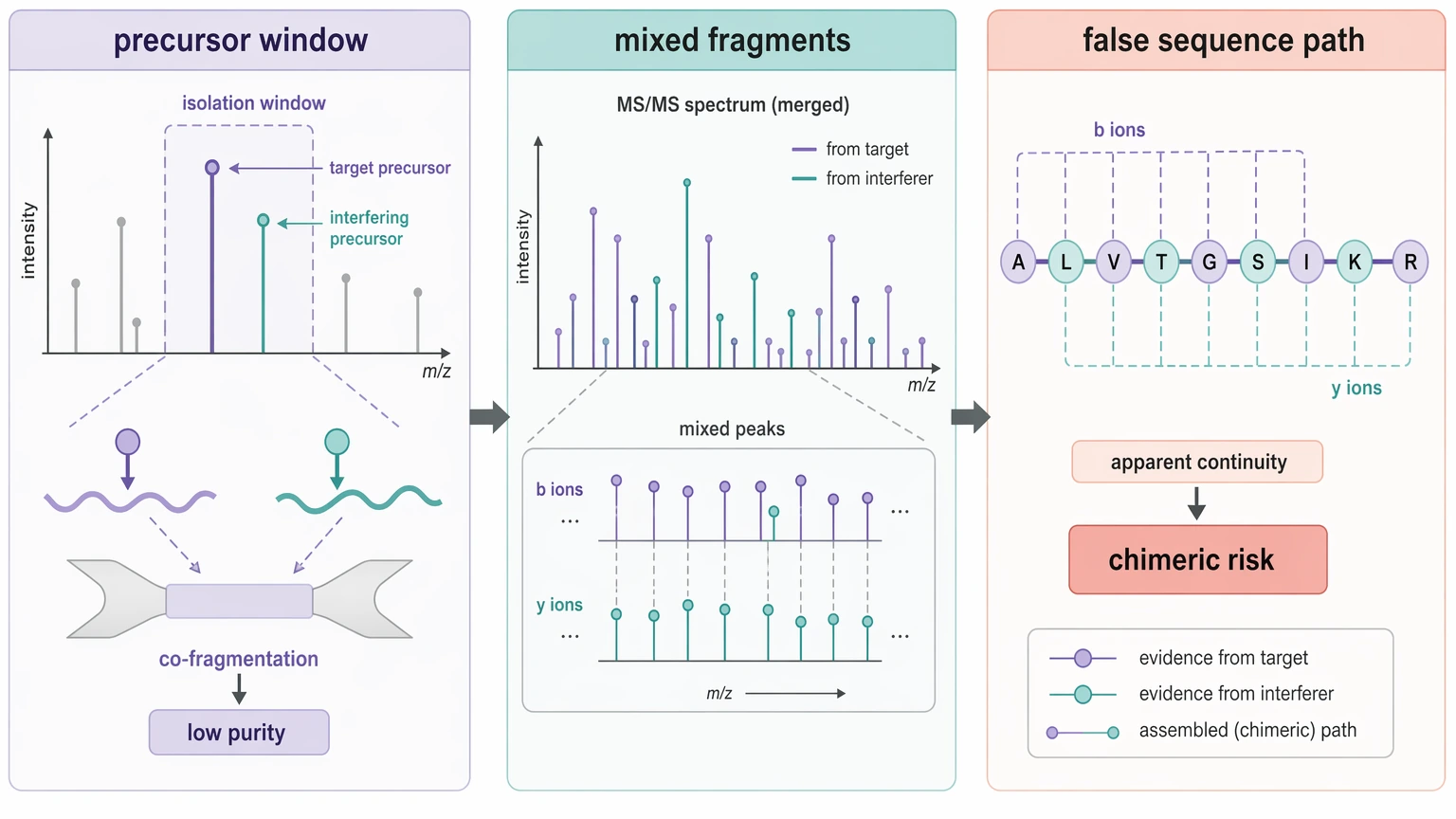
- Add manual spectrum review when local confidence changes sharply by residue, internal gaps appear, or the spectrum shows chimeric spectrum risk.
- Add orthogonal validation when PTM localization, isobaric residue ambiguity, or a novel peptide claim could change reporting, synthesis, or follow-up experiments.
- Key limitation: even a strong de novo output does not always resolve every residue, and standard MS/MS alone may leave leucine/isoleucine or PTM localization uncertainty in place.
In practice, the real issue is not whether PEAKS produced a candidate sequence. It is whether the fragment evidence behind that sequence is strong enough for the way the result will actually be used.
Where Teams Usually Get Stuck
The hard part usually starts after the software run. A core facility or proteomics team has already processed an unknown peptide or partially characterized protein by LC-MS/MS, and PEAKS de novo sequencing has returned one or more candidate sequences with Average Local Confidence (ALC) values and possible PTMs. The report looks usable, but the reporting boundary is still not obvious.
That uncertainty matters more in a few common situations:
- an impurity or degradation product needs sequence clarification before process decisions are made
- a novel peptide or unknown peptide has no database support
- a short sequence tag fits more than one plausible interpretation
- a modified peptide appears important, but PTM localization remains unsettled
- a facility has to decide whether to release the software result directly or escalate to manual spectrum review
In those cases, a “probably right” sequence can help with triage but still fall short of formal sequence confirmation.
Why PEAKS-Only Results Can Look More Certain Than They Are
For this decision, four cause categories matter most.
1. A strong summary score can hide weak local evidence
ALC is useful, but it is still a summary. A peptide can show a favorable overall score while several residues have low local confidence, sparse fragment coverage, or unsupported mass jumps. Operationally, the key question is not just the peptide-level value. It is whether the full sequence path is supported across the tandem mass spectrum.
2. Precursor isolation purity can undermine the whole interpretation
Poor precursor isolation purity increases the chance of co-fragmentation and a chimeric spectrum. In that setting, PEAKS may assemble a sequence path that looks coherent even though some assigned fragments come from different precursor ions. When overlapping ion ladders are present, that apparent continuity can be misleading.
3. PTMs increase both sequence ambiguity and localization ambiguity
PTMs change fragment masses and can alter fragmentation behavior. As PTM burden rises, the software has to infer both residue order and PTM localization. Multiple modified sequence paths may explain the same MS/MS spectrum almost equally well. That is why PTM-rich peptides often need more review than unmodified peptides with otherwise similar scores.
4. The consequence of error changes the confirmation standard
A provisional sequence tag may be acceptable for exploratory work. The same evidence may be too weak for final reporting, custom synthesis, therapeutic peptide characterization, or intellectual property review. The more expensive the consequence of a wrong residue call, the less comfortable a software-only interpretation becomes.
How to Choose the Right Interpretation Depth
The most practical way to use PEAKS de novo sequencing is to treat it as a decision tool with clear boundaries, not as an automatic final answer.
Before the table below, ask one simple question: Would a disputed residue, PTM site, or alternate sequence path change what the team does next? If yes, the project is already much closer to expert-reviewed confirmation.
<div class="article-table-wrap" style="overflow-x:auto;margin:16px 0 20px 0;">
| Scenario | Recommended workflow | Key limitation | Validation need |
|---|---|---|---|
| Clean MS/MS spectrum with continuous b ions and y ions | PEAKS-centered analysis is often reasonable | Isobaric residue ambiguity may remain | Confirm that the project can tolerate that ambiguity |
| Short unknown peptide with one weak internal region | PEAKS plus manual spectrum review | Sequence tag may fit multiple candidates | Check replicates or related precursors |
| PTM-rich peptide with unstable PTM localization | PEAKS plus expert review | Modification placement may alter sequence logic | Add orthogonal validation for the modified site |
| Low precursor isolation purity or visible co-fragmentation | Re-acquire data or escalate | Chimeric spectrum risk can create false ladders | Review isolation and compare adjacent precursors |
| Novel peptide claim without database support | Expert-reviewed de novo peptide sequencing workflow | Database-search limitation removes an external check | Use intact mass, replicates, and targeted follow-up |
The table works best when spectrum quality and reporting risk are considered together. A spectrum that is acceptable for internal screening may still be too ambiguous to release as a confirmed sequence.
A Step-by-Step Method-Selection Framework
Step 1: Define the minimum answer the project needs
Start with intended use. Does the project need:
- a provisional sequence tag for hypothesis generation
- a working peptide assignment for internal screening
- residue-level sequence confirmation for reporting or synthesis
- confident PTM localization tied to a biological or manufacturing decision
If the project only needs a directional lead, software-centered interpretation may be enough. If the project needs residue-level certainty, the bar should be higher from the start.
Service Routes to Consider
For this project scenario, readers usually compare these service routes before requesting a quote or submitting samples.
Step 2: Inspect residue-level evidence, not just the candidate list
A good de novo peptide sequencing result usually shows:
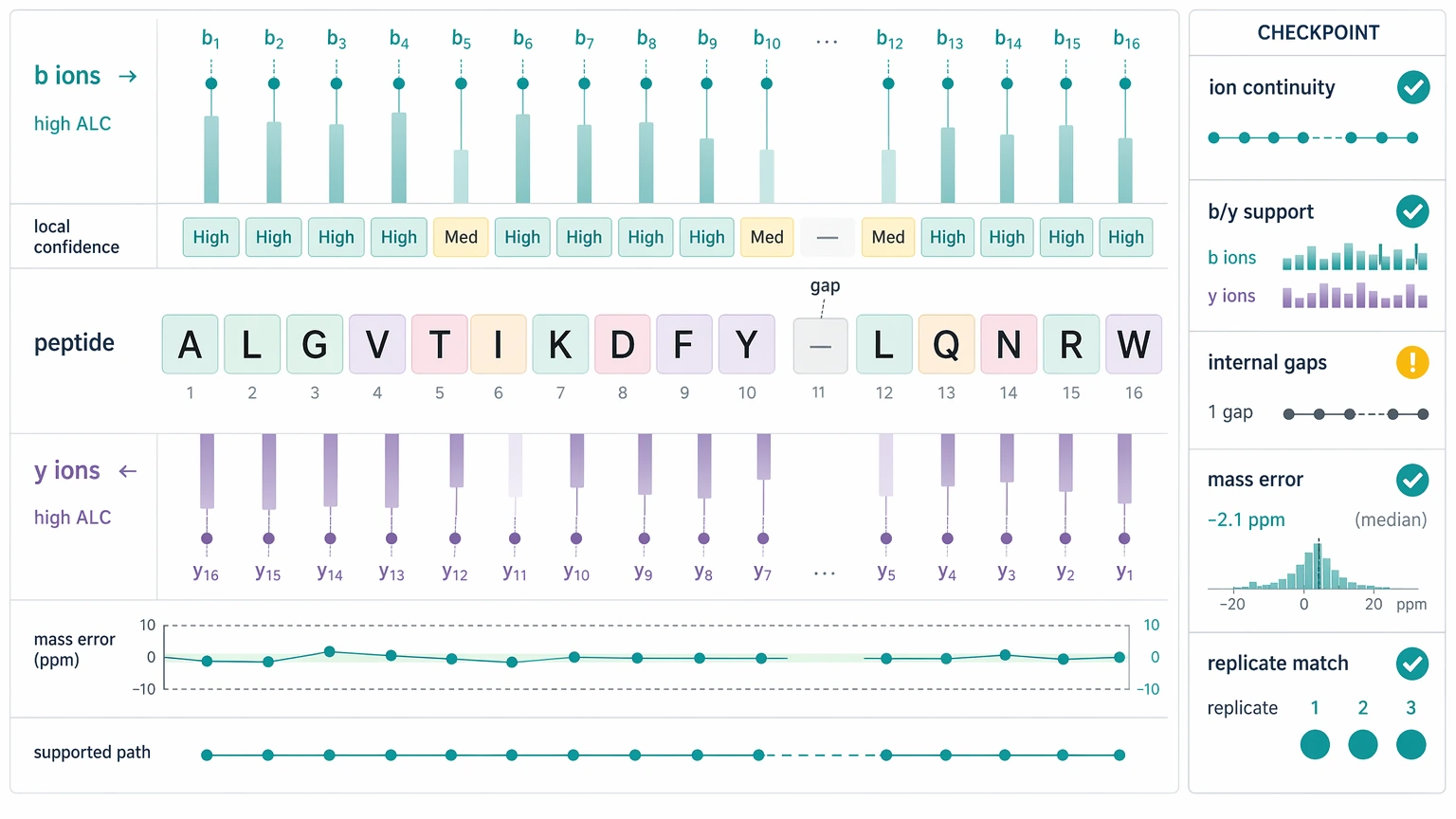
- coherent fragment ion series across most of the sequence
- support from both b ions and y ions
- limited internal gaps or unassigned mass segments
- consistent mass error across assigned fragments
- similar sequence logic across replicate spectra, charge states, or related precursors
When the sequence is built from a strong N-terminal tag, a weak middle region, and an inferred finish, the output is better treated as provisional. That pattern often justifies manual spectrum review before any formal reporting.
Step 3: Look for escalation triggers
Certain features should move the project out of the PEAKS-only comfort zone:
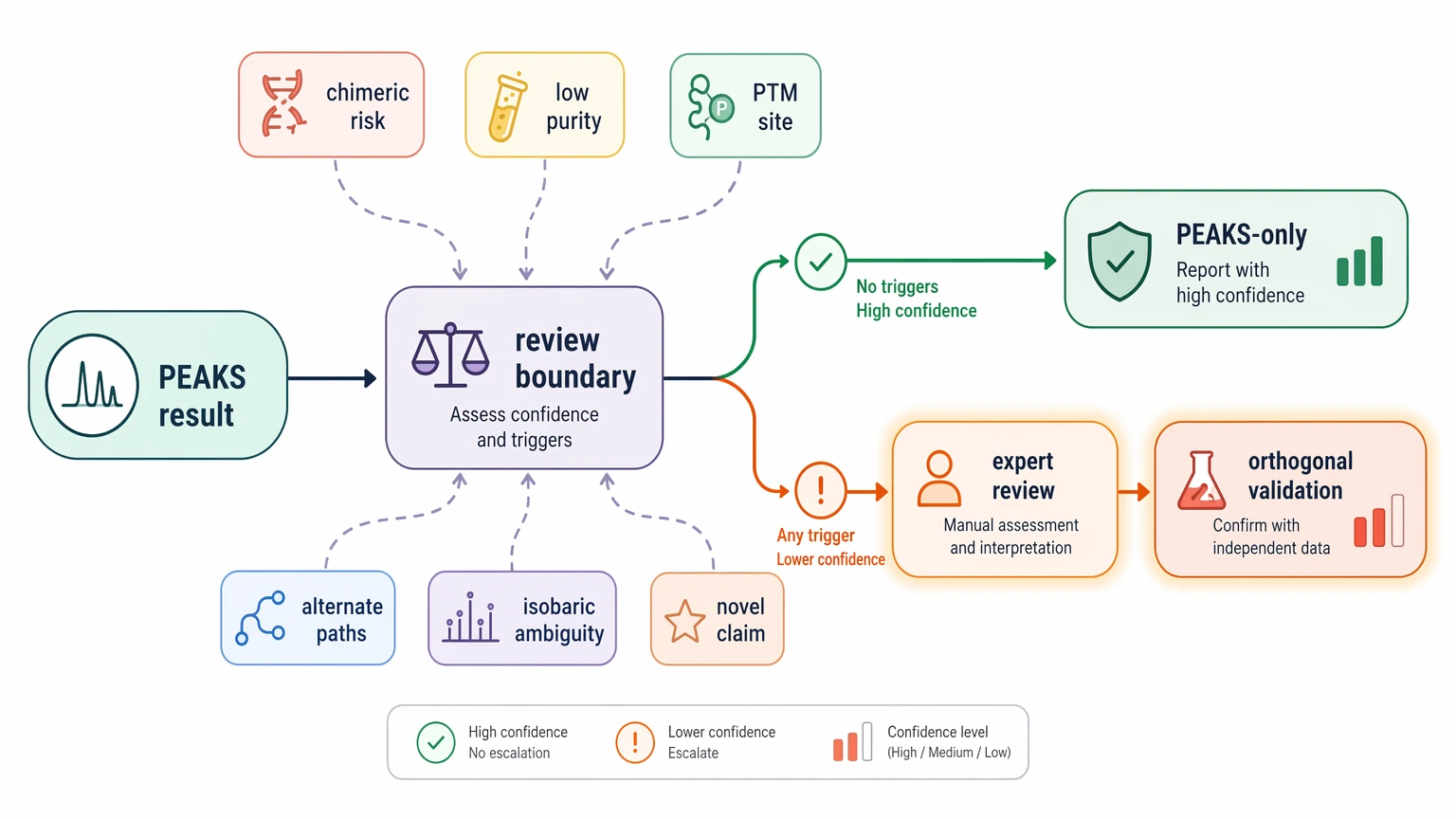
- clear chimeric spectrum risk
- poor precursor isolation purity
- unstable PTM localization
- multiple plausible sequence paths
- unresolved isobaric residue ambiguity
- a novel peptide claim supported only by a short sequence tag
A useful rule is this: if the result looks convincing mainly because the software assembled a plausible path, but the tandem mass spectrum does not directly support each residue, the sequence is not yet decision-ready.
Step 4: Match the review depth to project stakes
Not every ambiguity carries the same weight. A natural product discovery screen may tolerate some sequence ambiguity if the goal is fast triage. A therapeutic peptide or impurity investigation usually cannot. At that point, it makes sense to submit your requirements to MtoZ Biolabs and evaluate your project against the raw LC-MS/MS evidence, the PEAKS output, and the reporting standard you actually need.
Service Routes to Consider
If the main decision is whether to trust the current result or expand the workflow, these service routes are the most relevant next steps:
- De Novo Peptide Sequencing Services
- De Novo Sequencing Mass Spectrometry Service
- LC-MS/MS-Based Targeted Site Validation Service
Step 5: Plan confirmation around the exact uncertainty
The best follow-up is targeted, not broad. Match the confirmation tool to the actual ambiguity:
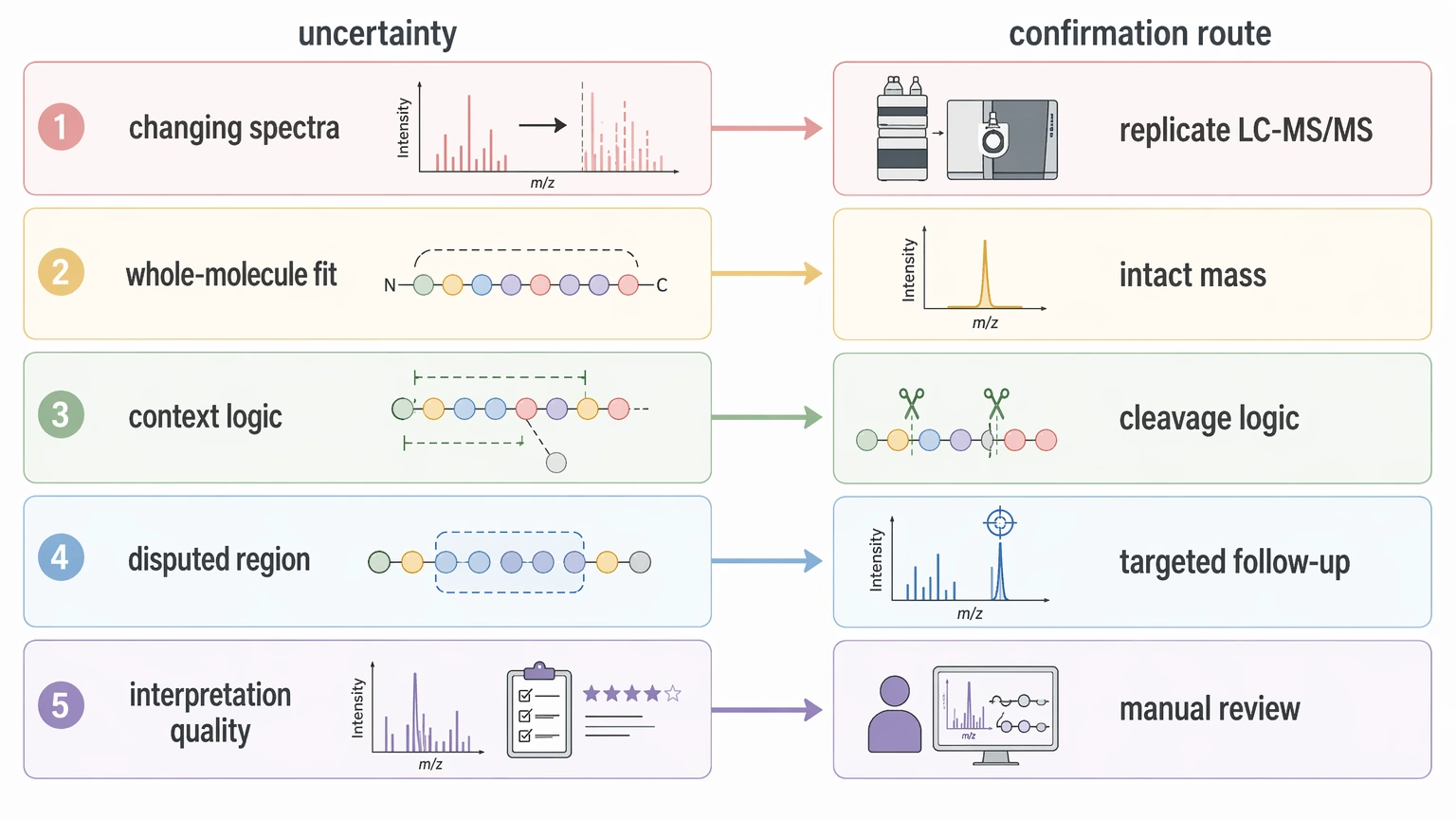
- use replicate LC-MS/MS when the call changes across spectra
- use intact mass concordance when whole-molecule plausibility is in doubt
- use enzymatic cleavage logic when peptide context matters
- use targeted follow-up when one residue region or one PTM site is disputed
- use manual spectrum review when the main problem is interpretation quality, not lack of data
For de novo protein sequencing questions, peptide-level evidence may also need to be placed in a broader sequence framework. In those cases, PEAKS output can still be valuable, but it should not be treated as the whole answer.
Expected Results and Validation Methods
After applying this framework, the first deliverable should be a clearer split between reportable sequence calls and provisional sequence hypotheses.
Immediate deliverables usually include:
- a ranked sequence interpretation with explicit local confidence patterns
- annotation of low-confidence regions rather than a single pooled conclusion
- identification of chimeric spectrum risk, PTM localization uncertainty, or unresolved isobaric residue ambiguity
- a decision on whether the current evidence supports release, expert review, or targeted follow-up
Follow-up confirmation serves a different purpose. It is meant to reduce the exact ambiguity left after interpretation, not to restate the same evidence in another format.
<div class="article-table-wrap" style="overflow-x:auto;margin:16px 0 20px 0;">
| Evidence type | Immediate deliverable | Follow-up confirmation role | Key limitation |
|---|---|---|---|
| High ALC with stable local confidence | Strong sequence plausibility | Supports prioritization for release review | Can still mask local weak spots |
| Continuous b-ion and y-ion support | Residue-order evidence across the sequence | Strengthens confidence in the main path | Does not always resolve isobaric residues |
| Replicate agreement | Reproducible interpretation | Tests whether the same call persists | Repeated bias can still occur |
| Intact mass concordance | Whole-molecule consistency check | Narrows incompatible sequence models | More than one model may fit |
| Targeted site validation | Focused evidence for a disputed region | Supports higher-stakes reporting decisions | Requires extra sample and time |
Use the table cumulatively. No single metric proves complete sequence correctness, especially when PTMs, novel sequence claims, or incomplete fragment ladders are involved.
Key Cautions and Practical Limits
Several practical limits should stay visible throughout the project.
- Sample quality and amount set the ceiling early. Low-abundance material can limit replicate acquisition or targeted validation later.
- Controls and repeat expectations should be defined before release. If the project cannot support repeat spectra, the report should state that limitation clearly.
- Batch effects, contamination, and carryover can distort interpretation. Background fragments may be mistaken for real support, especially in complex or low-level samples.
- Interpretation boundaries should be stated directly. If sequence ambiguity remains, the result may still be useful, but it should not be described as full sequence confirmation.
- Another method may be the better next step. When PEAKS de novo sequencing leaves an unresolved high-impact ambiguity, outside support, broader de novo protein sequencing, targeted validation, or an orthogonal sequencing method may be more efficient than arguing over the same MS/MS spectrum.
Conclusion
PEAKS de novo sequencing is most useful when the tandem mass spectrum supports a clear residue path, local confidence stays stable across the sequence, and the project can work with a bounded interpretation instead of an overclaimed answer. Expert review matters more when co-fragmentation, PTM localization, database-search limitation, or residue-level ambiguity changes what the sequence means in practical terms. For unknown peptide characterization, impurity identification, and other confirmation-sensitive projects, a technical summary of the raw evidence plus a focused validation plan usually leads to faster and more defensible decisions. If that matches your project context, contact MtoZ Biolabs to discuss the sample, raw LC-MS/MS data, and intended use so the team can help evaluate your project and define the right confirmation path.
FAQ
Can a strong sequence tag be enough even if the full peptide is not resolved?
Yes, if the project goal is limited to classification, triage, or narrowing follow-up candidates. It is usually not enough when the missing region affects synthesis, IP review, or a residue-specific claim.
What is the clearest sign that a high ALC should not be trusted alone?
A mismatch between the summary score and the residue-level evidence. If several positions have weak local confidence, missing fragment support, or unexplained mass segments, the overall ALC should be treated cautiously.
When is re-acquisition better than manual spectrum review?
Re-acquisition is often the better first move when the precursor ion selection was poor, co-fragmentation is obvious, or the spectrum is too sparse to support any defensible residue-by-residue interpretation. Manual review cannot recover fragment evidence that was never collected.
Does orthogonal validation always mean a different instrument platform?
No. Orthogonal validation can mean intact mass agreement, a targeted LC-MS/MS check, alternate fragmentation logic, or another chemistry-based constraint. The point is to test the uncertainty from a different angle.
How should a facility phrase a result when confidence is mixed?
State what is supported, what remains ambiguous, and what follow-up would resolve it. That is usually more useful than collapsing the whole interpretation into a yes-or-no call.
How to order?




