






Monoclonal Antibody Sequencing vs De Novo Protein Sequencing: Which Route Fits an Antibody Recovery Project?
Quick decision guide
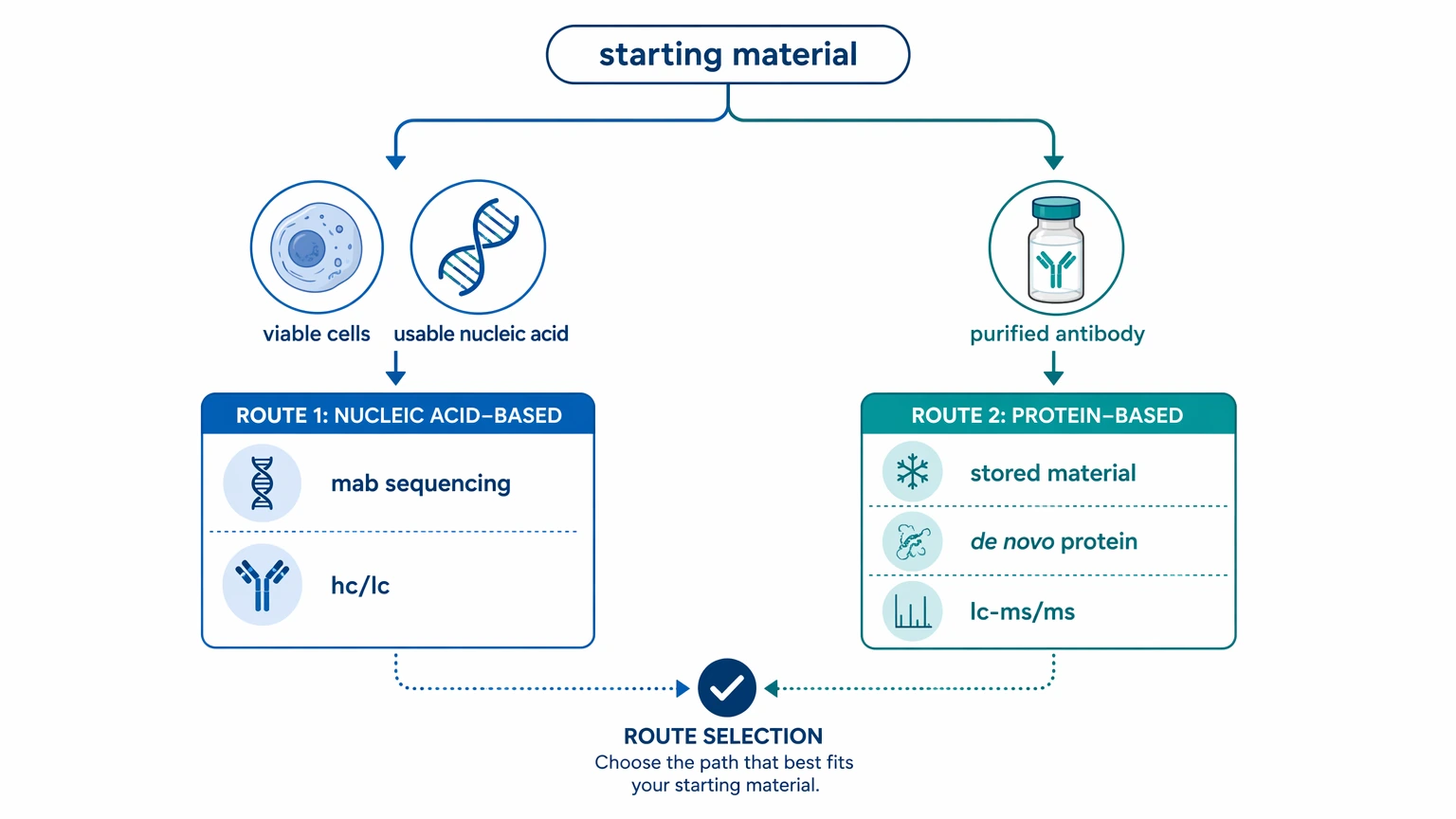
- Start with monoclonal antibody sequencing when you still have viable hybridoma cells or another usable biological source and need rebuild-oriented heavy chain and light chain sequence recovery.
- Start with de novo protein sequencing when the project begins with a purified antibody vial, archived formulated material, or a legacy antibody record that may not match the material in storage.
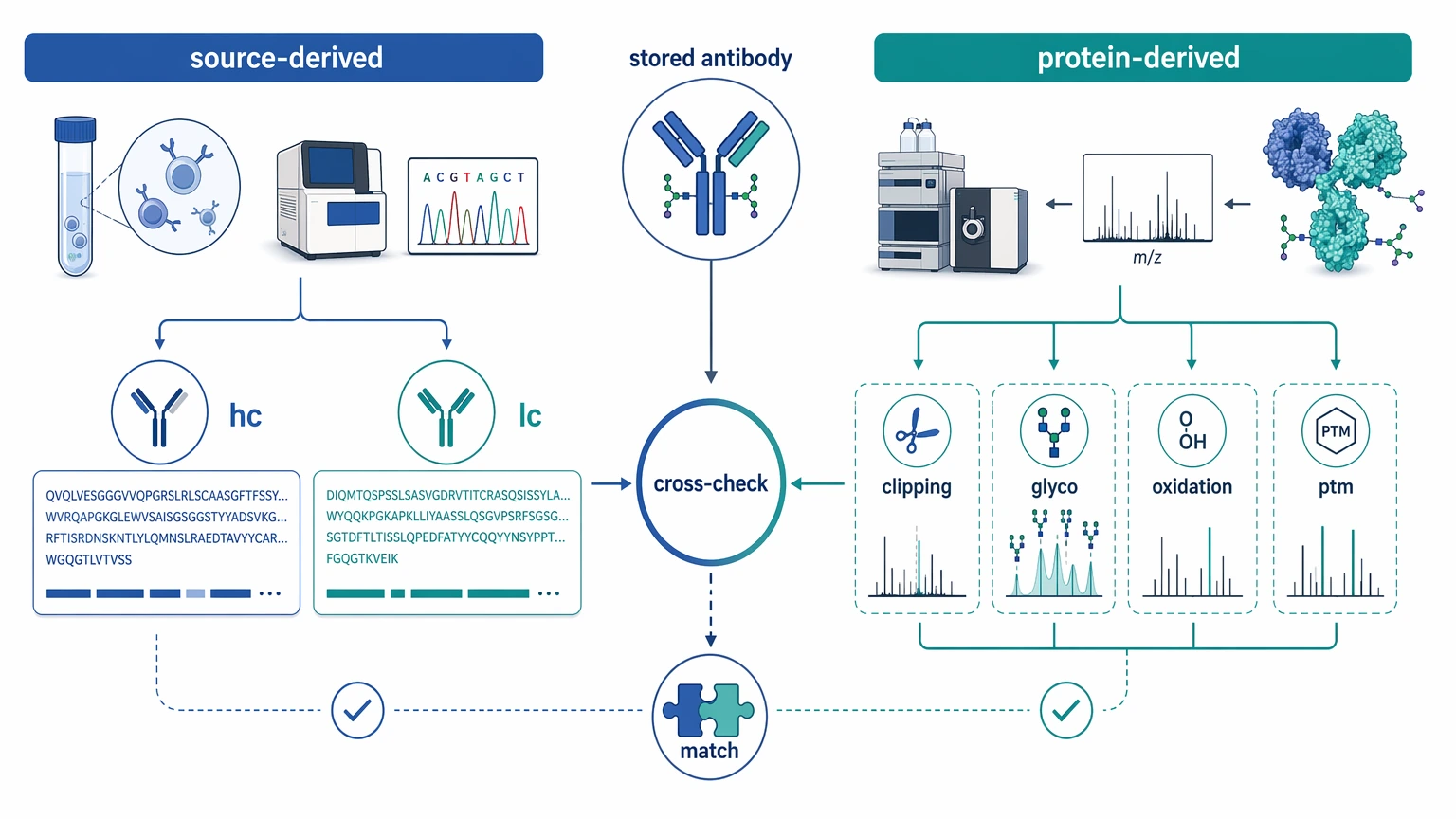
- Use both routes together when the antibody has high redevelopment value, the records are conflicting, or sequence confidence must be strong enough to support recombinant re-expression planning.
In an antibody recovery project, the practical question is not which method sounds more sophisticated. It is which evidence source answers the problem you actually need to solve. If source material is still available, monoclonal antibody sequencing is often the cleaner path to coding-sequence recovery. If only the antibody remains, de novo protein sequencing becomes the route that examines the molecule that is actually in hand today.
That difference matters when teams inherit incomplete records, uncertain heavy/light chain annotations, or archived lots that may have drifted from the original documentation. In those cases, the project goal usually falls into one of three categories: recover a missing sequence, confirm a suspected sequence, or resolve a mismatch between old records and stored material.
Where the Comparison Matters in Real Projects
This choice usually comes up when a legacy antibody becomes relevant again, but the supporting documentation is too thin for a simple handoff. Common starting points include a purified monoclonal antibody with no dependable variable region record, a hybridoma with uncertain viability, a partial FASTA file with questionable chain annotation, or a stored antibody that behaves differently from what the historical records suggest.
For recovery work, the route should track with the main uncertainty. If the missing piece is the original coding sequence, source-based recovery has the advantage. If the real issue is whether the stored antibody still matches the record, protein-derived evidence becomes the more useful starting point.
What Each Route Actually Reads
Monoclonal antibody sequencing
Monoclonal antibody sequencing starts from biological source material, such as hybridoma cells or B-cell-derived nucleic acid. Its main strength is recovery of heavy chain and light chain sequence information in a form that supports construct design and recombinant re-expression. It is often the more direct option when the project needs variable region recovery rather than protein-level confirmation alone.
De novo protein sequencing
De novo protein sequencing infers sequence directly from LC-MS/MS data generated from the antibody sample itself. In practice, this often includes de novo peptide sequencing, sequence tag assembly, database search support, and database-independent interpretation of MS/MS spectra. This route is especially useful when no trustworthy source material remains or when the stored antibody may differ from the legacy antibody record.
One limitation needs to be stated plainly: MS/MS-based reconstruction does not always yield unambiguous residue calls across the full antibody. Leucine/isoleucine ambiguity, incomplete overlap, PTM-related spectral complexity, and chain assignment uncertainty can all reduce confidence in specific regions.
Side-by-Side Comparison by Decision Dimension
The first table helps match the workflow to the actual project starting point.
| Scenario | Recommended workflow | Main constraint | Typical next step |
|---|---|---|---|
| Viable hybridoma or B-cell source, goal is rebuild-ready recovery | Monoclonal antibody sequencing first | Protein-level processing may still need confirmation | Add peptide mapping or intact mass analysis |
| Purified antibody only, no trusted record | De novo protein sequencing first | Heavy/light chain assignment and residue ambiguity may remain | Plan orthogonal validation |
| Stored antibody behaves differently from old records | De novo protein sequencing first | May not reconstruct original coding history | Compare protein findings with prior files and retest function |
| Both cells and purified protein are available | Combined strategy | More coordination and a broader validation plan | Cross-check source-derived and protein-derived evidence |
| PTM-rich, clipped, or oxidized antibody | De novo protein sequencing with PTM-aware review | Modified peptides can complicate sequence reconstruction | Add PTM-focused follow-up |
Takeaway: choose the route that sits closest to the uncertainty you need to remove.
Service Routes to Consider
For this project scenario, readers usually compare these service routes before requesting a quote or submitting samples.
The Decision Dimensions That Matter Most
Starting material
Starting material is the first filter because the two approaches do not answer the same question from the same evidence. Source-based monoclonal antibody sequencing works best when viable cells or usable nucleic acid are still available. De novo protein sequencing is the practical starting point when the protein sample is the only dependable asset left.
Recovery objective
Some projects need full variable region recovery for recombinant re-expression. Others need to test whether a stored antibody still matches a partial record. Those goals are related, but they are not the same. A protein-centered question usually favors de novo interpretation, while a coding-sequence-centered question usually favors source-based recovery.
Antibody-specific analytical risk
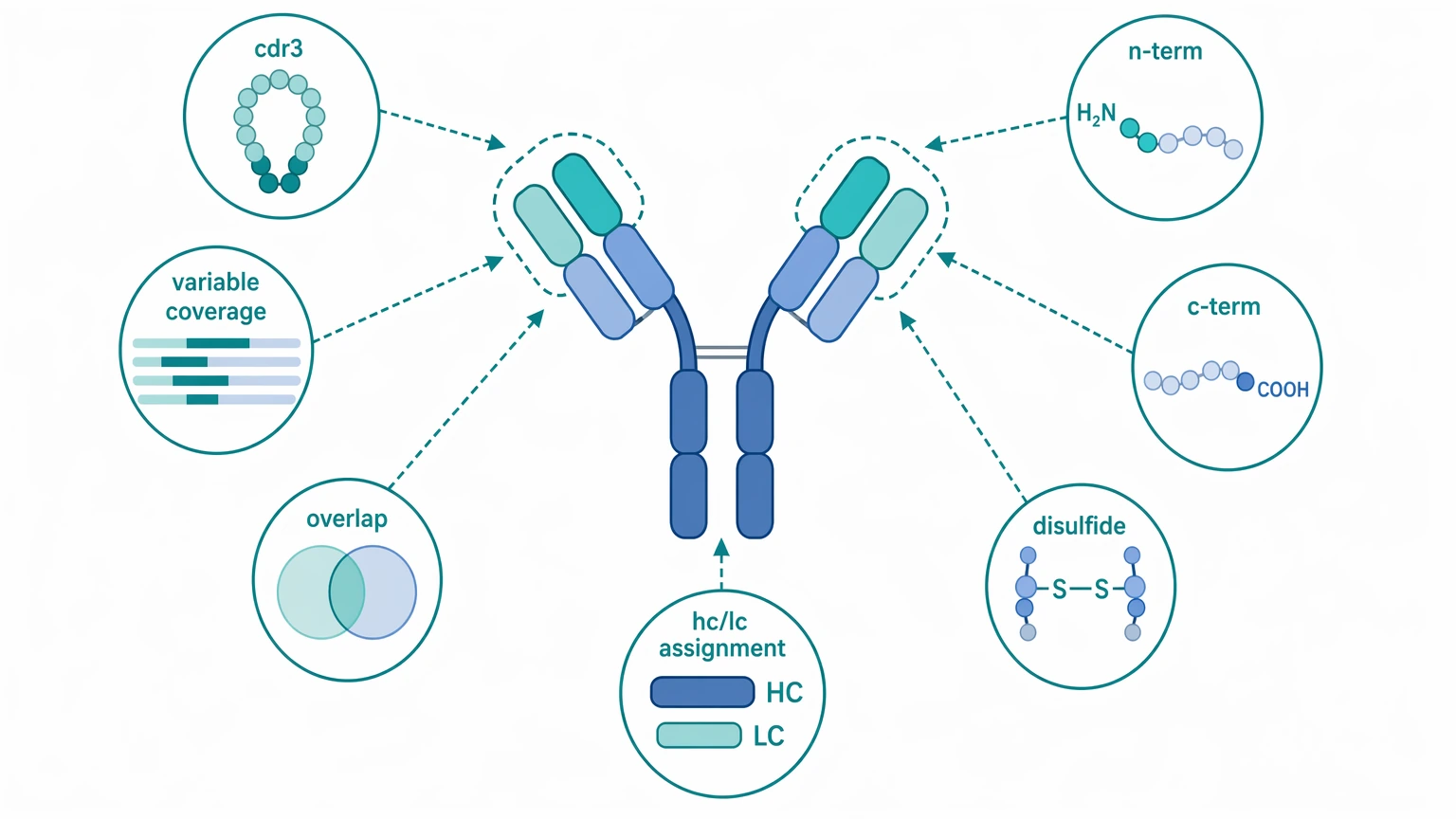
Antibody recovery is more demanding than generic protein identification. A project may succeed or fail on complementarity-determining region (CDR) support, especially CDR3, rather than on constant region identification alone. Sequence coverage across the variable region, overlap density, N- and C-terminal evidence, disulfide bond constraints, and heavy/light chain assignment all influence whether the output is usable for redevelopment.
Database dependence risk
A database search is only as useful as the reference behind it. In legacy antibody recovery, that assumption may break down. A novel sequence, a mislabeled chain, or an incomplete record can push the workflow toward database-independent interpretation rather than simple confirmation against an unreliable reference.
Expected Results and Validation Methods
Before choosing a provider or internal workflow, it helps to separate immediate deliverables from follow-up confirmation.
Immediate deliverables
A source-based monoclonal antibody sequencing project may deliver candidate heavy chain and light chain sequences, variable region calls, and chain-specific annotations suitable for construct planning. A de novo protein sequencing project may deliver sequence tags, inferred peptide assignments, sequence coverage maps, CDR-supporting peptides, PTM observations, and confidence notes tied to the LC-MS/MS evidence.
The second route can be highly informative, but it should not be assumed to be automatically complete. PTM localization may remain partial, and MS/MS spectra alone may not fully resolve every uncertain residue or chain-assignment question.
Follow-up confirmation
Follow-up confirmation often determines whether the sequence evidence is ready for recombinant re-expression. Common confirmation steps include:
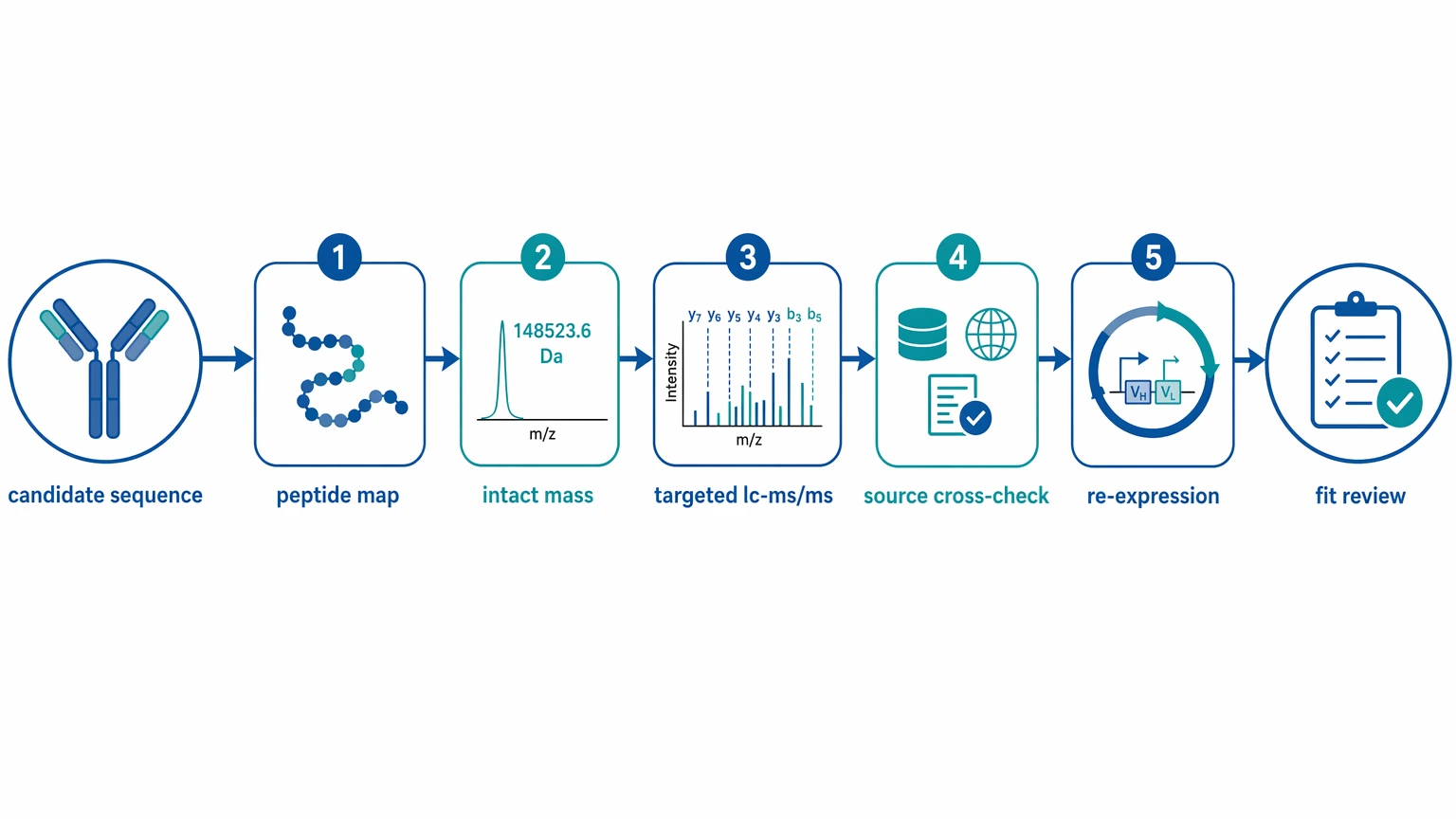
- Peptide mapping to confirm key regions against the proposed sequence
- Intact mass analysis to test whether reconstructed chain masses are chemically plausible
- Targeted LC-MS/MS checks for uncertain residues, terminal processing, or modified sites
- Source-material cross-checks when transcript-level evidence is also available
- Functional retesting after recombinant re-expression, especially if the antibody is being rescued for continued use
If you need help matching the sample you have to the right evidence plan, you can submit your requirements to MtoZ Biolabs to evaluate your project around antibody sequencing, LC-MS/MS sequence evidence, and the validation package needed before redevelopment decisions.
When a Combined Strategy Is Worth It
Using both routes is not necessary for every project, but it can lower downstream risk in a few situations:
- the purified antibody is available, and viable source cells also still exist
- the antibody has high scientific or redevelopment value
- the legacy antibody record is incomplete and suspected to be wrong
- the team needs stronger sequence confidence before formal recombinant re-expression work
In that setting, source-derived monoclonal antibody sequencing can establish the candidate heavy chain and light chain sequences, while de novo protein sequencing checks whether the actual stored antibody agrees with that reconstruction and reveals clipping, glycosylation, oxidation, or other post-translational modification (PTM) features that matter for interpretation.
Key Cautions and Practical Limits
A recovery project is easier to scope when the limits are clear from the start.
Sample quality or amount limits
Low protein amount, poor purity, formulation interference, or degraded source material can narrow what either route can deliver. Surfactants, stabilizers, and excipients may also interfere with digestion or LC-MS/MS readout.
Controls and repeat expectations
One dataset is not always enough to settle an antibody rescue decision. Repeat digestion strategies, complementary enzymes, or targeted confirmation may be needed when sequence coverage is thin across the variable region or when CDR-supporting peptides are sparse.
Batch and contamination risk
Archived antibodies can contain background proteins, lot-specific changes, or handling-related contamination. These issues can complicate heavy/light chain assignment and reduce confidence in low-abundance sequence tags.
Interpretation boundaries
De novo peptide sequencing supports database-independent interpretation, but it does not remove all ambiguity. Standard workflows may leave leucine/isoleucine ambiguity unresolved at some positions, and PTM-rich regions may resist clean localization. A report can still be useful without resolving every residue, but rebuild decisions should reflect that confidence boundary.
When another method or outside support is the better next step
If the antibody amount is extremely limited, the source cells are no longer viable, or the project needs stronger confirmation before expensive redevelopment work, adding orthogonal validation early may be the better move rather than relying on a single evidence stream. In narrow terminal-sequence questions, Edman-based follow-up can still be useful. In high-value rescue programs, outside support is often justified when the internal team needs clearer interpretation of sequence coverage, PTM findings, or chain assignment risk.
What to Prepare Before a Route Evaluation
A useful project discussion usually starts with five items:
- Starting material type: purified antibody, hybridoma cells, supernatant, or another biological source
- Material sufficiency: approximate amount, concentration, purity, and storage condition
- Record status: complete, partial, conflicting, or absent legacy antibody record
- Recovery target: variable region recovery, discrepancy resolution, sequence confirmation, or CDR-focused support
- Validation threshold: internal continuity, recombinant re-expression, transfer to another team, or formal redevelopment planning
Comparison Summary and Consultation Guidance
For antibody recovery, monoclonal antibody sequencing is usually the better opening route when viable source material still exists and the project needs rebuild-oriented heavy chain and light chain recovery. De novo protein sequencing is usually the better opening route when the antibody sample itself is the only dependable starting material or when the stored molecule may not match the legacy antibody record. When both evidence sources are available, a combined plan can reduce uncertainty before recombinant re-expression, especially for high-value legacy assets with conflicting records or visible PTM heterogeneity. If your team is sorting through a purified vial, hybridoma-derived material, or incomplete antibody documentation, gather the sample details, prior files, and intended use case, then contact MtoZ Biolabs to discuss the study and evaluate your project before committing to a recovery path.
FAQ
Can de novo protein sequencing distinguish signal peptide removal from later protein processing?
Sometimes, but not always from one dataset alone. Mature antibody material reflects the processed protein, so signal peptide history may need source-derived sequence information or targeted confirmation to separate biosynthetic processing from later truncation.
If the heavy and light chains were mislabeled in old records, which route is safer?
Protein-derived evidence is often more useful for testing whether the record is wrong, but it may still require extra review to confirm heavy/light chain assignment. If source material is also available, combining the routes usually lowers that risk.
Does Fc glycosylation interfere with variable region recovery?
Fc glycosylation mainly affects the constant region, but complex glycopeptide signals can still compete for analytical attention and complicate interpretation. That is one reason many recovery projects benefit from a workflow that separates sequence reconstruction from PTM-focused review.
Is a subclass call enough to support recombinant re-expression?
No. Subclass identification helps with constant region context, but redevelopment decisions usually require variable region evidence, especially across the CDRs, plus follow-up confirmation that the reconstructed sequence fits the observed protein.
When should functional retesting happen?
Usually after a candidate sequence has been selected and recombinant material is available. Functional retesting is most informative when it is used to check whether the rebuilt antibody behaves consistently with the archived material or the intended assay use.
What if the only sample is formulated drug substance rather than research-grade antibody?
That does not rule out recovery work, but formulation interference should be disclosed early. Buffer components and excipients can affect cleanup, digestion, and LC-MS/MS interpretation, so the intake plan should be built around the actual sample matrix.
How to order?




