






Monoclonal Antibody Sequencing for Recombinant Recovery: When Should You Sequence an Existing Antibody Asset?
Send an existing monoclonal antibody for sequence recovery now when three conditions line up: the antibody already informs meaningful program decisions, the original sequence record cannot be recovered with confidence, and the remaining material is still suitable for LC-MS/MS. If you wait until tech transfer, reformulation, scale-up, or hybridoma failure becomes urgent, monoclonal antibody sequencing often shifts from planned preservation to last-minute rescue.
Quick decision block
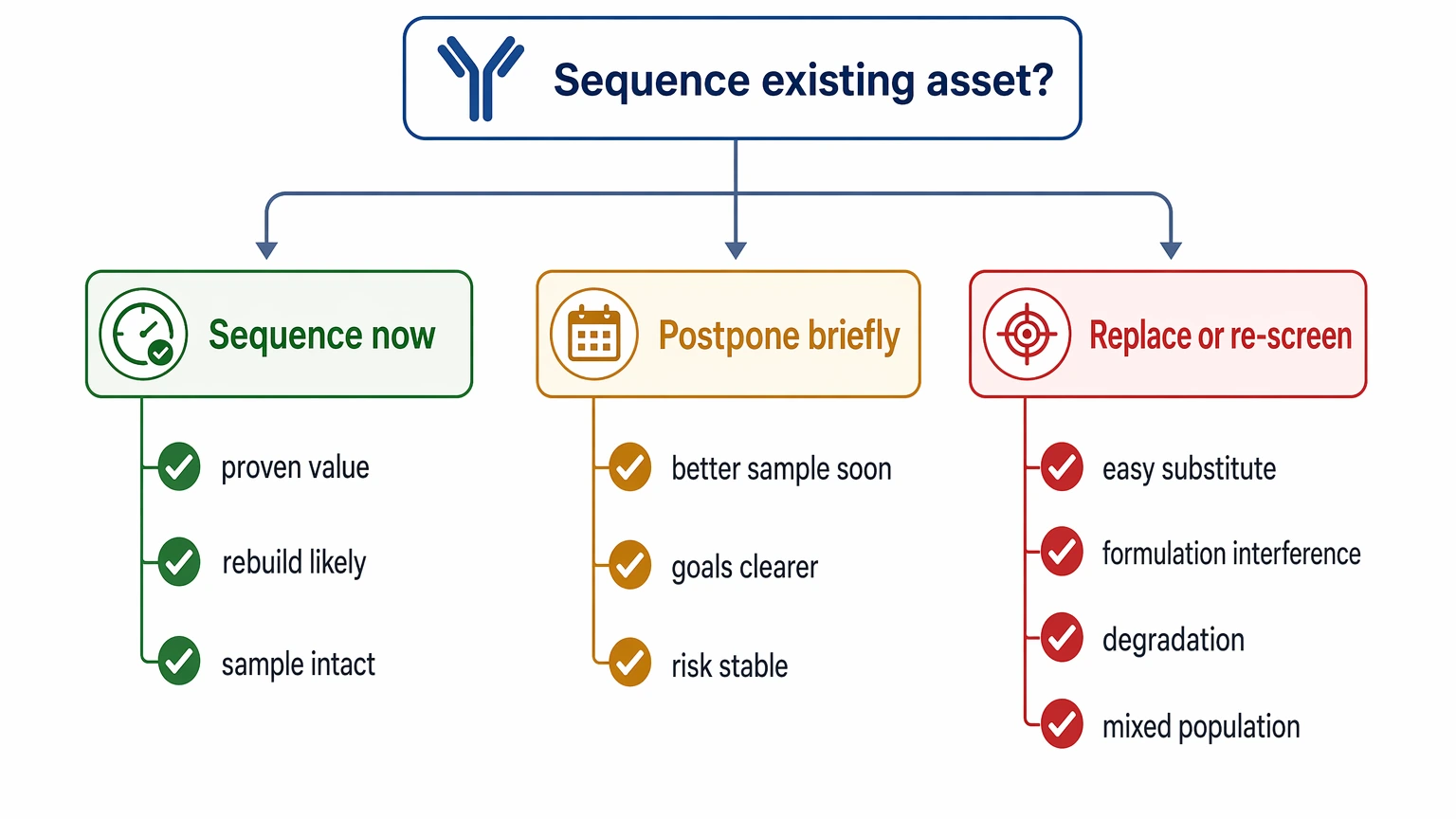
Sequence now if the antibody has proven functional value, recombinant recovery is a realistic next step, and current purified material still has acceptable sample integrity.
Postpone briefly if better material or clearer project goals are likely soon and the delay does not materially increase asset-loss risk.
Replace or re-screen if the antibody is weakly differentiated, easy to substitute, or the available sample shows severe formulation interference, degradation, or mixed population risk.
Where teams usually get stuck
This issue usually surfaces midway through development. A team may already have years of binding data, internal assay history, or preclinical utility tied to one antibody, but still lack a verified heavy chain and light chain sequence. As long as the reagent continues to perform, the missing molecular identity can feel tolerable.
That changes when the asset has to move into a new setting. Common triggers include recombinant expression for supply continuity, assay transfer to another site, reformatting, humanization support, or concern that the original hybridoma is unstable or no longer available. At that point, the missing sequence is not just a documentation gap. It becomes a real bottleneck for recombinant recovery, long-term asset preservation, and comparability planning.
What problem sequencing is actually solving
For an existing antibody asset, sequencing is not simply another characterization task. The practical aim is to recover enough sequence information to rebuild or preserve the molecule before access is lost.
In this setting, monoclonal antibody sequencing usually depends on de novo peptide sequencing and de novo protein sequencing from LC-MS/MS data rather than simple database matching. That distinction matters. A proprietary or undocumented antibody may not appear in any reference library, and database search alone may not support confident variable region assignment.
For recombinant recovery, the key question is not generic protein identification. It is whether tandem mass spectrometry data can support a defensible reconstruction of the heavy chain and light chain, especially the CDRs (complementarity-determining regions) within the variable region. The constant region still matters for isotype context and molecular interpretation, but the sequence decisions that guide gene synthesis usually center on the variable domains and their framework regions.
When sequencing should move from “later” to “now”
Sequencing becomes the sensible next step when delay increases business risk faster than it improves technical readiness.
The strongest “sequence now” signals are:
- the antibody already anchors an internal assay, screening workflow, or translational readout
- the original hybridoma shows hybridoma instability, access restrictions, or uncertain provenance
- the remaining material exists mainly as purified IgG or archival antibody stock
- upcoming milestones such as transfer, scale-up, or reformatting will require recombinant expression
- the cost of losing the binder is higher than the cost of a sequencing and validation package
Waiting can still be reasonable when a fresher sample is likely soon, hybridoma recovery remains realistic, or the antibody is replaceable without meaningful program disruption. The main point is to set a firm review point. “We will revisit this later” too often turns into “we no longer have usable material.”
How to assess whether the sample is fit for sequencing
The decision should stay focused on the sample features that most directly affect interpretability.
1. Sample amount and integrity
Low mass, low concentration, clipping, aggregation, or oxidation can reduce recoverable peptide evidence. Archived antibodies may still be usable, but heavily stressed material raises the chance of incomplete sequence coverage.
2. Purity and formulation interference
Purified IgG in a simple buffer is usually the cleanest starting point. Formulated stocks may contain glycerol, salts, detergents, carrier proteins, or azide that interfere with digestion or spectral clarity. This kind of formulation interference does not always stop the project, but it should be checked before scarce sample is consumed.
3. Clonality and mixed population risk
A nominal monoclonal sample is not always truly uniform. Clonality concerns, chain heterogeneity, contamination, or more than one antibody species can weaken peptide-spectrum interpretation and complicate heavy/light chain pairing. If mixed population risk is high, direct sequencing may not be the best first move.
4. PTM burden
Antibodies commonly carry PTMs (post-translational modifications) such as glycosylation, oxidation, deamidation, and N-terminal cyclization. These features are normal in real samples, but they can complicate peptide assignment and lower confidence in some regions.
What LC-MS/MS can realistically deliver for recombinant recovery
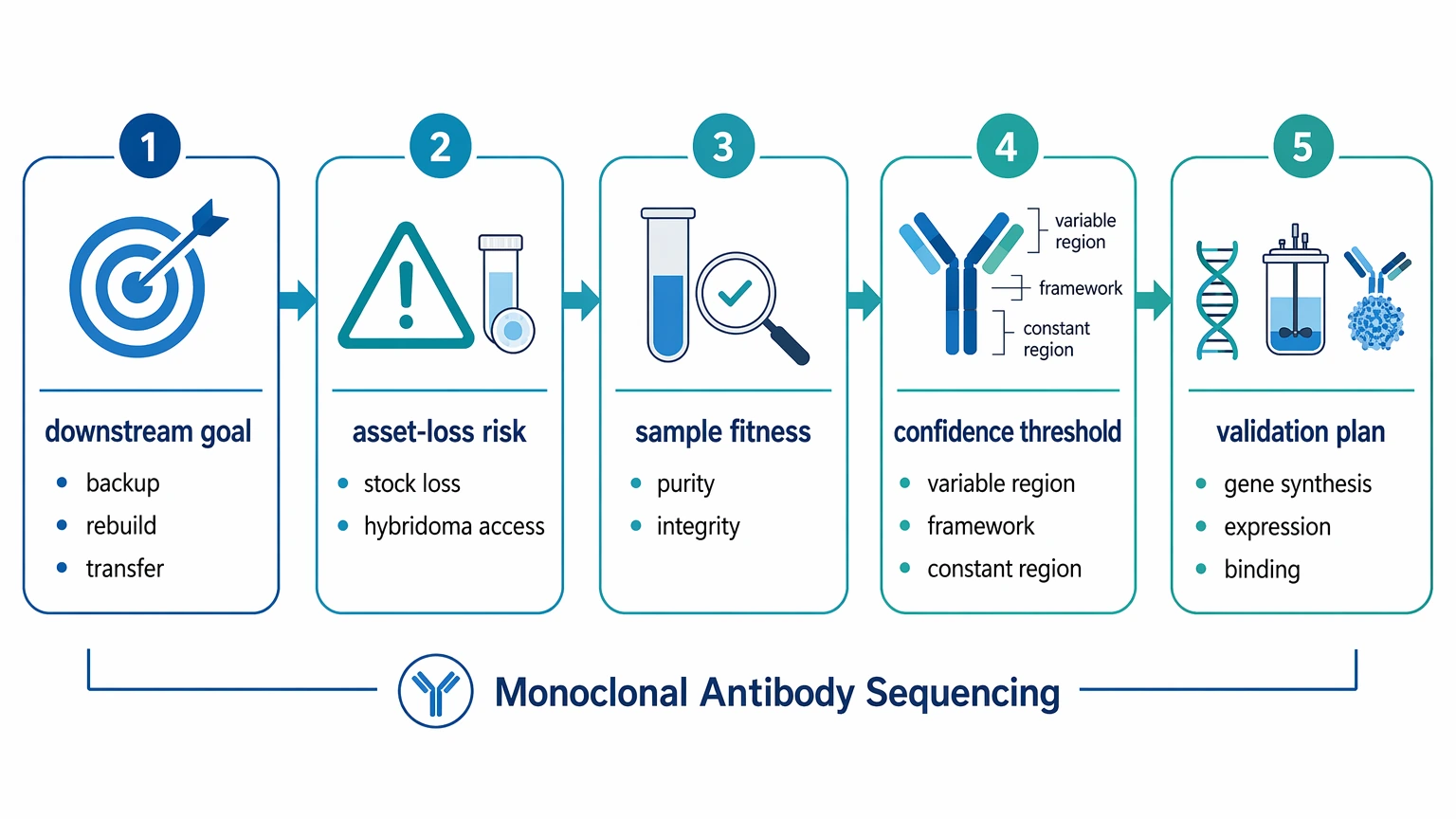
A well-scoped sequencing project can produce a practical recovery package: proposed heavy-chain and light-chain sequences, variable-region reconstruction, CDR-focused evidence, flagged ambiguities, and a roadmap for follow-up confirmation.
It does not remove every uncertainty. One clear limit is leucine/isoleucine ambiguity. These isobaric residues often cannot be distinguished directly in every peptide context by standard MS/MS data alone. Some positions can be inferred from orthogonal evidence or expression-stage testing, but not every assignment will be equally direct. PTM-rich or partially degraded peptides can also leave local uncertainty even when the broader variable-region model is strong.
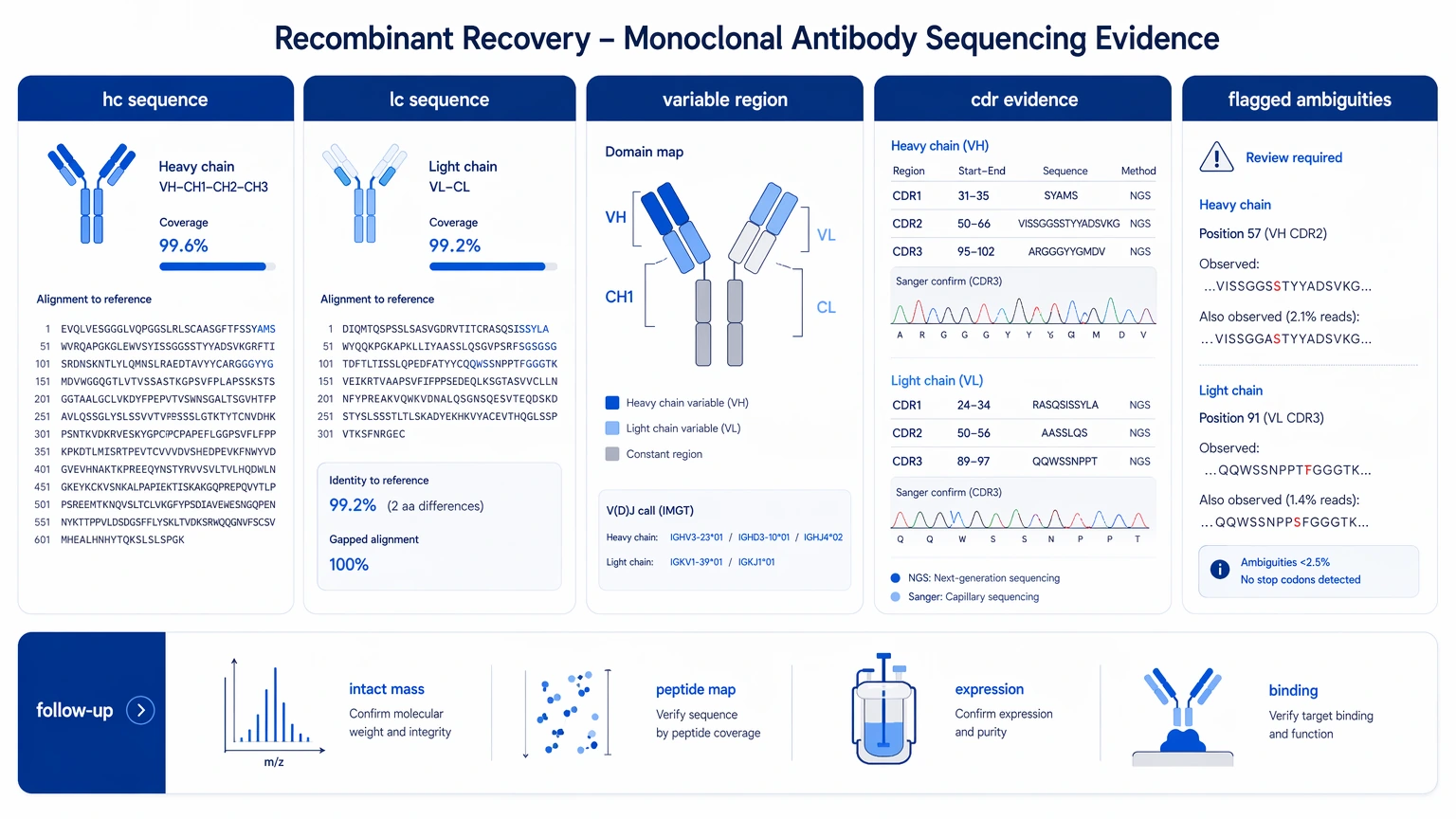
So the right question is not “Will MS solve everything?” It is “Will the resulting sequence confidence support the next project decision?”
If you need a sample-fit review tied to recombinant recovery planning, submit your requirements to MtoZ Biolabs with sample type, buffer composition, concentration, known storage history, and the intended use of the recovered sequence.
A practical project-planning workflow
For this type of problem-solution article, the useful structure is not a generic lab sequence. It is a planning sequence.
-
Define the downstream decision.
State whether the goal is backup preservation, recombinant rebuild, assay continuity, reformatting, or transfer support. -
Rank asset-loss risk.
Ask what happens if the current antibody stock degrades further or the hybridoma becomes inaccessible. -
Review sample fitness.
Check amount, purity, sample integrity, PTM burden, and mixed population risk before submitting material.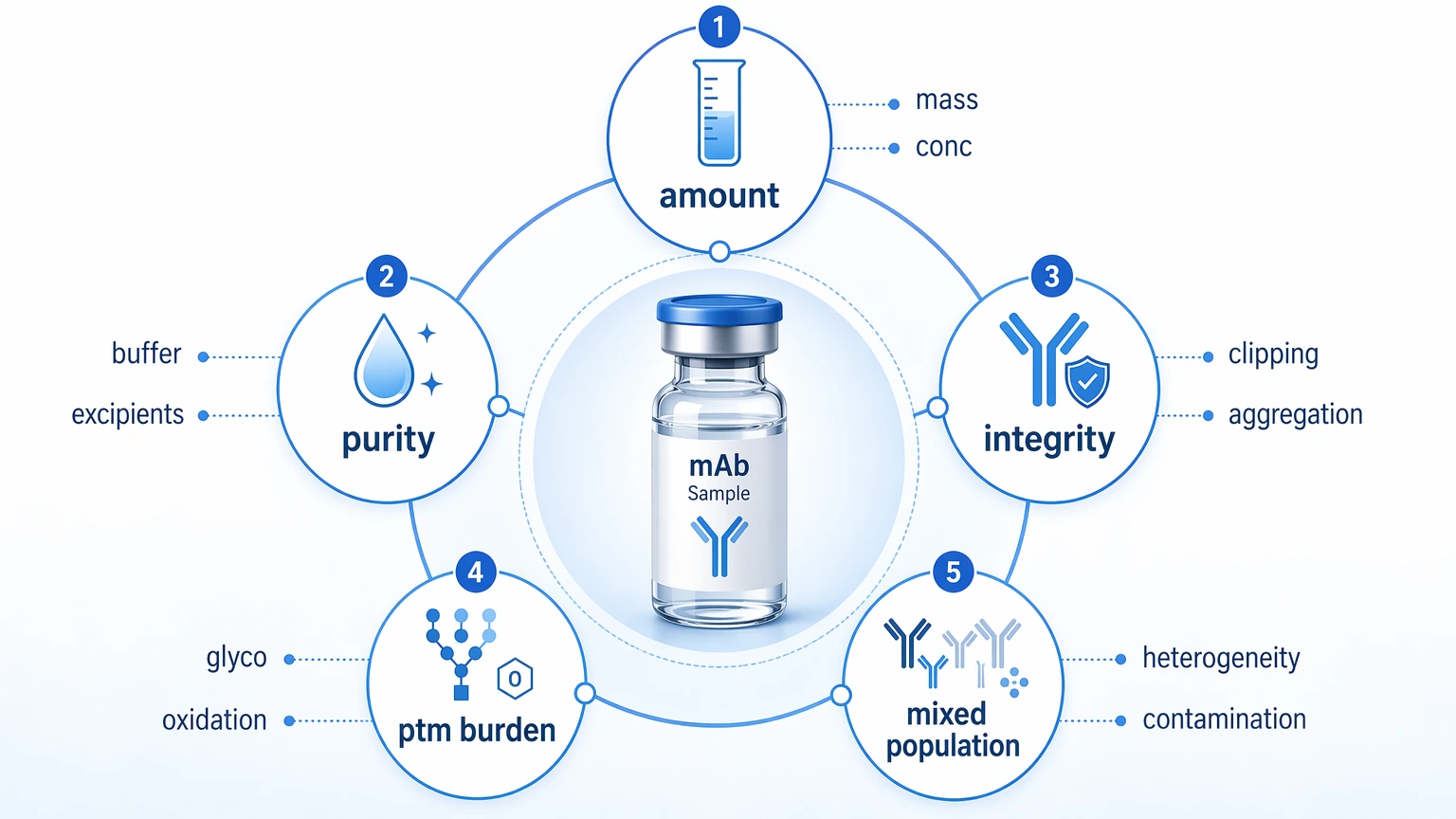
Figure 4. Monoclonal antibody sequencing sample-fit checkpoint map for pre-submission review. -
Set the confidence threshold.
Decide whether the project needs variable-region recovery only, higher confidence across framework regions, or additional support for constant-region interpretation. -
Plan orthogonal validation in advance.
Do not treat sequence recovery as the finish line. Decide upfront which checks will be used before gene synthesis and after recombinant expression.
Expected results and validation methods
The immediate deliverable should be more than a list of peptide hits. For recombinant recovery planning, the useful near-term output is a structured sequence package that separates supported assignments from uncertain ones.
Immediate deliverables may include:
- proposed heavy-chain and light-chain sequences
- variable-region and CDR-focused evidence summary
- reported sequence coverage across framework and constant regions
- flagged low-confidence positions, unresolved residues, or leucine/isoleucine ambiguity
- notes on PTMs, degradation signals, or formulation-related interpretation limits
- supporting peptide mapping and, where included, intact mass analysis
Follow-up confirmation should still be planned:
- compare the proposed sequence against intact mass behavior
- review peptide mapping consistency for key regions
- synthesize constructs for recombinant expression
- retest binding or the original assay function
- assess whether the rebuilt reagent is sufficiently comparable for the intended use
That distinction matters. Immediate deliverables support a go/no-go decision for rebuilding. Follow-up confirmation determines whether the rebuilt antibody is acceptable in the real project context.
Service Routes to Consider
For this project scenario, readers usually compare these service routes before requesting a quote or submitting samples.
Key cautions and practical limits
A sound decision framework should also name the cases where sequencing is the wrong next step or where claims need to stay narrow.
- Sample quality or amount limits: very low input, degraded material, or heavily aggregated antibody may yield incomplete evidence rather than recovery-ready sequences.
- Controls and repeat expectations: if the original reagent may be replaced, preserve enough material for side-by-side testing whenever possible.
- Batch and contamination risk: carrier proteins, serum background, excipients, and mixed populations can distort interpretation.
- Interpretation boundaries: LC-MS/MS-based de novo reconstruction supports planning, but it does not by itself prove functional equivalence, manufacturability, or developability.
- When another method is better: if viable cells are available and trustworthy, nucleic-acid-based recovery may be more direct. If the binder is weakly differentiated and replaceable, re-screening or substitution may be more efficient than pushing an uncertain MS-based rebuild.
Final decision guidance
Monoclonal antibody sequencing makes the most sense when a proven antibody asset is becoming sequence-vulnerable, current material still offers a reasonable chance of interpretable LC-MS/MS data, and recombinant recovery would reduce a real program risk. The best candidates are functionally established antibodies with incomplete records, uncertain hybridoma access, or finite archival stock that will soon become harder to use.
For teams facing transfer, rebuild, or preservation decisions, the practical next step is to combine technical review with validation planning. Contact MtoZ Biolabs to evaluate your project if you need a sequencing feasibility discussion linked to recombinant expression, peptide mapping, or intact mass analysis before committing limited sample.
FAQ
How much original functional data should exist before sequencing is worth funding?
Enough to justify preservation. If the antibody has repeatable binding history, assay dependence, or translational relevance, sequencing is easier to defend. If the binder has only preliminary data and no clear differentiation, replacement may be the better investment.
Can a sequence package support reformatting into another antibody format?
Sometimes, yes. A recovered variable region can support planning for recombinant re-expression or format changes, but reformatting introduces its own comparability questions. Binding, expression behavior, and molecular properties still need follow-up testing.
Is the Fc region always necessary for recombinant recovery?
Not always at the same priority. For many rebuild decisions, the variable region drives the first go/no-go decision because it carries target recognition. The constant region still matters for isotype selection, intact mass expectations, and full construct design.
What information should be sent with the sample to improve project review?
Provide concentration, approximate mass available, buffer composition, storage history, prior purification notes, and any signs of aggregation, clipping, or unusual background. Also include the intended use: backup preservation, recombinant expression, assay transfer, or another recovery goal.
If ambiguity remains in a few residues, should the project stop?
Not automatically. The more relevant question is whether the remaining uncertainty affects CDR interpretation, construct design, or the validation plan. Some ambiguities can be managed in follow-up confirmation, while others may block a confident rebuild.
When is sequencing mainly a risk-control measure rather than a development step?
When the main threat is loss of access rather than lack of interest. If the hybridoma is unstable, records are incomplete, or only finite archival material remains, sequencing becomes a way to preserve future options before the asset disappears.
How to order?




