






Monoclonal Antibody Sequencing for Clone Rescue: A Practical Planning Guide
If the original clone, plasmid, or trusted nucleotide record is gone, monoclonal antibody sequencing can become a practical rescue route, but only if the remaining antibody material can support defensible heavy chain and light chain reconstruction in the variable region, especially across the CDRs / complementarity-determining regions. The key issue is not whether any sequence data can be produced. It is whether the evidence is strong enough to support recombinant expression and later fit-for-purpose confirmation without going back to the original producing cells.
Quick decision guide
- Proceed first when you still have purified or partially purified antibody with enough material for protease digestion, replicate LC-MS/MS runs, and targeted follow-up.
- Use de novo sequencing when variable-region identity is missing or unreliable and database search alone cannot recover rescue-relevant sequence information.
- Pause before gene synthesis if sequence coverage is weak in the variable region, residue ambiguity falls inside a CDR, or degradation and PTMs are likely to distort interpretation.
- Treat the output as confidence-tiered rather than final truth; immediate deliverables and downstream confirmation are not the same thing.
For clone rescue, the most useful planning sequence is fairly direct: define the rescue goal, audit the sample that still exists, build a de novo sequencing plan around bottom-up proteomics and tandem mass spectrometry, review uncertainty before construct design, and set validation rules before calling the clone rescued.

Where Clone Rescue Projects Usually Break Down
Clone rescue is a different kind of sequencing problem because the sequence record is missing, incomplete, or no longer trustworthy. In that setting, projects usually stall for one of four reasons.
First, the sample itself may limit reconstruction. Archived antibody can carry degradation, aggregation, truncation, or formulation interference that reduces interpretable peptide evidence.
Second, the unknown variable region often goes beyond database-only workflows. Constant-region assignment may be straightforward, but the rescue value sits in the variable domain, where de novo sequencing is often needed.
Third, uncertainty can remain even after strong LC-MS/MS acquisition. Isoleucine/leucine ambiguity, poorly fragmenting peptides, blocked termini, and competing peptide assemblies can prevent residue-level certainty at selected positions.
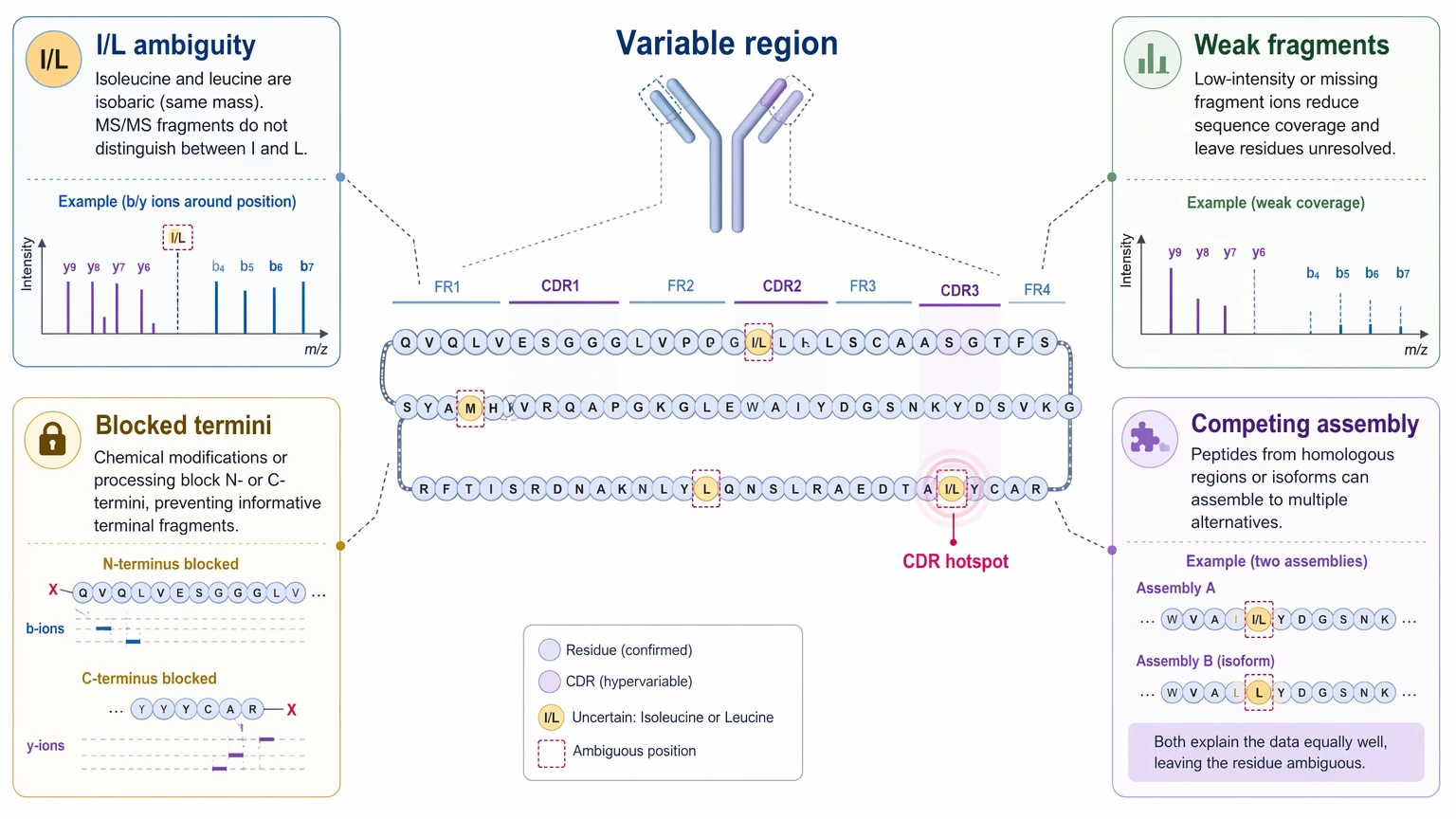
Fourth, a sequence report may look reasonable but still be weak for expression planning. A reconstructed antibody is only useful for clone rescue when the confidence boundaries are clear enough to guide construct design and confirmation.
Step 1: Define the Rescue Decision Before You Define the Assay
Start with the downstream decision, because that sets the evidence threshold. Teams usually need the recovered sequence for one of a few practical reasons:
- recombinant re-expression for reagent continuity
- rescue of a legacy monoclonal antibody after clone loss
- transfer of an undocumented antibody into a controlled recombinant format
- preservation of an assay reagent before program handoff
- sequence recovery for follow-up binding or epitope work
If the goal is archival documentation, partial information may still help. If the goal is recombinant expression, the bar is higher. You need a reviewed heavy-chain and light-chain sequence set, clear annotation of uncertain positions, and a plan for sequence validation after expression.
Step 2: Audit the Material You Still Have
For monoclonal antibody sequencing, sample form matters because rescue projects rarely have unlimited repeat material. Purified IgG in a simple buffer is usually the strongest starting point, while partially degraded or excipient-heavy samples call for more caution.
The first triage table below helps with a go/no-go decision.
| Sample type | Best fit | Main constraint | Planning implication |
|---|---|---|---|
| Purified IgG in simple buffer | Full clone rescue planning | PTMs still require review | Strongest starting route |
| Formulated antibody sample | Rescue can still be feasible | Excipients may interfere with cleanup or digestion | Add cleanup assessment early |
| Supernatant-derived material | Possible when purified stock is limited | Co-protein background lowers interpretability | Consider enrichment before sequencing |
| SDS-PAGE band | Salvage option | Recovery loss and patchy sequence coverage | Use only when better material is unavailable |
| Degraded archive sample | Feasibility check | Truncation and artifacts may mislead reconstruction | Confirm integrity before full workflow commitment |
The sample audit should document amount, concentration, storage history, visible precipitation, expected glycosylation burden, and whether replicate aliquots remain for repeat analysis. If only a single low-mass aliquot survives, the project may still move forward, but the room for confirmation becomes narrow.
Service Routes to Consider
For this project scenario, readers usually compare these service routes before requesting a quote or submitting samples.
Step 3: Choose a Sequencing Strategy That Matches the Risk
For clone rescue, one analytical view is rarely enough. A stronger workflow combines intact mass analysis, subunit analysis, and peptide mapping within a bottom-up proteomics strategy.
| Evidence layer | What it adds | What it cannot settle alone |
|---|---|---|
| Intact mass analysis | Overall mass plausibility and major heterogeneity | Residue-level sequence assignment |
| Subunit analysis | Chain-level separation and mass support | Exact sequence across difficult regions |
| Single-protease peptide mapping | Fast first-pass coverage review | Gaps in difficult variable-region segments |
| Multi-protease de novo sequencing | Better peptide overlap and stronger assembly | All ambiguity, especially I/L positions |
| Targeted follow-up LC-MS/MS | Focused review of flagged residues | Whole-sequence reconstruction |
This layered approach matters because rescue-relevant evidence sits in the variable region, not only the constant region. A report with broad constant-region support but weak CDR continuity may still be poor input for recombinant design.
A direct limitation should be stated plainly: LC-MS/MS-based de novo sequencing does not always resolve every residue with equal confidence, and PTMs, database-search limits, and isoleucine/leucine ambiguity can leave selected positions uncertain even when overall sequence reconstruction looks plausible.
For teams deciding whether to outsource the workup, this is the point to submit your requirements or evaluate your project with MtoZ Biolabs so the sample form, digestion plan, ambiguity burden, and rescue-readiness of the expected deliverables can be reviewed before synthesis starts.
Step 4: Review Sequence Confidence Before Ordering Genes
Many rescue delays come from reading too much certainty into a sequence report. What matters is not only whether a full-length sequence can be assembled, but how much of it is directly supported.
Focus the review on:
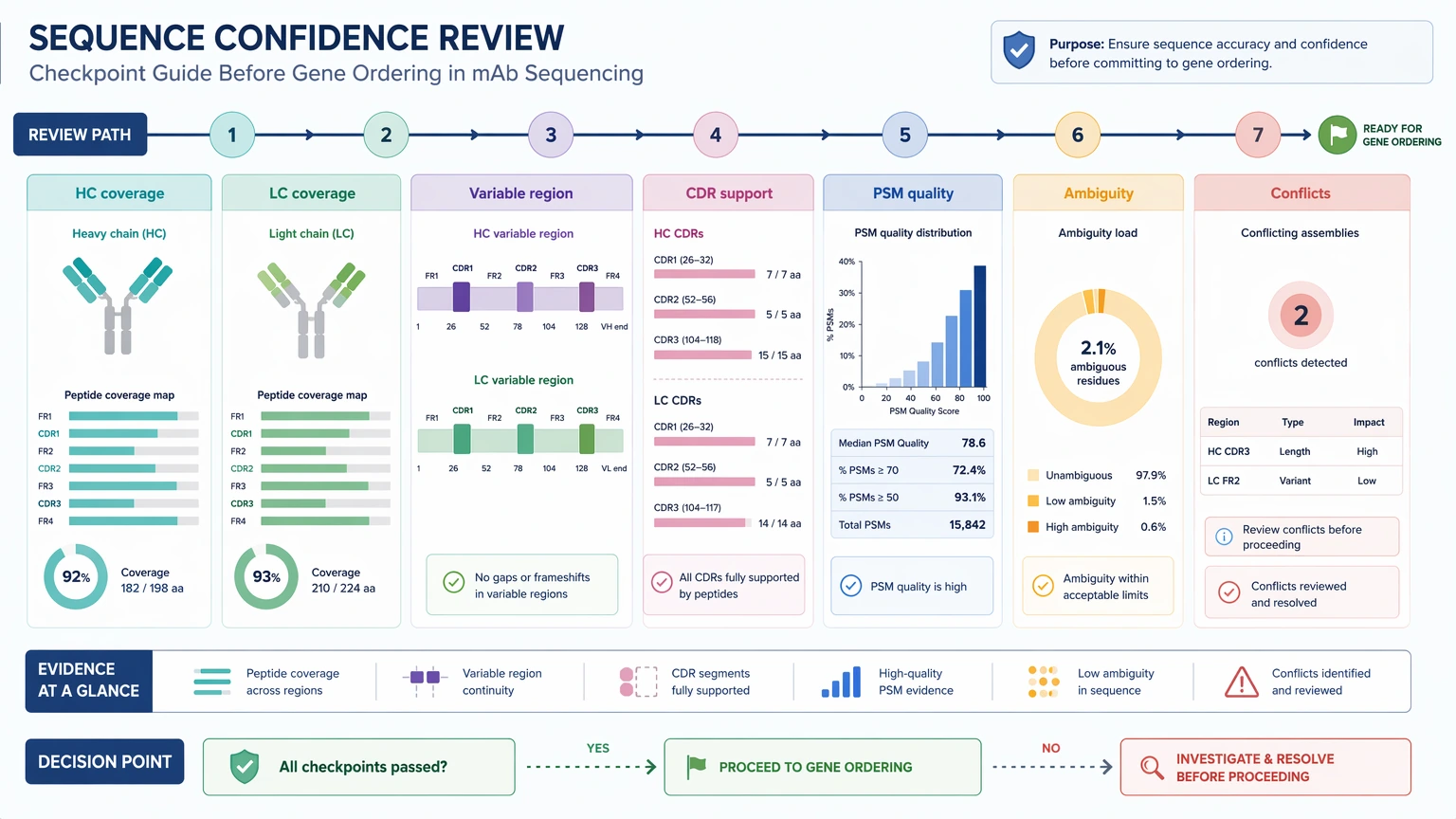
- sequence coverage across heavy chain and light chain
- continuity in the variable region
- direct support across CDRs / complementarity-determining regions
- quality of each peptide-spectrum match
- the burden and location of residue ambiguity
- whether conflicting assemblies remain after replicate review
Not all uncertainty carries the same risk. A low-confidence call in a framework region may be manageable. A low-confidence call inside CDR3 is more likely to change rescue strategy. Likewise, oxidation, deamidation, pyroglutamate formation, and glycosylation-adjacent fragmentation can complicate interpretation and should not be mistaken for true clone-defining sequence features.
A useful rescue package should show which residues are supported directly, which are inferred from assembly context, and which may require alternative construct testing.
Step 5: Translate the Sequence Package Into Expression Planning
A rescue-ready handoff is more than a FASTA file. It should include the preferred heavy-chain and light-chain sequences, unresolved positions, constant-region assumptions, and a rationale for whether one construct pair or a small comparison set is safer.
In practice, a narrow alternative set often makes sense when uncertainty is localized. If only one or two CDR-adjacent positions remain open, building a primary construct plus limited alternatives can be more efficient than acting as if the ambiguity is not there.
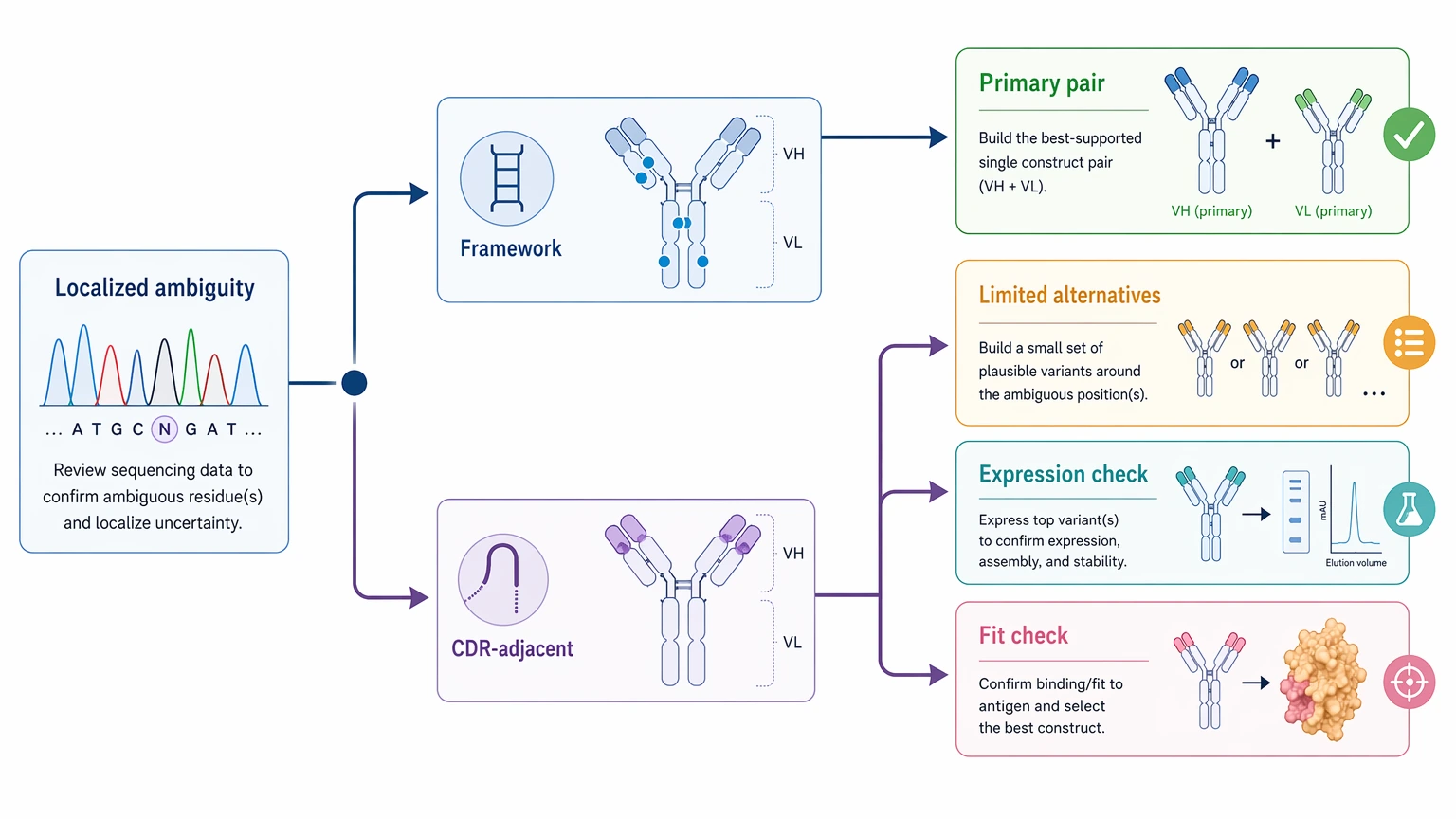
At this stage, immediate deliverables and later confirmation should stay separate.
Expected Results and Validation Methods
The immediate deliverables from a well-planned rescue workflow are analytical, not biological proof. They typically include:
- a reconstructed heavy-chain and light-chain sequence set
- documented sequence confidence by region
- an annotated list of ambiguity hotspots
- evidence summaries from peptide mapping, intact mass analysis, and, when used, subunit analysis
- construct-planning notes for recombinant expression
Follow-up confirmation asks a different question: whether the expressed antibody behaves closely enough to the original material for its intended use. That stage may include:
- expected mass consistency for the expressed product
- targeted confirmation of flagged peptides
- binding comparability against retained reference material
- functional or assay-alignment checks when those readouts matter to the rescue goal
A credible rescue project therefore ends with a sequence-informed expression decision, not with a claim that every residue is beyond question.
Key Cautions and Practical Limits
Several practical limits deserve explicit review before committing to synthesis.
Sample quality or amount limits: low concentration, visible degradation, or insufficient material for repeat digestion can narrow interpretation and reduce options for follow-up confirmation.
Controls and repeat expectations: clone rescue usually benefits from replicate acquisition, contamination checks, and, when uncertainty is localized, targeted repeat review rather than a single-pass dataset.
Batch or contamination risk: supernatant-derived material, mixed-protein backgrounds, and poorly documented archives can introduce non-antibody peptides that complicate assembly.
Interpretation boundaries: confidence in the constant region does not guarantee equivalent confidence in the variable region. Likewise, a plausible sequence does not prove that the recombinant antibody will fully reproduce original binding behavior.
When another route is better: if a viable cell source, plasmid archive, or trusted nucleotide record still exists, nucleic-acid-based recovery may be more direct. If critical CDR residues remain unresolved after protein-level work, outside support or an alternative confirmation method may be the better next step.
FAQ
Can a formulation buffer sample still support clone rescue?
Yes, if the antibody remains intact and the excipients can be cleaned up without excessive loss. The deciding issue is whether the variable-region peptides remain interpretable after preparation.
Do I need both heavy-chain and light-chain reconstruction to move forward?
Usually yes for recombinant rescue. A partially recovered pair may still guide feasibility review, but expression planning is much stronger when both chains have mapped variable regions and clearly flagged uncertainties.
Why is multi-protease digestion often preferred over a single enzyme?
Different enzymes create different peptide overlaps. That extra overlap can improve assembly across difficult framework region and CDR segments where one digest leaves gaps or weak fragmentation.
Should unresolved I/L positions always stop gene synthesis?
Not always. If the uncertainty is limited and outside the most decision-sensitive regions, teams may proceed with a justified call or a small alternative construct set. The key is to make that choice visible, not implicit.
What is the most common mistake after a sequencing report is delivered?
Treating the report as production-ready without ranking uncertainty. Rescue programs usually move more smoothly when confidence tiers, alternative residue calls, and validation triggers are defined before constructs are ordered.
Conclusion
Monoclonal antibody sequencing can support clone rescue when the remaining material is intact enough for informative LC-MS/MS analysis, the variable region can be reconstructed with usable confidence, and the handoff into recombinant expression includes explicit limits rather than hidden assumptions. That is most useful in projects involving lost clones, unstable producer lines, legacy antibodies, or handoff-driven reagent continuity work. If your team needs to decide whether the surviving material is sufficient for rescue, contact MtoZ Biolabs to evaluate your project, discuss the sample scenario, and define a sequencing and confirmation plan before gene synthesis.
How to order?




