






Mass Spectrometry: Structural Proteomics
Introduction
A proteomics dataset can document thousands of protein identifications and still leave higher-order structure unresolved. A biologics team may confirm peptide coverage yet remain uncertain whether disulfide pairing, domain assembly, or conformational states are preserved after a process change. A structural biology group may know that a protein binds a partner but lack residue-level evidence for the interaction interface. A drug discovery program may detect target engagement by immunoassay without understanding how ligand binding alters protein conformation. These gaps sit in the space between expression proteomics and true structural understanding.
Structural proteomics uses mass spectrometry to extract information about protein architecture, connectivity, interactions, and conformational behavior. Unlike standard discovery proteomics, which often focuses on identity and abundance, structural proteomics asks how proteins are folded, connected, assembled into complexes, and altered by binding events or modifications. Mass spectrometry supports this field through native MS, hydrogen-deuterium exchange MS, chemical cross-linking MS, top-down proteoform analysis, and peptide-level mapping of disulfide bonds and other connectivity features.
For laboratories evaluating structural questions, the key decision is which MS approach measures the structural feature that matters most for the project.
What Structural Proteomics Measures
Structural proteomics is the large-scale or targeted analysis of protein structure-related properties rather than protein presence alone. The field spans primary connectivity features such as disulfide bonds and cleavage sites, higher-order assembly in complexes, conformational dynamics, and proteoform architecture under defined conditions.
Mass spectrometry contributes several types of structural evidence.
Connectivity evidence defines how residues or chains are linked, including disulfide bonds, cross-links, and chain pairing in multimeric proteins.
Proteoform architecture describes intact protein variants with defined mass and fragmentation patterns that reflect sequence and modification state on one molecule.
Complex composition and interaction proximity are inferred when proteins copurify together or when cross-linking places residue pairs within spatial distance limits.
Conformational dynamics are probed when solvent accessibility changes over time, as in hydrogen-deuterium exchange experiments.
Structural proteomics does not replace high-resolution methods such as cryo-EM or X-ray crystallography in every project. It often provides complementary MS-based evidence that is feasible on lower sample amounts and adaptable to complex mixtures when the structural question is defined clearly.
Expression Proteomics and Structural Proteomics Are Different
Many projects begin with expression proteomics and later discover that a structural question remains unanswered.
Expression proteomics usually addresses which proteins are present, how abundant they are, and where some post-translational modifications occur. Structural proteomics addresses how those proteins are folded, connected, assembled, and altered by interactions or environmental change.
The table below summarizes practical differences that influence project design.
|
Dimension |
Expression Proteomics |
Structural Proteomics |
|---|---|---|
|
Primary question |
Who is there and how much? |
How is the protein organized and connected? |
|
Typical workflow |
Bottom-up digestion and LC-MS/MS |
Native MS, HDX-MS, XL-MS, top-down, or connectivity mapping |
|
Sample handling |
Denaturing extraction often acceptable |
Native or controlled handling often required |
|
Main output |
Protein lists and quant matrices |
Connectivity maps, protection patterns, cross-links, proteoforms |
|
Common fit |
Discovery and abundance comparison |
Biologics HOS, complex mapping, interaction interfaces |
|
Main limitation |
Weak on higher-order structure |
More specialized design and interpretation |
Integrated programs often use expression proteomics for screening and structural proteomics for follow-up on selected proteins or product states.
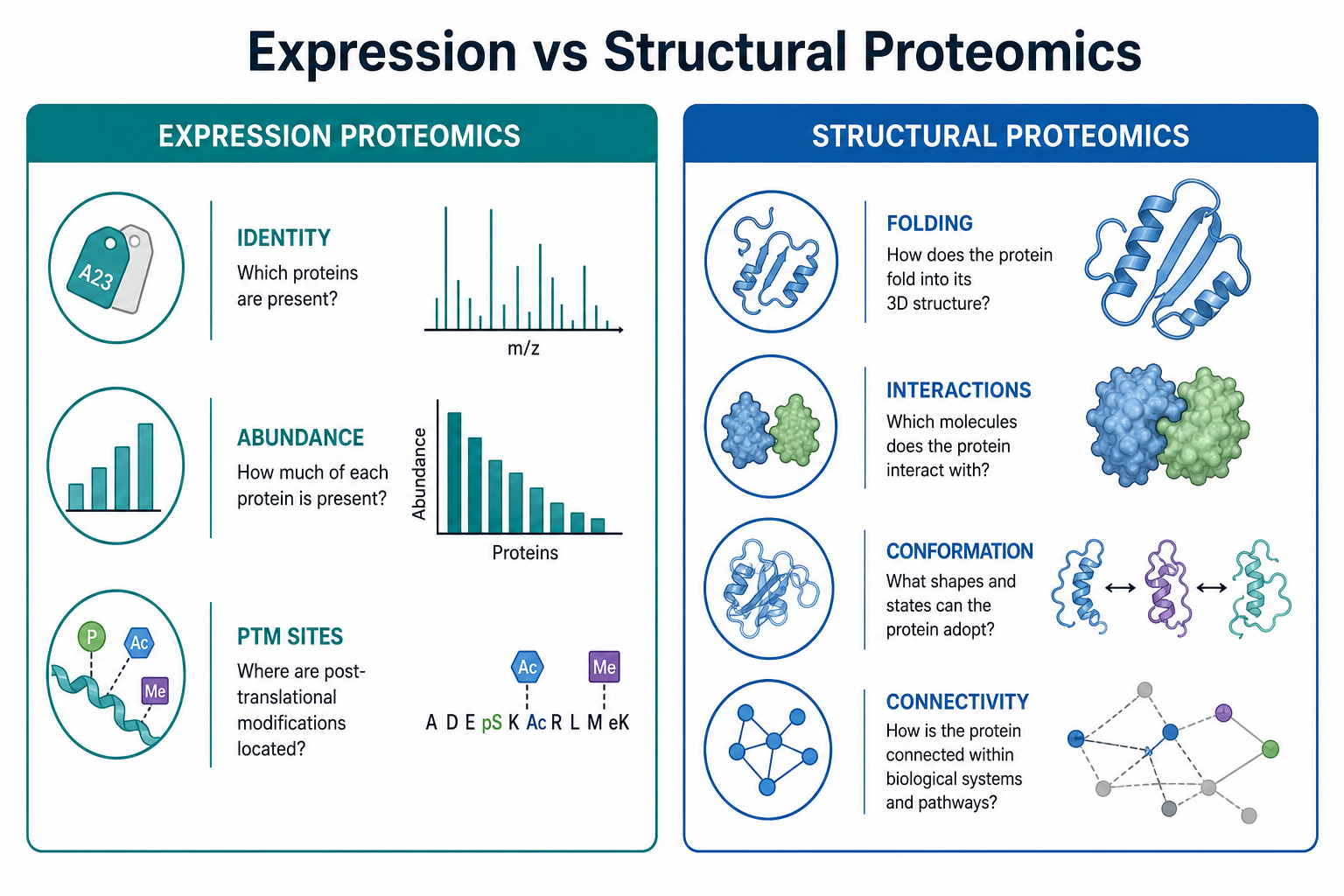
Figure 1. Expression proteomics and structural proteomics answer different questions and usually require different mass spectrometry workflows.
Main Mass Spectrometry Approaches in Structural Proteomics
Structural proteomics is not one technique. It is a set of MS methods selected according to the structural feature under investigation.
Hydrogen-deuterium exchange mass spectrometry measures solvent accessibility by monitoring amide proton exchange over time. Differences in protection patterns can reveal binding sites, conformational changes, and region-level flexibility when sample handling preserves native state during labeling and quenching.
Chemical cross-linking mass spectrometry captures residue pairs that lie within the cross-linker distance limit. Cross-linked peptides identified by LC-MS/MS support protein-protein interaction mapping and domain architecture modeling in complexes.
Native mass spectrometry analyzes intact proteins and complexes under nondenaturing conditions. It provides intact mass profiles, stoichiometry information, and assembly states for purified proteins and some complexes.
Top-down and middle-down mass spectrometry characterize proteoforms and larger sequence fragments with more structural context than small peptides. These approaches are useful when modification coexistence or intact variant assignment is central.
Disulfide bond and connectivity mapping by peptide LC-MS/MS defines cysteine pairing and other covalent links using non-reduced digestion, linkage-specific chemistry, or comparative reduced versus non-reduced workflows.
Each method reports a different structural layer. Project success depends on matching the method to the structural question rather than defaulting to standard bottom-up discovery settings.
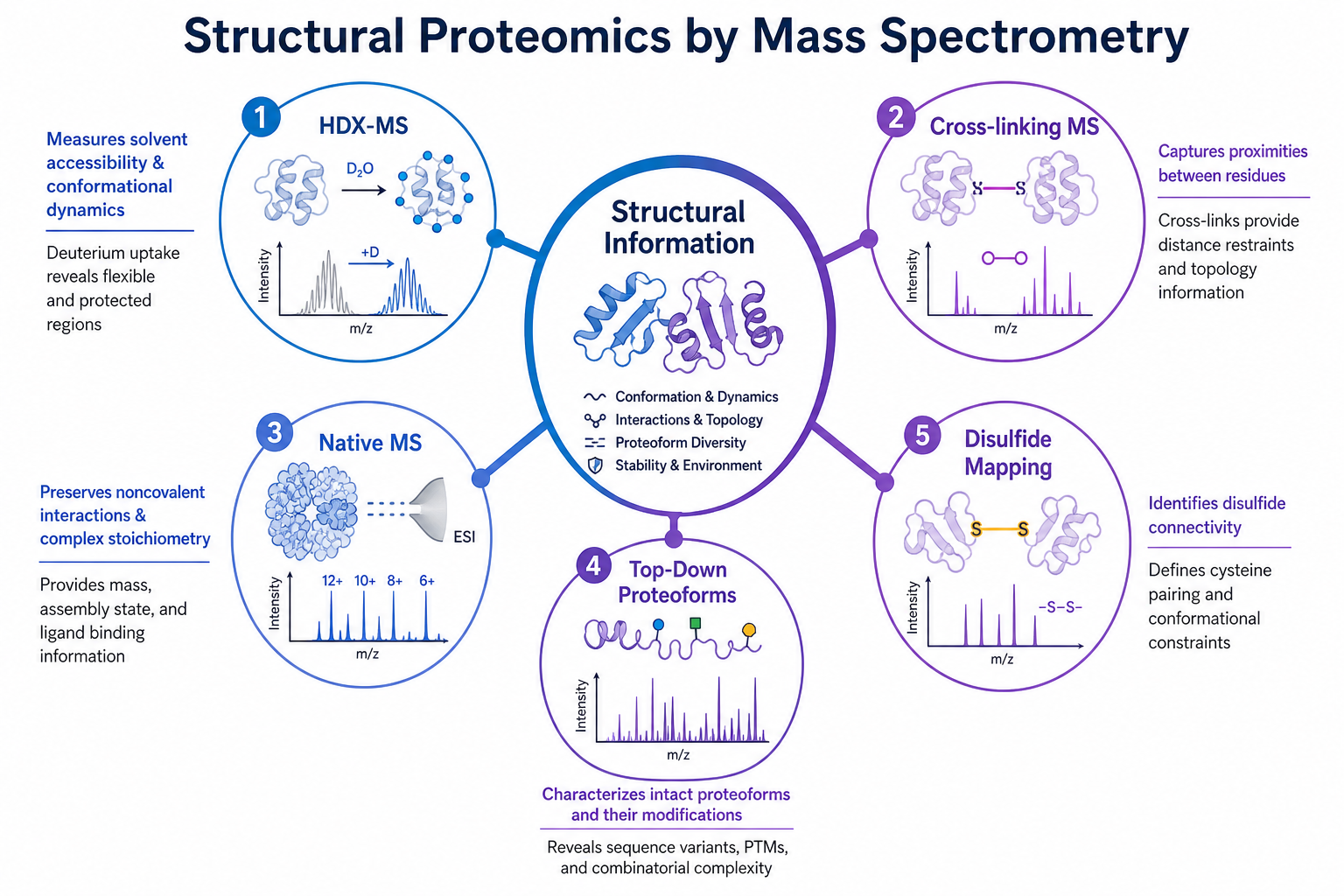
Figure 2. Structural proteomics by mass spectrometry includes HDX-MS, cross-linking MS, native MS, top-down proteoform analysis, and connectivity mapping.
A Practical Structural Proteomics Workflow
A structural proteomics project should begin with the structural claim that must be supported, not with instrument availability alone.
Step one defines the structural question. Examples include whether disulfide bonds are correctly paired, whether a ligand induces conformational protection, which subunits assemble into a complex, or whether a biologic contains additional intact proteoforms.
Step two selects the MS approach or combination of approaches that can measure that feature with acceptable confidence.
Step three designs sample handling to preserve the relevant structural state. Native complexes, HDX labeling, and cross-linking each impose different timing, buffer, and temperature constraints.
Step four performs MS acquisition under conditions matched to the method, whether intact protein analysis, timed deuterium labeling, cross-linked peptide LC-MS/MS, or non-reduced peptide mapping.
Step five interprets structural evidence with method-specific review standards, including control experiments, false discovery controls for identifications, and structural plausibility checks for cross-links or protection changes.
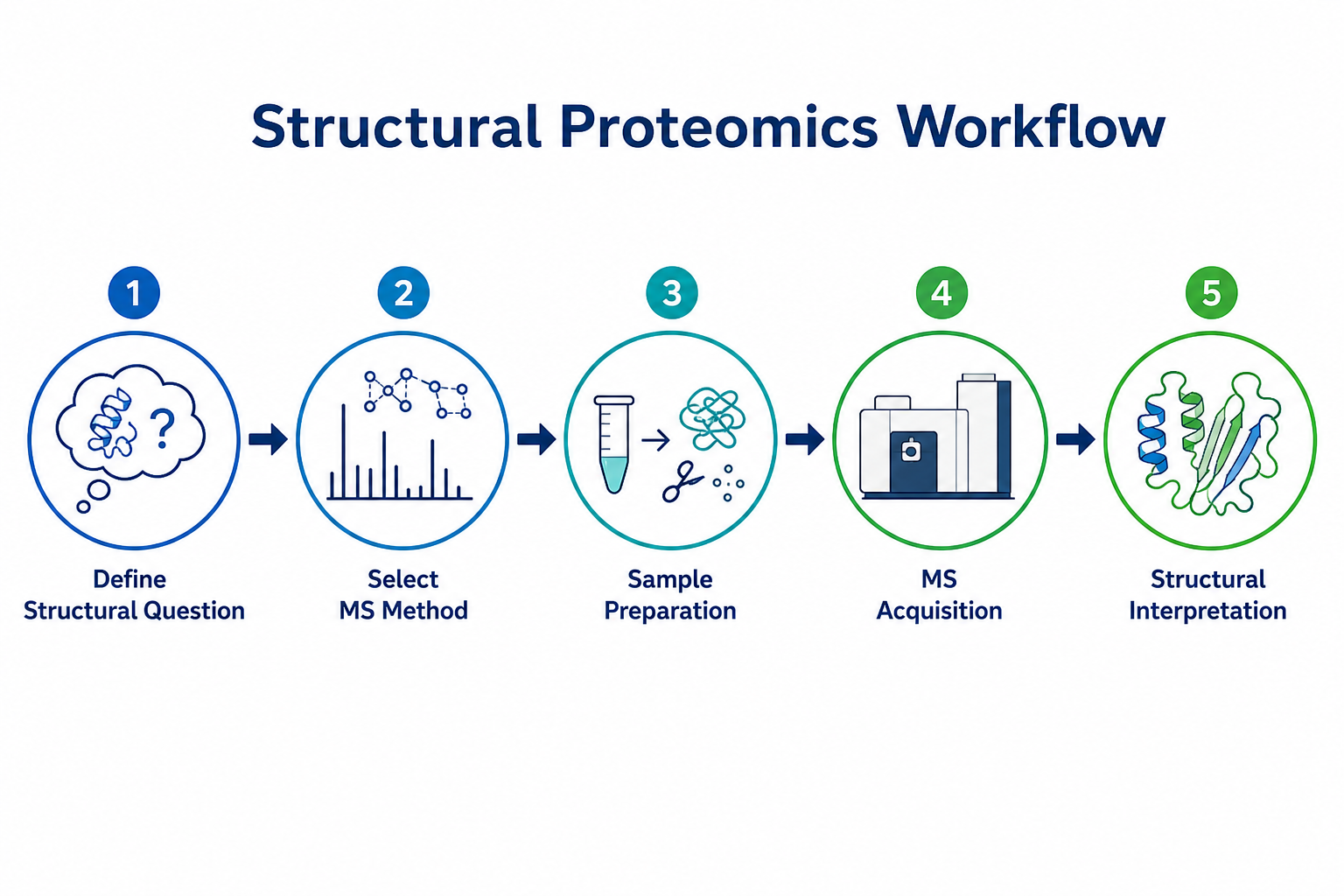
Figure 3. Structural proteomics projects move from a defined structural question to method selection, controlled sample handling, MS acquisition, and interpretation.
Related Services
Structural proteomics projects often combine advanced MS characterization with protein interaction or biologics structure services. Relevant options include:
Hydrogen Deuterium Exchange Mass Spectrometry, HDX MS Service
Chemical Cross-Linking Mass Spectrometry Analysis Service
Native Mass Spectrometry Analysis Service
Disulfide Bond Analysis Service
Protein-Protein Interactions Characterization Service | HDX-MS
Researchers planning structural proteomics by mass spectrometry should define the structural claim, sample constraints, and reporting format before phase 1 method selection and phase 2 data acquisition begin.
Method Selection by Structural Question
The method should follow the question. The table below links common structural questions to MS approaches used in practice.
|
Structural Question |
Useful MS Approach |
Typical Evidence Output |
|---|---|---|
|
Are disulfide bonds correctly paired? |
Non-reduced peptide mapping LC-MS/MS |
Disulfide-linked peptide assignments |
|
Does binding alter protein conformation? |
HDX-MS |
Differential deuterium uptake profiles |
|
Which proteins form a complex? |
Affinity purification MS or XL-MS |
Copurified proteins or residue cross-links |
|
What is the intact proteoform profile? |
Native MS or top-down MS |
Intact mass and proteoform fragmentation |
|
Where are interaction interfaces located? |
XL-MS or HDX-MS |
Cross-linked residue pairs or protected regions |
|
Did process change alter higher-order structure? |
Combined peptide mapping and intact MS |
Coverage plus intact mass or connectivity shifts |
Combined workflows are common. A biologics program may use peptide mapping for coverage and disulfide assignment, then apply native MS to compare intact mass profiles across batches.
Applications in Biologics and Mechanistic Research
Structural proteomics by mass spectrometry supports several research and development settings.
In biologics characterization, MS-based structural analysis supports higher-order structure review, disulfide connectivity confirmation, comparability assessment after manufacturing changes, and intact mass monitoring of product variants.
In protein complex biology, cross-linking MS and affinity-MS workflows help define subunit contacts and interaction networks in purified or enriched assemblies.
In drug mechanism studies, HDX-MS can localize binding-induced conformational changes for protein-ligand or protein-protein interactions when controlled experiments are feasible.
In proteoform-focused research, top-down and native MS clarify variant architecture when expression-level peptide data are insufficient to explain intact mass behavior.
These applications share a need for clear controls and conservative interpretation. Structural claims should remain tied to the specific MS evidence type generated in the experiment.
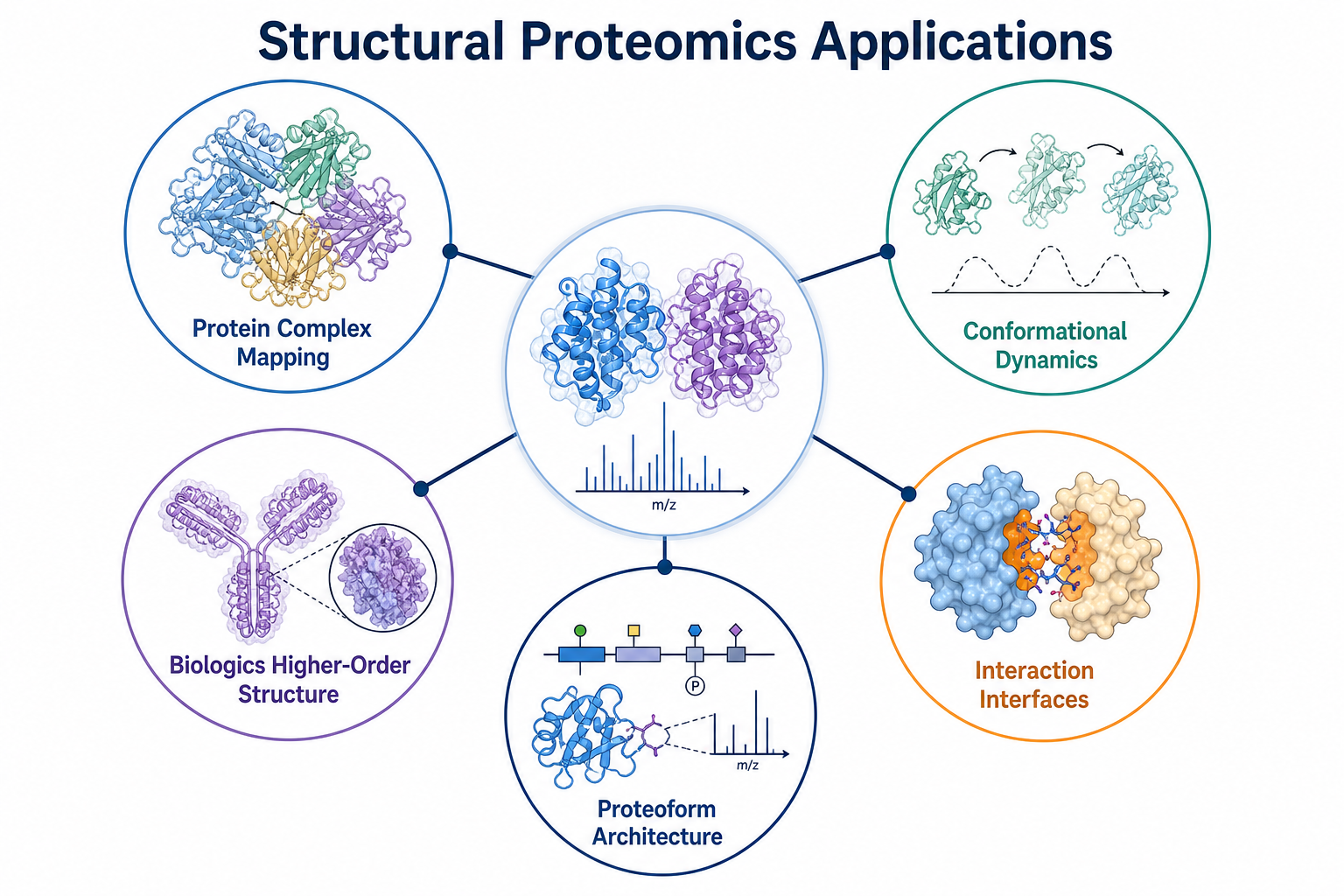
Figure 4. Structural proteomics by mass spectrometry supports complex mapping, conformational analysis, biologics higher-order structure review, and proteoform characterization.
Technical Value and Current Limits
Technical Value
Mass spectrometry can provide structural information on lower sample amounts than some high-resolution structural methods require.
Multiple structural layers can be measured in a coordinated program, from connectivity mapping to intact mass and conformational protection.
MS-based structural workflows integrate with biologics characterization, interaction proteomics, and discovery follow-up in many laboratories.
Current Limits
Not every structural detail can be resolved by MS alone. Atomic-resolution folding is usually inferred with complementary methods.
Sample handling constraints are strict for native MS, HDX-MS, and cross-linking MS.
Interpretation often requires method-specific expertise and well-designed controls.
Complex mixtures reduce confidence for intact assembly assignment without enrichment or purification.
Frequently Asked Questions
What is structural proteomics?
Structural proteomics is the study of protein architecture, connectivity, interactions, and conformational behavior, often using mass spectrometry to generate residue-level or proteoform-level structural evidence.
How is structural proteomics different from standard proteomics?
Standard proteomics often focuses on protein identification and quantitation. Structural proteomics focuses on folding, connectivity, complexes, and conformational changes.
Which mass spectrometry methods are commonly used in structural proteomics?
Common methods include HDX-MS, chemical cross-linking MS, native MS, top-down proteoform analysis, and disulfide or connectivity mapping by LC-MS/MS.
Can structural proteomics support biologics development?
Yes. It is widely used for higher-order structure review, disulfide connectivity confirmation, comparability analysis, and intact proteoform monitoring in therapeutic protein programs.
Do structural proteomics experiments replace crystallography or cryo-EM?
Usually not completely. MS-based structural proteomics often complements higher-resolution methods by providing accessible connectivity, interaction, and conformational evidence under project-relevant conditions.
Conclusion
Mass spectrometry has become a central tool in structural proteomics because it can measure connectivity, proteoform architecture, interaction proximity, and conformational behavior in ways that expression-focused proteomics alone cannot. Hydrogen-deuterium exchange MS, cross-linking MS, native MS, top-down analysis, and connectivity mapping each address a distinct structural layer. The right choice depends on the claim that must be supported, the sample format, and the level of structural resolution required.
Strong structural proteomics programs define the structural question early, preserve relevant protein states during sample handling, and interpret MS evidence with method-matched controls. That discipline is what converts mass spectrometry data into structural insight rather than a generic protein list with unsupported higher-order conclusions.
Teams planning structural proteomics by mass spectrometry can contact MtoZ Biolabs to review the structural question, method fit, and reporting depth required for the project.
If a program needs coordinated connectivity mapping and intact protein characterization, MtoZ Biolabs can help design a phased workflow that links peptide-level and intact MS evidence.
Researchers evaluating structural proteomics options for biologics or interaction studies can request a project assessment from MtoZ Biolabs to define phase 1 method selection and phase 2 structural deliverables.
How to order?




