






Mass Spectrometry Antibody Sequencing for Protein-Only Samples: How to Plan the Right Recovery Strategy
A protein-only recovery project should begin with a simple question: what sequence information will actually support the next decision? In mass spectrometry antibody sequencing, that usually means choosing among CDR / complementarity-determining region recovery, broader variable region reconstruction, or a re-expression-oriented consensus sequence package before any sample is used. That choice affects cleanup strategy, protease digestion, chain assignment, and how much orthogonal validation will be needed later.
When hybridoma material, plasmids, RNA, or DNA are no longer available, a protein-only sample may be the only realistic starting point. In that situation, mass spectrometry antibody sequencing is not just a generic sequencing task. It is a planning exercise. What can this antibody sample still tell you? How much sequence ambiguity can the project tolerate? What level of evidence is needed before recombinant re-expression or assay transfer?
Where the Protein-Only Recovery Problem Starts
This problem usually shows up after continuity has already been lost somewhere in the program history. A team may still have a purified antibody that works in a binding assay, an archival antibody sample tied to older data, or an old reference vial from a transferred program. The reagent still matters. The original biological source does not.
The immediate need is rarely “get every residue at any cost.” More often, the team needs to answer one of a few practical questions:
- Do we have enough CDR evidence to compare this reagent to a historical sequence?
- Can we recover the heavy chain and light chain variable region well enough to nominate recombinant re-expression candidates?
- Is the sample only suitable for peptide mapping and region-specific confirmation?
- Should we keep searching for lost biological material in parallel?
If that decision is not defined early, limited sample can be spent on a broad de novo sequencing effort that generates technically valid peptide-spectrum match data but still leaves the project risk in place.
The Main Planning Failures to Avoid
Most unsuccessful recovery efforts come back to four problems that matter directly in this setting.
1. The recovery goal is too broad or poorly matched to the project
A request for “full antibody sequencing” often hides a much narrower real objective. If the project only needs CDR confirmation, a full variable region reconstruction workflow may add cost and complexity without improving the decision. The opposite happens too. Teams planning recombinant re-expression sometimes underestimate how much framework region support and chain assignment confidence they need.
2. The sample is treated as sequencing-ready without enough assessment
A purified antibody is not automatically a clean input for LC-MS/MS. Formulation excipients, carrier proteins, visible precipitation, repeated freeze-thaw exposure, fragmentation, oxidation, and glycosylation can all reduce peptide observability or complicate sequence assembly. With an archival antibody sample, storage history can matter just as much as sample mass.
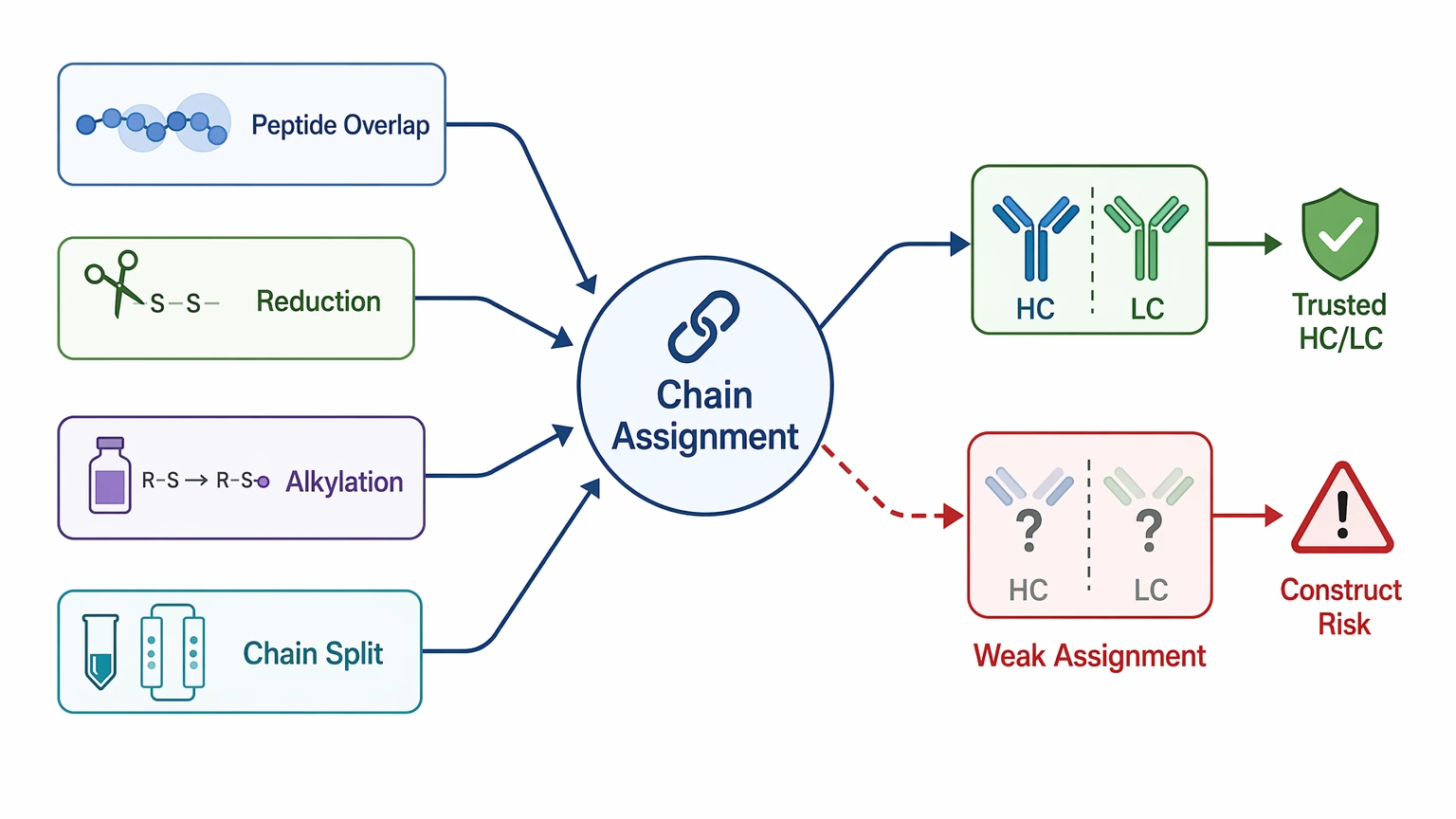
3. Chain assignment is assumed rather than demonstrated
In protein-based de novo sequencing, heavy chain and light chain reconstruction depend on peptide overlap, disulfide reduction strategy, alkylation, and sometimes chain-separation logic. A plausible peptide list does not automatically produce a trustworthy consensus sequence. If chain assignment is weak, downstream construct design becomes much less dependable.
4. Sequence ambiguity is treated as an afterthought
Mass spectrometry antibody sequencing can still be useful when some positions remain uncertain. But only if that uncertainty is reported plainly. Isobaric residues such as leucine and isoleucine, modification-related mass shifts, and low-support peptide segments should be flagged as sequence ambiguity, not folded into a polished-looking final sequence.
Step-by-Step Project Planning Guide
This is fundamentally a project-planning problem, so the right structure is not a generic lab workflow. The practical order is: define the decision, test feasibility, set the recovery depth, frame the deliverable, and prepare validation.
Step 1: Define the decision the sequence must support
Start with the downstream use case. A protein-only sample can support different outputs, and those outputs are not interchangeable.
| Project need | Most useful deliverable | Typical tolerance for sequence ambiguity |
|---|---|---|
| Historical comparison | CDR peptides and regional consensus sequence | Moderate outside CDR |
| Molecule reconstruction | Heavy chain and light chain variable region consensus sequence | Lower in key variable region segments |
| Recombinant re-expression | Candidate heavy chain and light chain sequences with annotated uncertainty | Low in CDR, controlled elsewhere |
| Identity confirmation | Peptide mapping plus targeted sequence evidence | Moderate |
This first choice determines how much peptide coverage, protease digestion diversity, and sequence assembly support the project should require. If your team is deciding whether the remaining material can support re-expression planning, this is also the right point to submit your requirements internally and define the minimum acceptable deliverable before lab work begins.
Step 2: Assess whether the protein-only sample can support de novo sequencing
A realistic plan starts with the material you actually have, not the sample you wish you had. Review these factors before choosing workflow depth:
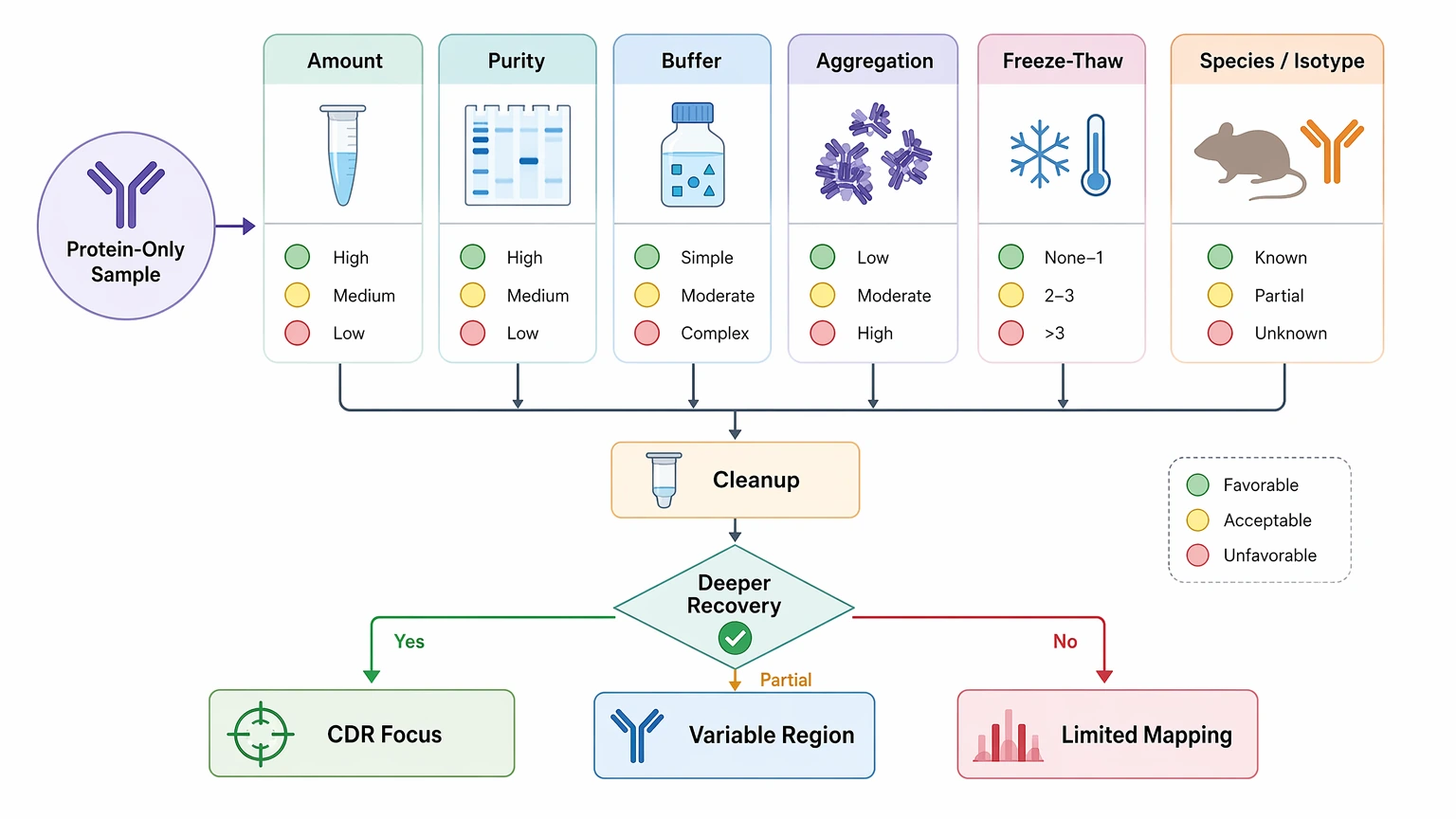
- remaining antibody amount and concentration
- whether the material is a purified antibody or part of a mixed background
- formulation buffer complexity, including surfactants, stabilizers, or carrier proteins
- visible precipitation, clipping, or aggregation
- storage time and freeze-thaw history
- known species, isotype, or fragment information
A clean monoclonal purified antibody gives you the best chance of strong peptide mapping and variable region recovery. A stressed archival vial may still be workable, but it usually calls for tighter expectations and more deliberate sample preparation. If the antibody is in a complex formulation buffer, cleanup may be required before informative LC-MS/MS can even start.
Step 3: Match the sequencing target to the sample condition
Once feasibility is clearer, set the recovery depth.
A CDR-focused strategy fits limited or stressed material when the highest-value question centers on binding-related regions. A variable region strategy makes more sense when the sample appears intact enough and the next step needs broader VH/VL reconstruction. A re-expression-oriented strategy should be chosen only when the evidence package can support candidate construct design, not just partial peptide identification.
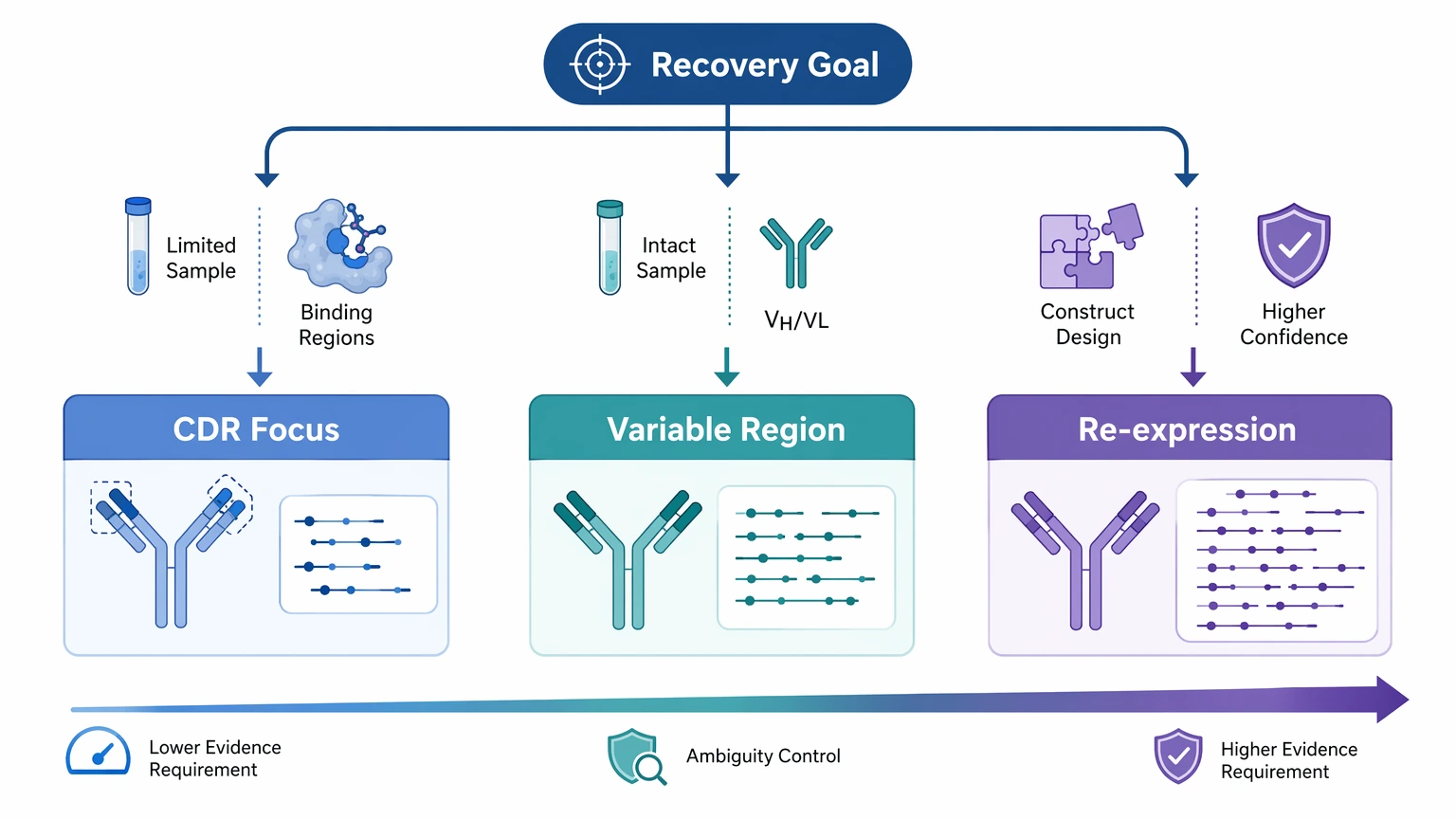
This is where expectations matter. A useful project may end with a region-ranked consensus sequence, peptide-spectrum match support, and a short list of ambiguity positions. That can still be enough to move a decision forward, even if the result is not a certainty-free end-to-end sequence.
Step 4: Build the peptide generation and sequence assembly plan around antibody-specific risks
For mass spectrometry antibody sequencing from a protein-only sample, overlapping evidence matters more than any single digest result. The planning logic usually includes:
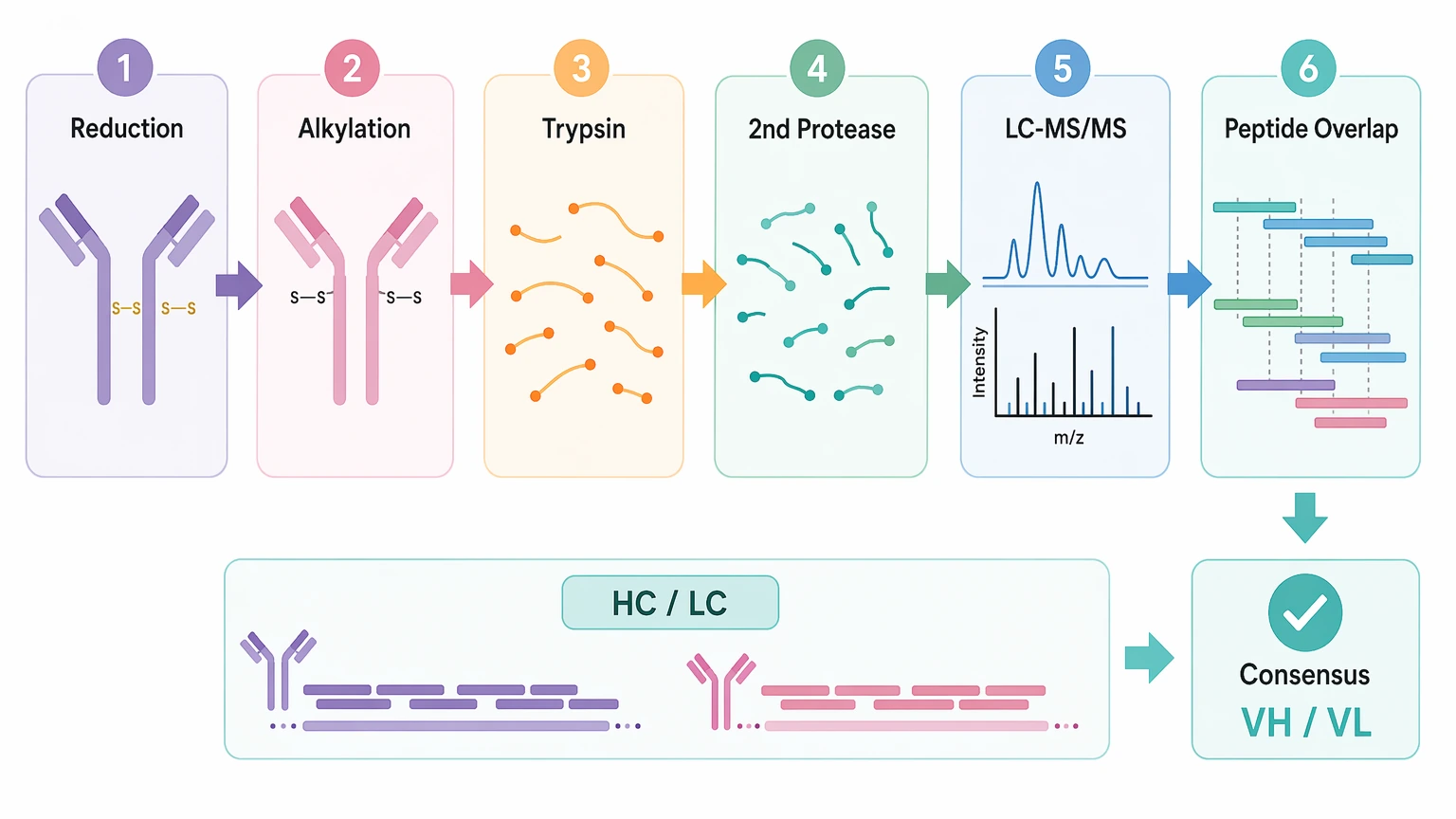
- disulfide reduction to open chain-linked structure
- alkylation to stabilize cysteine-containing peptides
- more than one protease digestion condition to improve overlap
- peptide mapping review across framework region and CDR segments
- attention to glycosylation and other PTM / post-translational modification effects
- explicit chain assignment review for heavy chain and light chain evidence
The antibody-specific challenge is not simply detecting peptides. The real question is whether those peptides support sequence assembly in a way that preserves variable region logic. Framework region peptides often anchor the reconstruction. CDR peptides may be shorter, more diverse, or harder to observe consistently. Heavy chain coverage may also be disrupted by glycosylation or storage-related modifications.
If your next decision is whether to move into construct design, this is a good point to evaluate the project with a sequencing team that can connect peptide evidence to deliverable format. For example, MtoZ Biolabs can review sample condition, target depth, and expected ambiguity before you commit scarce material to a full recovery attempt.
Step 5: Decide how sequence ambiguity will be reported
A strong deliverable does not hide uncertainty. It organizes it. Before work starts, define how sequence ambiguity will be documented and how that information will be used later.
Useful reporting elements often include:
- peptide-spectrum match support by region
- consensus sequence for each variable region segment
- unresolved residues, including likely leucine/isoleucine positions
- PTM-related alternative interpretations
- chain assignment confidence reported separately for heavy chain and light chain
This matters most when the goal is recombinant re-expression. Construct design can move forward with some controlled uncertainty, but only when those positions are visible and interpreted in context.
Step 6: Plan orthogonal validation before recombinant re-expression
A consensus sequence is a recovery output, not proof that the original antibody has been fully recreated. If the next stage is recombinant re-expression, validation should already be part of the project scope.
Typical follow-up steps include:
- expression of candidate heavy chain and light chain pairs
- binding comparison with the original antibody material
- functional assay comparison when a known activity readout exists
- analytical confirmation such as intact mass review or follow-up peptide mapping
Teams should also keep searching for biological material when there is still a realistic chance of finding it. If frozen cells, old plasmids, or residual RNA later become available, PCR- or hybridoma-based recovery can serve as orthogonal validation rather than a replacement for the protein-based work already completed.
What a Good Deliverable Looks Like
For this kind of project, the best result is usually not “one final sequence with no caveats.” A more useful deliverable for decision-making often includes:
- LC-MS/MS-based peptide mapping summary
- de novo sequencing evidence for the variable region
- sequence assembly notes by region
- heavy chain and light chain chain assignment rationale
- a consensus sequence with explicit ambiguity annotation
- practical guidance on what is ready for recombinant re-expression and what still needs orthogonal validation
That format gives assay teams, outsourcing managers, and discovery groups a clearer way to judge whether the recovered information is enough for the next milestone.
Final Planning Cautions
Preserve reserve material whenever possible. Recovery projects often fail because all remaining sample is consumed in a first pass that was never aligned with the actual decision.
Do not assume monoclonality if the sample history is unclear. Mixed immunoglobulin backgrounds can make peptide mapping and sequence assembly much harder to interpret.
Treat PTM burden as a planning variable, not a footnote in the report. Oxidation, deamidation, pyroglutamate formation, and glycosylation can shift peptide behavior and change how confidently a region can be reconstructed.
Finally, keep “sequence recovered” separate from “project risk removed.” Those are not the same milestone. If your team needs to decide whether a legacy purified antibody is suitable for re-expression, assay transfer, or historical backtracking, contact MtoZ Biolabs to evaluate your project and submit your requirements before limited material is consumed.
Conclusion
The right recovery strategy for mass spectrometry antibody sequencing in a protein-only sample starts with a narrow technical question: do you need CDR evidence, broader variable region reconstruction, or candidate sequences for recombinant re-expression? From there, sample condition, peptide mapping quality, sequence assembly support, and chain assignment confidence determine how far the project should go and where orthogonal validation becomes necessary. This planning approach fits hybridoma loss, missing nucleic-acid records, legacy purified antibody recovery, and archival antibody sample backtracking. If you are working with limited material and need to define a feasible path before sequencing begins, contact us to discuss the sample, validation burden, and next-step deliverables.
FAQ
How much sample history is worth collecting before starting a sequencing project?
Even partial history is useful. Buffer composition, storage duration, freeze-thaw count, prior purification notes, and whether the vial ever showed precipitation can all affect cleanup and digestion strategy. A short sample history often improves planning more than a small increase in sample amount.
Can mass spectrometry antibody sequencing distinguish whether two historical antibody lots are likely the same reagent?
It can support that comparison, especially through peptide mapping and variable region evidence, but the answer may still be region-specific rather than absolute. Lot comparison is usually stronger when sequence evidence is paired with intact mass or functional comparison.
When should a team stop pushing for full variable region reconstruction and switch to a narrower goal?
That shift usually makes sense when the sample is heavily formulated, clearly degraded, mixed with background proteins, or too limited to support replicate protease digestion. In those cases, CDR-focused recovery or targeted confirmation may preserve material and still answer the key project question.
Why is chain assignment often harder than peptide identification?
Peptides can be detected without clearly proving whether they belong to the heavy chain or light chain in the final reconstruction. Chain assignment requires overlap, context, and antibody-aware interpretation, especially when coverage is incomplete.
Is back-translation enough to build expression constructs from a protein-derived sequence?
Back-translation can support construct design, but it does not resolve every uncertainty introduced by protein-based inference. Teams still need to review ambiguous residues, chain pairing assumptions, and functional validation plans before treating a construct as representative of the original antibody.
What should an outsourcing manager ask for in a sequencing proposal?
Ask for the expected deliverable level, regional confidence reporting, treatment of sequence ambiguity, chain assignment logic, sample consumption plan, and the recommended orthogonal validation path for recombinant re-expression.
How to order?




