






IP-MS vs. Co-IP-MS vs. AP-MS: Which Workflow Fits Your Study?
The Decision Behind IP-MS, Co-IP-MS, and AP-MS
Many protein interaction projects stall at the same point: the biological question is clear, but the enrichment strategy is not. A team may know that a target protein participates in a pathway, yet still need to choose among immunoprecipitation, co-immunoprecipitation with mass spectrometry, affinity purification-mass spectrometry, or pull-down-MS.
These workflows all enrich proteins before LC-MS/MS, but they answer different questions. IP-MS focuses on antibody-based recovery of a bait protein and associated partners. Co-IP-MS emphasizes discovery of endogenous interactors. AP-MS uses a tagged bait for broader interactome mapping. Pull-down-MS tests binding with a defined recombinant bait outside the native cellular context.
This article compares IP-MS, Co-IP-MS, and AP-MS, places pull-down-MS in the same decision framework, and explains when an antibody validated for IP-MS is required for a reliable study design.
What Each Workflow Is Designed to Answer
The first comparison step is to match each method to a primary research question.
IP-MS asks whether an antibody can enrich a bait protein from a complex sample and which proteins co-purify under those conditions. It is often used when the bait is endogenous, when antibody performance must be evaluated, or when the goal is to recover a known target with associated partners for mass spectrometry.
Co-IP-MS asks which proteins associate with an endogenous bait under physiological or near-physiological conditions. The bait is usually captured with a specific antibody, and MS identifies co-enriched candidates. The output is a list of candidate interactors that still require validation.
AP-MS asks what proteins associate with an affinity-tagged bait expressed in a defined system. The tag replaces antibody dependence for bait capture and supports systematic interactome studies across conditions or mutants.
Pull-down-MS asks whether a purified recombinant bait can bind specific partners from a lysate or recombinant protein pool. It is useful for hypothesis testing and direct binding assessment, but it does not fully represent endogenous complex architecture.
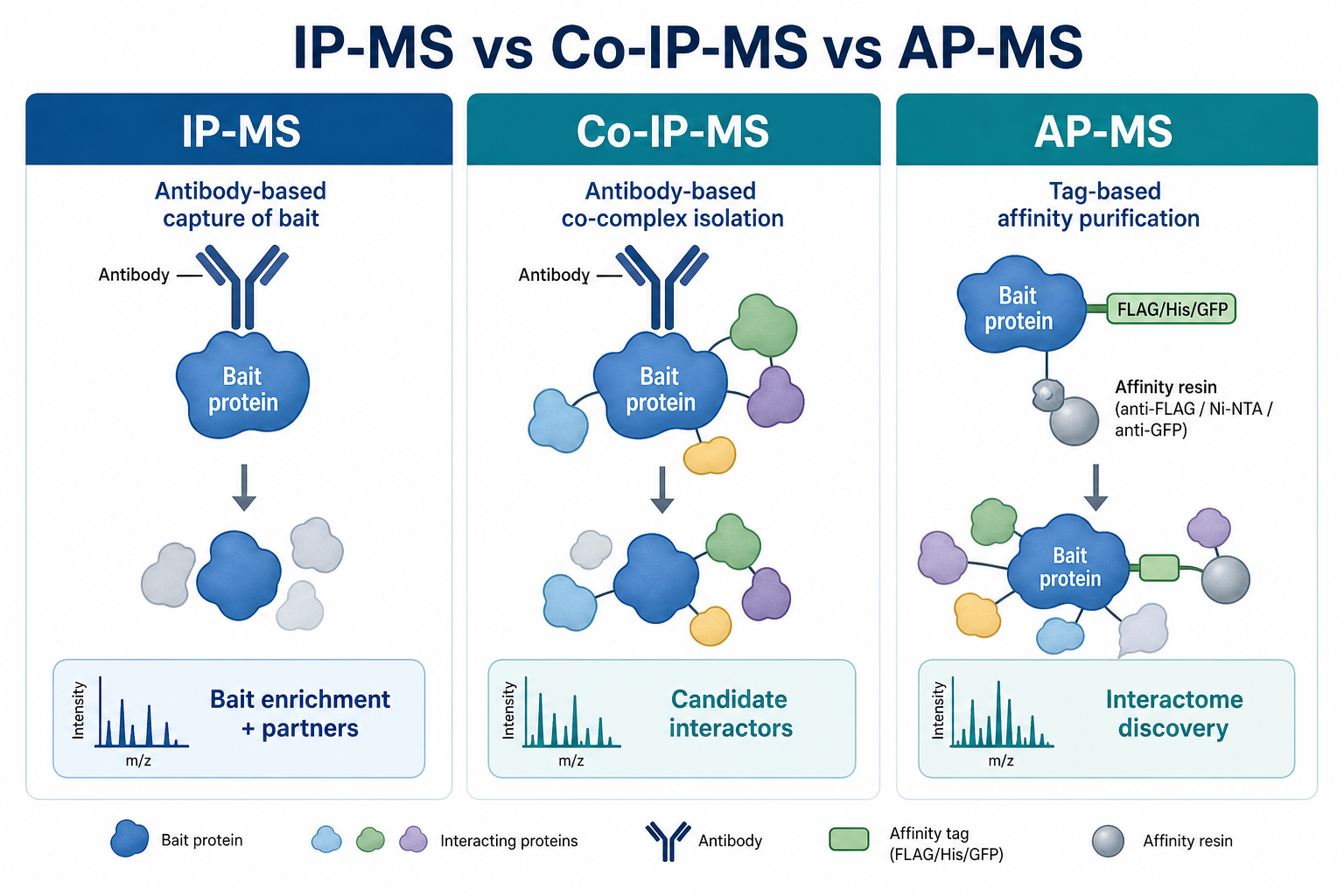
Figure 1. IP-MS and Co-IP-MS rely on antibody capture of endogenous bait, while AP-MS uses a tagged bait for affinity purification before mass spectrometry.
Core Comparison Dimensions
A practical method choice depends on five dimensions: bait format, antibody dependence, interaction context, discovery breadth, and validation burden.
Bait Format
IP-MS and Co-IP-MS typically start from endogenous proteins. AP-MS starts from tagged constructs. Pull-down-MS starts from recombinant bait proteins. If tagging is not allowed or endogenous context is required, antibody-based workflows are usually preferred.
Antibody Dependence
Antibody-based IP and Co-IP succeed only when the antibody works under immunoprecipitation conditions. An antibody validated for IP-MS has been shown to enrich the intended bait with acceptable specificity and yield for downstream mass spectrometry. Tag-based AP-MS reduces dependence on target-specific antibodies but introduces tag and overexpression considerations.
Interaction Context
Co-IP-MS preserves more of the endogenous cellular context than recombinant pull-down assays. AP-MS can preserve complex formation in the expression system used, but the tag and expression level can alter partner selection. Pull-down-MS is strongest for confirming direct or reconstituted binding under controlled conditions.
Discovery Breadth
AP-MS and Co-IP-MS are commonly used for discovery of candidate interactors. IP-MS may be narrower when the project prioritizes bait recovery and antibody performance. Pull-down-MS is usually more targeted unless used as a screening assay with careful controls.
Validation Burden
All MS-based enrichment workflows generate candidates, not final interaction proof. Orthogonal confirmation by Western blot, reciprocal IP, proximity labeling, or functional assays remains necessary when biological claims depend on specific interactions.
Method-by-Method Analysis
IP-MS
IP-MS combines immunoprecipitation with LC-MS/MS to identify proteins recovered by antibody capture. In many laboratories, IP-MS is used both as an interaction discovery tool and as a practical way to evaluate whether an antibody performs under IP conditions for MS readout.
IP-MS is appropriate when the bait is endogenous, when a validated antibody is available or under evaluation, and when the project needs bait enrichment plus associated protein identification. It is less suitable when no antibody with documented IP performance exists and tagging is a viable alternative.
Because antibody quality dominates the outcome, projects that depend on IP-MS should confirm that the antibody is validated for IP-MS in the relevant sample type, lysis buffer, and detection format. Western blot reactivity alone does not guarantee IP-MS suitability.
Co-IP-MS
Co-IP-MS uses antibody capture of an endogenous bait to recover protein complexes, followed by MS identification of co-enriched partners. Relative to classical Co-IP with Western blot, Co-IP-MS expands the searchable partner space beyond predefined candidates.
Co-IP-MS fits studies that ask which proteins associate with a native bait in cells or tissues. It is especially useful when the research goal is endogenous interactome discovery and a high-quality IP antibody is available.
Limitations include antibody cross-reactivity, nonspecific binder enrichment on beads, and loss of weak or transient interactions during washing. Quantitative designs with controls, replicates, and enrichment filters are required before ranking candidates.
Co Immunoprecipitation (Co-IP) Service
AP-MS
AP-MS uses an affinity tag on the bait protein for purification, then identifies co-purifying proteins by mass spectrometry. Common tags include FLAG, HA, His, Strep, and GFP-related systems, selected according to expression system and purification chemistry.
AP-MS is a strong option when tagging is acceptable, when antibody performance is uncertain, or when systematic comparison across mutants and conditions is needed. It supports broader interactome mapping than many antibody-limited Co-IP designs.
AP-MS does not eliminate false positives. Tag effects, overexpression artifacts, and bead background still require controls such as empty-tag lines, quantitative comparison, and orthogonal validation. Endogenous complex stoichiometry may differ from that of tagged systems.
Affinity Purification-Mass Spectrometry Service
Pull-Down-MS in the Same Decision Space
Pull-down-MS is often grouped with IP-MS and AP-MS because it also couples affinity enrichment to mass spectrometry. The critical difference is the bait source. Pull-down assays typically use immobilized recombinant bait proteins rather than antibodies against endogenous bait or cellular tagged constructs.
Pull-down-MS is useful when a hypothesis already exists and direct binding evidence is needed. It can also help map domains or mutant effects under controlled conditions. It is not the first choice for unbiased endogenous interactome discovery.
Pull Down based Protein Analysis Service with Mass Spectrometry
Comparison Table for Study Design
|
Decision Factor |
IP-MS |
Co-IP-MS |
AP-MS |
Pull-Down-MS |
|---|---|---|---|---|
|
Typical bait |
Endogenous protein |
Endogenous protein |
Tagged protein |
Recombinant bait |
|
Capture strategy |
Antibody |
Antibody |
Affinity tag |
Immobilized bait |
|
Needs IP-MS validated antibody |
Yes |
Yes |
No |
No |
|
Best for |
Bait enrichment and associated partners |
Endogenous interactor discovery |
Systematic interactome mapping |
Direct or reconstituted binding tests |
|
Main risk |
Poor antibody performance |
Background binders and weak recovery |
Tag or overexpression artifacts |
Non-physiological binding |
|
Typical next step |
Confirm bait enrichment and candidates |
Prioritize and validate interactors |
Filter background and validate hubs |
Confirm with endogenous assays |
No single workflow is universally superior. The fit depends on whether the project prioritizes endogenous context, antibody availability, tagging flexibility, or controlled binding confirmation.
Scenario-Based Recommendations
Scenario 1: Endogenous Bait with a Strong Antibody
If the bait is endogenous and an antibody validated for IP-MS is available, Co-IP-MS is usually the most direct discovery route. IP-MS remains appropriate when the immediate goal is to confirm antibody enrichment quality before expanding to broader interactor ranking.
Scenario 2: No Reliable IP Antibody
If available antibodies fail under IP conditions, AP-MS with a carefully designed tag is often more productive than continuing antibody screening. Parallel empty-tag controls should be planned from the start.
Scenario 3: Need for Condition or Mutant Comparison
AP-MS is often preferred when many constructs must be compared under matched purification chemistry. Co-IP-MS can still work if one antibody performs consistently across all conditions.
Scenario 4: Direct Binding Confirmation
When the question is whether two proteins can bind, pull-down-MS or targeted reciprocal assays are usually more efficient than a broad Co-IP-MS discovery screen.
Scenario 5: Antibody Product or Reagent Qualification
When the question is whether an antibody is suitable for immunoprecipitation prior to MS, IP-MS is the relevant workflow. Successful bait enrichment, acceptable background, and reproducible recovery are the key acceptance criteria for an antibody validated by IP-MS.
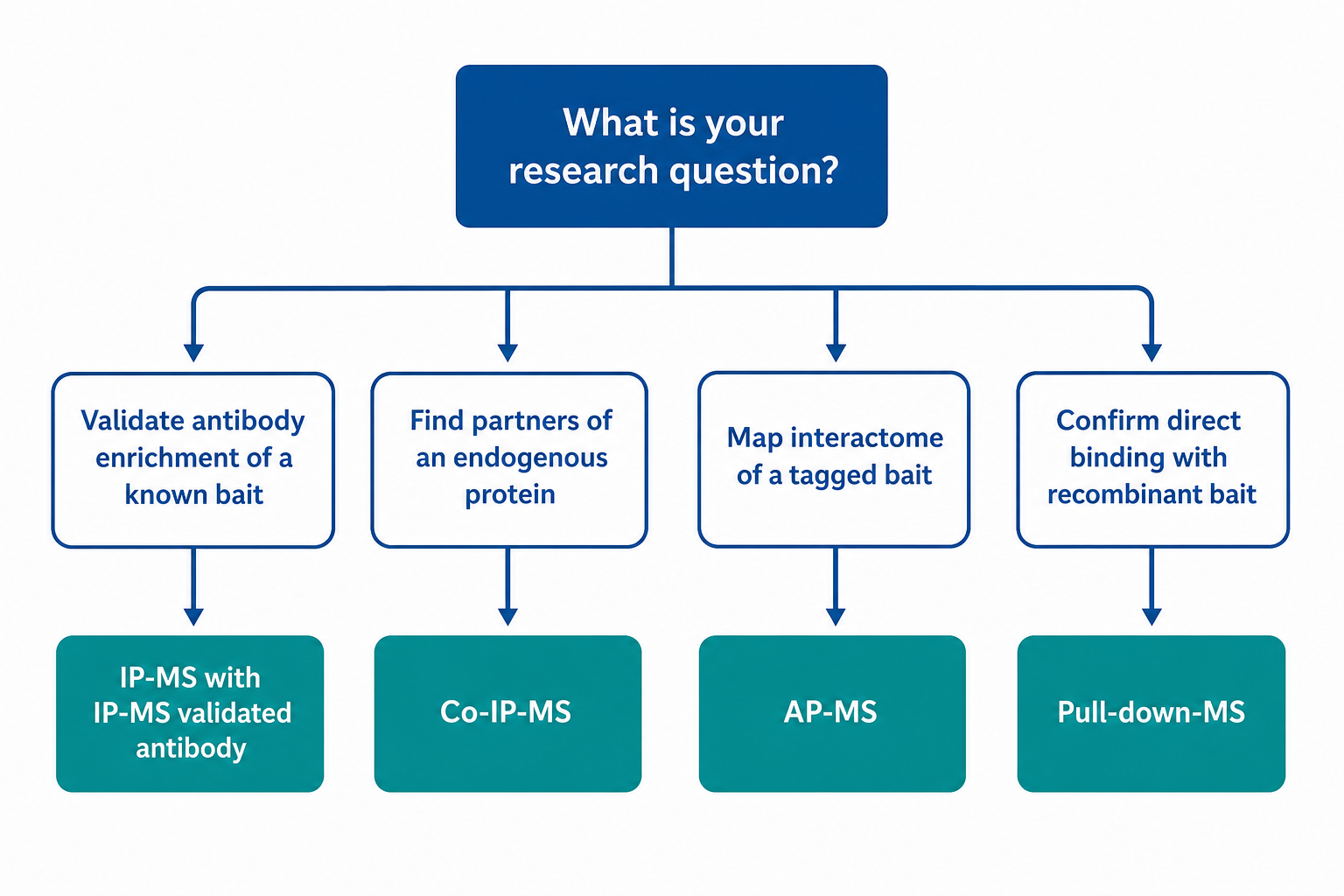
Figure 2. A practical decision path links research question to IP-MS, Co-IP-MS, AP-MS, or pull-down-MS.
Why Antibody Validation Matters for IP-MS and Co-IP-MS
Antibody performance is the main controllable variable in antibody-based enrichment MS. An antibody can work in Western blot or immunofluorescence and still fail in IP-MS because epitope accessibility, lysis conditions, and bead chemistry differ.
An antibody validated for IP-MS should demonstrate:
- enrichment of the intended bait relative to isotype or bead-only controls
- compatibility with the lysis and wash buffers needed for complex recovery
- sufficient bait yield for reliable LC-MS/MS detection
- an acceptable background profile under the planned MS workflow
Without this validation step, Co-IP-MS results are difficult to interpret. Apparent interactors may reflect nonspecific binders, while true partners may be missed because the bait was not efficiently captured.
Teams evaluating reagents for interaction proteomics should treat IP-MS antibody validation as a project gate, not as an optional quality check after data collection.
Related Services
Protein-Protein Interaction Analysis Service
MS-Based Protein-Protein Interaction Analysis Service
LC-MS Analysis of Pull-down Proteins
SILAC Based Co-IP-MS for Protein Interaction Analysis Service
Information Needed Before Choosing a Workflow
Before locking a method, define the following:
- research question: bait enrichment, endogenous discovery, tagged interactome, or direct binding
- bait format: endogenous, tagged, or recombinant
- antibody status: untested, Western-only, or validated for IP-MS
- sample type and amount: cells, tissue, lysate volume, and expected bait abundance
- control strategy: isotype IgG, empty tag, bead-only, or quantitative enrichment design
- expected output: bait confirmation, candidate interactor list, or binding confirmation
- validation plan for priority candidates after MS
MtoZ Biolabs supports Co-IP-MS, AP-MS, pull-down-MS, and broader protein interaction analysis for projects that need method selection before enrichment and LC-MS/MS. The technical team can review bait format, antibody status, control design, and whether IP-MS antibody validation should precede full interactome analysis.
To discuss workflow selection, contact MtoZ Biolabs with your bait protein, sample type, antibody or tag status, study groups, and the interaction question you need to answer.
Frequently Asked Questions
Is IP-MS the same as Co-IP-MS?
They overlap but are not identical in project emphasis. IP-MS focuses on antibody-based enrichment of a bait and associated proteins, and is often used to assess antibody performance. Co-IP-MS emphasizes discovery of endogenous interactors recovered with the bait.
When should I choose AP-MS instead of Co-IP-MS?
Choose AP-MS when tagging is acceptable and antibody performance is uncertain, or when matched purification across many constructs is required. Choose Co-IP-MS when endogenous context is essential and an antibody validated for IP-MS is available.
Do I need an IP-MS validated antibody for AP-MS?
No. AP-MS relies on affinity tags rather than target-specific IP antibodies. Controls for tag background and expression artifacts remain necessary.
How does pull-down-MS differ from AP-MS?
Pull-down-MS typically uses an immobilized recombinant bait to test binding partners. AP-MS usually purifies a tagged bait expressed in cells, recovering proteins that associate in that cellular context.
Can MS alone prove a protein-protein interaction?
No. Enrichment MS identifies candidates based on co-purification. Biological claims generally require orthogonal validation and careful control design.
Conclusion
IP-MS, Co-IP-MS, AP-MS, and pull-down-MS are related enrichment strategies with different decision criteria. Antibody-based IP and Co-IP workflows depend on reagents validated for IP-MS and are best suited to endogenous bait studies. AP-MS is often the better path for tagged systems and systematic interactome comparison. Pull-down-MS is most useful when direct or reconstituted binding needs controlled testing.
The strongest study designs start with a clear interaction question, honest assessment of antibody or tag readiness, and a control plan that matches the chosen workflow. Teams comparing these options can review sample type, bait format, and expected MS outputs with MtoZ Biolabs before committing to a single enrichment strategy.
How to order?




