






Hybridoma Monoclonal Antibody Sequencing Workflow: What to Check Before Sequence Rescue From Unstable Cell Lines
An unstable cell line does not automatically rule out sequence rescue. In many cases, hybridoma monoclonal antibody sequencing is still workable if you first confirm three things: which remaining sample source still preserves antibody identity, whether clonality is still believable, and whether the material on hand supports an RNA-based, DNA/amplicon-based, or purified antibody recovery path. When intact cells remain, transcript-based recovery is usually the most direct route to the variable region, including VH and VL. When the current culture is drifting or no longer trusted to represent the original clone, archived culture supernatant or purified antibody may carry stronger identity evidence, although chain pairing usually becomes less certain.
Before using limited sample, decide what the deliverable must be. If the goal is recombinant re-expression, a partial CDR call is rarely enough. Most teams need a full-length variable-region sequence, defensible heavy chain and light chain assignment, and a realistic sequence validation plan. That target should set the rescue strategy, not the reverse.
Why This Decision Becomes Urgent in Declining Hybridomas
This issue usually shows up after a previously useful hybridoma starts to slip. Viability drops after thaw, growth turns erratic, secretion falls, or recovery from frozen stock becomes inconsistent. In some projects, the only material left is a small pellet, one aging vial, stored supernatant, or a limited amount of antibody purified during an earlier production run.
At that point, the practical question is not whether sequencing can work in theory. The question is whether the remaining material can still support credible transcript recovery or protein-based rescue with enough confidence for downstream reconstruction. Common warning signs include weak amplification, multiple heavy chain or light chain candidates in NGS output, inconsistent isotype history, or LC-MS/MS data dominated by serum or host-cell background rather than immunoglobulin peptides.
The longer a failing clone is passaged or thawed again, the harder it becomes to show that current cells still match the antibody that originally mattered. That identity link often decides whether rescue is worth pursuing.
The Failure Modes That Matter Most
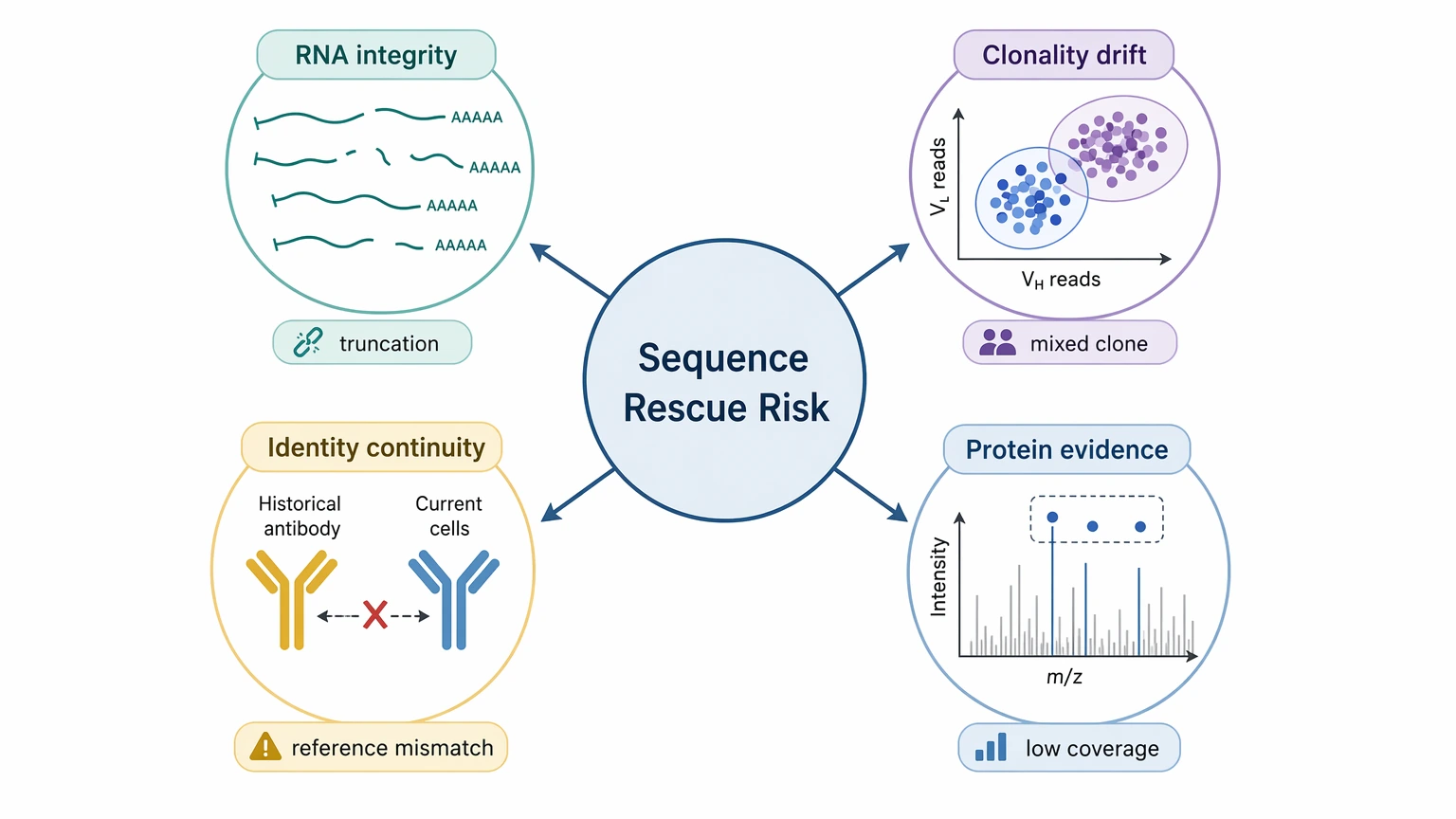
For this troubleshooting scenario, four cause categories usually matter more than a broad end-to-end workflow review.
1. RNA integrity and transcript loss
A low-viability hybridoma can still yield useful sequence information, but damaged RNA lowers confidence in clean heavy chain and light chain recovery. Stressed cells may show uneven transcript abundance, truncated products, or poor end coverage, which can complicate RACE and downstream interpretation.
2. Clonality drift or mixed population risk
An unstable cell line may no longer be truly monoclonal. A mixed population can produce several VH or VL candidates, and extra sequencing depth does not, by itself, identify the correct biological pair.
3. Antibody identity discontinuity
Earlier purified antibody may reflect the desired clone better than current cells do. If archived material and present-day cells point to different identities, the rescue plan needs to address that conflict directly instead of assuming the living culture is still the reference.
4. Inadequate protein evidence
De novo antibody sequencing can support rescue when cells are no longer dependable, but it still needs enough antibody amount, purity, and peptide coverage. Serum carryover, host-cell proteins, or multiple antibody species can lower confidence in sequence inference and orthogonal confirmation.
Step-by-Step Troubleshooting Before Sequence Rescue
This article follows a troubleshooting path: identify the dominant risk, choose the least fragile sample source, then match the method to the evidence you still have.
Step 1: Separate culture instability from sequence irrecoverability
Poor growth does not always mean the sequence is gone. Start by documenting:
- current viability trend
- post-thaw recovery behavior
- estimated cell input still available
- whether secretion declined gradually or abruptly
- prior isotype and kappa/lambda light chain information
If the clone grows poorly but still contains usable RNA, transcript recovery may still be practical. If antibody production has become inconsistent and heterogeneity is increasing, the bigger problem is often identity confidence rather than simple sequencing failure.
Step 2: Rank sample sources before choosing a platform
Do not choose the platform first. Choose the strongest evidence first.
| Sample source | Best use | Main advantage | Main limitation |
|---|---|---|---|
| Live hybridoma cells | RNA-based recovery | Direct access to expressed VH/VL | Sensitive to RNA degradation |
| Frozen vial remnants | RNA or DNA/amplicon support | May preserve an earlier clone state | Recovery after thaw may be poor |
| Cell pellet | Rescue triage when culture cannot continue | Useful when only residual cells remain | RNA integrity may be low |
| Culture supernatant | Antibody identity support | Reflects secreted product | Titer and background may limit use |
| Purified antibody | Protein-based rescue | Independent of failing cells | Chain pairing is harder |
| Archived earlier batches | Orthogonal confirmation | Links rescue to historical material | Often limited in volume |
If current cells are weak but trusted purified antibody from an earlier batch is available, a combined plan may be stronger than forcing an RNA-only workflow. Teams that need to weigh those options against the intended output can submit their requirements to MtoZ Biolabs for project evaluation around sample condition, rescue path, and expected sequence depth.
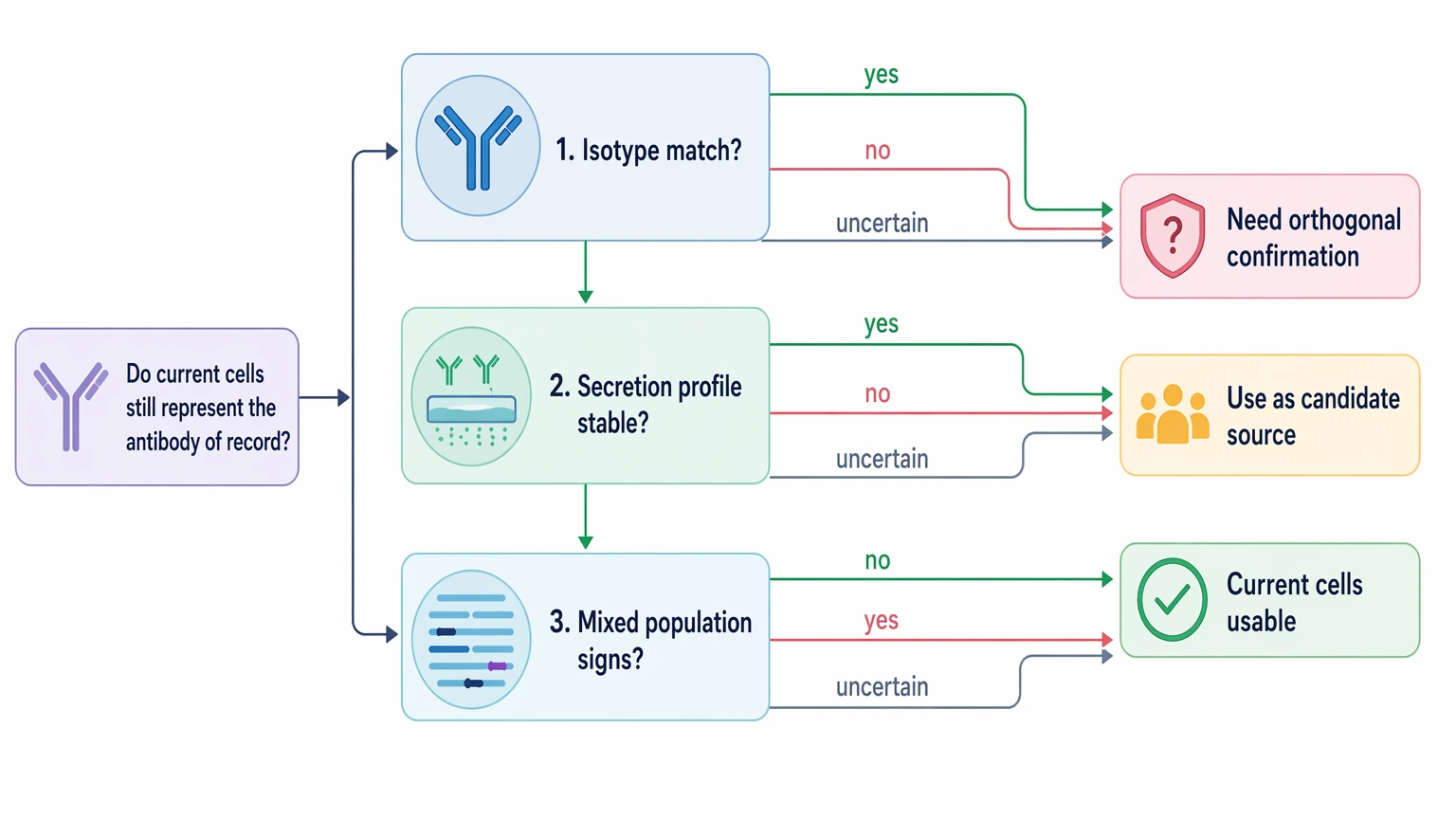
Step 3: Check whether current cells still represent the antibody of record
This is often the main decision point. Ask:
- Does the current culture still match the historical isotype?
- Is the secretion profile still consistent with earlier records?
- Is there evidence of a mixed population, such as heterogeneous reads or conflicting light-chain class calls?
If any answer is uncertain, treat present-day cells as one candidate source rather than the final reference. In that setting, archived supernatant or purified antibody becomes much more important for orthogonal confirmation.
A low-viability clone with stable identity may still be a good rescue candidate. A healthier culture with unresolved drift may be a worse one.
Step 4: Match the method to the strongest evidence
When RNA-based rescue is still a reasonable first choice
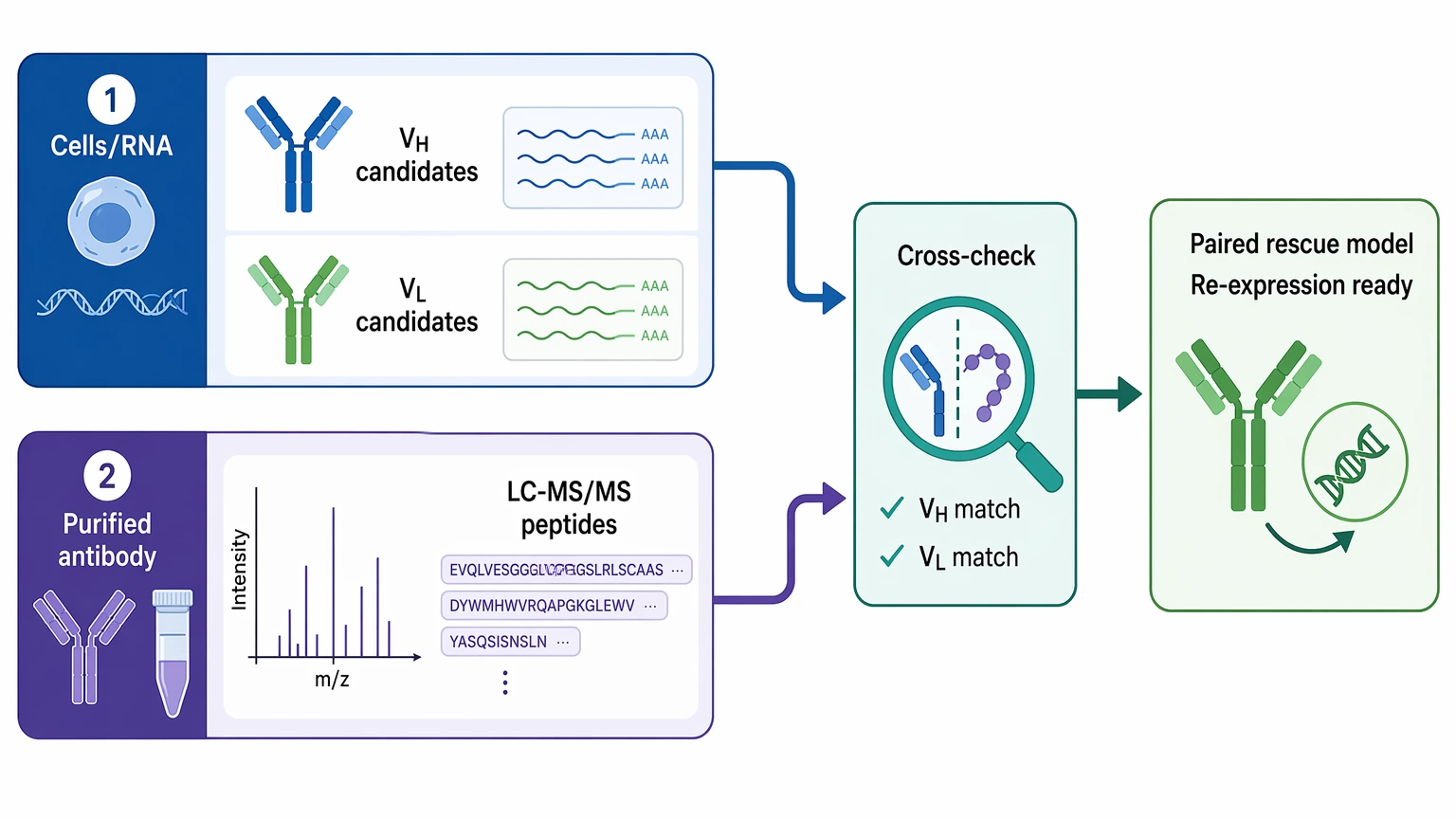
Use RNA-based hybridoma monoclonal antibody sequencing when intact cells or recently thawed material are still available, RNA integrity is likely adequate, and the line still appears monoclonal. This route is usually preferred when the main goal is full-length variable-region sequence recovery for recombinant re-expression.
RACE is useful when standard primer approaches miss incomplete ends or weak transcripts. NGS broadens candidate discovery, but it still needs to be interpreted alongside clonality and chain-pairing evidence.
When DNA or amplicon support is useful
If RNA quality is borderline but residual cellular nucleic acid remains, DNA/amplicon-based support can help with targeted recovery or confirmation. This approach may narrow uncertainty, especially when prior isotype knowledge guides primer design, but it does not solve mixed-clone problems on its own.
When purified-antibody-based rescue becomes more defensible
Shift toward de novo antibody sequencing when viable cells are no longer dependable, transcript recovery is unlikely to be clean, or archived purified antibody comes from the last trusted production period. Protein-based rescue is especially relevant when identity continuity matters more than whether the current cells are still secreting well.
When combined evidence is the best option
Many unstable hybridoma cases are best handled by combining cell-derived and protein-derived evidence. Transcript-based VH and VL candidates can be checked against peptide evidence from LC-MS/MS, which improves confidence before re-expression work begins.
Step 5: Set a realistic deliverable before wet work starts
A rescue project should define the endpoint in technical terms. Common outputs include:
- CDR-supported sequence information
- heavy chain and light chain full-length variable-region sequence
- ranked VH/VL candidates with chain-pairing notes
- a rescue plan with defined sequence validation steps
| Sample condition | Realistic output | Likely follow-up need |
|---|---|---|
| Viable monoclonal cells with good RNA | Full VH/VL recovery | Standard sequence validation |
| Weak cells with marginal RNA | Partial rescue or candidate set | RACE, NGS, or protein support |
| Mixed population suspected | Multiple candidate chains | Strong orthogonal confirmation |
| Purified antibody only | Protein-inferred candidates | Pairing review and re-expression testing |
Most rescue disappointments come from a mismatch between sample condition and the expected deliverable, not from a complete lack of sequence signal.
Step 6: Plan validation before calling the project complete
Recovered sequence is not the same as confirmed antibody identity. Before calling a project successful, decide how the result will be checked. Practical validation layers include:
- isotype consistency review
- kappa/lambda light chain confirmation
- peptide support from LC-MS/MS
- agreement between transcript-derived and protein-derived CDR evidence
- recombinant re-expression
- binding or identity comparison to historical material
If the available evidence is fragmented, the result may still be useful, but it should be described as a best-supported rescue model rather than a definitive clone reconstruction. For unstable or mixed-source assets, teams can contact MtoZ Biolabs to discuss the sample inventory, validation route, and whether RNA-based rescue, protein-based rescue, or a combined strategy is the more defensible next step.
How to Interpret Risk After the First Rescue Attempt
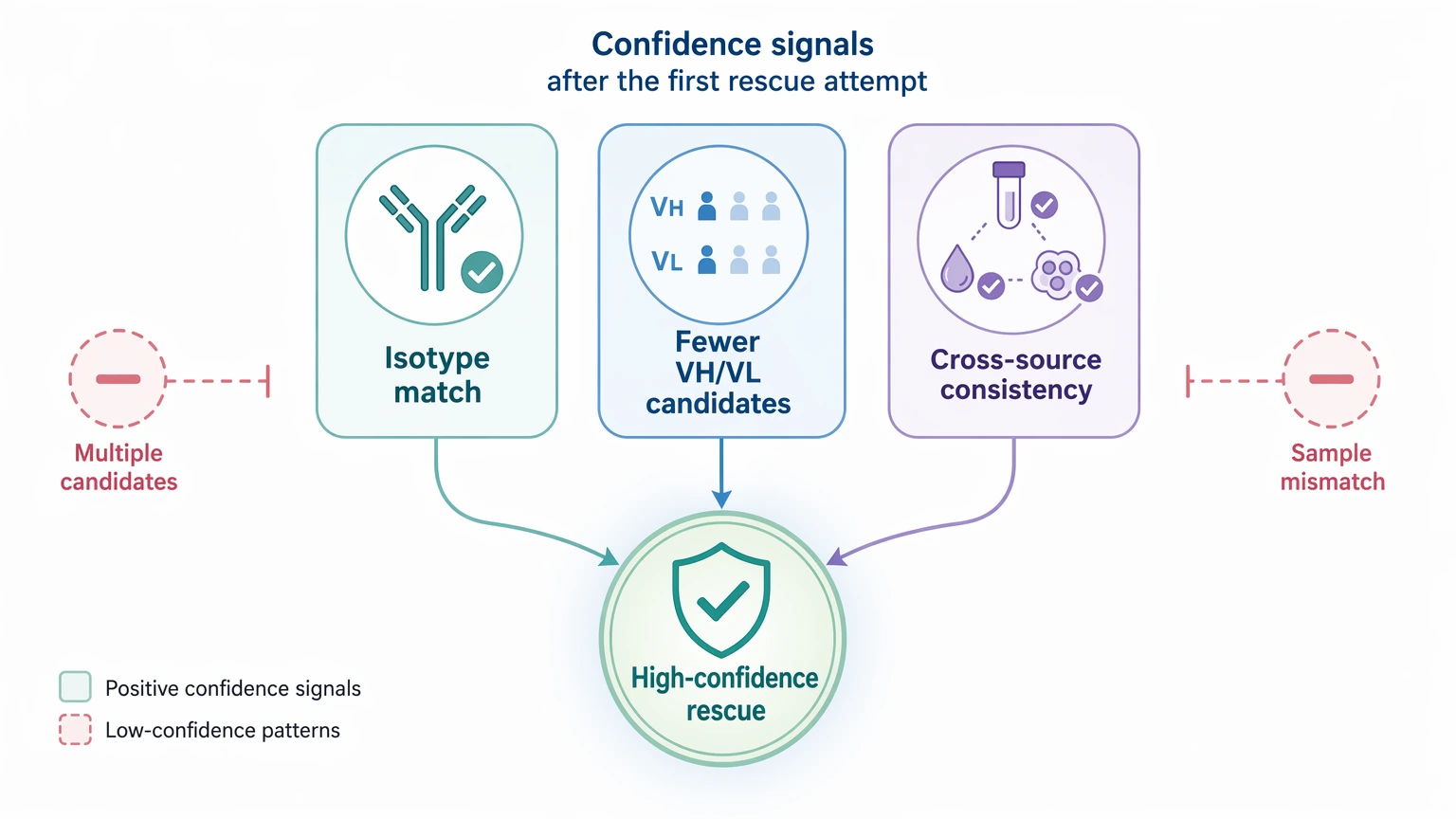
A strong early outcome is not simply “a sequence was found.” A better sign is that the candidate sequence matches known isotype context, narrows the heavy chain and light chain possibilities, and stays consistent across sample sources.
By contrast, the following patterns should lower confidence:
- several competing VH or VL candidates
- mismatch between current-cell data and archived antibody evidence
- poor peptide coverage across informative regions
- unresolved residues after protein-based inference
- chain-pairing uncertainty that blocks re-expression planning
In other words, deterioration affects confidence as much as recoverability. That distinction matters when the rescue result will be used for assay transfer, antibody engineering, or replacement of a disappearing hybridoma asset.
Conclusion
Sequence rescue from an unstable hybridoma is often still possible, but the decision should start with evidence quality rather than platform preference. The most useful early checks are sample-source ranking, clonality review, RNA integrity assessment, and confirmation that current cells still match the original antibody history. For projects involving declining banks, weak pellets, archived supernatant, or purified antibody, the most defensible path usually combines a realistic output definition with a planned validation strategy. If your team needs a full-length variable-region sequence for recombinant recovery, or needs to decide whether low-viability cells still justify sequencing effort, prepare the sample inventory, historical isotype records, and downstream use case before you submit your requirements or request a project review.
FAQ
Can culture supernatant support sequence rescue if no viable cells remain?
Sometimes, yes. Culture supernatant cannot replace transcript recovery when direct VH/VL pairing is required, but it can preserve antibody identity evidence and may support protein-based rescue or confirmation when paired with archived records.
Does an IgM hybridoma change the rescue strategy?
Often it does. IgM projects can complicate primer choice, transcript recovery, and protein handling, so teams should confirm chain class early and set expectations for whether the deliverable is CDR support, variable-region recovery, or a broader rescue-and-validation plan.
If multiple VH candidates appear, should the longest sequence be prioritized?
Not automatically. Candidate ranking should consider transcript abundance, framework plausibility, consistency with isotype history, and peptide support if protein evidence is available. Length alone is not a reliable selection rule.
When is purified antibody not a good fallback?
Purified antibody is a weak fallback when the material is scarce, highly contaminated, heavily modified, or likely to contain more than one antibody species. In those cases, protein-based inference may produce incomplete or ambiguous results.
What records are most useful before starting rescue?
The most helpful records are prior isotype calls, kappa/lambda status, freeze-thaw performance notes, historical productivity data, and any archived chromatograms, peptide maps, or binding comparisons tied to earlier trusted material.
How to order?




