






Hybridoma Monoclonal Antibody Sequencing for Cell Line Transfer and Recombinant Reformatting
Hybridoma monoclonal antibody sequencing becomes a practical risk-control step when a legacy clone needs to be transferred, backed up, or reformatted without validated paired heavy chain / light chain sequence records. Historical binding data, isotype notes, and frozen vials may support basic identity history, but they do not replace sequence-level evidence for continuity planning or recombinant design.
Decision snapshot
- Sequence now if the hybridoma is aging, records are incomplete, recombinant backup is planned, or a new site/CDMO will rely on the asset.
- Start with purified antibody when the main question is the mature antibody sequence actually being expressed.
- Add hybridoma cells or RNA when chain pairing, unresolved residues, or construct readiness need orthogonal validation.
- Do not rely on database search alone when the exact variable region is unknown or legacy records are weak.
- Treat remaining ambiguities explicitly; local uncertainty in CDR3, Leu/Ile positions, or PTM interpretation can affect downstream decisions.
Why hybridoma assets become transfer risks without sequence-level backup
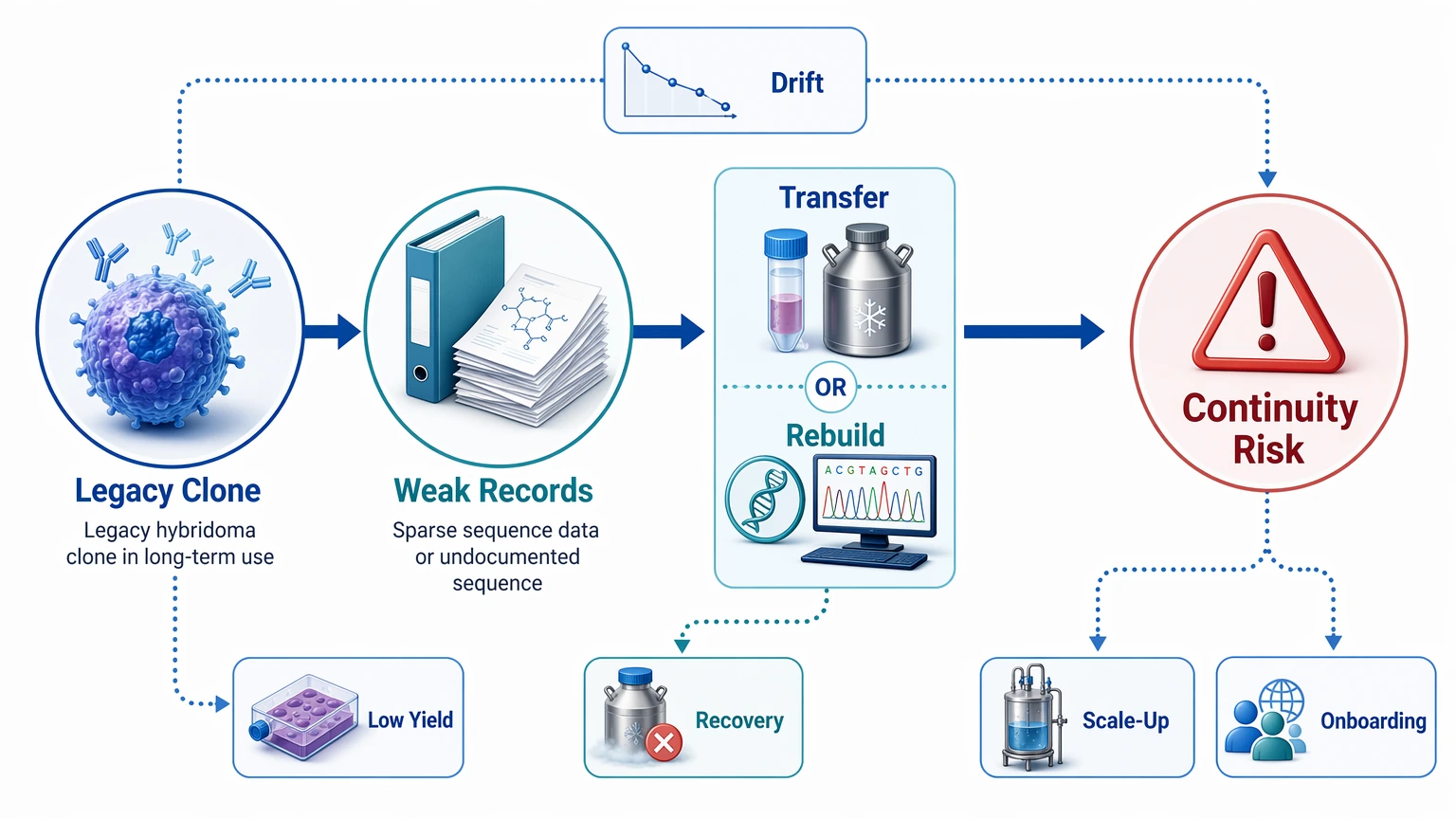
The problem usually shows up during a handoff. A team inherits a hybridoma-derived monoclonal antibody with acceptable historical performance, but the molecular record is thin. The archive may include a clone name, isotype, ELISA history, and partial cDNA, yet still lack validated variable region sequences and defensible chain pairing.
That gap becomes important when the program has to move from “the clone worked before” to “we can transfer or rebuild it with confidence.” Without a mature antibody sequence, the project stays tied to a living cell line that may drift, lose productivity, or fail during storage recovery, scale-up, or external onboarding. If the cell bank is old or the production profile is unstable, waiting until after transfer can raise continuity risk.
Common trigger points include:
- planned cell line transfer to a new internal site or CDMO
- recombinant backup generation in CHO or HEK cells
- reformatting into a new expression construct
- incomplete records from older discovery programs
- uncertainty about whether historical nucleotide records still match the produced antibody
In these cases, hybridoma monoclonal antibody sequencing is more than an analytical exercise. It helps show whether the asset can be documented and reconstructed well enough for the next operational step.
Why this is not a routine database search problem
A legacy hybridoma often does not fit a standard reference-based identification workflow. The exact variable region may be absent from searchable databases, changed by somatic mutation, inconsistently documented, or only partially captured in old records. Database matching can still support constant region assignment or partial peptide mapping, but it may not recover the variable region detail needed for recombinant reformatting.
That is why de novo sequencing is often central to the plan. In an LC-MS/MS workflow, the project relies on tandem mass spectra to reconstruct peptide sequences rather than assuming the correct answer already exists in a reference set. For antibodies, that interpretation has to remain chain-aware. The key decision points usually sit in the variable region, especially the CDR / complementarity-determining region and most critically CDR3, where clone-specific identity is concentrated.
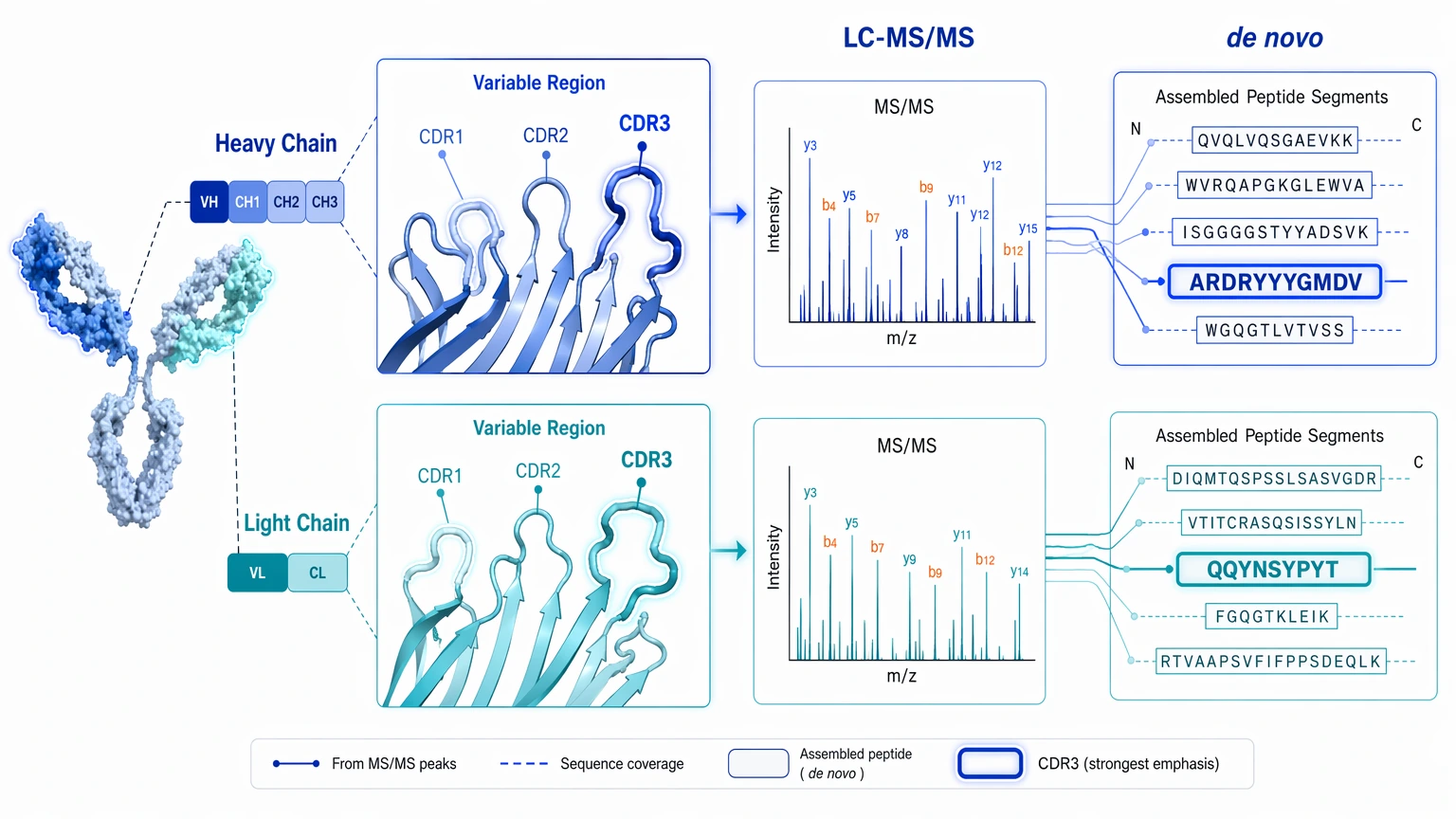
Even with good data, some uncertainty can remain. Isobaric residue ambiguity, especially Leu/Ile ambiguity, may not be fully resolved from MS/MS evidence alone. PTM / post-translational modification findings such as pyroglutamate, deamidation, oxidation, or glycosylation-related heterogeneity can also complicate residue interpretation. For that reason, sequence confidence should be judged by spectral support, coverage, and agreement with orthogonal evidence, not by a simple identified/not identified label.
When de novo sequencing is the rational planning step
The right time to sequence is usually before the project becomes dependent on a fragile transfer path. For many teams, that means sequencing before sending the hybridoma to a new manufacturing group, before committing to vector design, or before assuming that archived records are good enough.
A useful planning question is: what decision must this sequence package support?
- Continuity review: confirm whether the hybridoma has enough sequence evidence to reduce dependence on the original line.
- Recombinant backup generation: recover the mature variable domains well enough to guide re-expression planning.
- Recombinant reformatting: define whether the recovered sequence is close to construct readiness or whether more confirmation is needed first.
- Transfer documentation: strengthen the technical file before cross-site movement or CDMO onboarding.
If the answer requires residue-level review of heavy chain / light chain variable regions, de novo sequencing is far more informative than relying only on historical paperwork, ELISA identity, or partial transcript records.
Project-planning workflow: how to choose the right starting path
For this topic, the solution is not a generic sequence of lab steps. It is a project-planning workflow that matches the sample and evidence threshold to the transfer or reformatting decision.
1. Define the downstream use before choosing the analytical package
Start by separating identity confirmation from construct design. A team that only needs continuity documentation can tolerate more unresolved positions than a team preparing recombinant expression. Clarify whether the output must support:
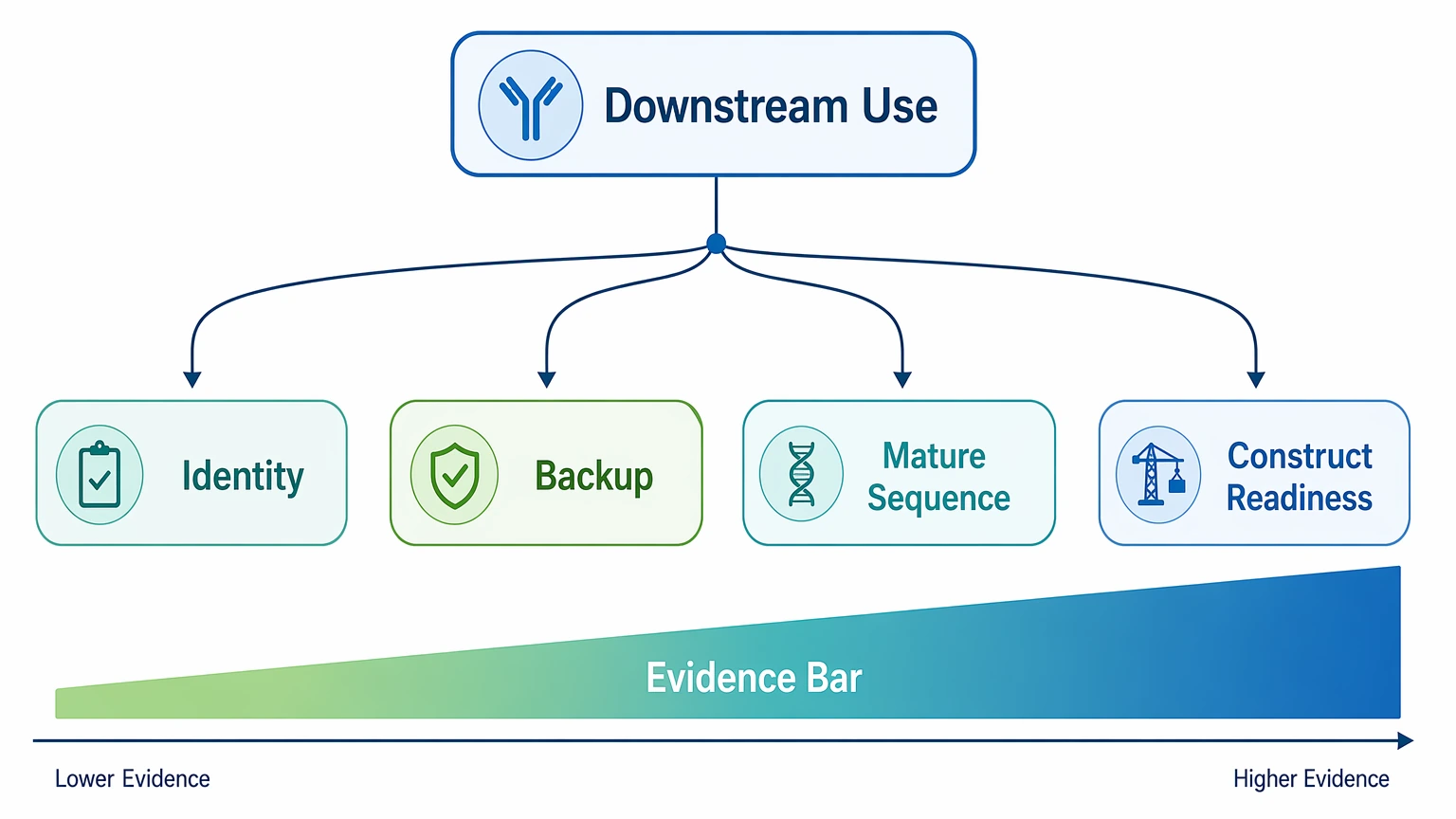
- identity review only
- recombinant backup planning
- mature antibody sequence interpretation
- vector design discussion and construct readiness assessment
This step sets the evidence bar before sample is consumed.
2. Choose the sample based on what risk must be removed
| Sample type | Best use | Main limit | Typical role |
|---|---|---|---|
| Purified antibody | Direct readout of the expressed product | Lower confidence if purity is poor or chains are difficult to assign | First-line input for mature antibody sequence and peptide mapping |
| Hybridoma supernatant | Early feasibility when purified material is unavailable | Background proteins can reduce sequence coverage and spectral support | Preliminary evaluation |
| Hybridoma cell pellet or RNA | Orthogonal support for chain pairing and transcript comparison | Transcript evidence may not fully define the mature protein product | Ambiguity review and construct planning |
| Combined protein + RNA strategy | Higher-risk transfer or reformatting projects | More coordination and more material requirements | Stronger orthogonal validation path |
Purified antibody is often the most decision-relevant input because it reflects the molecule actually being produced, including mature termini and PTM burden. Hybridoma material becomes more useful when chain pairing is uncertain or when protein-level interpretation leaves gaps in decision-critical regions.
3. Set the sequence evidence threshold for the intended handoff
For transfer and reformatting decisions, the most useful metrics are:
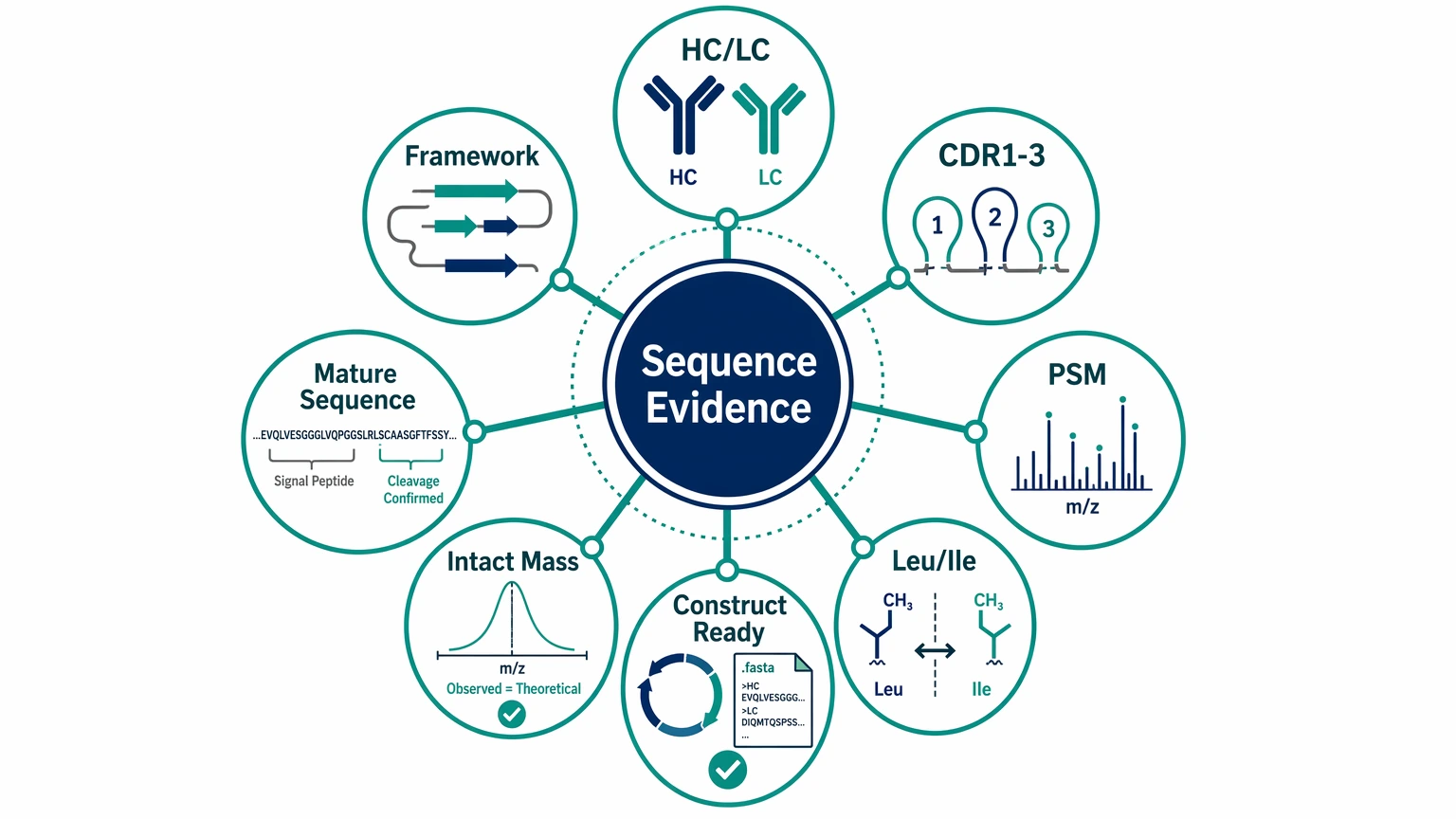
- sequence coverage across heavy chain and light chain
- complete or near-complete coverage of the framework region
- CDR1, CDR2, and especially CDR3 support
- explicit peptide-spectrum match support or equivalent spectral support for assembled residues
- handling of isobaric residue ambiguity
- agreement with intact mass / subunit mass
- definition of the mature antibody sequence
- a clear statement about construct readiness
If your team needs a report that can feed directly into transfer review or backup design, submit your requirements to MtoZ Biolabs so the project can be evaluated against available sample type, expected ambiguity burden, and the need for orthogonal validation.
Service Routes to Consider
For this project scenario, readers usually compare these service routes before requesting a quote or submitting samples.
4. Plan for unresolved positions instead of assuming complete certainty
A credible antibody sequencing package does not hide uncertainty. It states where confidence is high, where local gaps remain, and whether those gaps change the next decision. This matters because MS/MS-based interpretation has real boundaries.
For example, a few unresolved positions outside a decision-critical region may still allow continuity planning to move forward. By contrast, an uncertain residue in CDR3, weak chain pairing evidence, or a PTM-related mass shift that could mask sequence differences may justify targeted follow-up before vector design. When the exact variable region is unknown, database-search limits and local spectral ambiguity should be treated as planning inputs, not as reporting footnotes.
Expected results and validation methods
A well-scoped project should produce an evidence package that is useful right away while also showing what still needs follow-up confirmation.
Immediate deliverables
- assembled heavy chain / light chain sequence output with identified gaps or ambiguities
- variable region and constant region assignment
- CDR and framework region coverage summary
- peptide mapping and LC-MS/MS spectral support for key residues
- PTM annotation, including pyroglutamate, deamidation, oxidation, and glycoform-related heterogeneity where relevant
- comparison with intact mass, subunit mass, isotype records, or available transcript information
Follow-up confirmation
- targeted review of unresolved CDR3 or framework positions
- orthogonal validation for chain pairing
- transcript-to-protein comparison if RNA material is available
- expression testing after recombinant reformatting
- functional bridging against historical material when the recombinant version will replace or supplement the hybridoma source
An explicit limitation matters here: de novo interpretation from tandem mass spectra can support strong sequence hypotheses, but it may not resolve every residue with the same level of confidence, particularly when PTMs, Leu/Ile ambiguity, mixed background proteins, or incomplete database support affect local interpretation.
Key cautions and practical limits
Sample quality is the first practical constraint. Low purity, low amount, degradation, or contaminated supernatant can reduce peptide recovery and interfere with variable region interpretation. Preserve enough material for repeat work if the project may need secondary confirmation.
Controls and repeat expectations also matter. Historical isotype records, prior peptide mapping, intact mass, subunit mass, or partial RNA information can strengthen interpretation when aligned with protein-level results. If decision-critical positions remain unclear, repeat analysis with alternative digestion, targeted LC-MS/MS, or orthogonal methods may be a better next step than forcing early construct selection.
Batch and contamination risk should be considered during transfer planning. A recovered sequence can reduce dependence on the original hybridoma, but it does not prove that future lots from a new site or recombinant system will behave the same.
Interpretation boundaries should stay narrow and explicit. Sequence recovery can support continuity planning, cell line transfer, and recombinant reformatting discussions, but it does not by itself prove functional equivalence, manufacturing comparability, or regulatory sameness. When ambiguity remains in key CDR residues or chain pairing, another method—or outside support for targeted confirmation—may be the better next step before committing to expression work.
Conclusion
Hybridoma monoclonal antibody sequencing is most useful when a legacy clone needs sequence-level backup before transfer risk turns into a continuity problem. The strongest projects align de novo sequencing, LC-MS/MS evidence, peptide mapping, and intact mass or subunit mass review with a specific operational goal: cell line transfer, recombinant backup generation, or construct-oriented variable region recovery. For programs managing older hybridoma banks, incomplete records, or planned recombinant reformatting, contact MtoZ Biolabs to evaluate your project, review sample fit, and discuss what level of sequence confidence and follow-up confirmation is appropriate before the handoff advances.
FAQ
Should a hybridoma always be sequenced before cell line transfer?
No. If the asset already has validated paired variable region records, stable documentation, and a low-risk transfer scope, sequencing may add less value. It becomes more relevant when the clone is older, the molecular record is incomplete, or a recombinant backup is part of the plan.
What makes CDR3 more decision-critical than broader coverage numbers?
Broad coverage can look strong while the most clone-specific region remains weakly supported. CDR3 often contains the most distinguishing sequence information, so uncertainty there can matter more than small gaps in less critical regions.
Can partial cDNA records replace protein-level sequencing?
Not always. Partial transcripts may help with orthogonal validation, but they do not guarantee that the mature antibody sequence matches the protein currently being secreted. Protein-level evidence is especially useful when records are old, incomplete, or suspected to be mismatched.
When is a combined protein-plus-RNA strategy worth the extra effort?
It is usually worth considering when the project must support recombinant reformatting, when chain pairing is uncertain, or when local ambiguities in the variable region could affect construct selection.
What is the practical difference between identity confirmation and construct readiness?
Identity confirmation asks whether the sample is consistent with the expected antibody class and overall sequence profile. Construct readiness asks whether the mature variable regions are defined clearly enough to support vector design without unresolved positions that could change expression or binding interpretation.
How to order?




