






How to Verify Heavy and Light Chain Pairing After Hybridoma Monoclonal Antibody Sequencing
A recovered heavy chain (HC) and light chain (LC) sequence should be treated as a likely native pair when both chains have chain-specific evidence, the CDR-containing regions are supported well enough for the intended recombinant reconstruction, and the dataset does not point to sample heterogeneity or a competing light-chain candidate. When sequence calls lack peptide-level confirmation, leave key CDR residues unresolved, or show more than one plausible LC, the safer decision is more analytical review before cloning.
This article compares the evidence types used to judge HC/LC pairing after hybridoma monoclonal antibody sequencing, explains where each evidence class is useful or limited, and shows when teams should move forward, rank alternatives, or pause for further confirmation.
Quick Decision Guide
The table below provides a practical first-pass framework for go/no-go decisions before gene synthesis.
| If your dataset shows... | Pairing decision |
|---|---|
| One HC, one LC, unique peptides for both chains, and usable CDR support | Usually reasonable to prepare for recombinant reconstruction with documented caveats |
| One HC but multiple LC candidates | Rank candidate pairs before synthesis; do not assume the top database-like match is correct |
| Good overall coverage but weak CDR3 confirmation | Hold the decision until high-impact residues are reviewed |
| Intact mass or subunit analysis fits, but peptide evidence is thin | Treat the sequence as plausible, not proven |
| Conflicting peptides, extra mass populations, or mixed signals | Investigate sample heterogeneity before moving forward |
The main takeaway is simple: the decision threshold is not total sequence recovery alone, but whether any unresolved issue could still change the construct you plan to build.
What “Verified Pairing” Actually Means
After hybridoma monoclonal antibody sequencing, the practical question is not whether an HC and LC were recovered at all. The real question is whether those recovered chains belong to the same original antibody molecule closely enough to justify recombinant reconstruction and downstream validation.
A defensible HC/LC pairing decision usually combines four elements: chain-specific evidence for each chain, peptide coverage in high-impact regions such as CDR3, agreement between the proposed sequence and intact mass analysis or subunit analysis, and a clear plan for orthogonal validation. This matters most when source material is limited, the hybridoma is unstable, or more than one LC appears in the report.
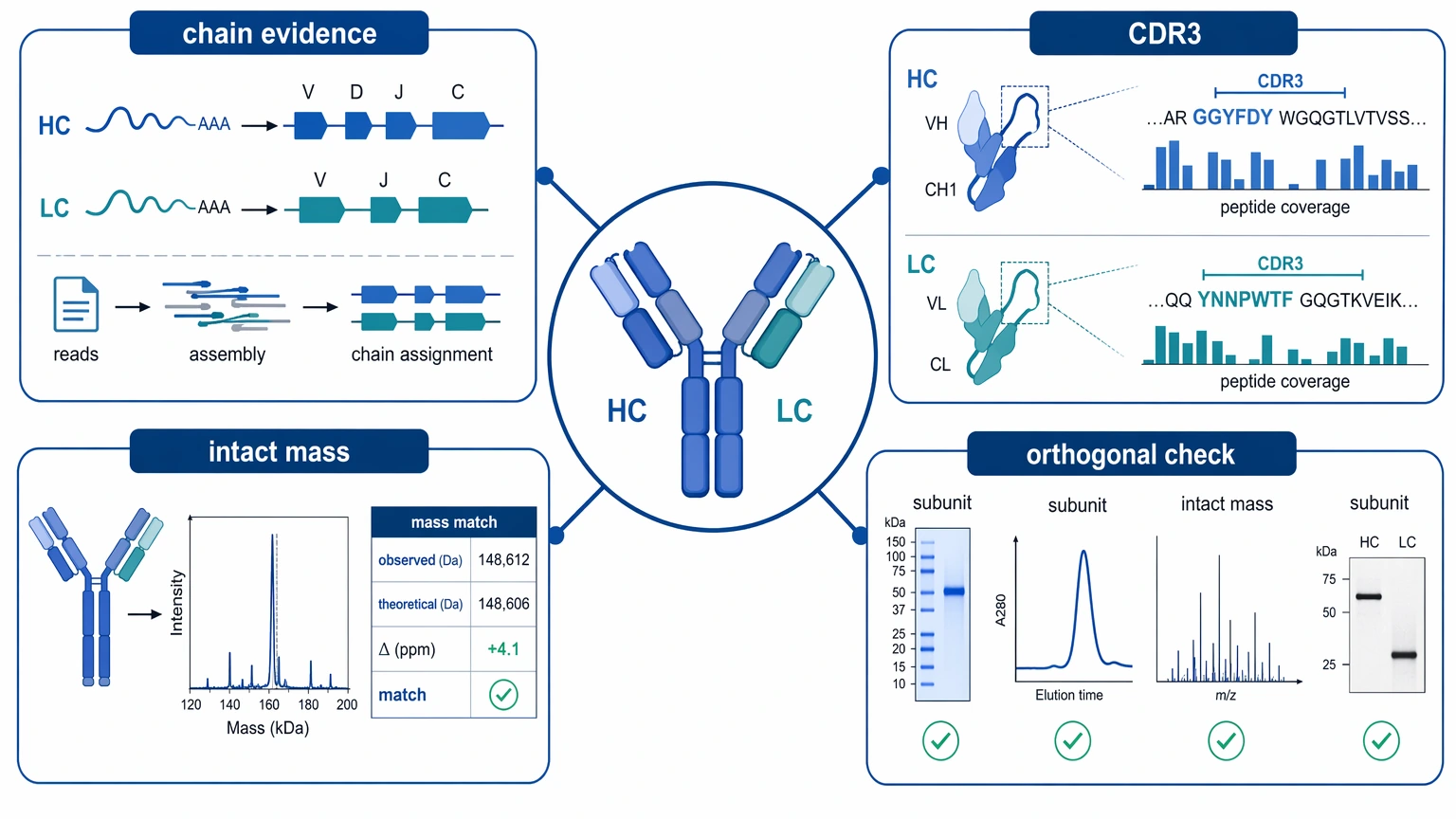
A useful distinction is that plausible pairing means the proposed HC and LC fit part of the data, whereas verified pairing means the pair is supported strongly enough that the remaining uncertainty is acceptable for the project goal.
When This Decision Becomes Critical
Most teams face this decision after sequence recovery but before gene synthesis. At that stage they may have a dominant HC, one or several LC candidates, partial LC-MS/MS support, and a few unresolved residues in framework regions or CDRs. Rebuilding the wrong pair can cost more time than one additional round of analytical review.
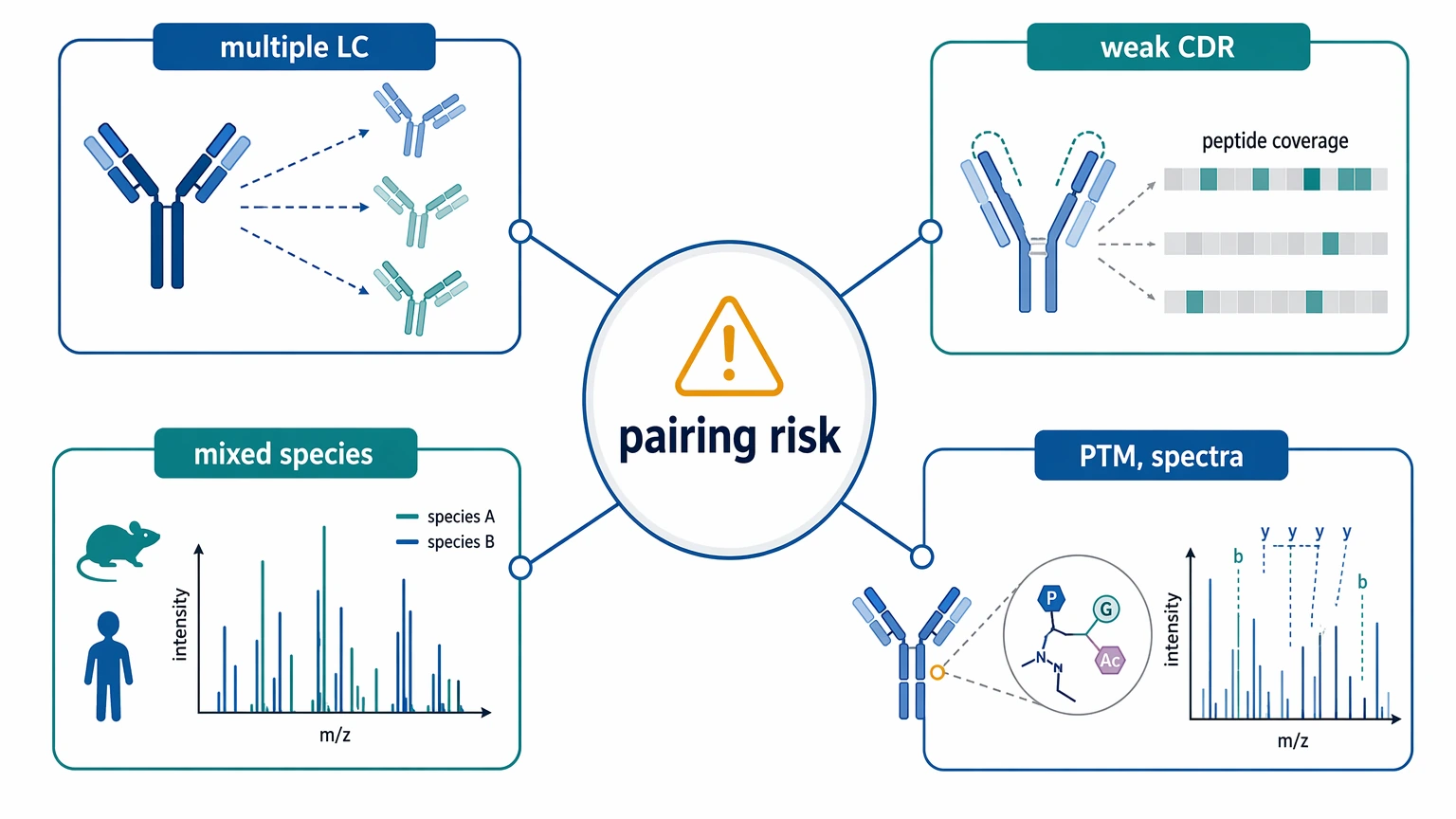
The main risks usually cluster in a few areas. Multiple LC candidates can make pair ranking uncertain. Weak peptide coverage in CDRs can leave binding-relevant residues underdefined. Mixed population signals can reflect sample heterogeneity rather than a single clean monoclonal species. PTMs, missed cleavages, or low-quality spectra can lower confidence at exactly the residues that matter most.
Comparing the Main Evidence Types
No single readout confirms native HC/LC pairing in every project. The most useful comparison is whether each evidence class supports nomination, discrimination, plausibility checking, or downstream confirmation.
| Evidence type | What it supports | Main limitation | Best use |
|---|---|---|---|
| Sequence-only recovery | Initial HC and LC candidate list | Does not prove native pairing | Starting point for review |
| LC-MS/MS peptide coverage | Chain-specific evidence and peptide-spectrum consistency | Coverage gaps may remain in CDRs | Core support for pair selection |
| De novo peptide sequencing / de novo protein sequencing | Review of novel regions and unresolved calls | Confidence can drop with low input, PTM complexity, or mixed species | Clarifying uncertain sequences |
| Intact mass analysis / subunit analysis | Sequence plausibility and mass agreement | Mass fit alone cannot assign the native LC | Orthogonal support |
| Recombinant reconstruction testing | Whether the selected pair expresses and behaves as expected | Does not automatically prove native pairing | Downstream confirmation |
The pattern is consistent: sequence-only output nominates candidates, peptide-level evidence does most of the discrimination work, mass-based methods test plausibility, and recombinant testing confirms whether the chosen construct behaves acceptably for the next stage.
How to Compare Sequence-Only Calls With Peptide-Level Evidence
Sequence-only recovery can look convincing when one HC and one LC dominate the report, but that is not enough to settle pairing when the antibody is legacy, highly mutated, or recovered from uncertain source material.
Peptide-level evidence improves the decision in three ways. It shows whether a proposed chain is supported by unique peptides rather than generic framework similarity, whether CDR and especially CDR3 assignments are backed by observed peptides or inferred through partial matching, and whether peptide-spectrum matches stay consistent across replicate runs or digestion strategies.
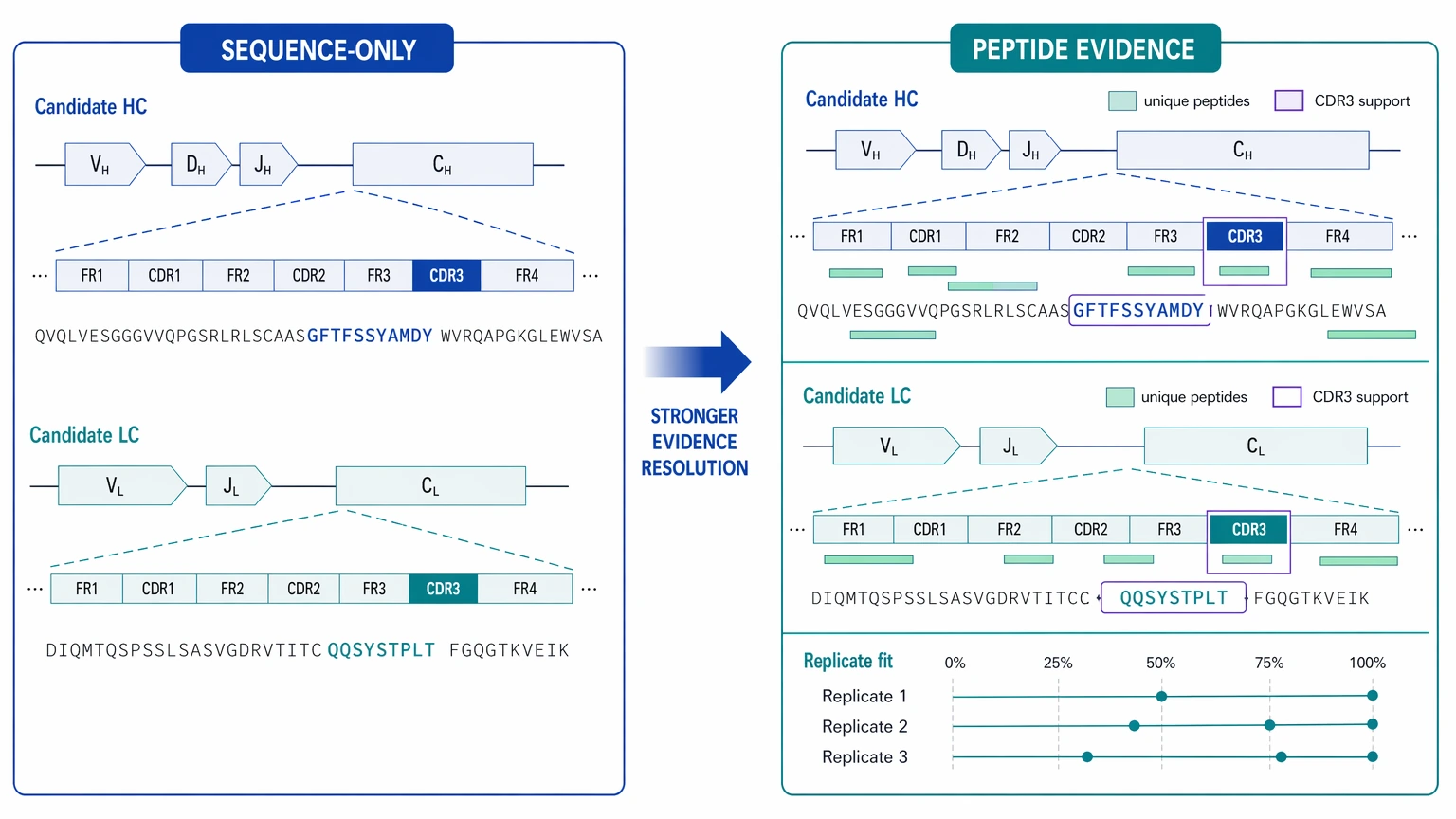
Overall coverage still needs context. Broad framework coverage with poor CDR support does not carry the same weight as fewer total peptides with direct support in chain-specific regions. Leu/Ile ambiguity, PTMs, or incomplete fragmentation can keep high-impact residues uncertain even in an otherwise strong LC-MS/MS report.
How to Rank Candidate Pairs When Multiple Light Chains Appear
Multiple LC candidates are one of the most common sources of reconstruction risk. The goal is not to choose the LC that looks most familiar against germline references; the goal is to rank candidate pairs using evidence that truly separates one LC from another.
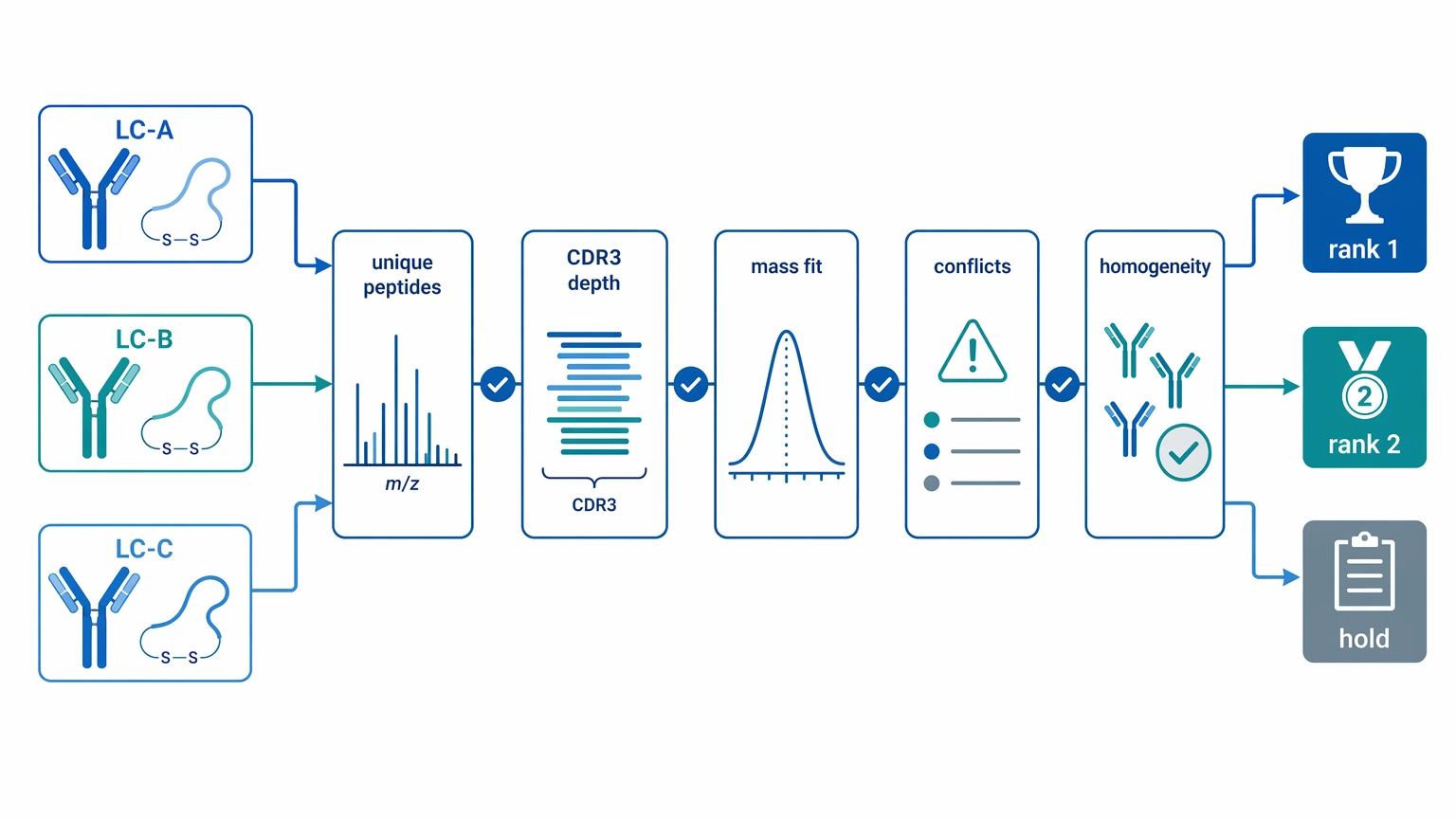
A workable ranking framework includes the following checkpoints:
- Unique peptide support for the LC
- CDR3 confirmation depth
- Agreement with intact mass analysis or subunit analysis
- Absence of conflicting peptides
- Consistency with the sample’s apparent homogeneity
This ranking often changes the decision. A familiar-looking LC without chain-specific evidence should not outrank a less intuitive candidate that is directly supported by unique peptides in CDR-adjacent regions. If two LC candidates remain close after review, delay synthesis rather than force a choice. If your package includes competing LC assignments, limited peptide evidence, or unresolved residues near the antigen-binding site, you can submit your requirements to MtoZ Biolabs for project evaluation focused on LC-MS/MS evidence review, de novo peptide sequencing, and HC/LC pairing risk before recombinant reconstruction begins.
Expected Results and Validation Methods
Immediate deliverables
Before cloning, a useful review package should make the decision points visible rather than just provide a sequence report.
- a proposed HC/LC pair or ranked candidate list
- peptide coverage summaries for both chains
- identification of unique peptide support where available
- CDR and CDR3 support status
- a list of unresolved residue positions, including Leu/Ile ambiguity
- comparison of predicted versus observed intact mass or subunit mass
- a short interpretation of whether the sequence is expression-ready or still underdefined
These deliverables support a go/no-go decision. They do not need to remove every ambiguity, but they should show whether the remaining uncertainty is acceptable for the reconstruction plan.
Follow-up confirmation
After the initial review, follow-up work may include targeted validation of high-impact residues, added digestion strategies to improve peptide coverage, orthogonal subunit analysis to test sequence plausibility, and recombinant reconstruction of the top-ranked pair with functional retesting as a downstream cross-check. Recombinant expression is useful, but it confirms the chosen construct more than it proves the exact original hybridoma pairing.
Service Routes to Consider
Key Cautions and Practical Limits
Several limits should remain visible in the final decision. Low-abundance antibody, degraded archived material, or limited purified sample can reduce peptide coverage and weaken de novo confidence. Replicate LC-MS/MS runs, alternative digests, or targeted follow-up are often justified when the decision turns on a few residues or one uncertain LC. Extra chain candidates or unexpected mass populations may reflect mixed material, carryover, or contamination rather than true biological pairing. Database-search support, framework plausibility, or intact mass agreement can strengthen confidence, but none of them alone confirms native HC/LC pairing.
Practical Go/No-Go Guidance
Move forward when one HC and one LC are supported by chain-specific evidence, CDR uncertainty is limited and documented, and the mass data do not conflict with the proposed sequence. Pause when the remaining uncertainty could still change the selected LC or alter a binding-relevant residue. For legacy transfer projects, that threshold is often stricter because carrying a pairing mistake forward is expensive in both time and material.
If you need to decide whether the current sequence package is sufficient for cloning, contact us at MtoZ Biolabs to evaluate your project against sample availability, existing LC-MS/MS data, unresolved residues, and the level of orthogonal validation that fits the reconstruction plan.
Conclusion
After hybridoma monoclonal antibody sequencing, the most defensible HC/LC pairing decisions come from combining chain-specific peptide evidence, focused review of CDR support, and orthogonal mass-based plausibility checks. Sequence-only recovery can nominate a pair, but it should not be treated as full proof when multiple LC candidates, mixed population signals, or unresolved high-impact residues remain. For teams preparing recombinant reconstruction of a legacy or limited-material antibody, the practical next step is to match the added analysis to the actual pairing risk and discuss the study, sample status, expected output, and validation needs before committing to synthesis when the dataset is still underdefined.
FAQ
Is overall peptide coverage enough to confirm HC/LC pairing?
No. Strong total coverage can still miss the decisive unique peptides or CDR-containing peptides. Pairing confidence comes more from chain-specific support than from the total percentage alone.
What should count as a high-risk unresolved residue?
A residue is higher risk when it falls in HC CDR3, LC CDR3, or another position likely to affect candidate ranking or binding interpretation. A framework ambiguity away from those regions is usually easier to tolerate.
Why can two LC candidates both look plausible in one report?
They may share similar framework regions, differ only in a few discriminating peptides, or reflect sample heterogeneity. That is why LC ranking should rely on unique peptide support rather than general sequence similarity.
When is de novo protein sequencing more useful than database-dependent interpretation?
It is more useful when the antibody is novel, heavily mutated, incompletely covered by reference data, or affected by PTMs that make database-only matching less decisive.
What is the clearest signal that cloning should wait?
The clearest signal is that the remaining uncertainty could still change the selected construct, such as unresolved LC CDR3 evidence, conflicting peptides, or unexplained mass populations.
Related Services
Main Service |
Supporting Service |
Validation Service |
Alternative Service |
How to order?




