






How to Interpret Antibody Sequencing Deliverables for Recombinant Re-Expression Planning
A usable antibody sequencing deliverable for recombinant re-expression planning should give you one biologically plausible heavy chain and one biologically plausible light chain variable region, with VH and VL that are complete or nearly complete, clearly annotated complementarity-determining regions, and no unresolved issue that could alter binding identity. If the report still shows CDR3 gaps, uncertain chain pairing, multiple ambiguous residue calls in the variable region, or conflicting confidence notes, stop construct design before gene synthesis.
The review path is fairly simple. First, confirm that both VH and VL were recovered and that the variable region has readable sequence coverage across each framework region and complementarity-determining region. Then sort the remaining uncertainties into manageable versus blocking. Missing native leader sequence is often manageable because the expression construct can use an engineered signal peptide. Uncertainty inside a CDR, a frameshift warning, or weak chain pairing support is different. Any of those issues can raise the chance of rebuilding the wrong molecule.
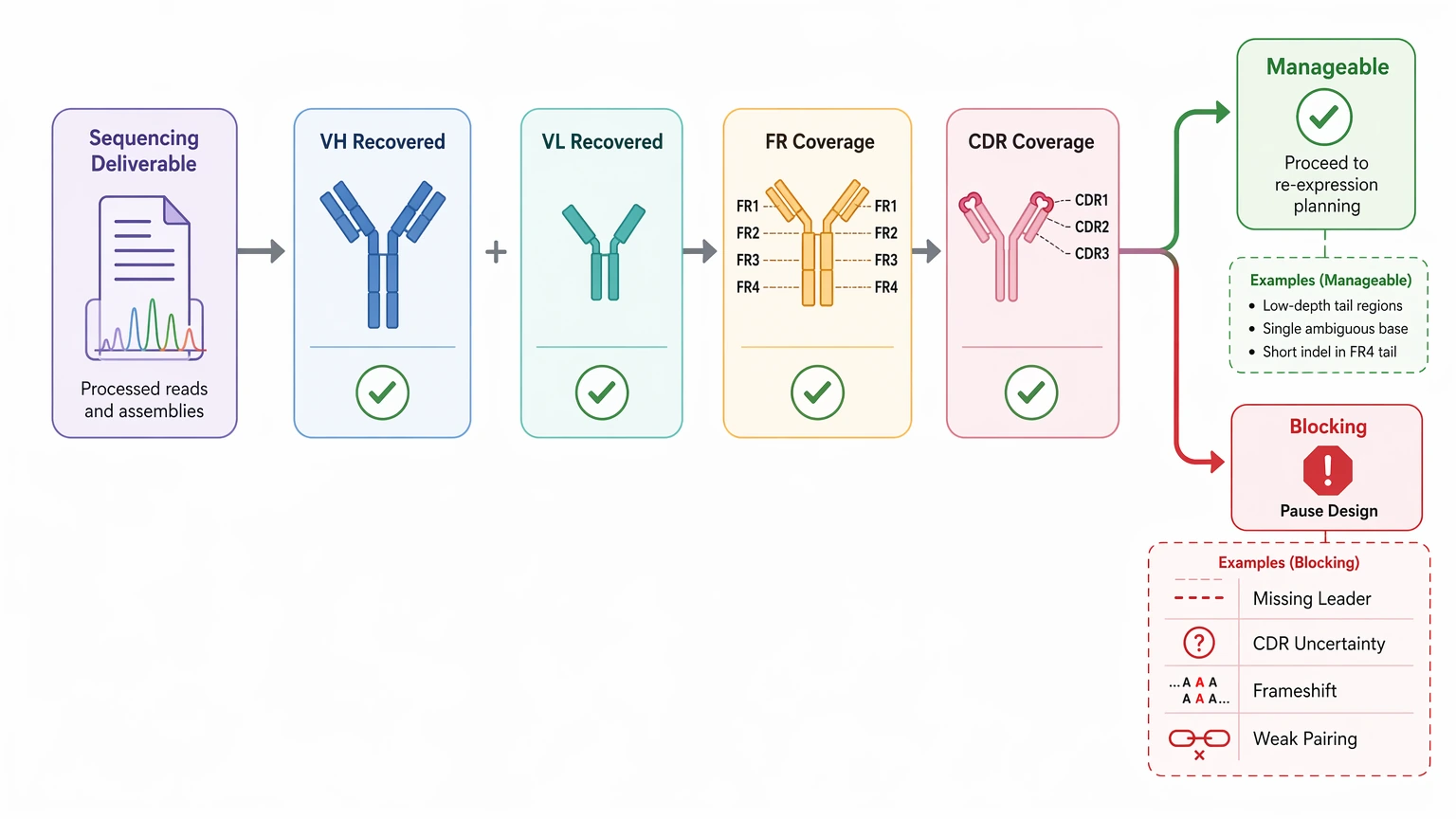
What makes a sequencing deliverable re-expression-ready
Teams often receive polished antibody sequencing reports that look complete on first pass. A report may include heavy chain and light chain sequences, CDR1, CDR2, and CDR3 labels, framework region assignments, peptide coverage summaries, contig confidence notes, and germline context. All of that helps, but it still does not answer the question that matters for the project: is this sequence recovery ready to move into recombinant re-expression?
For planning purposes, a report is usually re-expression-ready when it supports a defensible molecular handoff into gene synthesis and expression construct design. That usually means:
- one candidate heavy chain variable region sequence
- one candidate light chain variable region sequence
- intact CDR1, CDR2, and CDR3 annotation for both chains
- continuous framework region logic across VH and VL
- sequence coverage, peptide coverage, or contig confidence that supports the called residues
- chain pairing support that is explicit or at least justified
- no stop codon, frameshift, or implausible motif that would undermine the recovered variable region
A report can still be useful even if it does not include every native feature. For example, the absence of native signal peptide information is not always a blocker, because many recombinant workflows replace it with a standard leader sequence. Constant-region recovery may also matter less at this stage if the project only needs variable region transfer.
The four uncertainty categories that matter most
Before construct planning starts, focus on the uncertainty categories most likely to change the downstream decision.
Incomplete variable region recovery
This is the most obvious blocker. Recombinant re-expression depends on sufficiently resolved VH and VL, especially across CDR3 and the flanking framework region. A small terminal gap outside the binding-relevant portion of the variable region may still be workable if orthogonal validation or reference logic can close it. A partial CDR is a different problem and usually needs clarification first.
Ambiguous residue calls in important positions
An ambiguous residue is not automatically disqualifying. Where it sits matters more than how many there are. Limited uncertainty in a framework region may be manageable if the team plans orthogonal validation or a functional re-check after transient expression. An isoleucine/leucine ambiguity inside CDR3 calls for more caution because even a single unresolved substitution can shift binding behavior.
Weak chain pairing support
Chain pairing is one of the easiest transfer risks to underestimate. A report may present one heavy chain and one light chain, yet the pairing evidence underneath may still be indirect. Hybridoma-derived projects often support stronger pairing inference than purified antibody projects, but source material alone does not remove uncertainty. If the pairing logic is weak or not explained, do not assume the sequence package is ready as-is.
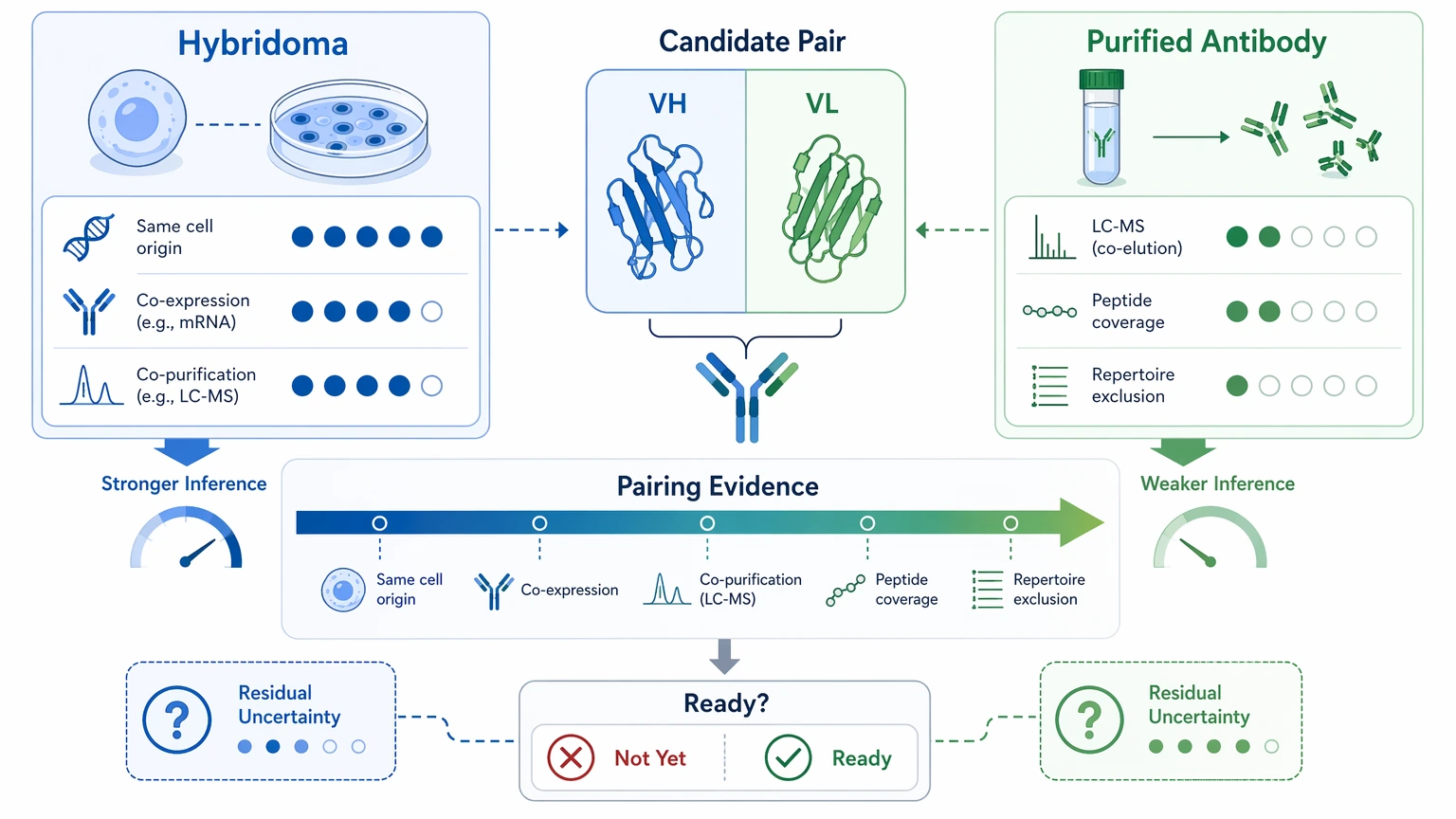
Method-linked confidence limits
Different antibody sequencing workflows leave different traces in the report. De novo sequencing by mass spectrometry may provide strong peptide coverage while still leaving certain ambiguous residue calls unresolved. NGS- or RACE-supported workflows may provide stronger contig confidence, but they still need a plausibility review. The point is not to ask which method sounds stronger in the abstract. The point is whether the report in front of you explains the remaining uncertainty well enough to support construct planning.
How to review the deliverable before gene synthesis
This article uses a data-interpretation workflow rather than a generic troubleshooting sequence. You already have the deliverable. The next job is to sort it into proceed, verify, or pause.
Step 1: Confirm the minimum handoff package
Start with the fields that directly affect recombinant re-expression:
- one candidate VH sequence
- one candidate VL sequence
- complementarity-determining region annotation for both chains
- framework region continuity
- support metrics such as sequence coverage, peptide coverage, or contig confidence
- a chain pairing statement, caution note, or supporting rationale
If one of these elements is missing, ask whether that omission changes the planned expression construct. Missing constant-region context may not stop early planning. Missing variable region content usually does.
Step 2: Test whether VH and VL are complete enough
Do not rely on a label such as “full report.” Check sequence boundaries, annotation consistency, and the exact sections with low confidence.
| Deliverable feature | Usually acceptable to proceed | Needs targeted confirmation | Usually blocks construct design |
|---|---|---|---|
| VH recovery | Full variable region with continuous framework region and CDR annotation | Small terminal uncertainty outside CDRs | Missing CDR segment, frameshift, or implausible motif |
| VL recovery | Full variable region with continuous framework region and CDR annotation | Minor non-CDR ambiguity | Missing CDR3 or fragmented sequence |
| CDR annotation | Consistent across report sections | Small annotation mismatch with clear underlying sequence | Conflicting CDR calls that alter sequence interpretation |
| Sequence coverage | Broad support across the variable region | Coverage dips outside key binding positions | Weak support at key CDR positions |
| Chain pairing | Explicitly supported or strongly inferred | Inference noted but limited | Multiple candidates with unresolved pairing |
| Ambiguous residue | Outside likely binding-critical positions | One or two residues requiring orthogonal validation | Several ambiguous residues in CDR3 or other critical positions |
A planning-grade package does not need to prove full biological equivalence. It needs to support a credible expression construct hypothesis.
Step 3: Separate acceptable uncertainty from blocking uncertainty
Teams lose time when every caveat is treated as if it carries the same weight. Some report notes are manageable. Others should stop the handoff.
Acceptable uncertainty often includes:
- missing native signal peptide information when an engineered leader will be used
- incomplete subclass context when VH and VL are already resolved
- isolated framework region ambiguity with low functional risk
- modest confidence dips that do not affect CDR interpretation
Blocking or near-blocking uncertainty often includes:
- an ambiguous residue within CDR1, CDR2, or especially CDR3
- stop codons or frameshift concerns in the reported variable region
- multiple candidate heavy chain or light chain sequences without a justified selection
- weak chain pairing support in a purified antibody project
- disagreement between orthogonal data types that changes the amino acid call
If your team is at this decision point, submit your requirements and the actual report package for a technical review before ordering constructs. A targeted review is usually cheaper than rebuilding vectors after the first expression round fails to match expectations.
Step 4: Assign the project to one of three paths
Proceed to construct design
Use this path when VH and VL are both recovered, all complementarity-determining regions are intact, framework region continuity is biologically plausible, ambiguous residue risk is limited, and chain pairing is well supported. The next steps are gene synthesis, codon optimization, expression construct design, transient expression, and binding re-verification.
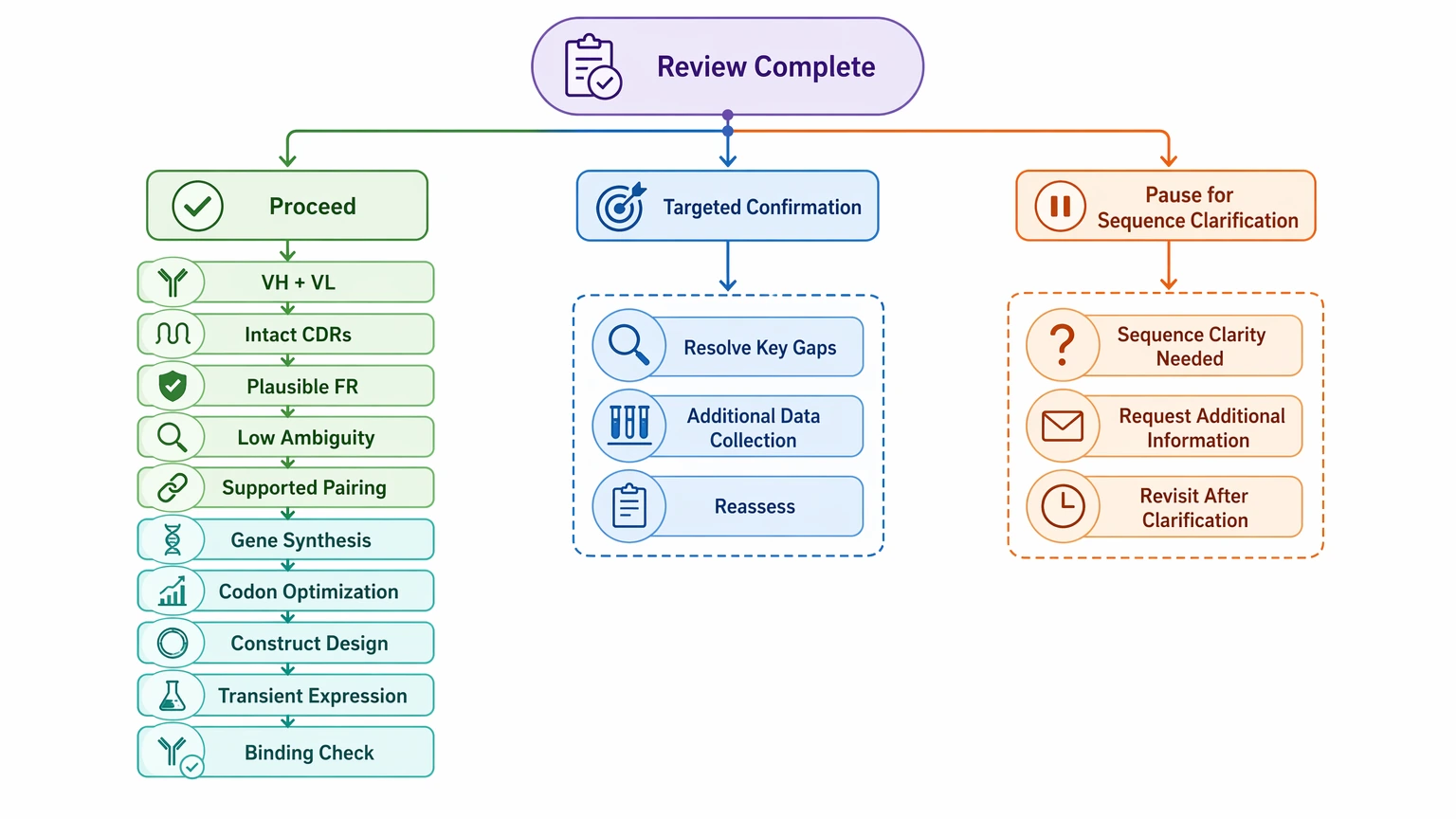
Proceed with targeted confirmation
Use this path when the report is mostly usable but one narrow issue remains. Common examples include a small terminal gap outside the main binding motifs, one or two ambiguous residue positions, or pairing support that is plausible but not conclusive. This path allows progress while keeping the risk visible and controlled.
Pause for sequence clarification
Use this path when the uncertainty could change the identity of the recombinant product. Partial VH or VL recovery, unresolved CDR3 content, or unclear pairing among multiple candidates usually justifies additional sequence clarification before cloning begins.
Sample source changes the interpretation
The same-looking report can carry very different risk depending on whether the starting material was a hybridoma or a purified antibody.
A hybridoma project may provide stronger evidence for heavy chain and light chain linkage because nucleic-acid-derived data can support pairing logic more directly. Even then, mixed populations, degraded input, or low-abundance transcripts can still introduce uncertainty.
A purified antibody project may still deliver strong variable region sequence recovery, especially when peptide coverage is broad, but pairing support can be less direct. That does not make the output unusable. It means the report should be read more carefully for inference statements, orthogonal validation notes, and any sign that multiple chain candidates remain compatible.
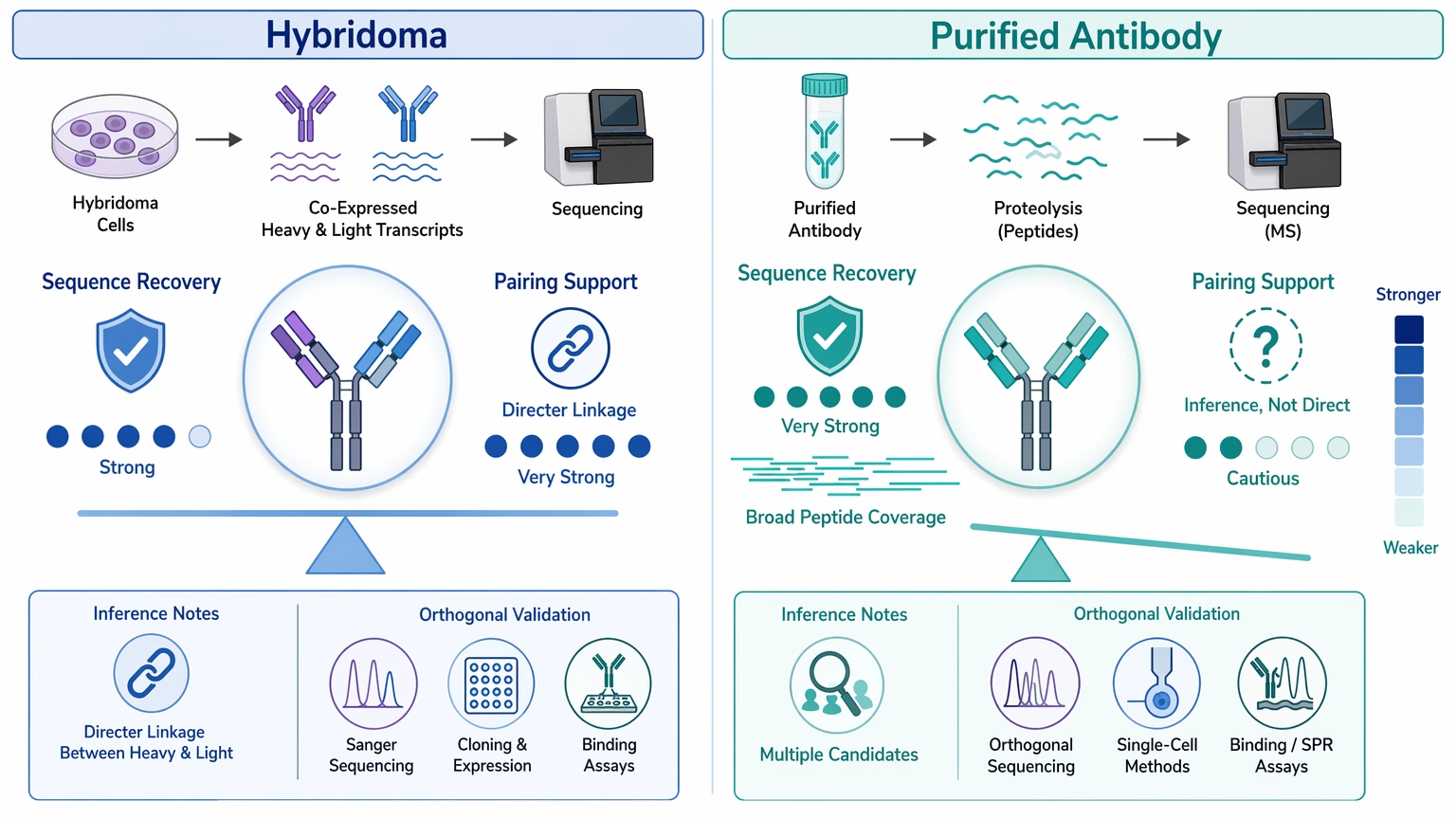
In borderline cases, contact MtoZ Biolabs to evaluate your project against the intended antibody sequencing handoff, sample source, and downstream expression construct plan rather than relying on a generic completeness label.
What to verify after sequence handoff
Even a strong antibody sequencing report does not establish functional equivalence by itself. Once the sequence moves into recombinant re-expression, the downstream plan should preserve the logic of the original recovery and include confirmation steps that match the actual risk.
Useful follow-up checks include:
- documenting every ambiguous residue and how it was handled
- recording the final VH and VL selected for gene synthesis
- retaining the chain pairing rationale in construct records
- running transient expression before committing to larger follow-on work
- rechecking binding against the original antibody material whenever possible
These checks matter most when the sequence package was acceptable but not especially clean. They help separate a true sequence issue from a later cloning or expression problem.
Conclusion
An antibody sequencing deliverable is ready for recombinant re-expression planning when it gives you a credible heavy chain and light chain variable region pair, complete complementarity-determining region interpretation, coherent framework region continuity, and confidence notes that do not change the identity of the planned construct. Small uncertainties outside binding-relevant positions may be manageable with targeted confirmation, while unresolved CDR ambiguity, weak chain pairing, or partial variable region recovery usually justify more clarification before gene synthesis.
This framework is most useful for teams transferring hybridoma- or purified antibody-derived sequence recovery into cloning, codon optimization, and transient expression workflows. If your project sits between “usable” and “too risky to transfer,” prepare the sequencing deliverable, sample-source details, and downstream goals, then contact MtoZ Biolabs to evaluate your project before construct design starts.
FAQ
If the variable region is complete, can I ignore missing native constant-region information?
Often yes for early planning. If your goal is to recreate binding in a research expression format, the variable region is usually the main requirement. Constant-region choice can often be set during expression construct design, as long as the report does not suggest subclass-dependent issues that affect the intended use.
What is the fastest way to judge whether a low-confidence note matters?
Check three things in order: where the note maps in the sequence, whether it changes a called residue, and whether that position falls in a complementarity-determining region or pairing-relevant part of the deliverable. A vague low-confidence note matters less than a residue-level warning inside CDR3.
Should codon optimization wait until every ambiguity is resolved?
Not always. If the remaining uncertainty sits outside likely binding-critical positions and the selected sequence is clearly documented, codon optimization can start in parallel with targeted confirmation. If ambiguity sits in CDRs or changes which chain candidate you would synthesize, wait.
Can germline assignment confirm that the recovered antibody is correct?
No. Germline context can support plausibility review, but it does not confirm that the recovered VH and VL are complete, correctly paired, or ready for recombinant re-expression. It is a useful annotation, not a stand-alone decision criterion.
When is orthogonal validation worth the extra step?
It is usually worth adding when one unresolved point could change the construct sequence, pairing decision, or interpretation of a CDR. Orthogonal validation is most efficient when it is aimed at a specific gap rather than used as a blanket repeat of the full workflow.
What materials should be prepared before asking for an external report review?
Prepare the full sequencing deliverable, sample-source information, the intended recombinant format, any known species or isotype context, and any original binding benchmark data. That package makes it easier to assess re-expression readiness and decide whether clarification should happen before synthesis.
How to order?




