






How to Improve Antibody Diversity and Specificity Analysis Workflows
Quick Answer
A research team can improve an antibody diversity and specificity analysis workflow by defining the decision the study needs to support, then aligning each step to that decision. In practice, that means separating diversity profiling from specificity assessment, designing a sample cohort with appropriate controls and replicates, choosing methods that answer the actual antigen-binding or epitope question, planning orthogonal validation before the main experiment, and setting reporting outputs that map back to the next project decision. Weak workflows usually fail not because a single assay underperforms, but because repertoire sequencing, binding assay results, validation, and downstream data interpretation are handled as separate workstreams.
Where Antibody Diversity and Specificity Workflows Commonly Break Down
Many teams do not recognize workflow misalignment until partial data has already been generated. They may have antibody repertoire readouts, early antigen-binding hits, or a proteomics follow-up in progress, yet still be unable to answer the original research question.
The breakdown points are usually operational:
- diversity analysis starts before the biological comparison is clearly defined
- specificity assessment is requested without deciding whether the project needs antigen-level, epitope-level, or cross-reactivity evidence
- the sample cohort does not support the intended comparison
- replicates or timepoints are too limited to separate technical variation from biological change
- repertoire-level and functional readouts are produced by different teams and never reconciled
- orthogonal validation is added only after conflicting results appear
- proteomics or mass spectrometry support is considered too late to guide clone-level interpretation
- the final report contains many outputs but does not help the team make a decision
A stronger workflow starts with a simpler question: what choice does the team need to make next? That choice determines which data are actionable and which are only descriptive.
Define the Biological Question Before Expanding the Assay Plan
The first improvement step is to turn a broad objective into a decision-ready question. “Characterize the antibody response” is too broad to guide method selection or sample allocation. A more useful project question might be:
- Are two immunization groups showing different clonal expansion patterns?
- Which candidate antibodies show antigen binding with manageable cross-reactivity risk for follow-up?
- Does the project require epitope differentiation, or is target-level binding sufficient?
- Are repertoire changes consistent across timepoints or treatment conditions?
- Does the team need clone-linked interpretation that justifies proteomics or mass spectrometry support?
Once that decision is clear, the workflow is much easier to structure.
If the decision concerns repertoire remodeling across conditions, diversity profiling metrics such as clonotype richness, clone count distribution, V(D)J usage distribution, CDR3 length distribution, and overlap indices between groups become central. If the decision concerns whether an antibody recognizes the intended target while avoiding related off-targets, specificity assessment should move earlier in the workflow, with emphasis on binding assay design, cross-reactivity screening, and, when needed, epitope-focused follow-up.
This is the practical core of how to improve antibody diversity and specificity analysis workflows: stop treating every antibody project as a single assay problem. Treat it as a sequence of decisions.
Diversity Analysis and Specificity Analysis Are Not the Same Decision
Antibody diversity analysis and antibody specificity analysis answer different questions, and they rarely rely on the same evidence.
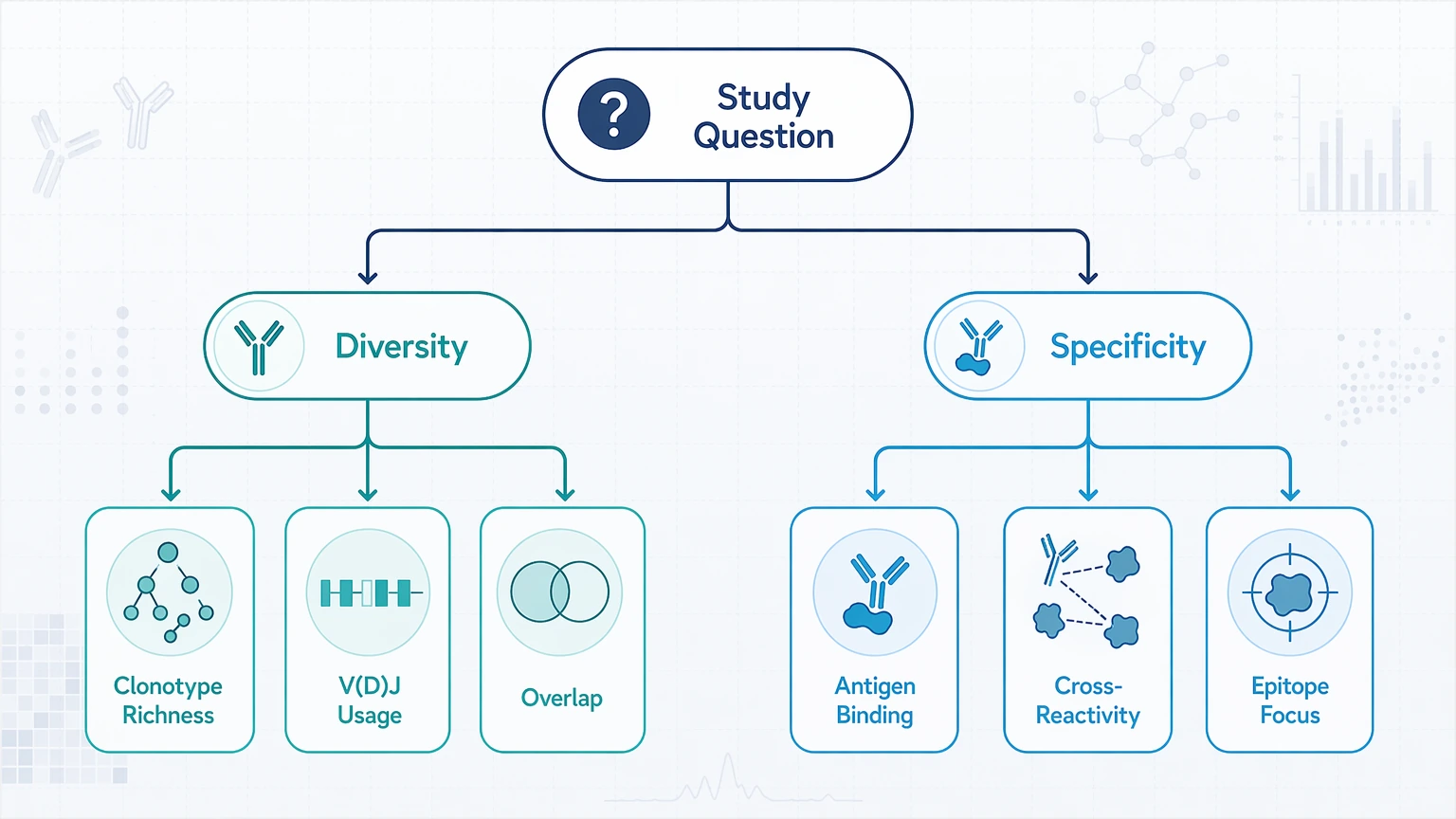
Diversity profiling asks:
- How broad is the antibody repertoire?
- Is there evidence of clonal expansion?
- Are certain clonotypes enriched in one condition or timepoint?
- How similar or distinct are sample groups?
Specificity assessment asks:
- Does a candidate antibody show antigen binding to the intended target?
- Is the observed signal distinguishable from background?
- Are there cross-reactivity patterns that could affect triage?
- Is epitope-level differentiation required?
Problems begin when teams assume one data type can stand in for the other. A repertoire sequencing dataset may show expansion of certain clonotypes, but it does not automatically identify which clones bind the target of interest. A binding assay may identify antigen-positive candidates, but it does not explain whether the broader repertoire structure supports the biological interpretation.
Improved workflows keep these evidence types connected while still treating them as distinct. The team should define where the handoff occurs—for example, from diversity profiling to target-focused binding confirmation, or from binding hits to epitope analysis.
How to Improve Sample Planning for Antibody Profiling Projects
Sample planning is often the point where workflow weaknesses become difficult to reverse. If samples are grouped poorly, or if the replicate structure does not support the intended comparison, stronger analytics later will not fully rescue interpretation.
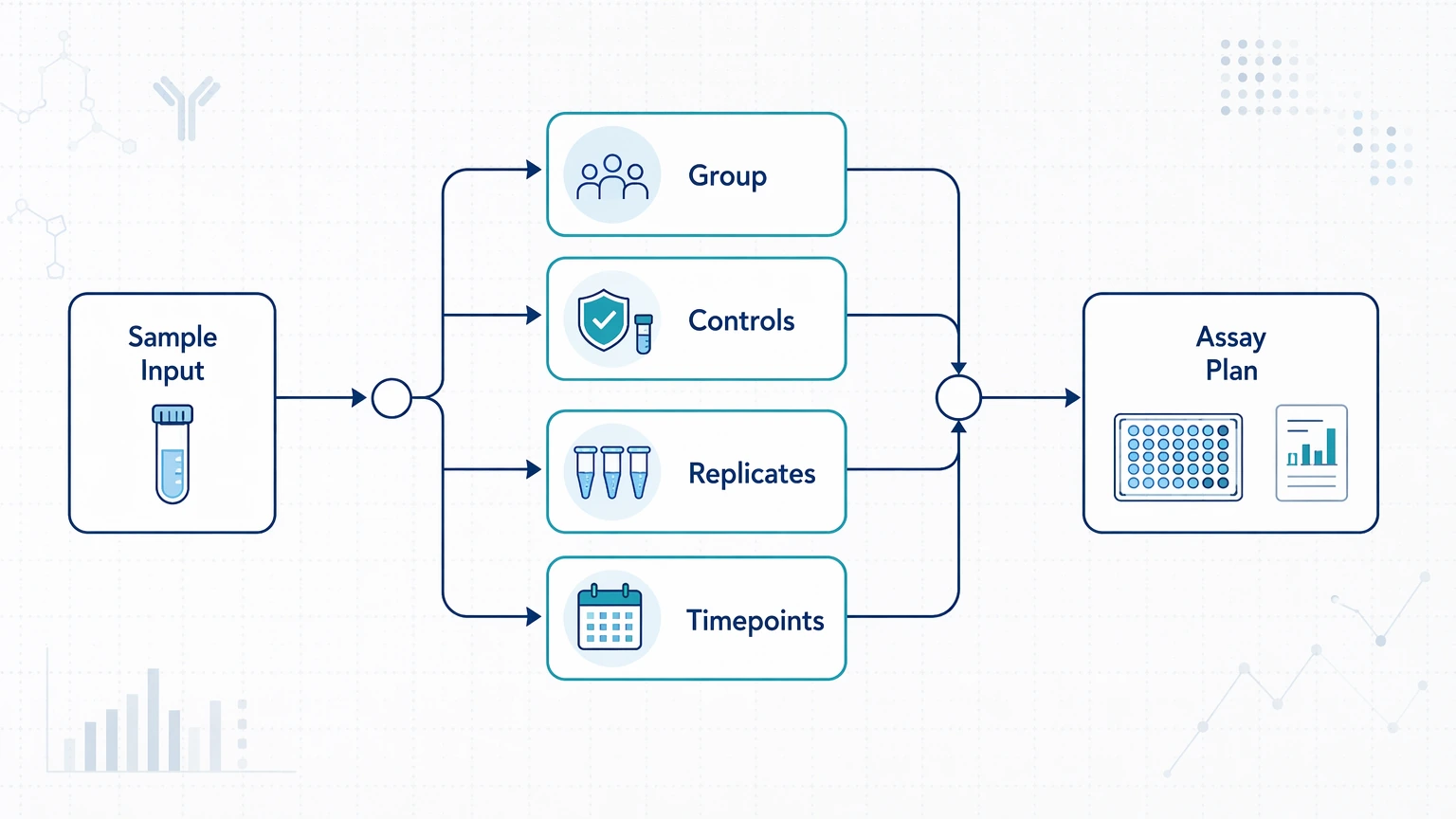
A practical sample design review should cover four areas.
1. Define the comparison unit
Decide whether the project compares:
- treatment vs. control group
- responder vs. non-responder research groups
- baseline vs. longitudinal timepoints
- sorted populations vs. bulk samples
- discovered candidates vs. a validation panel
The comparison unit determines whether repertoire diversity, antigen binding, or both should be treated as primary outputs.
2. Match sample inputs to assay demands
Repertoire sequencing, binding assay work, epitope analysis, and proteomics support do not place the same demands on input material. Confirm early:
- available sample type and volume
- whether material must be split across multiple assays
- whether replicate allocation remains feasible after preservation, sorting, or preprocessing
- whether controls consume a substantial fraction of limited material
3. Use controls and replicates with a defined purpose
A control group should answer a comparison question, not simply satisfy convention. Technical and biological replicates should be selected according to interpretation risk. If the workflow aims to compare clone distribution shifts, replicate concordance becomes especially important. If it aims to screen antigen-binding candidates, control design and signal-to-background performance may matter more than broad repertoire coverage.
4. Add timepoints only when they affect the decision
Additional timepoints can add context, but they also split sample material and complicate interpretation. A time-course design is worth that cost only when the timing of clonal expansion or specificity maturation could change the next research step.
Match Analytical Methods to the Research Objective
Method selection should follow the question, not the reverse. A common mismatch is ordering deep diversity profiling when the team actually needs an antigen specificity workflow, or requesting epitope-level analysis before basic antigen binding has been confirmed.
A practical method-matching framework looks like this:
The table below summarizes the main planning implications for the method choice.
| Research objective | Primary readout | Useful supporting readout | Main risk if mismatched |
|---|---|---|---|
| Compare repertoire architecture across groups | repertoire sequencing, clonotype distribution, V(D)J usage, CDR3 length distribution | overlap or similarity indices, replicate concordance | descriptive diversity data without functional context |
| Identify target-binding candidates | binding assay, antigen-binding hit rate | repertoire context, control group behavior | hits cannot be prioritized in a biologically relevant way |
| Distinguish related binding sites | epitope-level differentiation, epitope binning | structural or HDX-based follow-up | target binding is confirmed, but the mechanism remains unresolved |
| Evaluate cross-reactivity risk in research screening | cross-reactivity panel performance | orthogonal binding confirmation | false confidence from a single assay format |
| Link clone identity to deeper molecular characterization | proteomics or mass spectrometry support | sequencing-derived candidate narrowing | downstream analysis arrives too late to guide selection |
Use these differences to align the analytical method with the biological question and validation plan.
A workflow handoff often fails because the receiving team gets a vague request such as “run specificity analysis.” A stronger handoff defines the target class, expected cross-reactivity concern, available controls, desired level of differentiation, and the decision the report must support.
If your workflow already includes disconnected sequencing, binding, and follow-up requests, this is a good point to consolidate them. Teams that need help aligning assay choice, sample feasibility, and report expectations can submit your requirements to MtoZ Biolabs for a project evaluation focused on workflow fit rather than isolated assay ordering.
Build Orthogonal Validation into the Workflow Early
Orthogonal validation should not be treated as a rescue step after the main dataset becomes difficult to trust. It is more useful when planned as a predefined confirmation layer with a clear trigger.
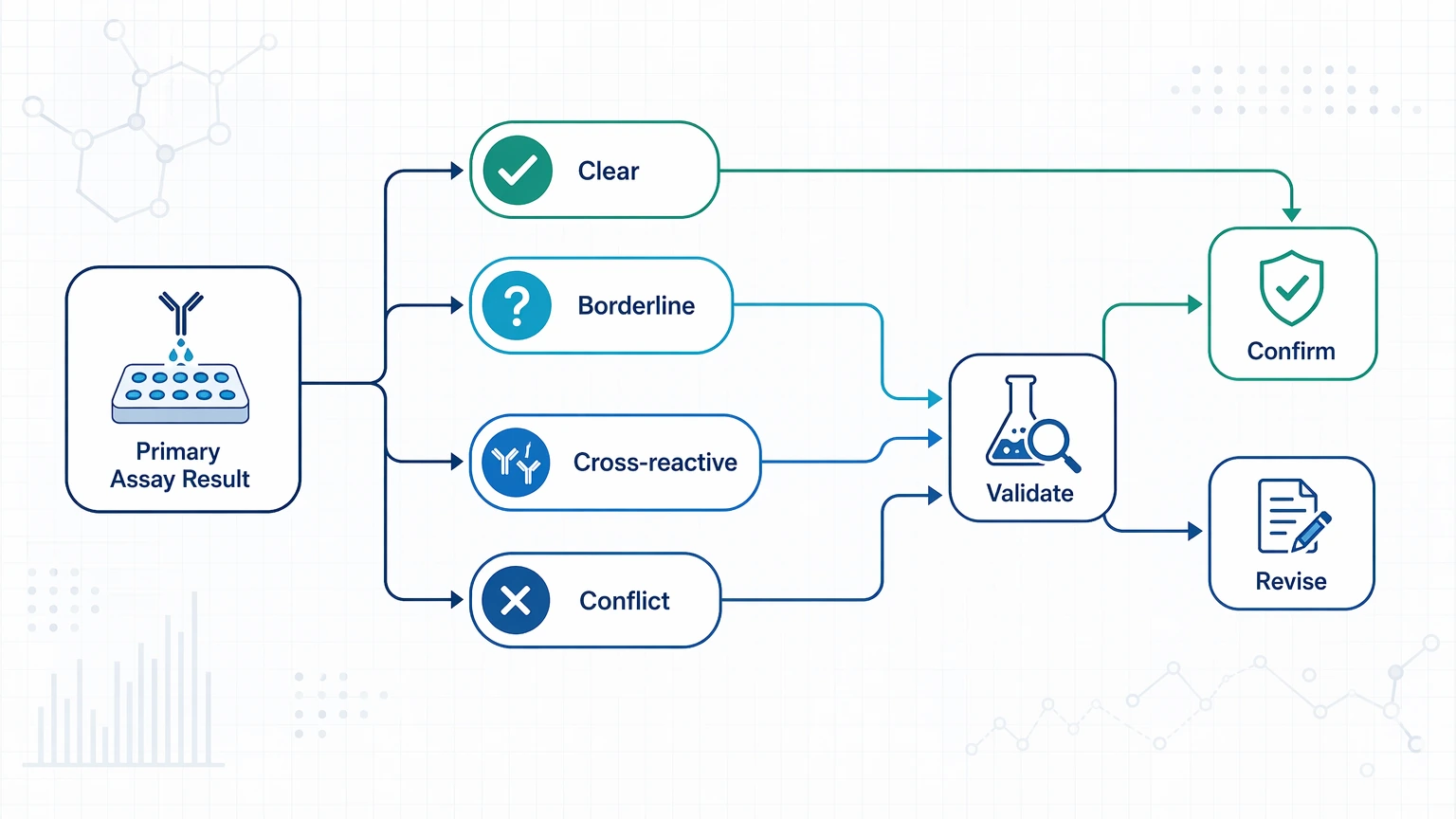
For example, orthogonal validation may be justified when:
- a candidate shows antigen binding in one assay format, but the signal-to-background margin is narrow
- cross-reactivity concerns are central to candidate triage
- a repertoire-based enrichment pattern needs confirmation at the binding level
- epitope interpretation affects which clones move forward
- different platforms produce partially conflicting rank orders
In workflow terms, the key question is not simply whether validation is needed. The better question is: which result would trigger validation, and which uncertainty should validation resolve?
Useful orthogonal validation outputs may include:
- confirmation rate across methods
- consistency of rank ordering between assays
- whether a binding-positive result reproduces in a different assay format
- whether epitope differentiation remains stable under a complementary approach
Planning validation this way also protects budget and sample material, because the confirmation step is tied to decision points rather than being added broadly after the fact.
When Proteomics or Mass Spectrometry Support Adds Real Value
Proteomics or mass spectrometry support is not necessary for every antibody profiling workflow, but it becomes useful when the project needs deeper molecular characterization than repertoire or binding data alone can provide.
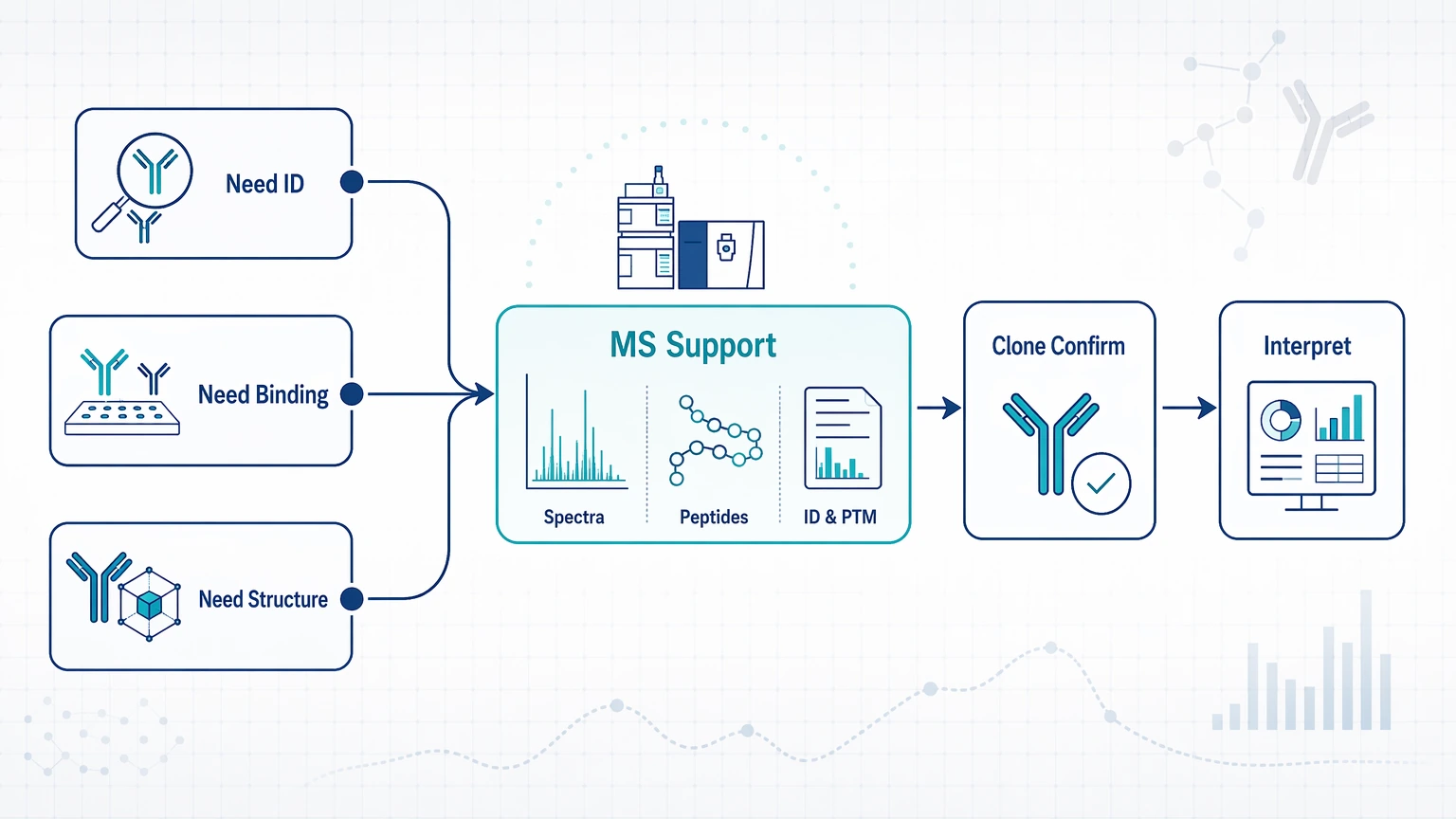
This is often relevant when teams need to:
- support clone-level sequence confirmation
- examine antibody-antigen interaction features beyond a simple binding-positive result
- connect candidate selection with structural or epitope questions
- resolve inconsistencies between repertoire-derived expectations and observed binding behavior
- add complementary characterization before the next screening round
Timing matters. If mass spectrometry support is added only after candidate triage is complete, the resulting data may still be technically informative, but it often arrives too late to shape the next decision. It is usually more useful when introduced at the stage where clone narrowing, antigen specificity, and downstream characterization begin to intersect.
Teams considering this step may also want to review related capabilities such as Antibody Sequencing Service: Advanced NGS and MS Techniques, Antibody-Antigen Interactions Characterization Service | HDX-MS, or Hydrogen Deuterium Exchange Mass Spectrometry, HDX MS Service when deeper characterization is likely to affect project decisions.
What a Better Antibody Analysis Report Should Actually Deliver
A workflow is only improved if the final outputs help the team decide what to do next. Reporting should therefore be designed backward from the intended decision.
A useful report may include:
- the original comparison question
- what each assay was intended to confirm
- sample cohort, replicate, and control group logic
- the main diversity profiling outputs, such as clonotype patterns, repertoire evenness, or clonal expansion behavior
- the main specificity assessment outputs, such as antigen binding behavior, cross-reactivity observations, or epitope-level differentiation
- orthogonal validation findings and the uncertainty they reduce
- limitations that affect interpretation
- recommended next actions for follow-up screening, deeper characterization, or revised sample collection
That structure is more actionable than a flat data package. It gives project managers, immunology leads, and downstream analytical teams a shared view of what was learned, what remains unresolved, and where the next workflow handoff should occur.
When External Project Support Helps
External support becomes useful when the project already has multiple moving parts that internal teams cannot easily align. That may include split ownership between repertoire sequencing and binding analysis, uncertainty about sample adequacy, or a pending decision on whether epitope work or mass spectrometry support should be added now rather than later.
The most productive engagement usually starts before another assay is ordered. A service partner should understand:
- the exact decision the team needs to support
- current sample constraints
- what data already exists
- where interpretation has stalled
- what handoff will occur after this phase
At that point, the discussion becomes operational: what is feasible, what should be sequenced first, and which confirmation step is worth reserving material for.
Practical Planning Checklist for Redesigning an Existing Analysis
Teams that want a more coherent antibody profiling workflow can use the checklist below:
1. Write the next project decision in one sentence. 2. Separate the diversity question from the specificity question. 3. Check whether the sample cohort, control group, and replicate plan support that decision. 4. Confirm whether antigen-level or epitope-level evidence is actually required. 5. Decide what orthogonal validation should confirm and when it will be triggered. 6. Determine whether proteomics or mass spectrometry support is needed for interpretation rather than added out of curiosity. 7. Redesign the report format so each output maps back to the original question.
That process does not make every workflow simple, but it does make it easier to interpret. It also shows when a smaller, decision-focused design is better than adding more disconnected assays.
Service Routes for Study Planning
For teams moving from method selection into execution, these service paths connect assay design, validation, and interpretation needs.
Conclusion
The most effective way to improve an antibody diversity and specificity analysis workflow is to organize it around a decision rather than a list of available methods. That means separating antibody repertoire questions from specificity assessment questions, designing the sample cohort and replicate structure to support the intended comparison, planning orthogonal validation before uncertainty becomes costly, and using proteomics or mass spectrometry support when deeper characterization will change the next step.
No single workflow template fits every project, especially when samples are limited or the biological question remains broad. If you are restructuring an active study, contact us at MtoZ Biolabs to evaluate your project, review sample feasibility, and discuss which data type should come next before more material is committed to another disconnected assay.
FAQ
What is the difference between antibody diversity analysis and specificity analysis?
Antibody diversity analysis examines the structure of the antibody repertoire, including clonotype richness, clonal expansion patterns, V(D)J usage, CDR3 length distribution, and similarity across groups. Specificity analysis focuses on binding behavior: whether antibodies recognize the intended antigen, whether cross-reactivity is present, and whether epitope-level separation matters for the project. One describes repertoire composition; the other tests target discrimination.
How should samples be designed for antibody repertoire and specificity studies?
Start with the comparison the study must support. Repertoire-focused work usually needs sample grouping that can reveal differences in clonotype distribution, repertoire evenness, or overlap between cohorts or timepoints. Specificity-focused work depends more heavily on controls that make antigen binding and background behavior interpretable. In combined workflows, material should be allocated early so the project does not exhaust samples before orthogonal validation or follow-up characterization.
When is orthogonal validation needed in antibody analysis workflows?
Orthogonal validation is most useful when a project decision depends on confirming a result across methods rather than relying on one assay format alone. Typical triggers include narrow separation between signal and background, suspected cross-reactivity, conflicting outputs across platforms, or a need to confirm that repertoire-associated candidates also behave as expected in functional binding assays.
Can mass spectrometry support antibody specificity research?
Yes, particularly when the project requires molecular characterization beyond a simple positive or negative binding result. Mass spectrometry support can help with clone-level confirmation, antibody-antigen interaction analysis, structural follow-up, or epitope-related interpretation. Its role is strongest when it is built into the workflow at the point where candidate narrowing and deeper characterization overlap.
How do you improve data interpretation in antibody profiling projects?
Improve interpretation by structuring the report around a decision rather than around assay outputs alone. Each section should clarify what changed in the repertoire, which candidates showed antigen binding, where cross-reactivity remains uncertain, what orthogonal validation confirmed, and which limitations still affect interpretation. A report is much easier to use when it connects diversity profiling, specificity assessment, and workflow handoff in one decision-oriented framework.
How to order?




