






How to Evaluate a Provider for Hybridoma Monoclonal Antibody Sequencing: Deliverables, Chain Pairing, and Reformatting Readiness
A strong hybridoma monoclonal antibody sequencing proposal should do more than promise “a sequence report.” It should spell out what sequence recovery will be delivered, how heavy chain and light chain identity will be interpreted, what evidence supports the final consensus sequence, and whether the output can move straight into archiving, transfer review, or recombinant reformatting. If a quote mentions only “antibody sequencing” or “CDR identification,” it may still generate technically interesting data, but that does not always support a confident redevelopment decision.
For buyers managing legacy hybridoma assets, the practical question is simple: will the provider return a package another team can use without reopening the project? In most cases, that means the proposal should fit the available starting material, report both VH and VL, explain chain pairing, and clearly state where uncertainty remains. What matters is downstream usability, not a broad promise to attempt sequence recovery.
Why This Comparison Matters for Legacy Hybridoma Programs
Teams usually begin this review when a legacy monoclonal antibody still performs in internal assays, but the original sequence record is missing, incomplete, or no longer trusted. In that setting, the sequencing project usually supports one of four business goals:
- protect the asset before the hybridoma becomes unstable or is lost
- prepare for recombinant re-expression
- support partner or site transfer
- compare archived antibodies before selecting one for redevelopment
Those goals are related, but they do not demand the same reporting standard. Archive protection can sometimes tolerate follow-up interpretation. A rebuild decision usually cannot. That is why two providers can both offer “hybridoma monoclonal antibody sequencing” and still deliver very different value to procurement and program teams.
The Four Buying Criteria That Separate Useful from Weak Proposals
1. Deliverable completeness
Start with the most basic question: what will you actually receive? For redevelopment or transfer, a useful package should include both nucleotide sequence and amino acid sequence for the recovered variable region, not just selected peptides or isolated CDR calls. It should also include clear annotation of CDR and framework region boundaries.
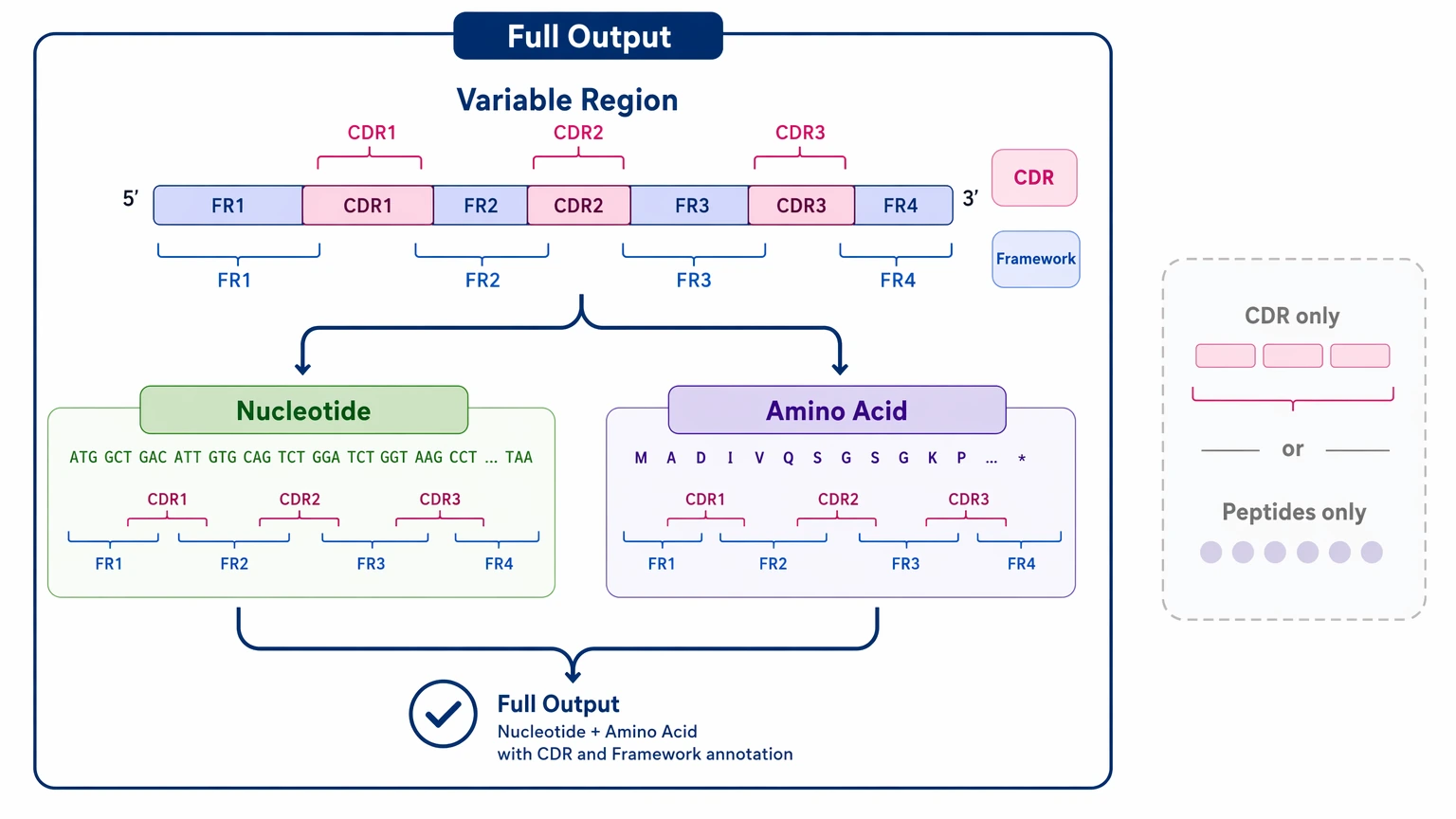
A weaker report often leaves gaps that slow later cloning or handoff work, such as:
- only one chain reported
- amino acid output without matching nucleotide output
- no clear distinction between partial and full variable region recovery
- no translation check between nucleotide and protein sequences
2. Chain pairing clarity
Chain pairing is one of the most important comparison points because redevelopment depends on the correct heavy chain and light chain combination. A provider should say whether pairing is directly supported, inferred from context, or unresolved.
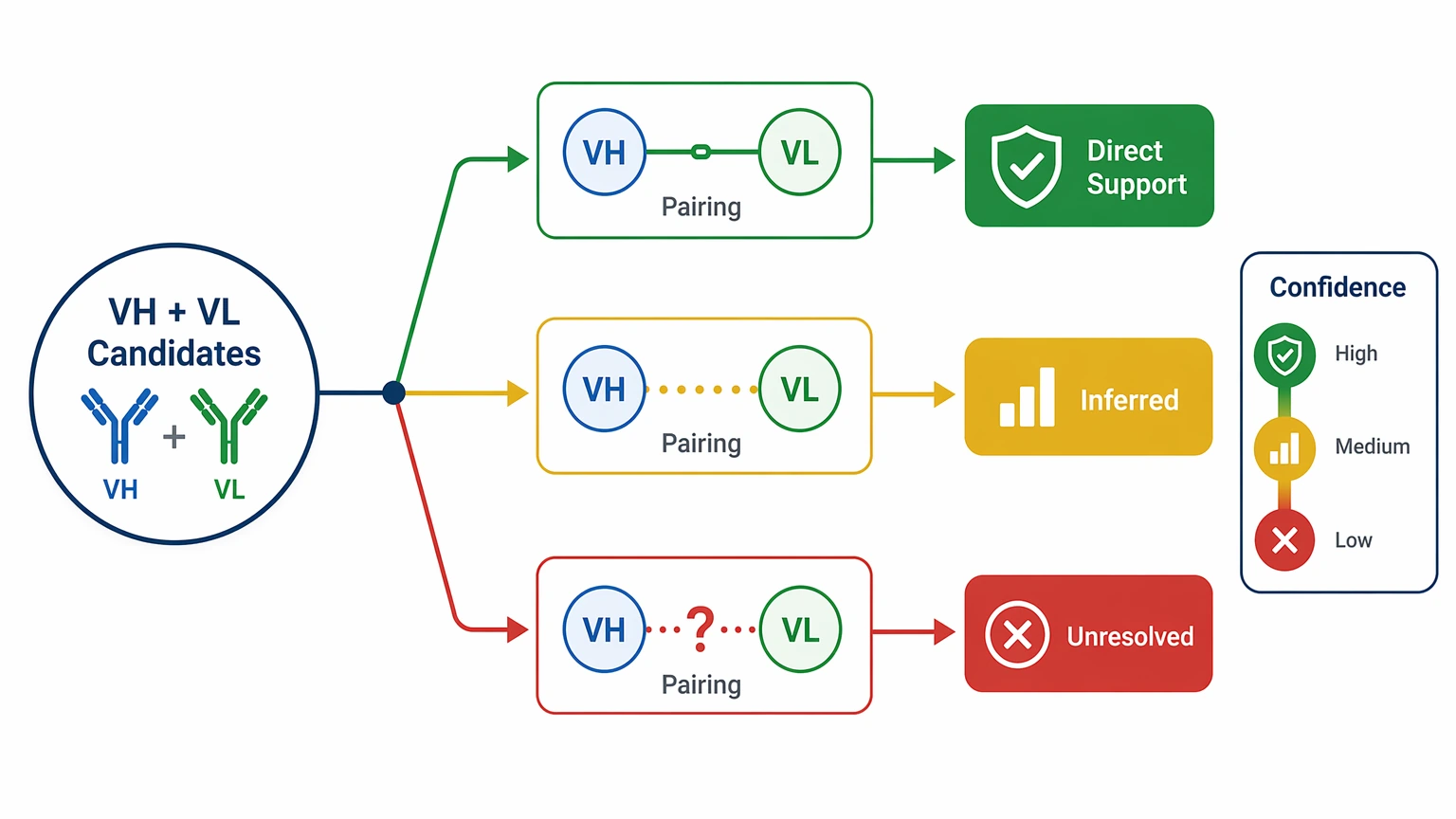
This becomes even more important when the sample input is limited or mixed. If multiple candidate chains appear, the provider should say that plainly rather than hide the ambiguity in technical notes. A proposal that stays vague on pairing may still have archive value, but it adds risk to recombinant reconstruction.
3. Reformatting readiness
A sequence can be real and still be awkward to use. For internal transfer or recombinant reformatting, buyers should ask whether the report is organized for cloning design and downstream handoff. That usually means:
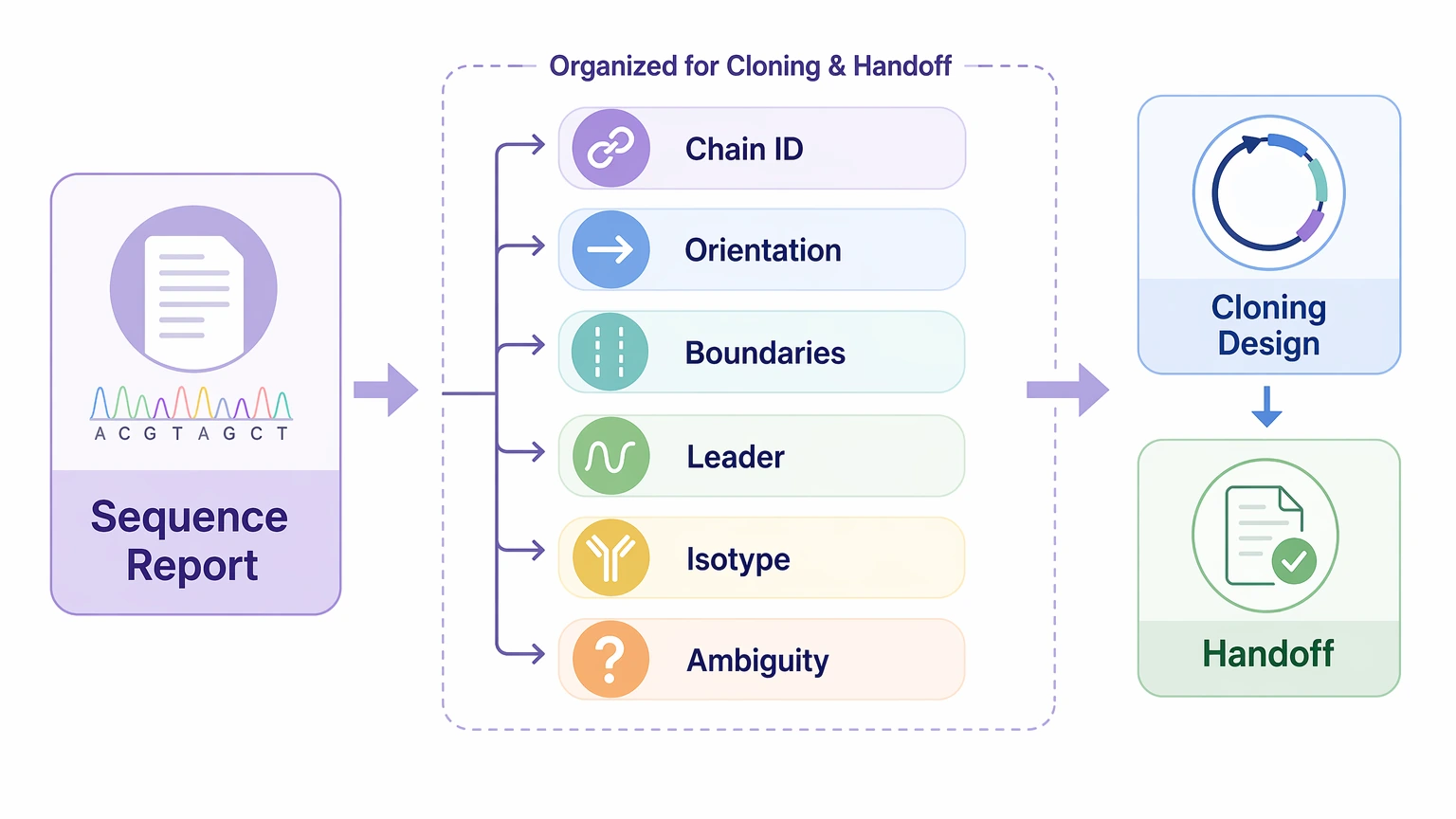
- chain identity labeled clearly
- orientation reported consistently
- variable region boundaries defined
- leader sequence handling explained if available
- isotype or constant-region context included when relevant
- uncertain residues flagged rather than normalized away
A provider that returns only raw sequence strings may leave molecular biology or CMC teams to rebuild basic context on their own.
4. Evidence package quality
The final consensus sequence should come with enough support to show how it was built. The exact evidence will vary with the workflow, whether it uses NGS, RACE, mass spectrometry, or a combination, but the report should still explain:
- what raw data are available
- how residue conflicts were resolved
- whether mixed populations were detected
- whether any part of the sequence is inferred rather than directly observed
- when orthogonal validation is recommended
Clear evidence does not remove uncertainty. It does make that uncertainty easier to manage.
How Starting Material Changes the Meaning of a Quote
Provider quotes are often hard to compare because the same service label can cover very different technical paths. The available starting material changes what can reasonably be concluded.
| Comparison point | Cell-based input | Purified protein input | Hybrid or staged approach |
|---|---|---|---|
| Typical material | Viable hybridoma, pellet, RNA, or cDNA | Purified antibody only | Mixed inputs or recovery plus follow-up validation |
| Sequence scope | Better path to paired VH and VL with nucleotide sequence | Often stronger on residue recovery than direct nucleotide definition | Useful for reconciling gaps |
| Pairing basis | More direct in nucleic-acid-based workflows | Often inferred from candidates or context | Can narrow ambiguity |
| Best fit | Archive protection, transfer, rebuild planning | Rescue attempt when cells are unavailable | Higher-value assets needing extra confirmation |
| Main caution | Depends on cell quality and nucleic acid integrity | Pairing confidence may be narrower | More coordination across steps |
That is why proposal review should focus on whether the workflow fits the material you actually have, not the material the provider would prefer to receive.
What a Redevelopment-Ready Package Should Contain
When a project may lead to reconstruction or transfer, buyers should expect more than a sequence file. A stronger package usually contains:
- recovered VH and VL
- both nucleotide sequence and amino acid sequence
- annotation for CDR and framework region
- a documented consensus sequence method
- confidence notes for ambiguous residues
- statements about contamination or mixed-chain signals
- handoff-ready formatting for downstream design review
If a proposal does not specify these items, ask for the deliverables in writing before a PO is issued. If your team needs help deciding whether a quote is suitable for redevelopment rather than basic sequence characterization, MtoZ Biolabs can evaluate your project against your sample scenario, expected outputs, and handoff needs before procurement is finalized.
Questions to Ask Providers Before Purchase
A short diligence checklist can surface major differences quickly:
- Will you report both heavy chain and light chain variable region sequences?
- Will the report include both nucleotide sequence and amino acid sequence?
- How is chain pairing established for my starting material?
- If more than one candidate chain is detected, how will that be reported?
- Will CDR and framework region annotation be included?
- How is the final consensus sequence generated?
- What raw evidence or confidence notes accompany uncertain positions?
- Is the package formatted for recombinant reformatting, or is that a separate service?
- When do you recommend orthogonal validation?
- What are the stated limits for degraded, low-input, or purified antibody-only projects?
These questions shift the conversation from “Can you try?” to “Will the result support the business decision we need to make?”
Matching the Deliverable Standard to the Project Goal
Archive protection
For sequence archival, prioritize completeness, traceable annotation, and clear record quality. A report with paired chains, defined variable region boundaries, and retained evidence is more useful than a short summary file.
Recombinant rebuild
For reconstruction, pairing confidence and handoff formatting matter most. Full VH and VL recovery is generally more useful than CDR-only reporting because construct design depends on the broader variable region context.
Partner or site transfer
Transfer projects need documentation another group can interpret without repeated clarifications. Clear chain labels, residue confidence notes, and standardized formatting reduce friction during handoff.
Purified-antibody-only rescue
A purified antibody project can still be worth pursuing when no viable hybridoma remains, but the confidence boundaries are different. Ask the provider to explain which parts of the package will be direct observation, which parts will be inference, and whether validation should be staged after initial sequence recovery.
Proposal Warning Signs
A quote may be a poor fit for redevelopment if it:
- promises “antibody sequencing” without naming both chains
- emphasizes CDR recovery without addressing full variable region output
- does not explain chain pairing
- offers no raw evidence or sequence-confidence notes
- does not distinguish direct calls from inferred sequence elements
- avoids discussing project limits for legacy or low-input material
A technically capable provider can still be the wrong choice if the reporting package is built for demonstration rather than operational handoff.
Summary and Next-Step Guidance
The best provider for hybridoma monoclonal antibody sequencing is usually the one whose deliverables match the decision that comes next. For archival, sequence completeness and documentation carry the most weight. For rebuild or transfer, chain pairing, boundary definition, and reformatting-ready output matter more. For protein-only rescue, evidence quality and a realistic validation plan often determine whether the result is actionable.
If your program is reviewing providers for legacy hybridoma preservation, recombinant redevelopment, or transfer planning, prepare a short input package with your starting material, intended use, desired deliverables, and validation threshold. Then submit your requirements or contact us so MtoZ Biolabs can review the workflow fit and reporting standard before you commit to a sequencing scope that may require a second clarification project.
FAQ
Is full VH/VL recovery always required for archive decisions?
Not always. If the immediate goal is record preservation rather than expression planning, a partial package can still be useful. However, full VH and VL reporting lowers the chance that the archive will need reinterpretation later.
Can purified antibody projects support chain pairing at the same level as cell-based projects?
Not in every case. Some purified antibody workflows can support strong candidate reconstruction, but the basis for chain pairing is often less direct than with nucleic-acid-based recovery from hybridoma material.
Should buyers ask for amino acid and nucleotide outputs even if the internal team mainly works at the protein level?
Yes. Protein teams may focus on the amino acid sequence, but redevelopment and cloning review often require the nucleotide sequence as well. Having both reduces rework during cross-team transfer.
When is orthogonal validation worth budgeting upfront?
It is usually worth planning when the asset is commercially important, the material is degraded, multiple chain candidates are plausible, or the result will be transferred to another organization for follow-up work.
What is a good sign that a provider understands redevelopment needs?
A strong sign is a quote that defines chain-level outputs, states how chain pairing will be interpreted, describes the evidence package, and explains whether the report is formatted for recombinant reformatting rather than only for research documentation.
How to order?




