






Epitope vs Antigen: Method Selection and Research Use Cases
Quick Decision Guide
Choose antigen identification when the first unresolved question is what molecule is being recognized.
Choose epitope mapping when the antigen is already supported and the next question is which region or residue is recognized.
Choose de novo peptide sequencing or de novo protein sequencing first when weak database search results, unknown sequence content, truncation, mutation, or PTM-rich spectra prevent confident interpretation.
Key limit: sequence evidence from LC-MS/MS can narrow candidate linear regions, but it does not by itself define every conformational epitope.
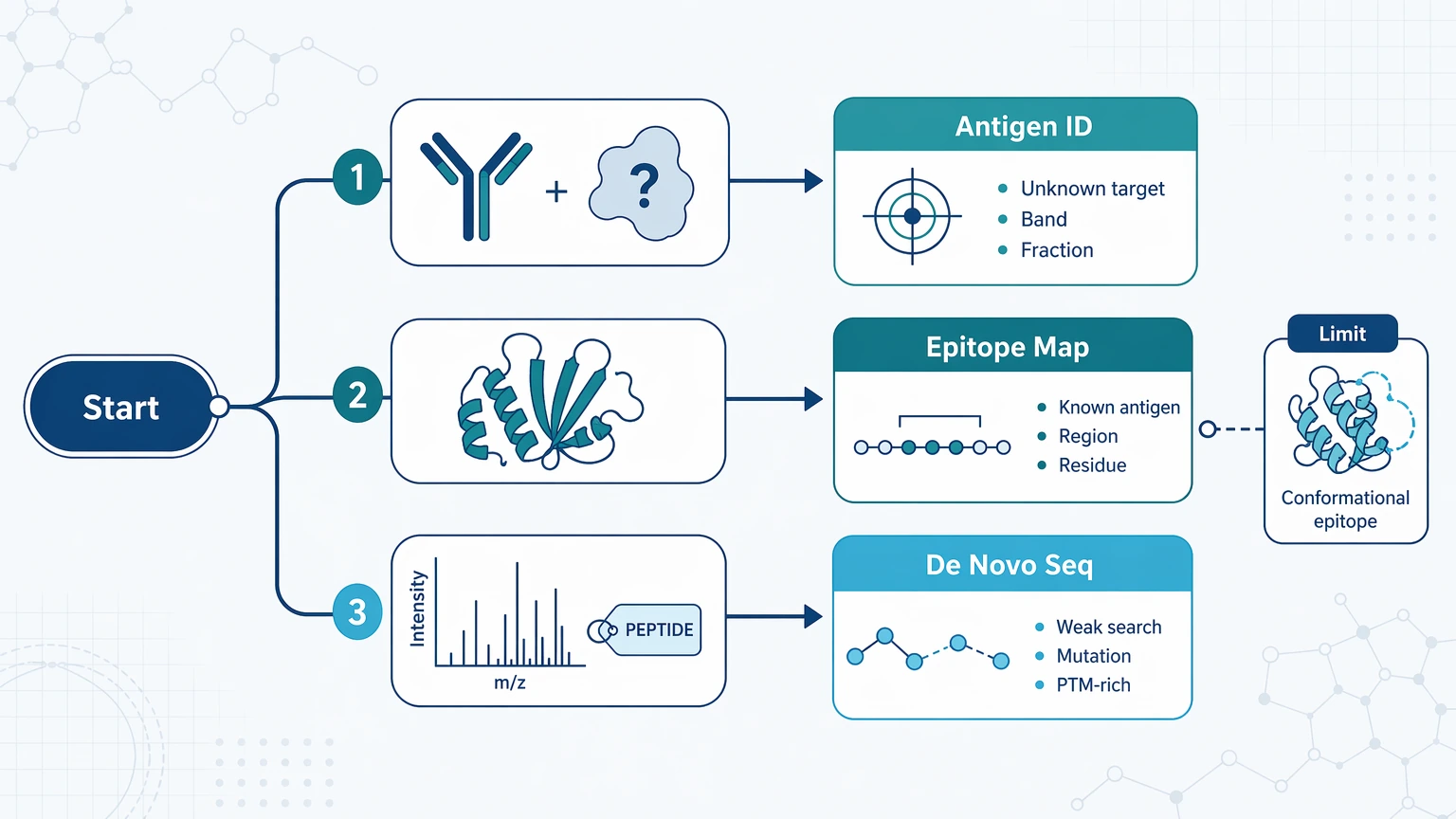
In practice, the decision becomes clearer when the open question is stated in operational terms rather than immunology shorthand.
What “Antigen” and “Epitope” Mean in Method Selection
An antigen is the full molecular entity recognized by an immune component. An epitope is the specific feature or region on that antigen recognized by an antibody or receptor. One antigen can contain several epitopes, and different antibodies may bind different regions of the same target.
That distinction quickly becomes a workflow choice once a project reaches data review. If a team only knows that an antibody reacts with a band, enriched fraction, or peptide signal, the first task is usually antigen identification rather than epitope mapping. If the target protein is already assigned with reasonable confidence, the next step is often to test whether binding points to a linear epitope, a modified residue, or a conformational epitope.
So epitope vs antigen is not just wording. It determines whether the study needs whole-molecule assignment, residue- or region-level follow-up, or a staged workflow that resolves sequence uncertainty before either claim is taken further.
What Each Research Question Is Actually Asking
The most useful comparison is not simply part versus whole. It is the practical question behind the request.
- Antigen identification asks: what molecule is present in the antibody-reactive sample?
- Epitope mapping asks: what part of that assigned antigen is recognized?
- Sequence-resolution support asks: is the current sequence evidence too incomplete for either claim to be reliable?
Projects often drift when those questions are blended too early. An antibody-reactive peptide does not automatically define the biologically relevant binding site. In the same way, identifying a likely antigen does not establish the exact epitope.
This matters most in four recurring situations: an antibody binds an unknown band or mixed fraction; a peptide hit has weak or conflicting database search results; a target appears heavily modified, truncated, or species-divergent; or a known antigen still lacks region-level binding information.
When Antigen Identification Should Come First
Many studies described as epitope projects are still antigen-assignment problems. This is common with gel bands, immunoprecipitated material, enriched fractions, and novel peptide candidates.
In those settings, the first goal is a defensible molecular identity. Typical evidence includes unique peptide support, interpretable peptide-spectrum match results, credible sequence coverage, precursor and fragment consistency across the assigned sequence, and agreement between database-driven and manual or hybrid interpretation.
A standard database search may be enough when the sample contains a well-represented canonical protein. It becomes less dependable when the analyte is novel, mutated, truncated, noncanonical, or rich in post-translational modifications. At that point, the project may need LC-MS/MS review beyond search-only output.
Antigen identification should also come first when several protein candidates appear together. Before asking where an antibody binds, the team needs to decide which candidate matters and which signals may come from background or carryover.
When Epitope Mapping Is the Better Next Step
A project reaches true epitope mapping once the antigen is already supported and the main question shifts to binding-site definition.
For a linear epitope, peptide-level strategies can be useful because the recognized segment is contiguous in sequence. MS-based evidence may help narrow candidate regions, especially when paired with peptide synthesis, mutational follow-up, or targeted confirmation.
For a conformational epitope, the limit is different. A conformational epitope depends on three-dimensional structure and residue proximity in the folded antigen. Tandem mass spectrometry can clarify sequence composition, sequence variants, and PTM context, but it does not by itself establish every higher-order binding surface. When binding depends on folded structure, structural or binding-context methods are usually the better follow-up.
A simple routing table can help translate that distinction into a first workflow choice.
| Scenario | Recommended workflow | Key limitation | Validation need |
|---|---|---|---|
| Unknown antibody-reactive band | Antigen identification by LC-MS/MS | Binding site remains unresolved | Confirm assigned target in follow-up assays |
| Known protein, unknown recognized segment | Epitope mapping, usually linear region screening first | May miss conformational binding | Use orthogonal binding-context confirmation |
| Novel or PTM-rich peptide hit | De novo peptide sequencing before epitope claims | Sequence inference may remain partial | Review spectra and targeted follow-up |
| Suspected conformational binding | Antigen confirmation plus structural follow-up | LC-MS/MS alone is not definitive for full conformational mapping | Add structure-aware or binding-surface methods |
The takeaway is straightforward: first assign the molecule when identity is open, then narrow the binding region only after that assignment is supportable.
When De Novo Sequencing Changes the Decision
De novo peptide sequencing and de novo protein sequencing are most useful when the sequence itself is the uncertain part of the project. Common triggers include low database-search match rates, spectra that suggest truncation or mutation, species divergence, and PTM-heavy precursor ions with uncertain PTM localization.
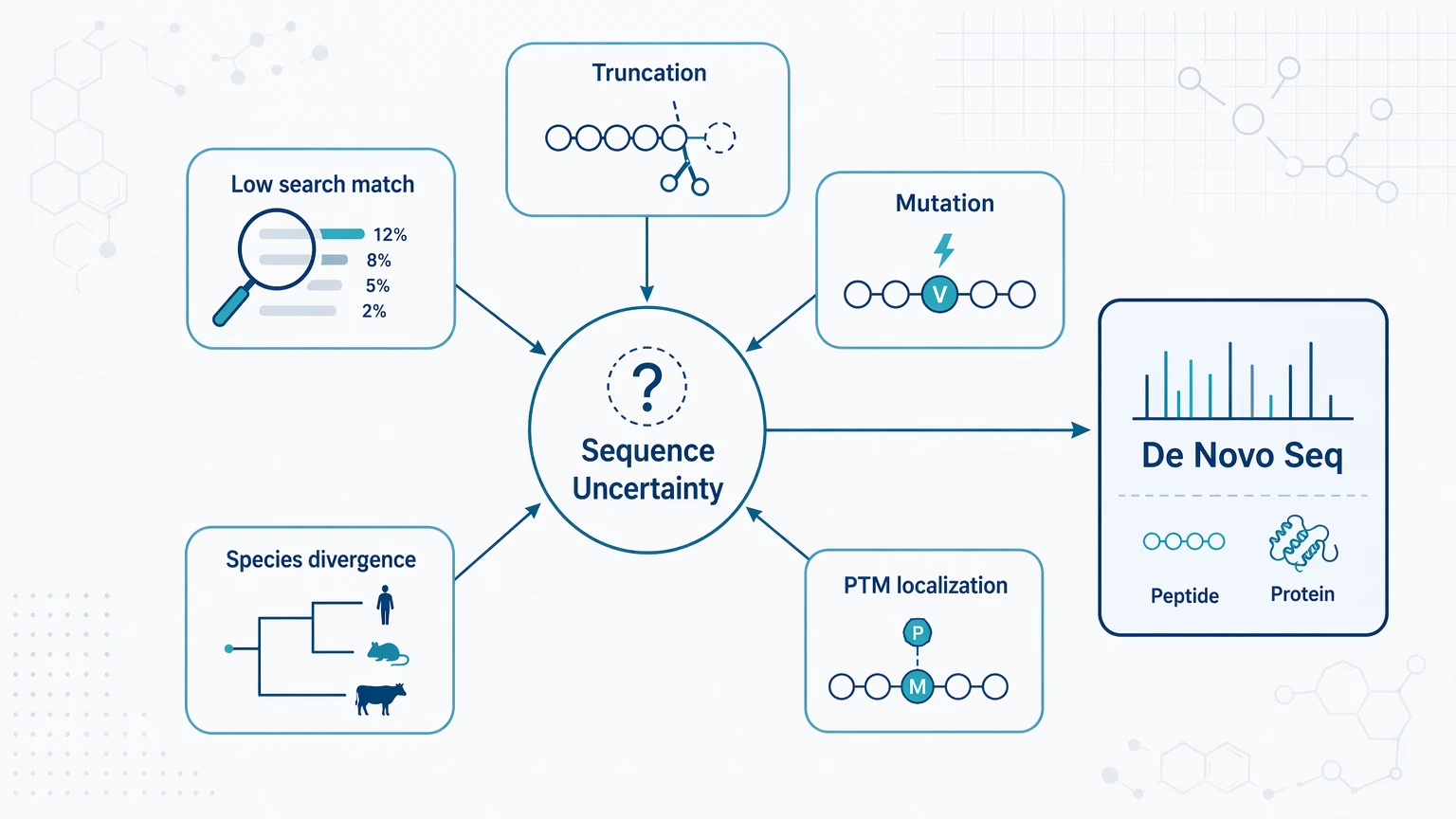
In these cases, de novo analysis does not replace epitope mapping. It works as a decision-support step that helps determine whether the reactive material contains an assignable known antigen, a novel or altered sequence variant, an unknown peptide identification problem, a candidate antibody-reactive peptide worth follow-up, or modification patterns that may affect recognition.
One limit should stay in view. MS/MS interpretation can generate strong candidate sequence tags without fully resolving every residue, modification state, or isomeric alternative. Confidence still depends on fragmentation quality, spectral complexity, and corroborating evidence. If your current data include weak search output, ambiguous sequence tags, or PTM-rich spectra, you can submit your requirements to MtoZ Biolabs to evaluate your project around de novo sequencing, LC-MS/MS interpretation, and the most appropriate validation path before moving into a narrower epitope study.
Sample and Data Checks Before You Choose a Workflow
Workflow selection becomes easier when sample type and decision goal are aligned from the start.
A purified peptide is often suitable for unknown peptide identification and linear epitope hypothesis testing, but it may not preserve native conformation. A protein band or enriched fraction may support antigen identification, although co-migrating proteins can complicate interpretation. Complex immunoprecipitated material can reveal antigen candidates, but background proteins often lower specificity. A PTM-rich digest may justify de novo sequencing first, especially when search results collapse into protein families instead of producing a clear assignment.
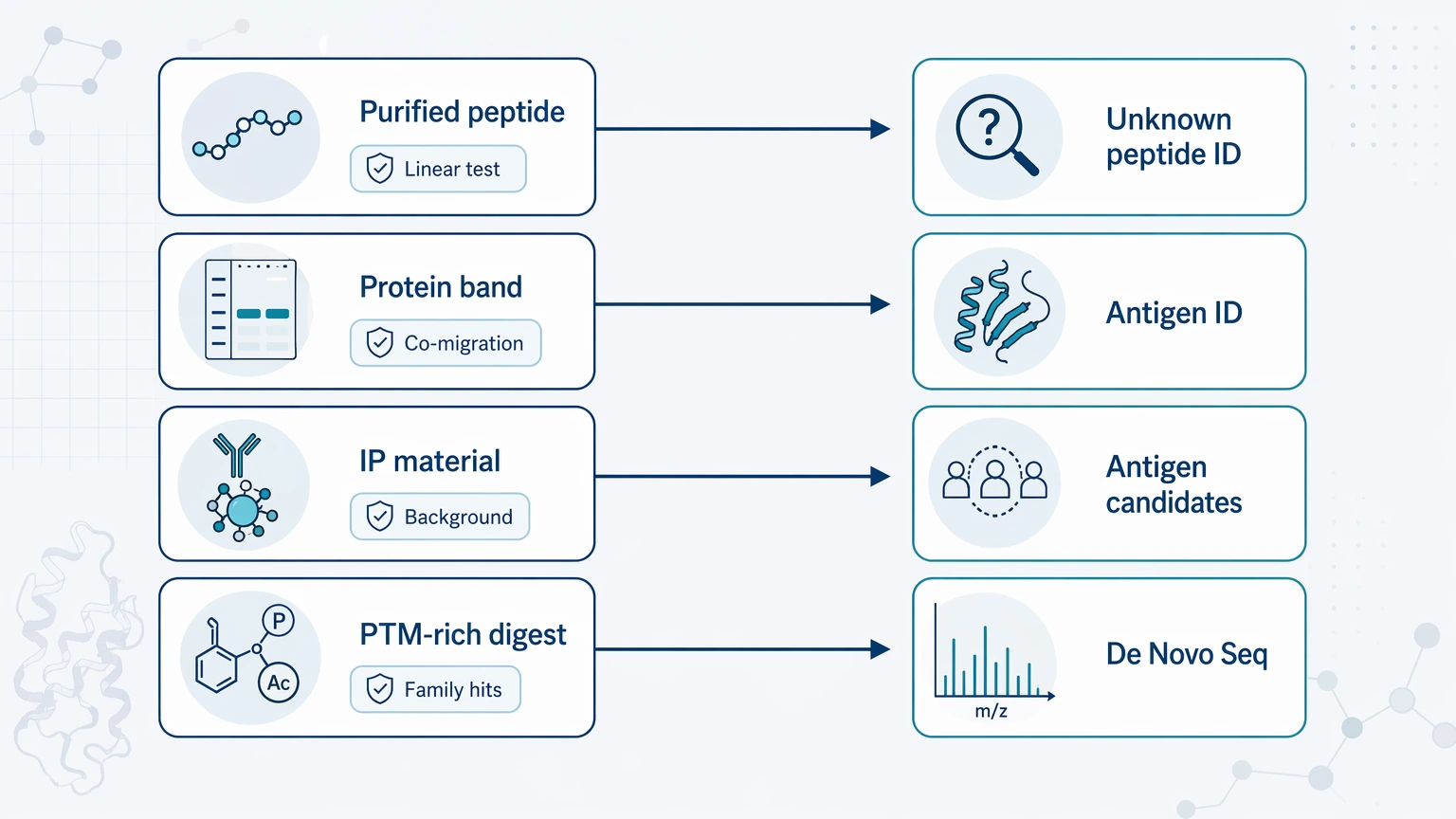
Before outsourcing, prepare the sample type and approximate amount, species or source background, whether the signal comes from a purified analyte or mixed fraction, prior LC-MS/MS files if available, database-search outputs and confidence concerns, suspected PTMs or truncation, and the exact decision to be made. That last point is often the difference between a useful report and a report that still leaves the main question open.
Expected Results and Validation Methods
The most useful reports separate immediate deliverables from follow-up confirmation.
Immediate deliverables may include candidate antigen assignment, unique peptide evidence, sequence tags, sequence coverage summaries, PTM localization calls, and notes on database-search limits versus de novo-supported interpretation. These outputs help define what the sample most likely contains and whether a linear epitope hypothesis is plausible.
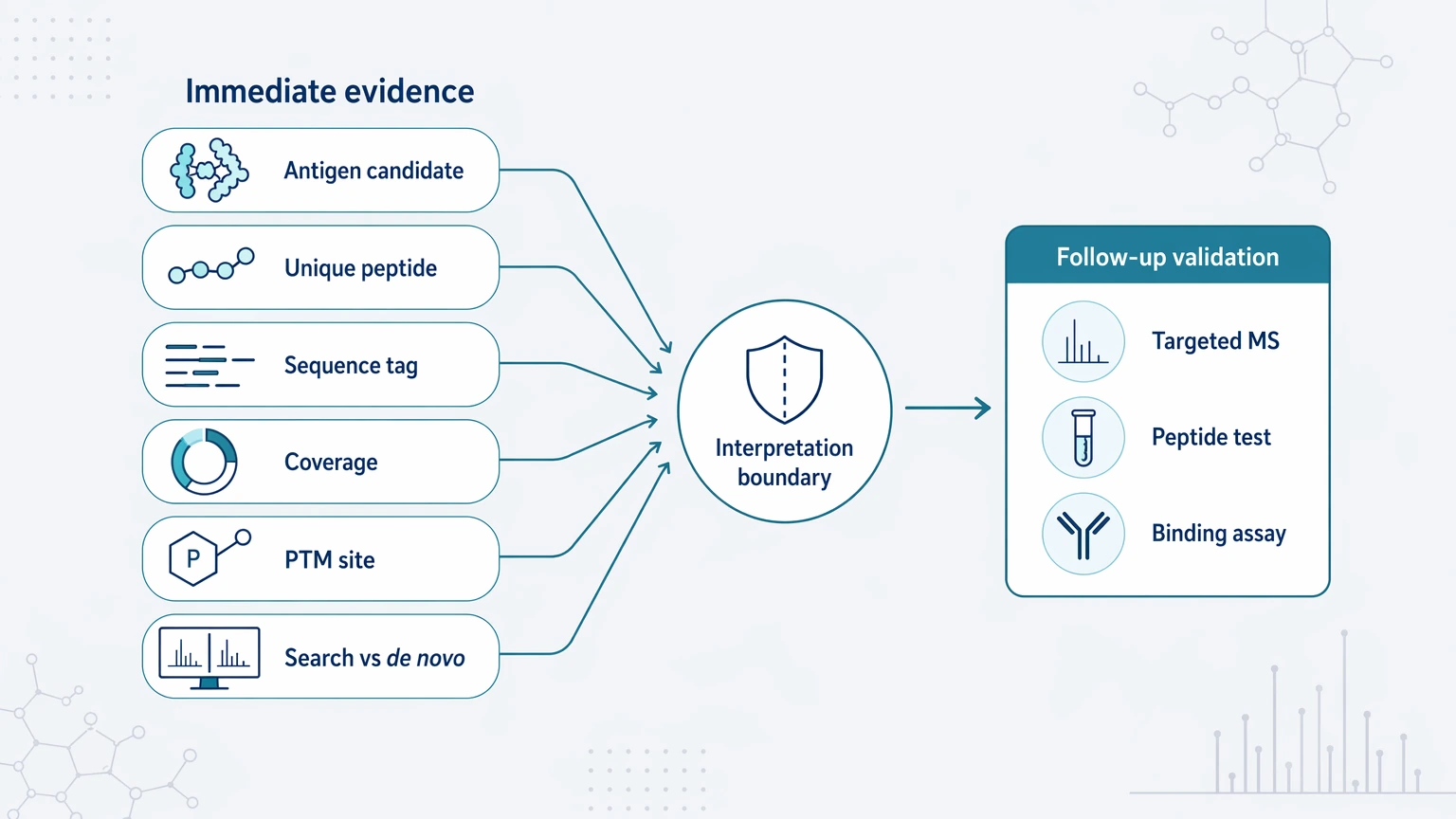
Follow-up confirmation asks a different question: does the candidate sequence or region hold up under an orthogonal test? Depending on the project, confirmation may involve synthesized peptides, targeted MS, immunoassays, mutational studies, or binding-context methods. For a modified target, targeted site validation can test whether the reported PTM or region is reproducible in an independent measurement.
This separation helps prevent overcalling. A candidate antigen from LC-MS/MS is not the same as validated biological relevance, and a sequence-supported region is not yet a confirmed epitope.
Service Routes to Consider
If the next project decision is still open, these routes usually match the most common handoff points after data review.
- De Novo Peptide Sequencing Services for unknown peptide identification, mutation-rich spectra, and truncated sequence candidates.
- Protein Identification by LC-MS/MS Service for antibody-reactive bands, enriched fractions, and first-pass antigen assignment.
- De Novo Protein Sequencing Service for noncanonical, species-divergent, or database-limited protein targets.
- LC-MS/MS-Based Targeted Site Validation Service when a sequence region or PTM call needs targeted confirmation.
Key Cautions and Practical Limits
Several limits should shape expectations before the study begins. Low abundance, degradation, or heavy contamination can restrict sequence coverage and reduce confidence in antigen assignment. Co-purified proteins, carryover peptides, and mixed fractions can also produce plausible but misleading candidates, so unique peptide support still matters when multiple proteins are present.
Interpretation boundaries are just as important. Partial sequence tags, incomplete fragmentation, and uncertain PTM localization may support a candidate rather than a final answer. This is especially relevant when the project turns on one modified residue or a short sequence segment.
Another workflow may be the better next step when the main question is folded-surface recognition, steric accessibility, or residue proximity in native structure. In that setting, deeper sequence interpretation alone will not replace structure-aware follow-up.
FAQ
Can antigen identification and epitope mapping be ordered together?
Yes, but they should be staged logically. If antigen identity is still uncertain, the first readout should focus on molecular assignment. Epitope-level follow-up makes more sense after the target list has narrowed.
What does weak database-search performance usually mean?
It often suggests sequence variants, truncations, PTMs, mixed species, or material not well represented in the reference database. It does not automatically mean the spectra are unusable, but it does change how much weight to place on search-only results.
How much sequence coverage is enough to trust an antigen assignment?
There is no single cutoff for every project. Coverage becomes more informative when read together with unique peptide evidence, precursor-fragment consistency, and whether competing candidates still look plausible.
If a modified peptide is detected, does that prove the modification drives antibody binding?
No. The modification may explain the observed mass pattern or improve target assignment, but functional relevance still needs orthogonal confirmation.
What is the best next step when the target may be conformational?
Start by confirming antigen identity and composition, then move to structural or binding-context methods if the main goal is surface-level epitope definition in a native state.
Conclusion
For epitope vs antigen, the practical choice becomes clear once the decision point is defined. If the open question is the identity of the recognized molecule, start with antigen identification. If the molecule is already supported and the next question is which region is recognized, move to epitope mapping. When poor database search performance, unknown sequence content, or PTM-related ambiguity blocks interpretation, a staged LC-MS/MS strategy with de novo sequencing is often the better entry point. For antibody-reactive fractions, novel peptide candidates, or modification-sensitive targets, start with a technical summary of the current evidence, then match that evidence to the project context and planned confirmation work. If you need a practical next step, submit your requirements and contact the MtoZ Biolabs team for a project discussion focused on sample fit, sequence uncertainty, and orthogonal confirmation options.
Related Services
How to order?




