






De Novo Antibody Sequencing: When Protein-Only Sequence Recovery Is the Right Choice
When no plasmid, hybridoma record, or usable nucleic acid template remains, de novo antibody sequencing is often the right option if you still have a purified antibody, the material is likely dominated by one monoclonal antibody species, and your team needs VH and VL information directly from the protein. It is a weaker option when recoverable cells, RNA, or clone-linked DNA still exist, because RACE, RT-PCR, or NGS can recover sequence from the template side with fewer ambiguity points from the mature protein.
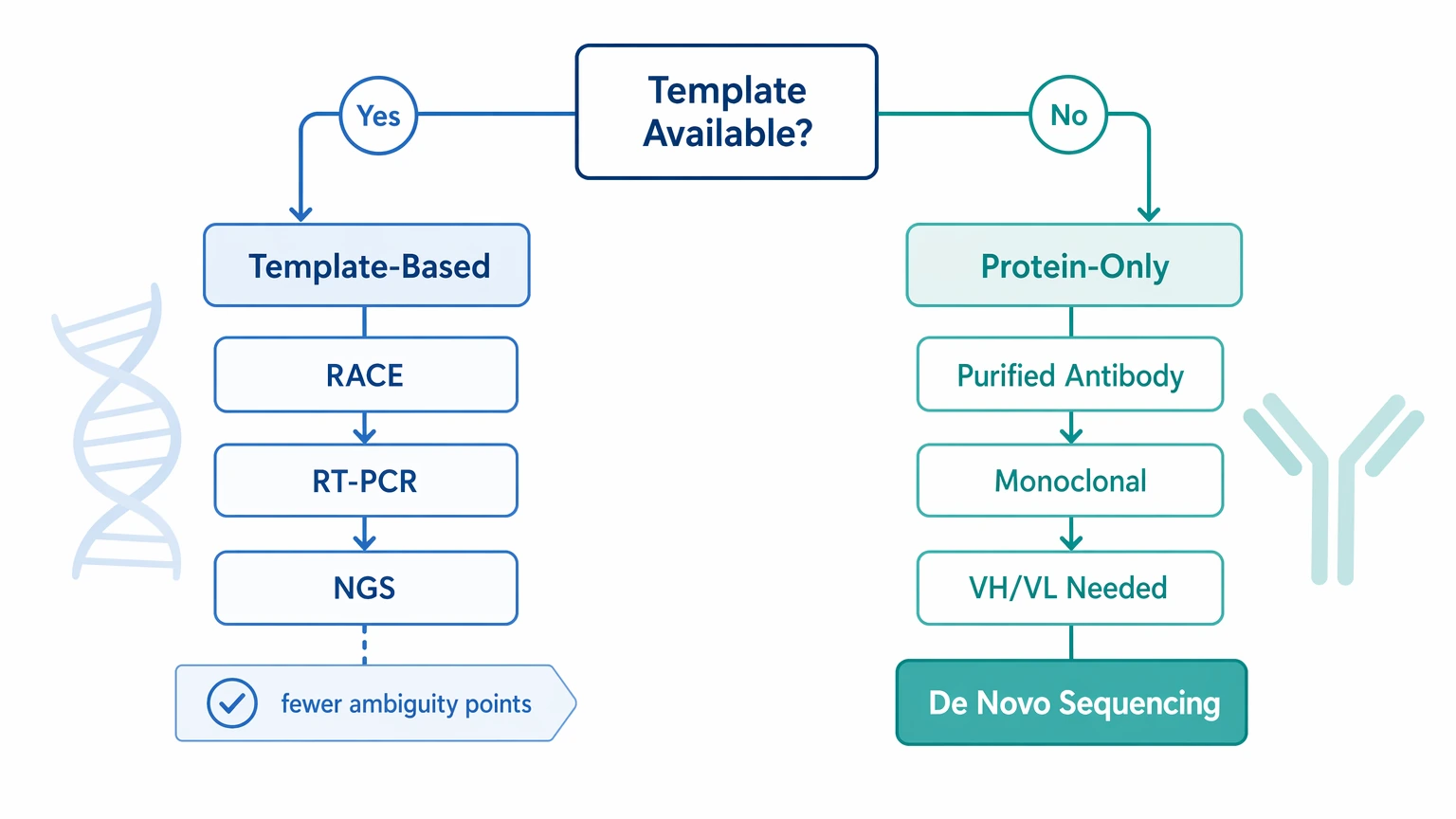
The choice usually becomes clear after three questions. First, is the sample suitable for protein-only sequence recovery? Second, how much variable region detail does the project actually need: CDR insight, broader framework support, or a sequence package meant for recombinant re-expression? Third, will the team treat the output as sequence evidence that still needs orthogonal validation, especially around chain pairing and leucine/isoleucine ambiguity? If the answer is yes across those filters, LC-MS/MS-based recovery is a practical route, not a last resort.
When This Decision Comes Up
This usually shows up as a late-stage asset rescue problem. A team inherits an antibody from a collaborator, an archived program, or an external transfer. The material still binds, and it may still perform well in internal assays, but the sequence trail is broken. The plasmid is missing, the hybridoma cannot be recovered, or the original nucleic acid template is too degraded or poorly documented to rely on.
At that point, the missing sequence is no longer just a record-keeping issue. It becomes a project constraint. Without usable heavy chain and light chain sequence information, it is difficult to move confidently into recombinant re-expression, sequence archiving, engineering review, or handoff to another group. The real question is not whether protein analysis is interesting. It is whether the antibody protein you still have can support the level of sequence recovery the project needs.
What De Novo Antibody Sequencing Can Recover
In this setting, de novo antibody sequencing means inferring amino acid sequence from LC-MS/MS peptide data rather than reading a DNA or RNA template. For antibody projects, the practical target is usually the variable region of both the heavy chain and light chain, with particular attention to the CDR, especially CDR3.
A well-scoped workflow can provide:
- peptide evidence across VH and VL
- sequence reconstruction across parts of the framework region
- residue-level support for key CDR segments
- an explicit map of well-supported positions versus unresolved ones
That distinction matters. The output is not automatically the same as template-confirmed sequence truth. It is a protein-derived sequence model built from peptide observations, interpretation rules, and any follow-up confirmation your team completes.
The Main Go/No-Go Filters
Only a few decision categories matter most for this method-selection question.
1. Sample identity and monoclonality
A purified antibody is far more suitable than a mixed fraction or crude hybridoma supernatant. If the sample contains multiple immunoglobulin species, chain pairing becomes more difficult and peptide assignments can start to overlap. In practice, the closer the material is to a single dominant monoclonal antibody, the more useful the recovered VH and VL information will be.
2. Downstream sequence depth requirement
The required deliverable changes the threshold for success. Archive-level documentation can tolerate more sequence ambiguity than a project preparing expression constructs. A CDR-focused question is narrower than full variable region reconstruction, and re-expression planning usually needs broader continuity across both chains.
3. Modification burden
The antibody is a mature protein, not a clean nucleic acid template. Post-translational modification patterns such as glycosylation, oxidation, deamidation, or clipping can complicate peptide interpretation and lower local confidence. These features do not rule out the method, but they do affect how far the output can be pushed downstream.
4. Validation readiness
If the project is expected to use the recovered sequence for recombinant re-expression, validation planning should be built in from the start. A team with no plan for confirmatory peptide mapping, targeted follow-up, or expression-based comparison may still get useful archival insight, but turning the sequence into a confident development asset becomes harder.
A Practical Method-Selection Path
Because this is a method-selection article, the easiest way to decide is to move through the choice in order.
Step 1: Define the minimum useful output
Start with the decision the sequence needs to support.
| Project aim | Minimum useful output | What that means for route selection |
|---|---|---|
| Legacy asset archiving | Broad sequence evidence across variable regions | Useful even if some positions remain ambiguous |
| Engineering review | Strong CDR and surrounding framework region support | Helps with paratope-related analysis and design planning |
| Recombinant re-expression | Broad VH and VL reconstruction plus a validation plan | Requires tighter control of uncertainty |
If the project only needs comparative insight, protein-only recovery may already be enough. If the project needs an actionable sequence for construct design, the tolerance for unresolved positions is much lower.
Step 2: Judge whether the sample is fit for LC-MS/MS work
Before debating platforms, assess the antibody sample itself.
| Sample feature | More favorable | Less favorable |
|---|---|---|
| Material type | Purified monoclonal antibody | Mixed or poorly defined material |
| Identity confidence | One dominant antibody species | Multiple species possible |
| Protein amount | Enough for digestion and confirmation work | Very limited material |
| Modification burden | Manageable | Heavy clipping or complex PTM burden |
A borderline sample does not always mean stop. It may simply mean narrowing the goal from re-expression support to sequence characterization.
Step 3: Decide whether template-based recovery is still realistic
If recoverable cells, clone-linked RNA, or reliable DNA are still available, RACE or NGS usually remains the better first route. Those methods solve the sequence problem from the template side rather than from the mature protein alone.
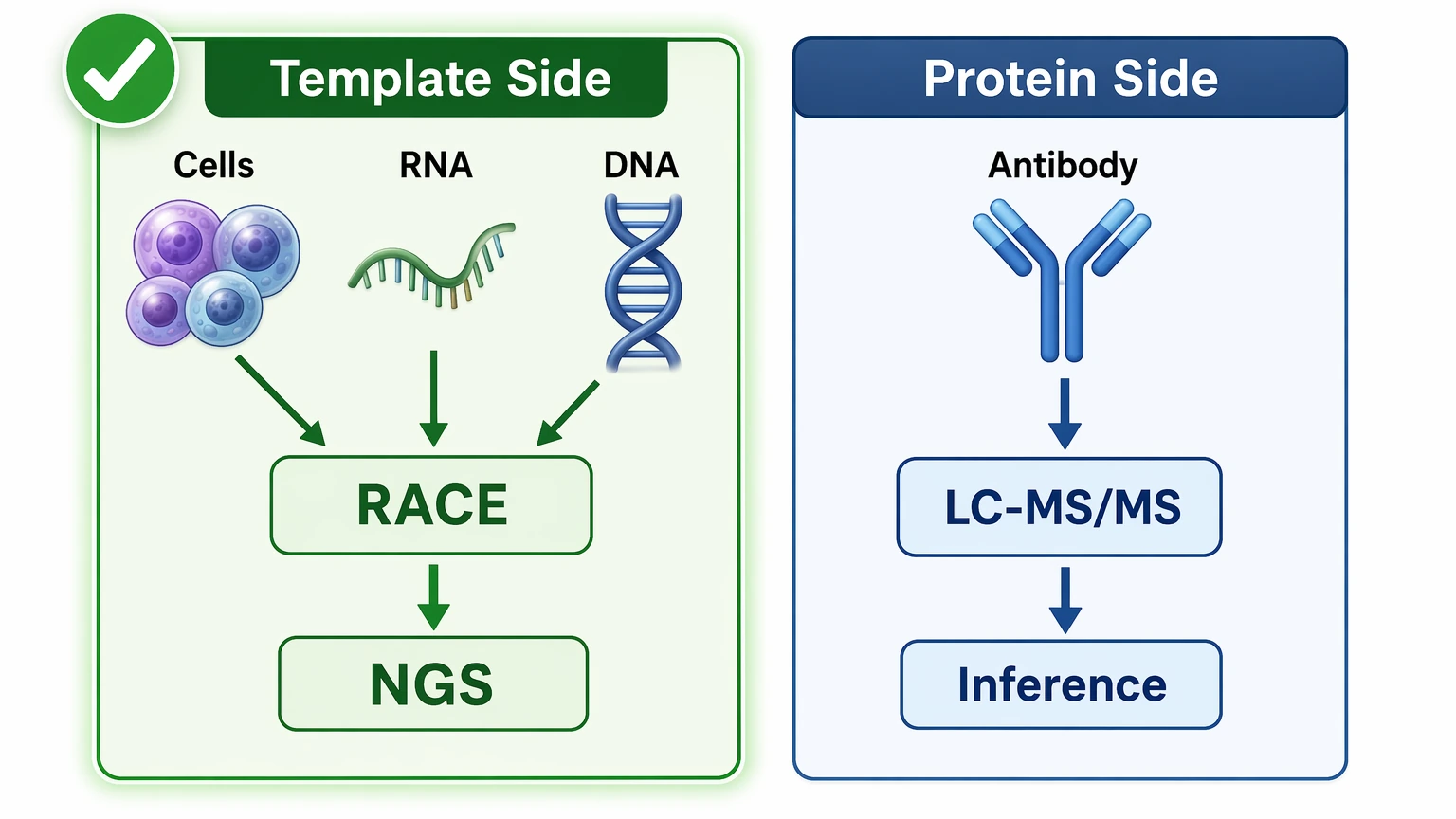
Choose de novo antibody sequencing when:
- the original biological source is unavailable or untrustworthy
- the antibody protein is the only dependable asset left
- the project still needs heavy chain and light chain variable region information
- the team can accept a sequence-recovery workflow followed by confirmation
If a record says that a hybridoma once existed but there is no credible path to retrieving usable material, waiting for template recovery may only add delay without improving the decision.
Step 4: Match expectations to known ambiguity points
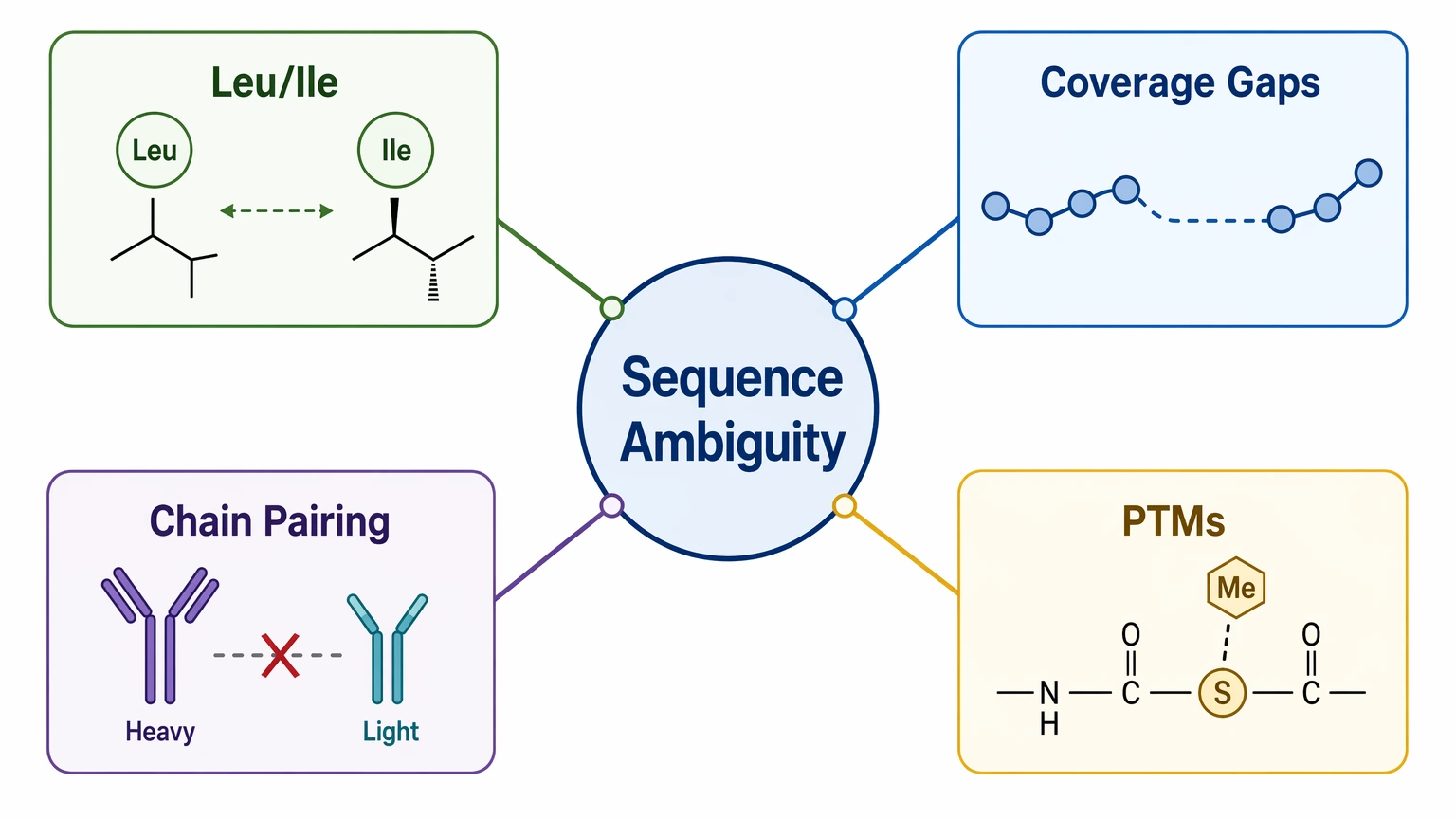
This method has a few recurring technical limits that are worth discussing upfront:
- leucine/isoleucine ambiguity from isobaric residues in standard MS
- incomplete sequence coverage across difficult peptide regions
- uncertainty in chain pairing if the sample is not clearly monoclonal
- interpretation challenges created by post-translational modification
These are not signs that the workflow failed. They are normal boundaries of protein-derived inference, and they should shape the validation plan.
If your team is weighing those boundaries against the intended use case, this is a good point to submit your requirements for a fit review. In projects centered on legacy antibodies or transferred purified material, MtoZ Biolabs can evaluate whether the sample state, target VH/VL scope, and expected report output fit a practical LC-MS/MS recovery strategy.
What a Useful Deliverable Looks Like
A good project outcome is not “one final sequence with no caveats.” A useful deliverable is a structured evidence package that separates confident calls from uncertain ones.
That usually includes:
- recovered heavy chain and light chain sequence candidates
- peptide-supported regions across VH and VL
- visibility into CDR3 support
- documentation of unresolved positions and sequence ambiguity
- guidance on whether the output is better suited for archiving, engineering review, or re-expression planning
For re-expression programs, the key question is whether the remaining uncertainty is small enough, and visible enough, to test through planned confirmation steps.
Validation Should Be Planned Before Re-Expression
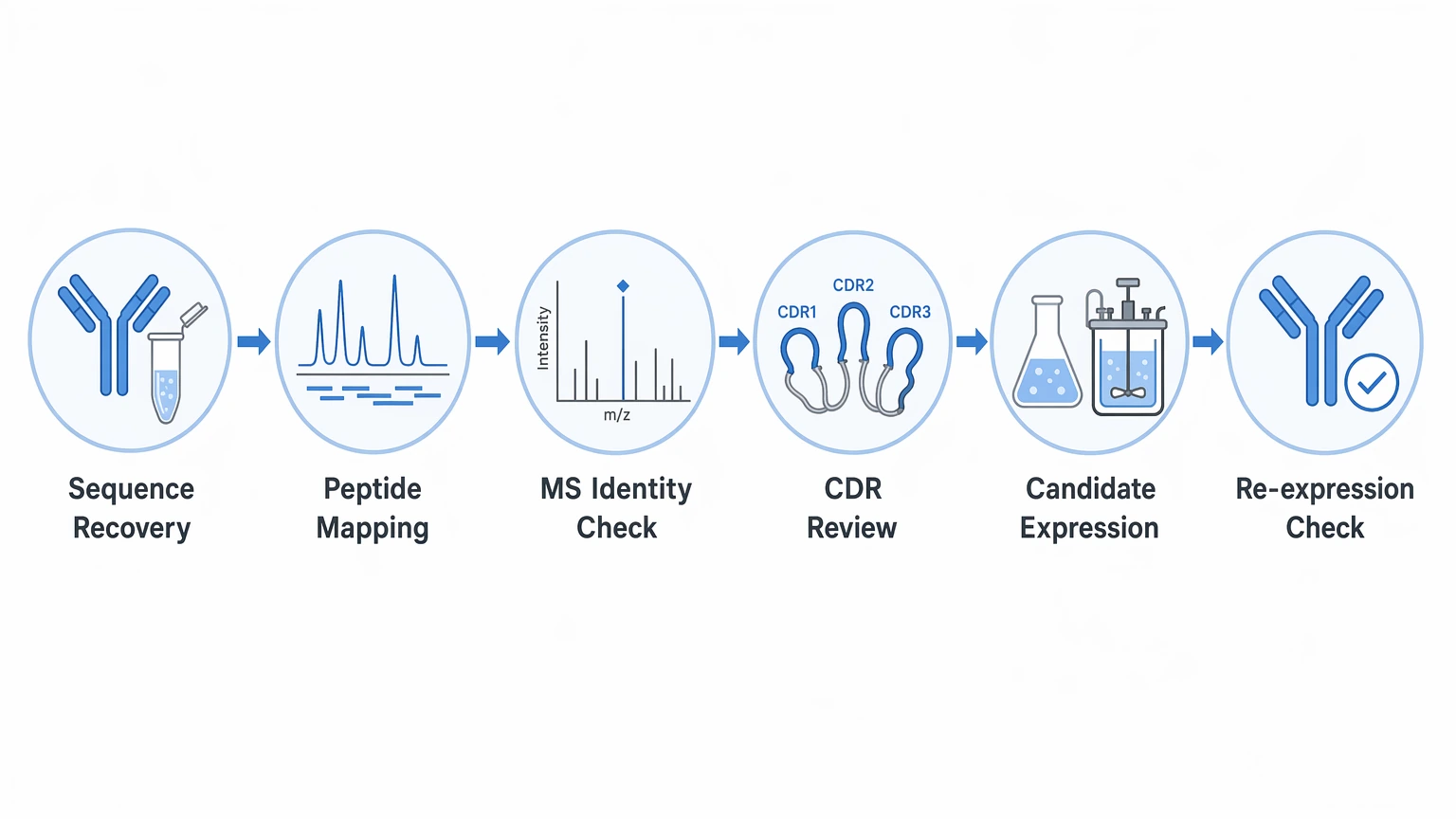
Teams sometimes treat sequence recovery as the endpoint. For protein-only workflows, it is better treated as the start of a controlled confirmation path.
Useful orthogonal validation options may include:
- targeted peptide mapping for uncertain regions
- intact or chain-level MS checks to support identity interpretation
- review of peptide continuity across key CDR segments
- expression of reconstructed candidates followed by binding comparison
That validation logic matters even more when chain pairing is inferred rather than known from a biological source. A recovered sequence may be highly informative, but functional confirmation still comes after sequence inference.
When to Pause or Narrow Scope
Not every lost-template antibody should move straight into de novo antibody sequencing. A pause makes sense when the sample is likely mixed, the remaining material is too limited for repeat analysis, or the project needs a near-final manufacturing-style sequence package that the available protein evidence is unlikely to support.
In those cases, narrowing the goal can still be useful. A team might shift from “recover the exact re-expression-ready sequence” to “determine whether the asset is worth deeper rescue work.” That smaller decision can still protect time and budget.
How to order?




