



Choose in two steps: first decide whether the cohort needs isobaric tandem mass tag (TMT) multiplex labeling or can stay unlabeled, then decide data-dependent acquisition (DDA) versus data-independent acquisition (DIA) for how precursors are fragmented. TMT is a labeling and reporter readout strategy, not an acquisition class. DDA and DIA are acquisition modes, usually paired with label-free quantification (LFQ). Typical stacks are DDA-LFQ, unlabeled DIA, and TMT with DDA-style reporter fragmentation. None of these routes reports absolute concentration by default. The better strategy is the one whose main constraint you can control: plex closure, missing-value pattern, spectral clarity, or library logistics (Thompson et al. 2003; Gillet et al. 2012; Cox et al. 2014).
Researchers who already have defined samples, comparison groups, or a specific project objective can also review the MtoZ Biolabs Deep DIA Proteomics Service, Label-Free Quantitative Proteomics Service, and TMT Quantitative Proteomics Analysis Service for project-specific feasibility and analysis planning.
DDA, DIA, and TMT Are Not Three Peers
Layer |
DDA |
DIA (including SWATH-style) |
TMT |
|---|---|---|---|
What it is |
Intensity-triggered top-N MS2 selection |
Scheduled m/z window fragmentation |
Isobaric amine labeling with reporter ions |
Typical pairing |
DDA-LFQ or library building |
Unlabeled DIA fragment chromatograms |
DDA MS2 or SPS-MS3 reporter readout |
Quantitative feature |
MS1 areas or reporter ions if labeled |
Fragment-ion chromatograms |
Reporter ratios inside one plex |
Main trade-off |
Stochastic missingness; often clearer MS2 |
More complete matrices; chimeric windows |
Same-run multiplex; ratio compression risk |
Claim type |
Relative discovery or library-centric ID |
Relative unlabeled discovery |
Relative ratios across closed channels |
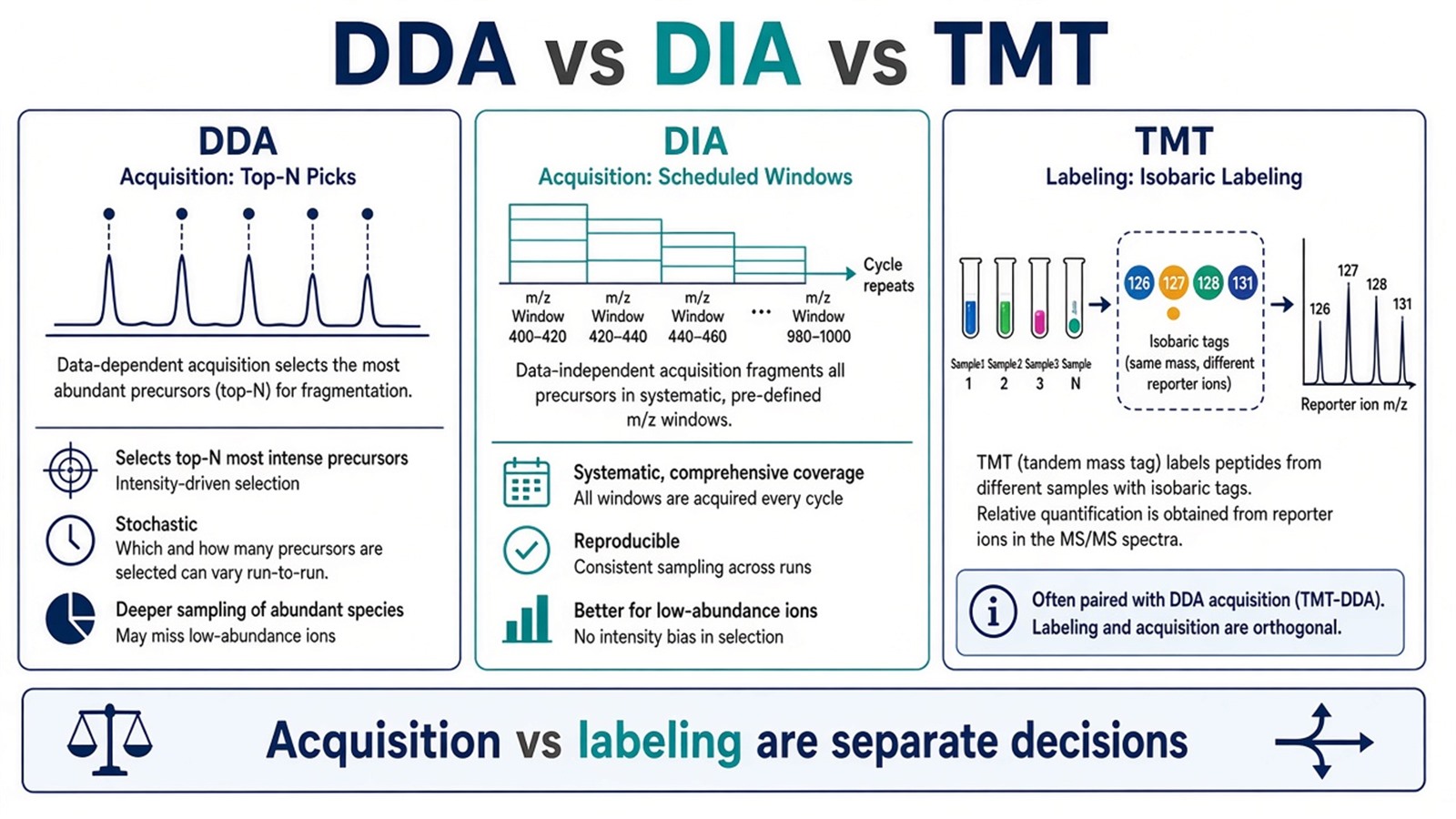
Figure 1. DDA and DIA answer how precursors are selected for fragmentation; TMT answers whether samples are pooled with isobaric reporters before acquisition.
Do not rank DDA, DIA, and TMT as interchangeable options. Separate labeling from acquisition, then match both to the quantitative claim.
Step 1: Multiplex Labeling or Label-Free
Prefer TMT when every planned comparison channel can be labeled, pooled, and frozen in one commercial plex without forcing unrelated samples into spare channels. TMT controls run-to-run drift for channels inside the same labeled injection because they share chromatography and precursor selection (Thompson et al. 2003). The cost is closed enrollment, amine-labeling chemistry, and ratio compression when co-isolated precursors dilute reporter signal.
Prefer label-free when samples must stay independent injections, enrollment may continue, or labeling would fail or consume scarce material. LFQ comparability is rebuilt by alignment, normalization, and QC across runs (Cox et al. 2014). Acquisition inside LFQ is usually DDA-LFQ or unlabeled DIA, not TMT.
For a focused TMT versus LFQ comparison, researchers can refer to TMT vs Label Free Quantitative Proteomics. For ratio compression limits on relative TMT reporting, see How Does Ratio Compression Arise in TMT-Based Quantitative Proteomics and Why Is It Limited to Relative Quantification?.
Step 2: DDA or DIA Inside a Label-Free Plan
When the project stays unlabeled, choose DDA when real-time top-N selection, cleaner single-precursor MS2, or a matched DDA spectral library is the priority. Choose DIA when scheduled-window fragment coverage and lower stochastic missingness across a cohort matter more than spectral simplicity (Gillet et al. 2012). SWATH-MS is one sequential-window DIA implementation, not a separate class beside DIA and DDA.
For acquisition-only trade-offs, see DIA vs DDA Proteomics: Key Differences and Applications Explained and What Is DIA and SWATH? Understanding Data-Independent Acquisition in Proteomics?. For software paths after acquisition, see Essential Analysis Tools for Label-Free Proteomics: A Comprehensive Review of MaxQuant and DIA-NN.
When TMT is selected, acquisition is still chosen for reporter readout. Most TMT discovery workflows use DDA-style fragmentation with reporter extraction; SPS-MS3 can reduce compression in some designs. Unlabeled DIA and TMT answer different questions and are not drop-in substitutes in one plex.
Judgment Table: Common LC-MS/MS Strategy Stacks
Study need |
Often prefer |
Why |
Reassess |
|---|---|---|---|
Multi-condition panel fits one TMT kit |
TMT plus DDA reporters |
Same-run relative ratios across channels |
Absolute units or open enrollment |
Large unlabeled cohort, completeness over picks |
DIA-LFQ |
Scheduled windows reduce stochastic gaps |
Library or library-free path undefined |
Identification-first or library for later DIA |
DDA-LFQ or DDA library |
Clearer MS2 and library-centric ID |
Only relative discovery with tight QC |
Evolving sample list |
Label-free DDA or DIA |
Independent injections |
Forcing extra samples into a TMT plex |
Closed target list after discovery |
PRM or MRM |
Targeted confirmation |
Ordinary DDA/DIA discovery alone |
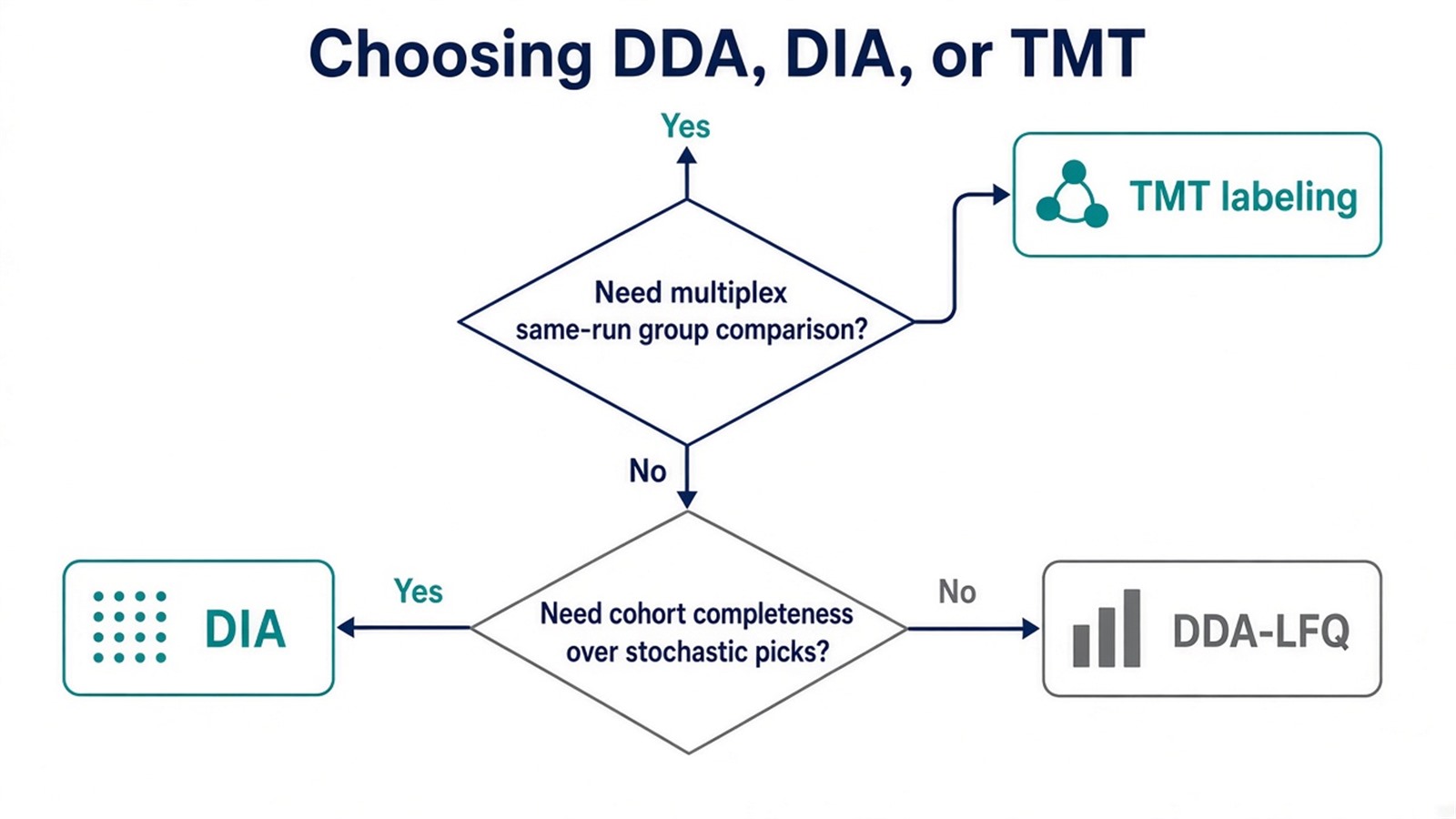
Figure 2. Freeze the labeling decision first, then pick DDA or DIA for unlabeled plans, or DDA-style reporter readout when TMT fits the cohort.
Prefer TMT when multiplex same-run comparison is the scarce resource and chemistry fits. Prefer DIA-LFQ when unlabeled relative discovery needs matrix completeness. Prefer DDA-LFQ when identification clarity, MaxLFQ-style workflows, or library construction dominates. Prefer PRM, MRM, or SIS-based absolute assays when the claim changes to closed targets or defined units.
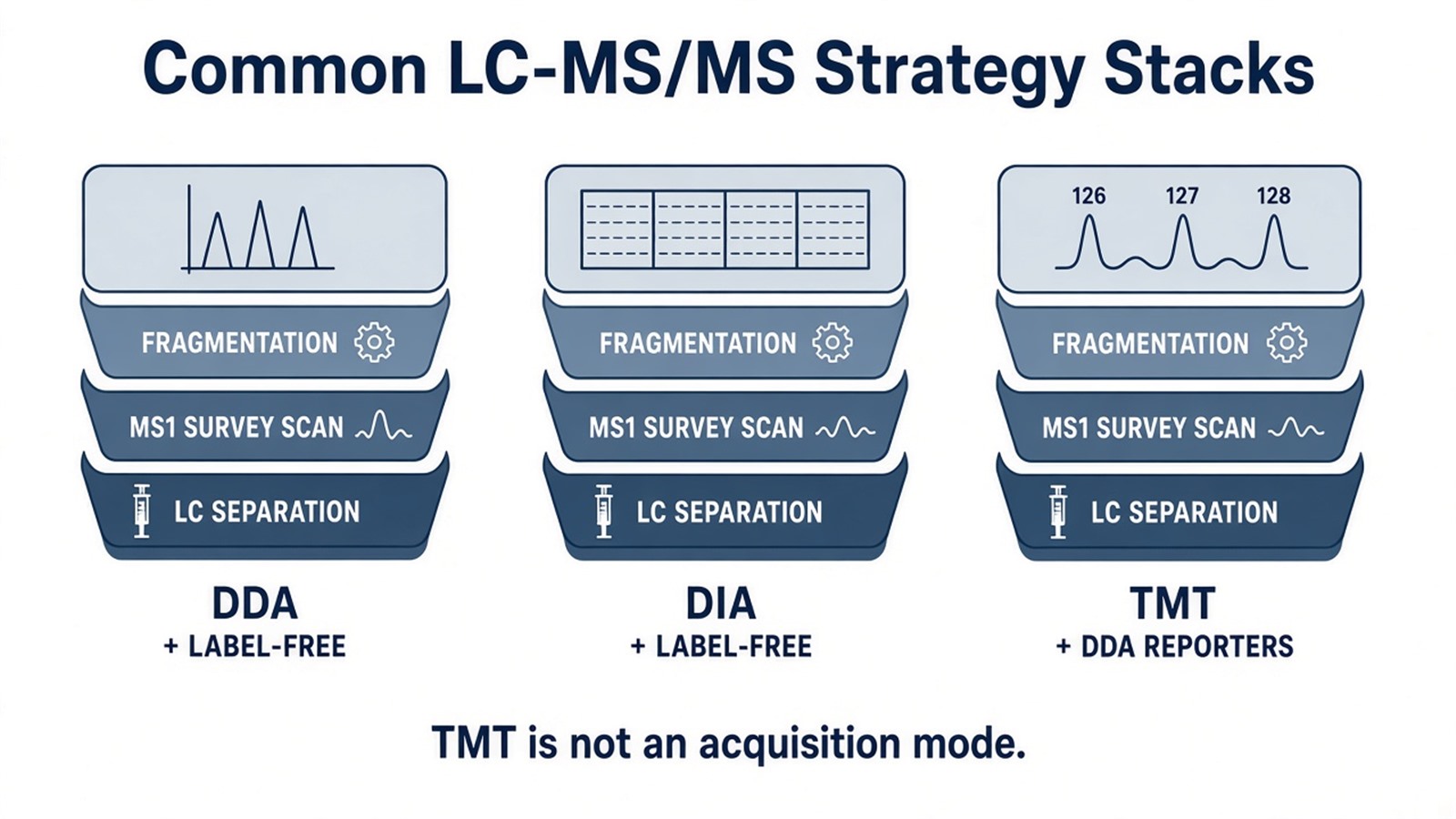
Figure 3. Most projects combine one acquisition mode with either label-free quantification or TMT labeling; TMT is not a replacement for choosing DDA versus DIA on unlabeled samples.
Limits and Application Boundaries
DIA does not remove window interference. DDA does not remove stochastic missingness. TMT does not remove ratio compression without design controls such as fractionation or SPS-MS3 where appropriate. Calling any one stack universally more accurate overstates method class alone. Ordinary intensities and reporter ratios remain relative unless matched standards and a calibration model are added.
Typical applications:
- TMT plus DDA: multi-arm treatment, genotype, or dose panels that fit one kit and need same-run relative contrasts.
- DDA-LFQ: novel-matrix identification, interactome or immunoprecipitation studies needing clearer MS2, and cohorts centered on MaxLFQ-style DDA plans.
- DIA-LFQ: larger unlabeled screens, complex digests where consistent fragment coverage matters, and projects that may reprocess stored files with updated libraries or search settings.
- Combined paths: DDA library then DIA quantification, DIA discovery then PRM confirmation, or TMT discovery with follow-up targeted assays for a shortlist.
Diagnostic cutoffs sit outside ordinary research DDA, DIA, or TMT reporting unless a separately validated assay framework is in place.
Once labeling, acquisition, and the relative comparison design are defined, the project can be scoped as a TMT, DDA-LFQ, or DIA-LFQ study. Researchers can review the MtoZ Biolabs TMT Quantitative Proteomics Analysis Service, Label-Free Quantitative Proteomics Service, and Deep DIA Proteomics Service. For TMT workflow optimization, see How Can SPS-MS3 Be Utilized to Optimize TMT Workflows and Minimize Ratio Compression?.
Frequently Asked Questions
1. Can I choose among DDA, DIA, and TMT as three equal options?
No. TMT is labeling and reporter quantification. DDA and DIA are acquisition modes. Start with labeling, then acquisition.
2. Is DIA always better than DDA if I skip TMT?
No. DIA often improves cohort completeness for unlabeled relative discovery. DDA can still fit identification-first work, library building, and DDA-LFQ when those controls are solid.
3. Does TMT require DDA?
TMT discovery commonly uses DDA-style MS2 or MS3 reporter readout. It is not defined by DIA window acquisition. Match fragmentation to the kit and software plan.
4. Can TMT and label-free DIA replace each other in the same project?
They answer different design constraints. TMT needs a closed labeled plex. Unlabeled DIA keeps independent injections. Pick the claim first.
5. Do these methods give absolute protein concentration?
Not by default. Relative ratios or aligned intensities need matched standards and calibration for absolute units.
Reference
- L.C. Gillet, P. Navarro, S. Tate, et al. (2012). Targeted data extraction of the MS/MS spectra generated by data-independent acquisition: a new concept for consistent and accurate proteome analysis. Mol. Cell. Proteomics, 11, O111.016717. https://doi.org/10.1074/mcp.M111.016717
- J. Cox, M.Y. Hein, C.A. Luber, et al. (2014). Accurate proteome-wide label-free quantification by delayed normalization and maximal peptide ratio extraction, termed MaxLFQ. Mol. Cell. Proteomics, 13, 2513-2526. https://doi.org/10.1074/mcp.M113.031591
- A. Thompson, J. Schaefer, K. Kuhn, et al. (2003). Tandem mass tags: a novel quantification strategy for comparative analysis of complex protein mixtures by MS/MS. Anal. Chem., 75, 1891-1904. https://doi.org/10.1021/ac034126r
