TMT Quantitative Proteomics Analysis Service
MtoZ Biolabs provides TMT quantitative proteomics for multiplexed relative protein quantification, helping researchers resolve differential proteins and proteome-wide changes across defined groups.
Designed for multi-group, treatment, phenotype, and time-course studies, with integrated support from sample preparation and TMT labeling to LC-MS/MS and functional analysis.
- High-Resolution Orbitrap Platform for TMT Quantification
- Extensive Experience With Diverse and Challenging Samples
- Bioinformatics Support for Functional and Multi-Omics Analysis
What Is TMT Quantitative Proteomics
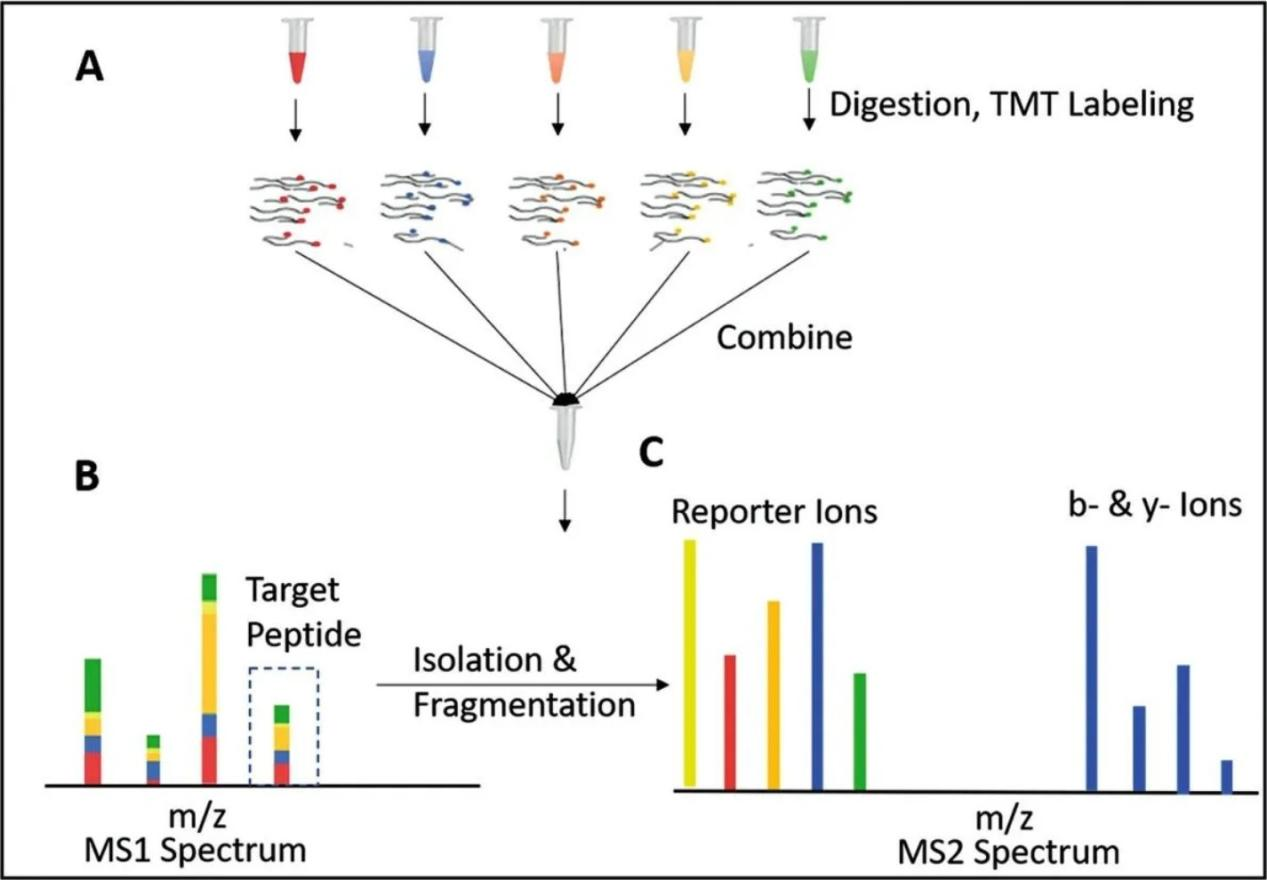
TMT quantitative proteomics analysis is an isobaric labeling-based mass spectrometry approach used to compare relative protein abundance across multiple biological samples. Peptides from different experimental groups are labeled with distinct Tandem Mass Tags, combined, and analyzed together by LC-MS/MS.
Each TMT tag contains three functional regions: a peptide-reactive group, a mass balance group, and a reporter group. The reactive group attaches the tag to peptides, while the balance and reporter groups allow different tags to have the same overall mass but generate distinct reporter ions during MS/MS fragmentation.
The relative intensities of these reporter ions provide sample-specific quantitative information. Combined with peptide and protein identification, this enables relative protein abundance comparison across predefined experimental groups, making TMT particularly useful for structured multi-group comparative proteomics studies.
Gupta, Sonnett. et al. Xenopus: Methods and Protocols, 2018.
Figure 1. Principle of TMT Quantitative Proteomics
When This Service Is a Good Fit
TMT Quantitative Proteomics Analysis Service is particularly suitable for studies with clearly defined experimental groups and planned comparisons. Common applications include control-versus-treatment experiments, comparisons among multiple treatment conditions or phenotypes, and time-course studies designed to track protein abundance changes across defined biological states.
The choice of quantitative strategy should still be based on the overall study design. Sample number, group structure, required flexibility, research objective, and downstream validation plan should all be considered before selecting TMT. Projects focused on targeted verification or absolute protein quantification may require other analytical approaches rather than standard TMT proteomics.
TMT Quantitative Proteomics Analysis Service at MtoZ Biolabs
MtoZ Biolabs provides TMT quantitative proteomics analysis services for protein identification, relative quantification, differential analysis, and downstream biological interpretation across defined experimental groups.
1. Protein Identification and Relative Quantification
TMT-based analysis provides large-scale protein identification together with relative protein abundance measurements across experimental samples. Quantitative results can be organized into protein-level data matrices to support direct comparison among control, treatment, phenotype, or other predefined groups. Standard TMT proteomics provides relative quantification rather than absolute protein concentration.
2. Differential Protein Analysis
Quantitative datasets can be used to identify proteins showing significant abundance differences between comparison groups. Analysis may include fold change, statistical significance, differential protein lists, volcano plots, clustering heatmaps, and other visualizations that help researchers recognize major proteomic changes and prioritize proteins for further investigation.
3. Functional and Pathway Analysis
Differentially abundant proteins can be further interpreted through functional annotation and enrichment analysis. Standard analysis may include Gene Ontology (GO) and KEGG pathway enrichment. Protein–protein interaction network analysis can also be considered when suitable reference databases are available for the study species.
4. Optional Advanced Data Analysis
Depending on the research objective and available supporting data, additional analyses may include GSEA, subcellular localization analysis, and multi-omics integration. These analyses are project-dependent and may be limited by species annotation, database coverage, or the availability of appropriate background datasets.
5. Project and Sample Support
MtoZ Biolabs supports projects involving a variety of biological materials, including tissues, cultured cells, blood-derived samples, microbial samples, and subcellular extracts. Project evaluation considers sample type, sample number, group design, biological replicates, available protein material, and the intended comparison before the analytical strategy is finalized.
Workflow of TMT Quantitative Proteomics Analysis Service
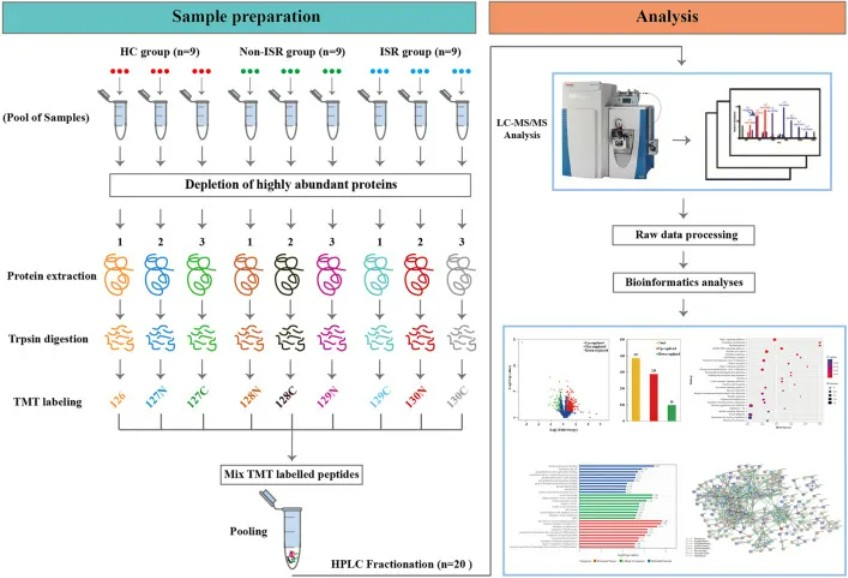
The TMT quantitative proteomics analysis workflow integrates sample preparation, isobaric labeling, high-resolution LC-MS/MS, and quantitative data analysis into a coordinated process.
1. Sample Reception and Quality Assessment
Submitted samples are reviewed according to sample type, preparation status, and project design. When required, proteins are extracted, quantified by BCA assay, and evaluated for suitability before downstream processing.
2. Protein Digestion
Proteins are enzymatically digested into peptides under controlled conditions. Consistent digestion across samples is important for reducing technical variation before TMT labeling.
3. TMT Labeling
Peptides from different experimental samples are labeled separately with TMT reagents. Labeling allows sample-specific quantitative information to be retained after the samples are combined.
4. Sample Pooling and Peptide Fractionation
TMT-labeled peptide samples are pooled for combined analysis. Peptide fractionation may be incorporated to improve proteome coverage before LC-MS/MS analysis.
5. High-Resolution LC-MS/MS Analysis
The pooled peptide mixture is analyzed by high-resolution LC-MS/MS. MS data provide peptide sequence information for protein identification and reporter-ion signals for relative quantification across labeled samples.
6. Protein Identification and Relative Quantification
The acquired spectra are searched against an appropriate protein database. Identified peptides and proteins are integrated with reporter-ion information to generate relative quantitative profiles across the experimental samples.
7. Differential and Functional Analysis
Quantitative results are evaluated according to the predefined comparison groups. Differential protein analysis, statistical evaluation, visualization, and functional enrichment are performed according to the project design and available database resources.
8. Data and Report Delivery
Processed quantitative results, differential analysis outputs, relevant functional analysis results, quality-control information, and project reports are compiled for delivery. Additional analyses may be included when specified in the project scope.
Hou, J. et al. Front Cardiovasc Med. 2022.
Figure 2. TMT Mass Spectrometry Service Process
Why Choose MtoZ Biolabs
1. High-Resolution Mass Spectrometry
MtoZ Biolabs uses high-resolution Orbitrap platforms for large-scale protein identification and TMT-based relative quantification.
2. Experience With Challenging Samples
We support diverse biological samples and have experience processing plant and animal tissues affected by polysaccharides, polyphenols, or high lipid content.
3. Bioinformatics Support
Quantitative results can be extended to differential analysis, visualization, GO/KEGG enrichment, and project-dependent advanced analysis.
4. Integrated Project Support
MtoZ Biolabs supports the workflow from sample preparation and TMT labeling to LC-MS/MS analysis, quantification, and data interpretation.
Applications
1. Disease Mechanism Research
Quantitative profiling of proteome changes associated with disease models, pathological states, and relevant biological processes.
2. Drug Response and Pharmacology Research
Analysis of protein abundance changes following drug treatment to support studies of cellular response, mechanism of action, and candidate response-associated proteins.
3. Biomarker Discovery Research
Screening of differentially abundant proteins associated with specific phenotypes or biological conditions to support candidate biomarker discovery and follow-up validation.
4. Plant and Agricultural Proteomics
Investigation of protein changes related to plant development, environmental stress, genetic variation, and responses to agricultural treatments.
5. Microbial Proteomics
Comparative analysis of microbial proteomes under different growth conditions, environmental stresses, genetic backgrounds, or experimental treatments.
6. Developmental and Physiological Research
Characterization of proteome changes across developmental stages, tissues, physiological conditions, or biological processes to support mechanism-oriented studies.
Sample Submission Suggestions
1. Sample Amount
MtoZ Biolabs accepts a variety of biological samples for TMT Quantitative Proteomics Analysis Service. The following quantities are general recommendations for project planning.
|
Sample Type |
Recommended Quantity |
Minimum Quantity |
|
Animal Tissue |
20–100 mg |
10–50 mg |
|
Plant Tissue |
2–5 g |
1–2 g |
|
Cell Pellet |
1 × 10⁷ cells |
2 × 10⁶ cells |
|
Microbial Samples |
50 mg or 50 μL |
20 mg or 20 μL |
|
Serum/Plasma |
10–50 μL |
5–25 μL |
|
Urine |
1 mL |
0.5 mL |
|
Cerebrospinal Fluid |
0.1 mL |
0.05 mL |
|
Culture Supernatant |
10 mL |
5 mL |
|
FFPE Samples |
20 sections or 30 mg |
10 sections or 15 mg |
|
Extracted Protein Solution |
20 μL |
10 μL |
2. Storage and Shipping
- Collect and process all experimental groups under consistent conditions.
- Freeze prepared samples promptly and store at −80°C when applicable.
- Avoid repeated freeze–thaw cycles.
- Ship frozen samples on dry ice and maintain low temperature throughout transportation.
- Seal and label sample tubes securely to prevent leakage, contamination, or misidentification.
These are general recommendations. Actual sample requirements may vary depending on sample type, project design, and analytical objectives. Project-specific evaluation is recommended before sample submission.
Deliverables
TMT Quantitative Proteomics Analysis Services typically include the following deliverables:
1. Protein Identification and Quantification Results
Protein and peptide identification results with relative quantitative data across experimental samples.
2. Differential Protein Results
Differential protein lists with fold change, statistical significance, and group comparison information.
3. Data Visualization
Quantitative and differential analysis plots such as volcano plots, heatmaps, and other project-relevant visualizations.
4. Functional Analysis Results
GO and KEGG enrichment results, with additional database-supported analyses provided when applicable.
5. Project Report
A structured report summarizing the experimental methods, data analysis, major results, and corresponding figures.
Additional analyses may be included according to the agreed project scope and available biological annotation resources.
FAQ
1. How does TMT compare with label-free DIA proteomics?
TMT is well suited to predefined multi-group studies because labeled samples are combined for coordinated relative quantification. Label-free DIA offers greater flexibility for larger cohorts or projects where samples may be added later. Method selection should consider sample number, study design, and research objective.
2. Does TMT provide absolute protein quantification?
No. Standard TMT proteomics provides relative protein quantification between samples or experimental groups. Projects requiring absolute protein quantification may require a targeted strategy such as PRM with appropriate reference standards.
Start Your Project with MtoZ Biolabs
Planning a TMT quantitative proteomics study? MtoZ Biolabs offers free project consultation to help evaluate sample suitability, study requirements, and analytical needs. Share your species, sample type, sample number, group design, biological replicates, available protein amount or concentration, planned comparisons, and research objective with us.
