






CDR Sequencing vs Full-Length Antibody Sequencing: Which One Supports Humanization and Re-Engineering?
Choose antibody CDR sequencing when the project only needs the identity of the binding loops or a limited comparison of complementarity-determining regions (CDRs) across antibodies. Choose full-length antibody sequencing when the next step may include humanization, recombinant re-expression, framework review, or sequence-guided redesign. For engineering programs, recovering the full variable heavy chain (VH) and variable light chain (VL) usually gives a stronger foundation because many design decisions rely on residues outside the canonical CDR boundaries.
The real difference is not simply “partial versus complete.” What matters is whether the sequence package includes enough framework regions (FRs), heavy/light chain pairing context, and interpretive confidence for the downstream decision. A CDR-only readout can help describe likely antigen-contact motifs, but it often leaves major gaps for back-mutation, Vernier residues review, developability assessment, and construct design.
When CDR-only information is enough
A narrower scope makes sense when the question itself is narrow. If a team wants to confirm that a legacy antibody belongs to a known binding family, compare loop motifs across archived candidates, or build a preliminary paratope-oriented record, antibody CDR sequencing may be enough for that stage.
This is most useful when a program is still sorting assets rather than rebuilding them. A group may have several purified monoclonal antibody samples and want a fast way to see whether two materials likely share related CDR content before deciding which one justifies deeper sequence recovery. In that situation, CDR-only data can reduce uncertainty without forcing full sequence reconstruction at the outset.
The tradeoff is clear: the result is informative, but it is usually not ready for engineering. Once the team wants to clone the antibody, move CDRs into a human scaffold, or plan framework substitutions, the missing FR context stops being a small omission and becomes a practical problem.
What full-length antibody sequencing adds
In this article, full-length antibody sequencing means recovery of the full antibody variable regions, not automatic inclusion of the constant regions. In practice, that means reconstructing VH and VL with FR1-FR4 coverage and interpreting the result in a way that supports re-engineering decisions.
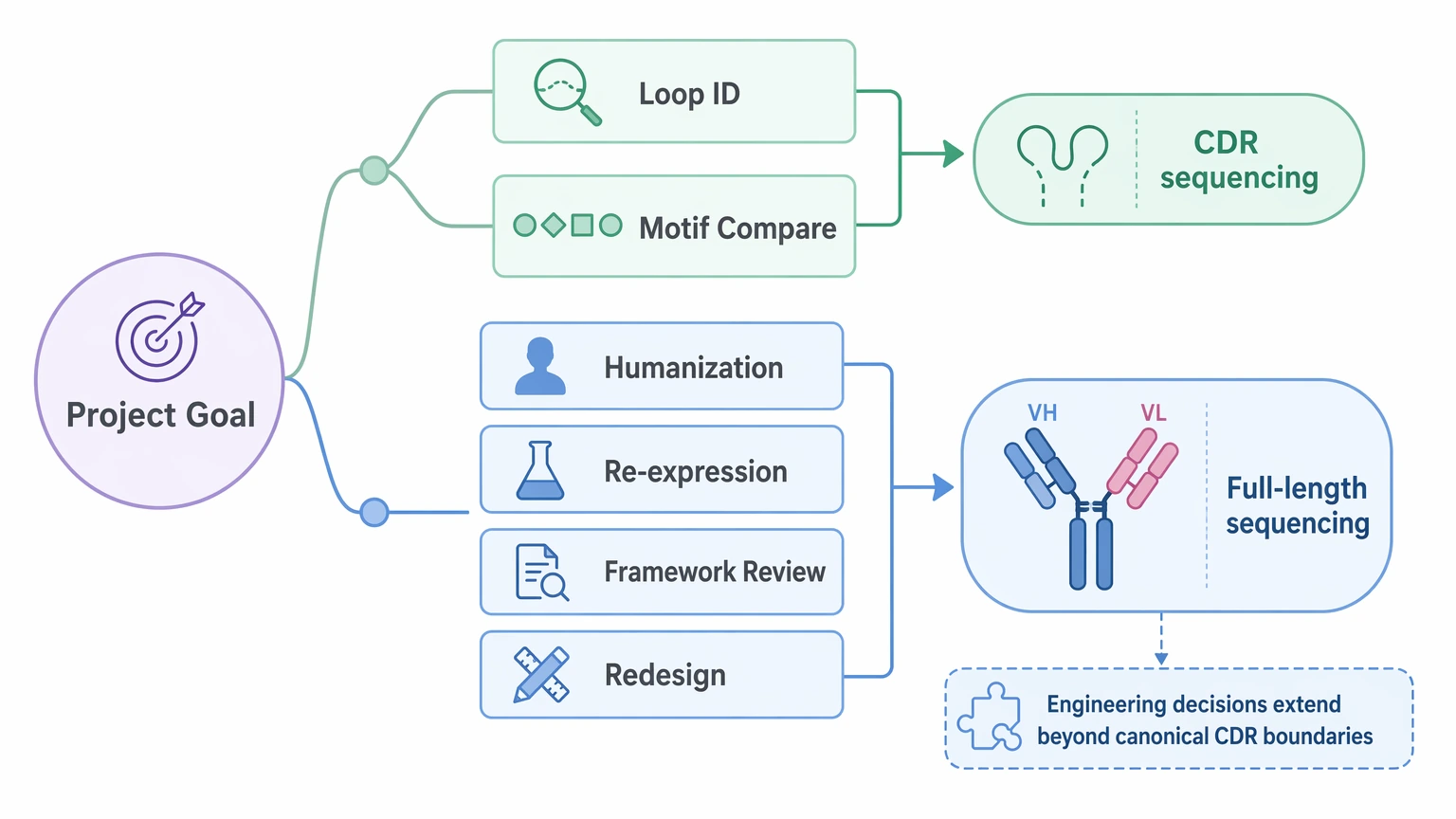
That broader scope changes what the team can do next. With VH/VL variable-region recovery, the output can support:
- humanization planning with framework context
- review of Vernier residues that may affect loop presentation
- heavy/light chain pairing decisions for recombinant design
- construct preparation for recombinant re-expression
- review of framework-linked developability liabilities
- mutation planning during lead optimization
Those additions matter because antibodies do not function as isolated loops. FR residues can influence loop orientation, paratope shape, stability, and how a CDR graft behaves after transfer into a new framework. A sequence package that ends at the CDRs may capture the obvious binding segments while missing residues that help those segments work in their native structural setting.
Comparison table for engineering readiness
A side-by-side view makes the distinction easier to judge.
| Decision dimension | Antibody CDR sequencing | Full-length antibody sequencing |
|---|---|---|
| Region coverage | CDR-focused sequence output | Full VH and VL variable-region reconstruction with FR1-FR4 |
| Humanization relevance | Limited when FR effects are unknown | Better suited to grafting, framework selection, and back-mutation planning |
| Heavy/light chain pairing | Often insufficient for construct-ready recovery | More useful for paired-chain design and recombinant builds |
| Recombinant re-expression | Usually incomplete for expression constructs | Better aligned with cloning and expression workflows |
| Developability review | Limited view of framework motifs | Broader visibility into framework-linked liabilities |
| Best-fit project stage | Early comparison, archival support, motif review | Humanization, redesign, recombinant rescue, lead optimization |
| Main risk | Missing framework context | More interpretation and validation work may still be needed |
Why framework regions matter during humanization
Humanization is the clearest reason not to rely on CDRs alone. A grafting strategy starts with CDR definition, but it rarely stops there. Teams usually need to inspect framework regions (FRs) to decide which non-CDR residues should stay, which human acceptor framework is the best fit, and where back-mutation may be needed if binding drops after the first design pass.
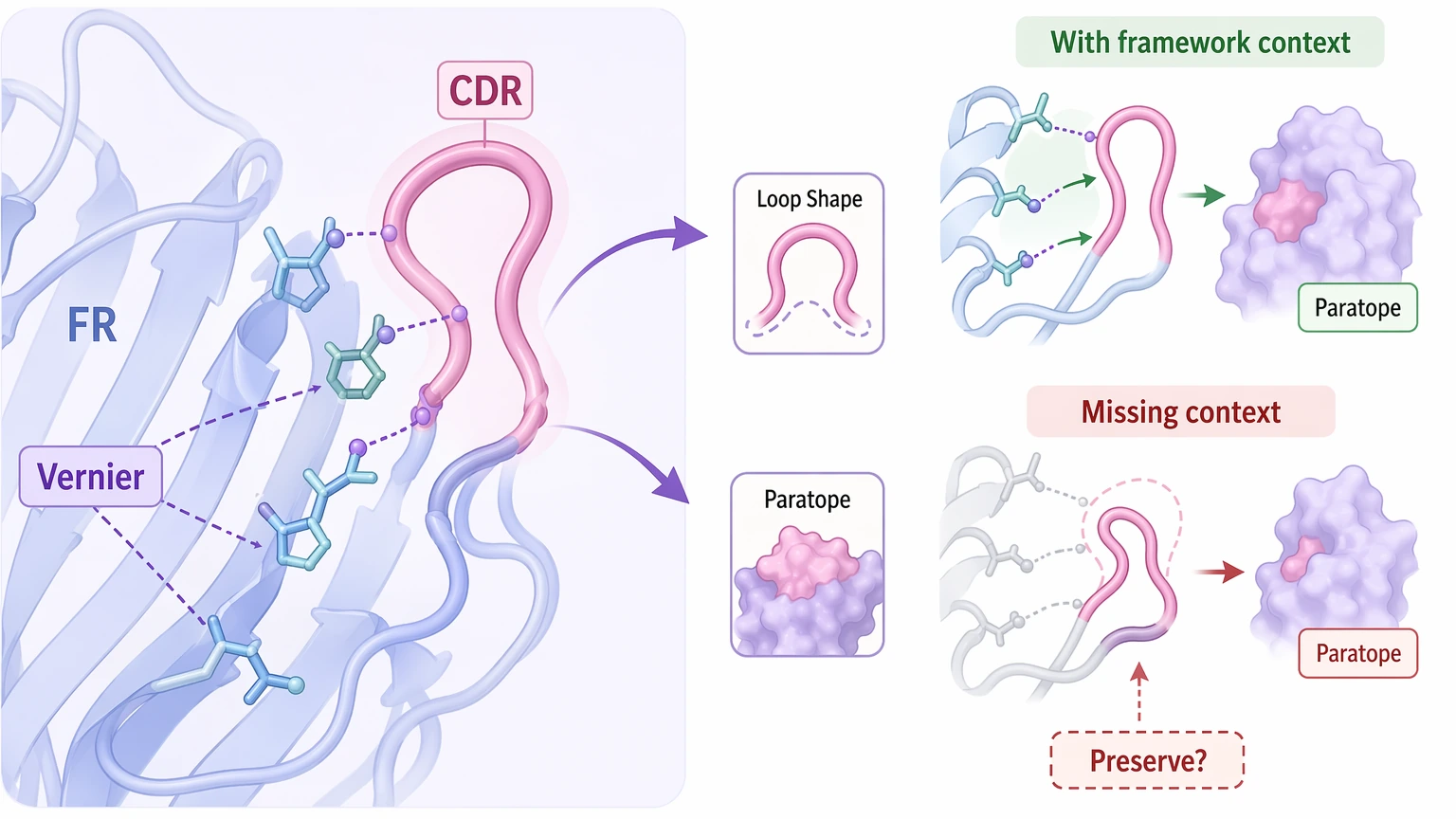
This is where Vernier residues matter. These positions do not always contact antigen directly, yet they can shape loop support and paratope geometry. If those residues are missing from the recovered sequence, the humanization team may end up guessing which framework features deserve to be preserved.
That does not mean full-length antibody sequencing guarantees successful humanization. Binding retention still depends on structural context, expression behavior, and the grafting strategy itself. What full-length recovery does provide is a basis for sequence-driven decisions with fewer blind spots.
Why recombinant re-expression usually requires full VH/VL recovery
A team cannot move from CDR calls alone to dependable recombinant re-expression. Expression constructs need coherent chain-level information. Even when the CDRs are correct, uncertain FR residues or unclear chain assignment can delay cloning or add avoidable rounds of iteration.
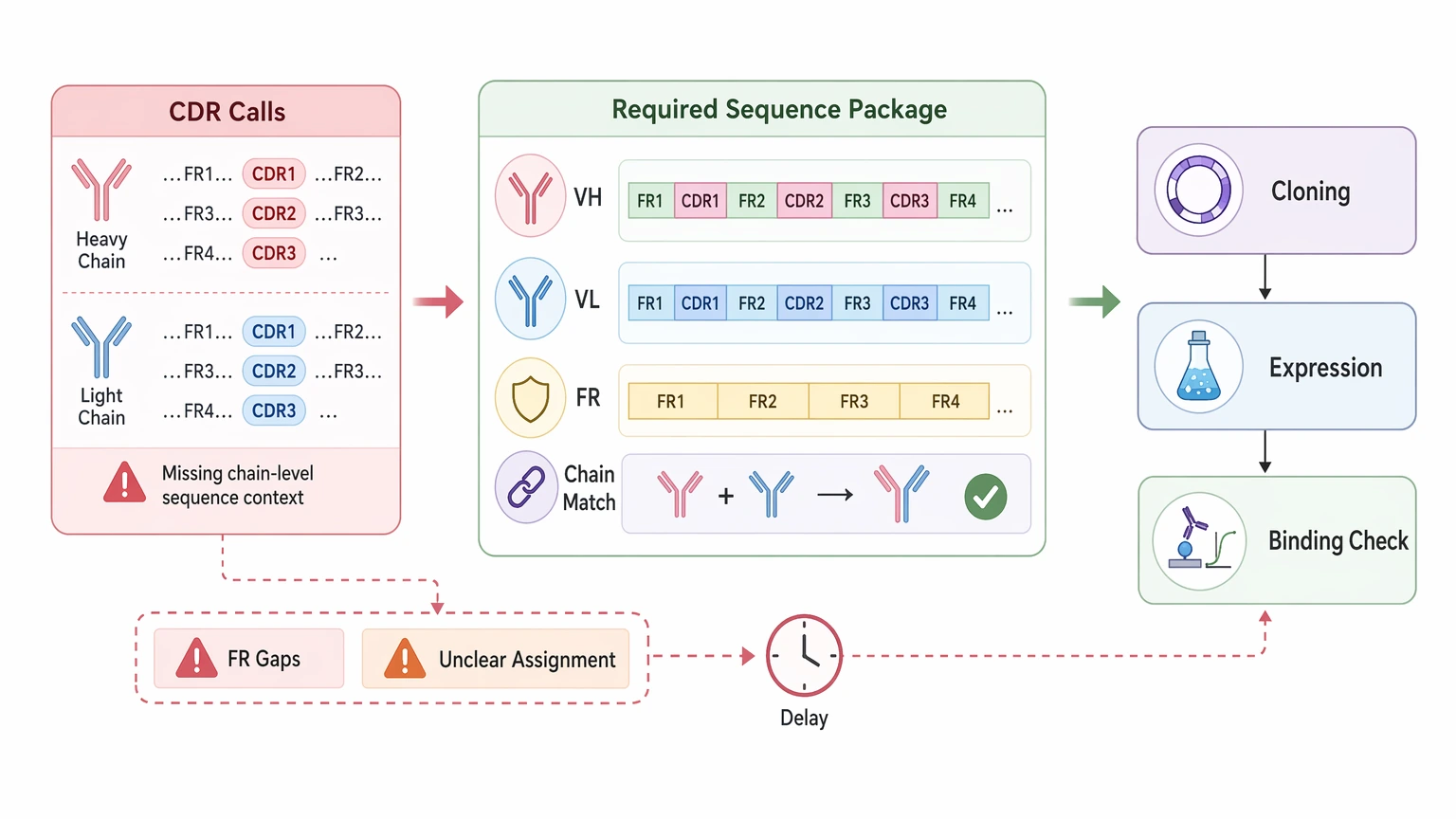
The value of full heavy/light chain pairing becomes obvious when a legacy program has to be rescued from incomplete records. Discovery teams may know the antibody works, yet without confident VH and VL recovery, they cannot rebuild the molecule in a way that is technically traceable. This comes up often in hybridoma rescue, platform transfer, or comparative expression studies across formats.
If your next milestone is an expression construct rather than loop annotation, full variable-region recovery should usually be the starting point. If teams need help matching sample condition and engineering goals to the right sequencing depth, they can submit their requirements to MtoZ Biolabs to evaluate project scope, likely ambiguity points, and the validation plan before committing to a rebuild.
How sample type changes the best sequencing strategy
The starting material affects both method choice and confidence.
For a hybridoma-derived antibody, nucleic-acid-based workflows such as NGS or RACE can provide a practical route to full VH/VL recovery because transcript information is still available. That can improve chain-level reconstruction and make recombinant design more direct, although transcript heterogeneity and primer strategy still need review.
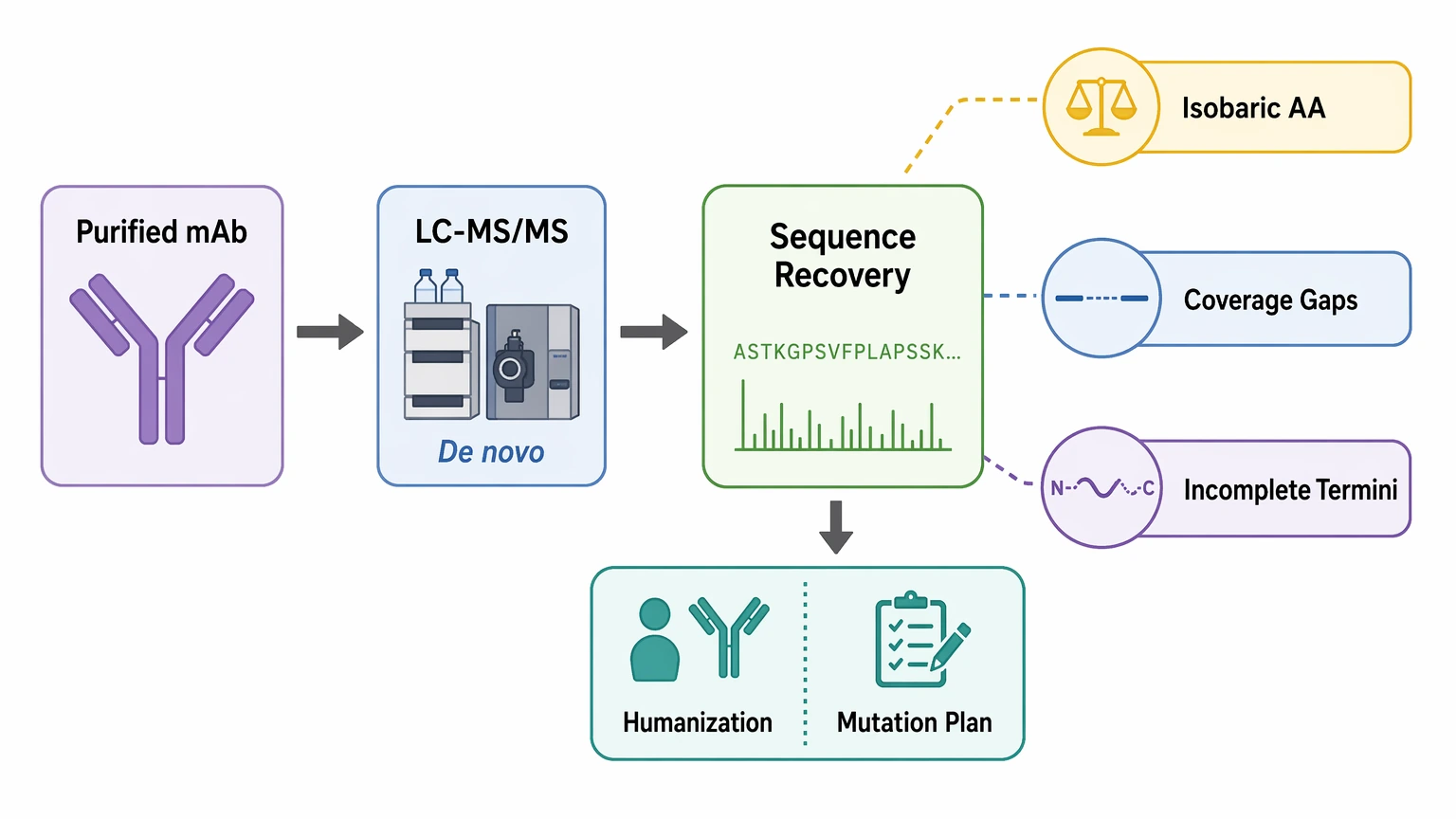
For a purified monoclonal antibody with no cellular source, the project often depends more heavily on protein-level recovery, including de novo peptide sequencing by LC-MS/MS. That route can recover substantial sequence information, but it may also leave sequence ambiguity at specific residues. Isobaric amino acids, uneven peptide coverage, or incomplete termini can all matter if the antibody is headed into humanization or mutation planning.
Archived supernatants and poorly documented legacy materials fall somewhere in between. Some support staged recovery. Others force an early choice between accepting a limited CDR readout and investing in deeper reconstruction from the start because the engineering endpoint demands it.
Which option fits each downstream goal
Humanization
Choose full-length antibody sequencing. Humanization needs CDR definition plus FR context, especially for Vernier residues and back-mutation planning.
Recombinant rescue
Choose full-length antibody sequencing again. If the molecule must be cloned and re-expressed, full VH/VL recovery is usually the more actionable output.
Early motif comparison or archival identification
Choose antibody CDR sequencing when the goal is limited to loop-level comparison and there is no immediate plan for redesign.
Developability review or lead optimization
Choose full-length antibody sequencing. Framework-linked developability liabilities and mutation options cannot be reviewed well from CDRs alone.
Protein-only sample with limited material
A staged approach may be reasonable, but only when the near-term decision is narrow. If engineering work is already planned, a partial result often just postpones the need for fuller reconstruction.
What validation should follow sequence recovery
Sequence recovery is not the same as engineering confirmation. Before redesign begins, teams should check three points:
-
Coverage and ambiguity review
Confirm which key CDR and FR positions are directly supported and which remain inferred or ambiguous. -
Chain-level interpretability
Check whether VH and VL assignment is strong enough for expression design, especially in mixed or degraded materials. -
Functional confirmation after reconstruction
Recombinant expression and binding comparison remain the practical test of whether the recovered sequence represents the intended antibody.
These checks matter even more when the project relies on LC-MS/MS-driven de novo peptide sequencing rather than a transcript-supported workflow. If you are weighing a fast partial readout against a deeper engineering package, contact MtoZ Biolabs to discuss sample type, downstream goal, expected deliverables, and validation needs before starting humanization or recombinant recovery.
Comparison summary and consultation guidance
For programs moving toward humanization, framework editing, recombinant re-expression, or lead optimization, full-length antibody sequencing is usually the better starting point because it preserves the VH/VL and FR context used in real engineering decisions. Antibody CDR sequencing still has a legitimate role when the task is narrower: loop identification, family comparison, or archival support before a candidate is prioritized for redevelopment. In practice, the right choice depends on the project endpoint, the available sample type, and how much sequence ambiguity the team can tolerate before cloning or redesign. If your project involves hybridoma material, purified antibody, or a legacy molecule with incomplete records, define the intended engineering use case and validation expectations first, then seek technical review so the sequencing scope matches the next experiment rather than only the smallest initial data package.
FAQ
Can antibody CDR sequencing support patent or portfolio triage?
Sometimes yes. If the immediate need is to compare binding-loop patterns across related assets, a CDR-focused result can help sort materials into likely families. It is less useful when the review must support reconstructability or engineering freedom.
How do Vernier residues differ from CDR residues in project decisions?
CDRs are the main loop regions used to describe antigen-contact diversity. Vernier residues sit in the surrounding framework and can influence loop shape and presentation. They become especially relevant when a team is planning humanization and needs to preserve binding behavior after grafting.
Is full-length antibody sequencing still useful if the original antibody will never be expressed again?
Yes, if the project still needs framework-based liability review, sequence archiving for future redesign, or comparison of engineering options across related variants. If none of those goals apply, a narrower readout may be enough.
Can NGS or RACE replace LC-MS/MS for every antibody sequencing project?
No. NGS and RACE work best when nucleic-acid-containing material is available, such as hybridoma-derived sources. LC-MS/MS becomes more important when the only recoverable material is purified protein.
What should a sequencing deliverable include before a humanization team starts design work?
At minimum, the team should have annotated CDRs, FR coverage across VH and VL, notes on any sequence ambiguity, and a clear statement about chain assignment confidence. Without that context, downstream grafting decisions are harder to defend.
If budget allows only one sequencing round, which choice reduces rework most often?
When the antibody may enter humanization, recombinant rescue, or sequence-guided optimization, full variable-region recovery usually reduces the chance of a second sequencing round. A CDR-only approach is more efficient when the program truly stops at loop-level insight.
How to order?




