






Can Polyclonal Antibodies Be Sequenced? Feasibility, Limits, and Better Planning Paths
A heterogeneous polyclonal antibody sample can sometimes provide actionable sequence information, but it usually will not yield one definitive antibody sequence for the entire mixture. In most projects, it is more useful to define the expected output more narrowly: peptide-level evidence, partial variable-region recovery, CDR-containing peptides, dominant component candidates, or a shortlist for recombinant re-expression with orthogonal validation.
That distinction matters because a true polyclonal antibody is a mixture, not a single clone. If your team only has serum-derived IgG or an archived purified reagent, direct LC-MS/MS with de novo peptide sequencing may support sequence inference, but heavy/light chain pairing and full CDR3 recovery often stay uncertain. When the actual goal is redevelopment, lot bridging, or functional replacement, antigen-specific enrichment, repertoire sequencing, RACE, or candidate reconstruction with follow-up testing is often more realistic than expecting one final full-length sequence from the protein mixture alone.
Where This Question Appears in Practice
This question usually comes up when a team inherits a legacy reagent or an immune-derived preparation with incomplete records. The material on hand may be total IgG, an antigen-specific enrichment fraction, or a purified polyclonal antibody vial with no hybridoma, no source B cells, and no existing sequence record.
At that point, a request for “full sequencing” often bundles together several different needs:
- document what antibody families are present
- recover dominant variable-region features
- determine whether informative CDR peptides are detectable
- support recombinant re-expression planning
- decide whether replacement is more practical than reconstruction
The core issue is not usually a failed instrument run. It is a mismatch between what the sample can actually support and what the project is asking for. Teams may get peptide lists, framework region coverage, or several heavy chain and light chain candidates without a clear sense of whether those results are enough for the next step.
Why Full Polyclonal Antibody Sequencing Has Clear Limits
Most unrealistic expectations in polyclonal antibody sequencing come back to four technical boundaries.
1. Clonotype heterogeneity means there is rarely one sequence to recover
A polyclonal antibody contains multiple antibody species with different variable-region sequences and abundance levels. Even a strong LC-MS/MS dataset may reflect overlapping peptides from many clonotypes rather than one binder that can be reconstructed cleanly. So the practical question is usually not “Can this antibody be sequenced?” but “What level of sequence resolution is realistic for this antibody mixture?”
2. Heavy/light chain pairing is usually unresolved in bulk proteomics
Mass spectrometry can identify heavy-chain and light-chain peptides, but bulk protein readouts do not preserve native heavy/light chain pairing. You may recover plausible heavy-chain candidates and plausible light-chain candidates and still have no direct evidence for which pairs formed the original functional antibodies. That gap matters most when the downstream goal is recombinant re-expression.
3. Variable-region recovery is uneven, and CDR3 is often the weak point
Framework region peptides are generally easier to observe and are often shared across related antibodies, which makes them less informative. The regions that carry more weight for specificity, especially CDR3, are harder to recover with confidence because of sequence diversity, digestion behavior, and incomplete peptide coverage. A report can show broad framework coverage and still leave the most important sequence questions open.
4. Sample origin strongly affects interpretability
Unfractionated serum-derived IgG is much harder to interpret than an antigen-specific enrichment fraction. A narrower response lowers clonotype heterogeneity and can make dominant component analysis more useful. If the starting material is broad, mixed, or poorly documented, the practical ceiling for sequence inference is lower even when the analytical workflow itself is sound.
A Better Planning Framework for Method Selection
Because this is really a method-selection and project-planning problem, a generic checklist is less helpful than a decision path. The most productive sequence recovery projects usually move through three planning questions.
Step 1: Define what success means before choosing the method
Different projects need different deliverables. Common examples include:
- Peptide evidence: confirms antibody-derived peptides and some variable-region signal
- Partial variable-region recovery: supports family-level assignment or candidate narrowing
- CDR-focused evidence: identifies CDR-containing peptides that improve interpretation
- Dominant component characterization: prioritizes the most abundant or enriched binders
- Re-expression-ready candidates: nominates heavy-chain and light-chain constructs for testing
If a project treats all five outcomes as interchangeable, expectations tend to drift toward an unrealistic demand for one exact sequence.
Step 2: Judge the sample by interpretability, not just starting amount
Sample amount matters, but sample context is usually the bigger variable. The table below shows how starting material changes what polyclonal antibody sequencing can realistically deliver.
| Sample context | Clonotype heterogeneity | Likely informative output | Main limitation |
|---|---|---|---|
| Total serum-derived IgG | High | Peptide evidence, broad family signals | Mixed background dominates |
| Antigen-specific enrichment fraction | Moderate | Better variable-region recovery, dominant component candidates | Pairing still uncertain |
| Archived purified polyclonal antibody | Moderate to high | Partial sequence inference, dominant-chain candidates | No source cells for rescue |
| Purified antibody plus donor B cells | Variable | Proteomics with repertoire sequencing support | Requires data integration |
| Purified antibody plus RACE or NGS inputs | Lower interpretation risk | Stronger candidate shortlist for redevelopment | Functional confirmation still required |
A narrower antigen-specific enrichment can be more informative than a larger amount of total IgG because it removes irrelevant antibody background at the point of analysis.
Step 3: Match the workflow to the missing information
Once the project goal and sample context are clear, the right path usually falls into one of these routes.
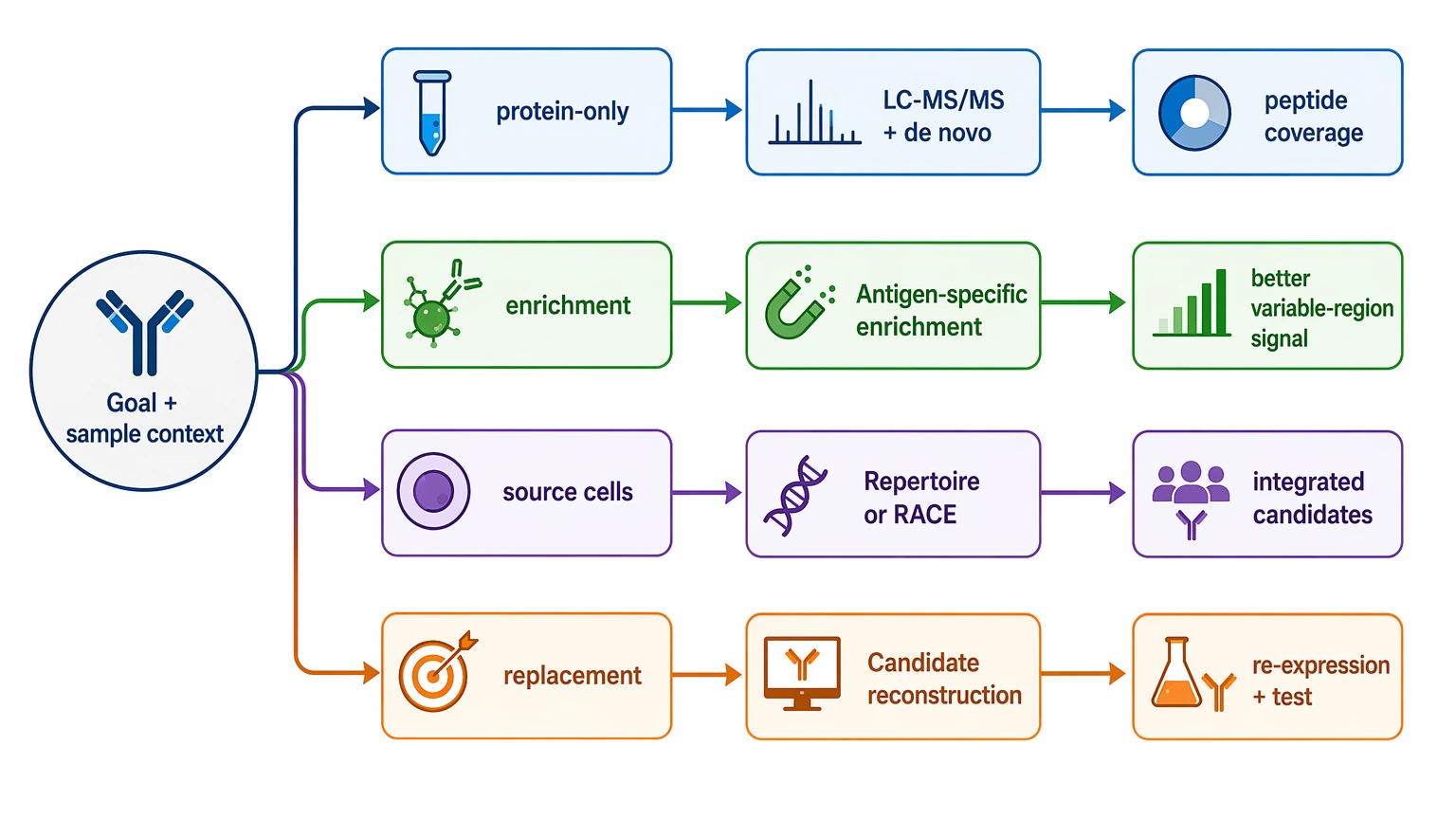
If only purified protein is available
Use LC-MS/MS and de novo peptide sequencing to establish peptide coverage, assess variable-region recovery, and determine whether sequence inference is possible around dominant chains or dominant components. This route can produce a technically defensible report, but it rarely turns a full antibody mixture into one unambiguous answer.
If antigen-specific enrichment is still possible
Do the enrichment first. Reducing unrelated immunoglobulin species can increase the fraction of informative peptides in the variable region. It does not resolve heavy/light chain pairing, but it can make dominant component analysis much more useful.
If source cells or donor material are still accessible
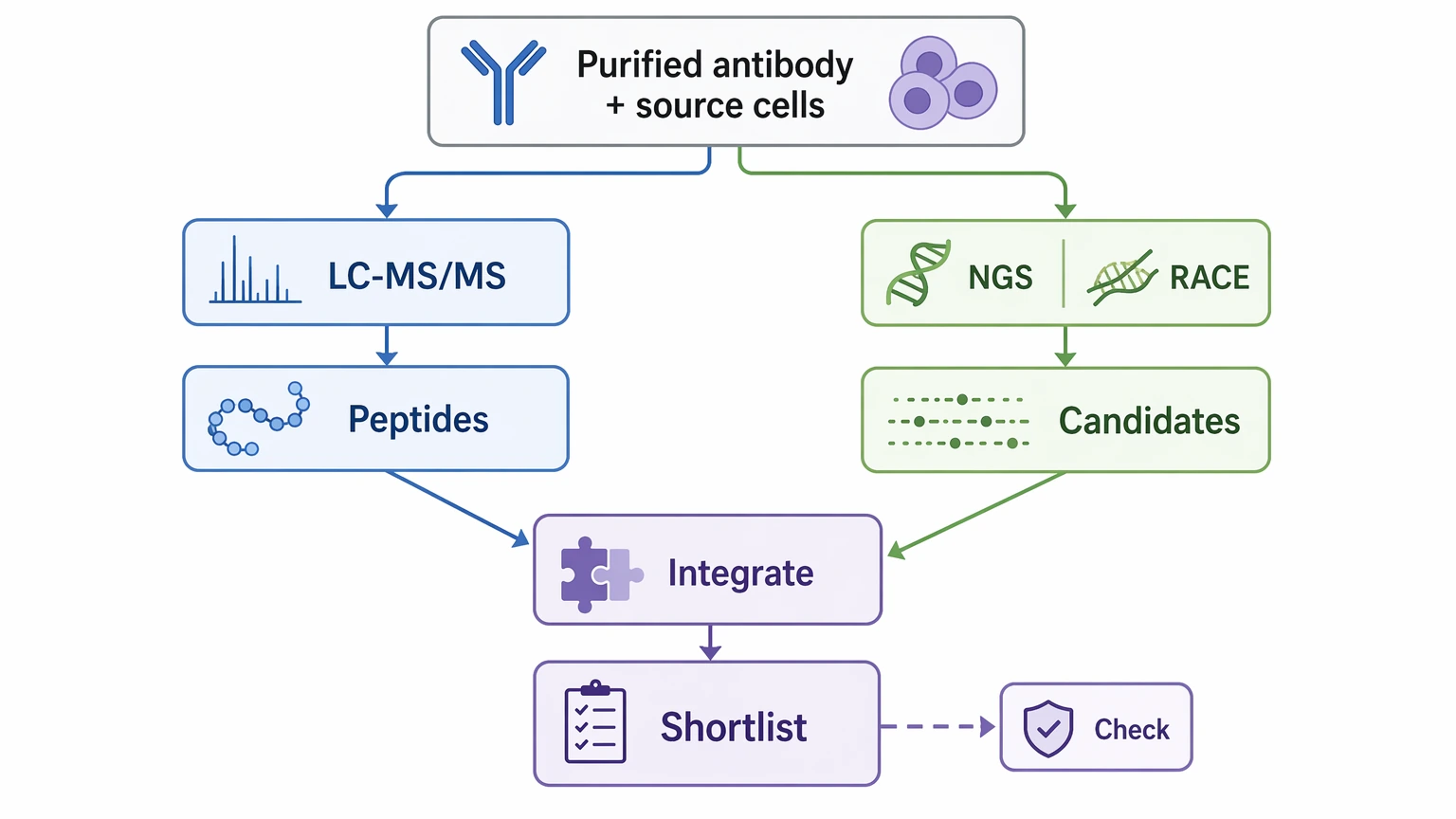
Add repertoire sequencing or RACE. That shifts the project from protein-only inference to integrated evidence. Proteomic peptides can support expression-level confirmation, while NGS or RACE expands the candidate sequence space in a way that is much more useful for reconstruction and follow-up verification.
If the goal is functional replacement
Do not frame the task as historical exact recovery unless that level of proof is truly necessary. In many redevelopment projects, the practical objective is to nominate candidate constructs, re-express them, and confirm binding behavior experimentally.
At this stage, teams often benefit from a sample-and-goal review before using up limited material. If you need to submit your requirements for that review, MtoZ Biolabs can evaluate the sample type, desired deliverable, and validation burden so the proposed workflow matches the actual redevelopment question.
What Deliverables Are Realistic?
A feasibility discussion usually works better when it is framed around deliverables rather than instrument names.
| Deliverable type | When it is realistic | What it supports | What it does not prove |
|---|---|---|---|
| De novo peptide list | Complex mixtures, limited material | Protein-level evidence, peptide mapping | Full variable-region identity |
| Partial variable-region recovery | Enriched or moderately complex samples | Candidate narrowing, family assignment | Reconstruction of the original binder |
| CDR-containing peptide evidence | Favorable digestion and coverage | Specificity-related interpretation | Complete CDR3 certainty |
| Dominant component report | Enriched or skewed responses | Redevelopment prioritization | Unique heavy/light chain pairing |
| Candidate constructs for recombinant re-expression | Proteomics plus orthogonal inputs | Experimental rebuilding and testing | Native function without validation |
This is also where many projects should change course. If the sample cannot support confident heavy/light chain pairing or strong CDR3 evidence, a careful shortlist is usually more useful than an overstretched full-sequence claim.
How to Plan Validation Up Front
Any sequence inference from a polyclonal antibody should be tied to the decision it will support. For documentation, peptide-level evidence may be sufficient. For redevelopment, the validation burden is much higher.
Useful validation steps may include:
- binding confirmation against the relevant antigen
- comparison of enriched and unenriched fractions
- consistency checks between LC-MS/MS peptides and repertoire sequencing
- intact mass assessment of purified material
- recombinant re-expression of shortlisted candidates
A good report should clearly separate what was directly observed from what was inferred. That keeps peptide-supported candidates from being treated as fully confirmed original antibodies. If your team needs to decide between protein-only recovery and an orthogonal workflow, contact MtoZ Biolabs with the sample source, desired deliverable, and downstream validation goal.
Conclusion
Polyclonal antibody sequencing is feasible when the goal is set at the right level. In most antibody-mixture projects, the realistic outcome is not one canonical antibody sequence but a bounded set of outputs such as peptide coverage, partial variable-region recovery, CDR evidence, or dominant component candidates. The main constraints are clonotype heterogeneity, incomplete coverage in the most informative variable regions, and unresolved heavy/light chain pairing. For serum-derived IgG, antigen-specific enrichment fractions, and archived purified reagents, the strongest planning path is to align the sample with a realistic deliverable, leave room for orthogonal validation, and decide early whether the project is aimed at documentation, redevelopment, or replacement. If that matches your project context, a consultation built around sample origin, sequence inference goals, and validation needs will usually be more useful than asking for “full sequencing” by itself.
FAQ
If a polyclonal antibody report identifies many framework region peptides, is that enough for redevelopment?
Usually not on its own. Framework region peptides confirm antibody content, but redevelopment decisions usually need more informative variable-region or CDR evidence, along with a plan to validate any inferred candidates.
Can intact mass analysis solve heavy/light chain pairing in a polyclonal antibody mixture?
Not by itself in most mixed samples. Intact mass data can support sample characterization, but it usually does not resolve which heavy chain pairs with which light chain across multiple clonotypes.
Is polyclonal antibody sequencing more realistic after affinity purification against the antigen?
Often yes. Antigen-specific enrichment can narrow the antibody mixture and increase the fraction of peptides tied to relevant binders, which makes variable-region recovery easier to interpret.
What is the most realistic outcome when only a legacy purified reagent is available?
A practical outcome is often a feasibility assessment with peptide-level evidence, partial variable-region recovery, and a shortlist of dominant-chain or dominant-component candidates rather than a single definitive sequence.
When does NGS add the most value to a proteomics-based workflow?
NGS becomes especially useful when source B cells or donor material are still available and the project needs stronger sequence inference, better candidate ranking, or a path toward recombinant re-expression.
How should teams decide whether to continue sequencing or switch to replacement planning?
The key question is whether the available sequence information can support the actual endpoint. If the project requires confident pairing and functional reconstruction but only weak mixed-sample peptide evidence is available, replacement planning may be the more defensible next step.
How to order?




