






AP-MS vs IP-MS: How to Choose the Right Interactome Workflow
AP-MS vs IP-MS: The Decision That Changes Your Interactome Design
Affinity purification-mass spectrometry and immunoprecipitation-mass spectrometry are often treated as interchangeable routes to protein interaction discovery. They are not. Both enrich a bait and identify co-purifying proteins by LC-MS/MS, but they start from different biological materials and fail for different reasons.
IP-MS captures an endogenous bait with a specific antibody. Its success depends on whether that antibody is validated for IP-MS under the planned lysis and wash conditions. AP-MS captures a tagged bait through an affinity handle such as FLAG, HA, His, Strep, or GFP-related systems. Its success depends on tag design, expression level, and empty-tag controls rather than on a target-specific IP antibody.
This article compares AP-MS vs IP-MS across the decision points that matter at the method-selection stage: bait format, antibody dependence, endogenous context, control strategy, and when to switch from one workflow to the other.
What Each Workflow Is Built to Answer
IP-MS asks which proteins co-enrich with an endogenous bait recovered by antibody capture. It is the preferred antibody-based route when native expression, endogenous post-translational state, or tissue and primary-cell context matter, and when a suitable antibody is available.
AP-MS asks which proteins co-enrich with an affinity-tagged bait purified from a defined expression system. It is the preferred route when tagging is acceptable, when antibody performance is weak or unknown, or when many constructs and conditions must be compared under matched purification chemistry.
Neither method proves a direct physical interaction by itself. Both return candidate interactors that require quantitative filtering and orthogonal validation.
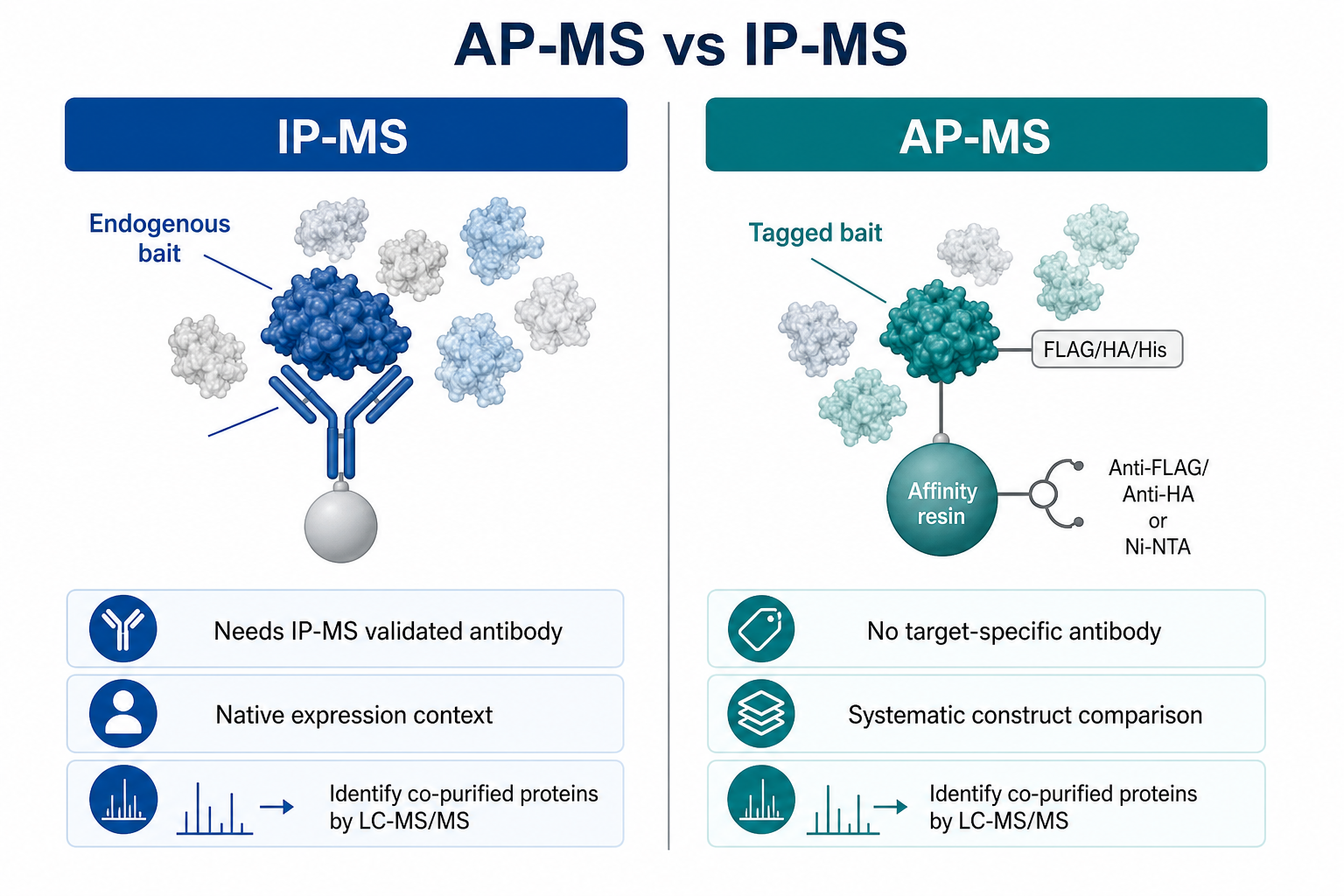
Figure 1. IP-MS depends on antibody capture of an endogenous bait, while AP-MS depends on affinity-tag purification of a designed bait construct.
Head-to-Head Comparison
|
Decision Factor |
IP-MS |
AP-MS |
|---|---|---|
|
Bait format |
Endogenous protein |
Tagged protein |
|
Capture reagent |
Target-specific antibody |
Affinity resin for the tag |
|
Needs IP-MS validated antibody |
Yes |
No |
|
Endogenous context |
Strong |
Depends on expression system |
|
Best for |
Native bait interactomes |
Systematic tagged interactomes |
|
Main risk |
Poor antibody performance and antibody background |
Tag effects and overexpression artifacts |
|
Core controls |
Isotype IgG, bead-only, knockdown or knockout when feasible |
Empty-tag line, matched expression controls |
|
Typical next step |
Validate candidates and confirm bait enrichment |
Filter tag background and validate hubs |
The practical difference is not MS detection. It is how the bait enters the experiment and which artifacts dominate interpretation.
Affinity Purification-Mass Spectrometry Service
When IP-MS Is the Better Choice
Choose IP-MS when the bait must remain endogenous and a high-quality antibody is available.
IP-MS is especially useful for:
- primary cells, tissues, or clinical specimens where tagging is impractical
- studies in which overexpression would distort partner selection
- projects that need the bait in its native modification state
- programs that already have an antibody validated by IP-MS for the relevant sample matrix
The limiting reagent is the antibody. Western blot reactivity alone is not enough. An antibody validated for IP-MS should demonstrate bait enrichment, acceptable background under IP conditions, and recovery compatible with LC-MS/MS. Without that evidence, AP-MS is often the more productive first discovery route.
IP-MS is less suitable when available antibodies fail under IP wash conditions, cross-react with abundant off-targets, or cannot provide reproducible bait recovery across replicates.
Co Immunoprecipitation (Co-IP) Service
When AP-MS Is the Better Choice
Choose AP-MS when tagging is acceptable and antibody performance is the bottleneck.
AP-MS is especially useful for:
- mutant, truncation, or domain-swap comparisons under one purification chemistry
- condition series that require matched bait recovery across many samples
- targets with no antibody validated for IP-MS
- systems where stable or inducible tagged lines are already available
AP-MS reduces dependence on target-specific antibodies, but it does not remove false positives. Tag sequences, linker design, expression level, and cellular compartment can change which partners are recovered. Empty-tag controls and quantitative enrichment filters are mandatory before ranking candidates.
AP-MS is less suitable when endogenous stoichiometry is essential, when tagging is prohibited by the biology or sample type, or when the research question requires the unmodified chromosomal locus product without engineered handles.
Control Design Differences That Affect Data Quality
AP-MS and IP-MS need different negative controls because their backgrounds arise differently.
For IP-MS, common controls include isotype-matched IgG, beads without antibody, and genetic reduction of the bait when feasible. These controls help separate antibody-driven enrichment from resin binders and off-target antibody capture.
For AP-MS, common controls include empty-tag expressing lines, untagged parental lines, and matched expression-level comparisons. These controls help separate tag-associated binders from bait-dependent partners.
In both workflows, single unreplicated enrichments are weak evidence. Replicates, intensity-based or spectral enrichment metrics, and a predefined candidate filtering plan should be set before acquisition whenever possible.
Artifact Profiles: What Each Method Tends to Overcall
IP-MS tends to overcall proteins that bind antibody constant regions, proteins that stick to beads under the chosen lysis chemistry, and proteins related to antibody cross-reactivity. Weak bait recovery can also create noisy lists dominated by contaminants.
AP-MS tends to overcall proteins that bind the affinity tag or resin, partners recruited by overexpression, and interactions stabilized by non-native localization of the tagged bait. Highly expressed tagged baits can recover sticky or abundant proteins that are not biologically meaningful partners.
Recognizing these profiles helps teams interpret AP-MS vs IP-MS results without treating every co-enriched protein as a validated interactor.
A Practical Decision Path for AP-MS vs IP-MS
- Ask whether the bait must remain endogenous.
- Ask whether an antibody has documented IP-MS performance in the planned sample type.
- If endogenous context is required and an IP-MS validated antibody is available, choose IP-MS.
- If antibody performance is weak or unknown and tagging is acceptable, choose AP-MS.
- If both routes are feasible, prefer IP-MS for native-state questions and AP-MS for construct-series or antibody-limited projects.
- Define controls and orthogonal validation before locking the enrichment protocol.
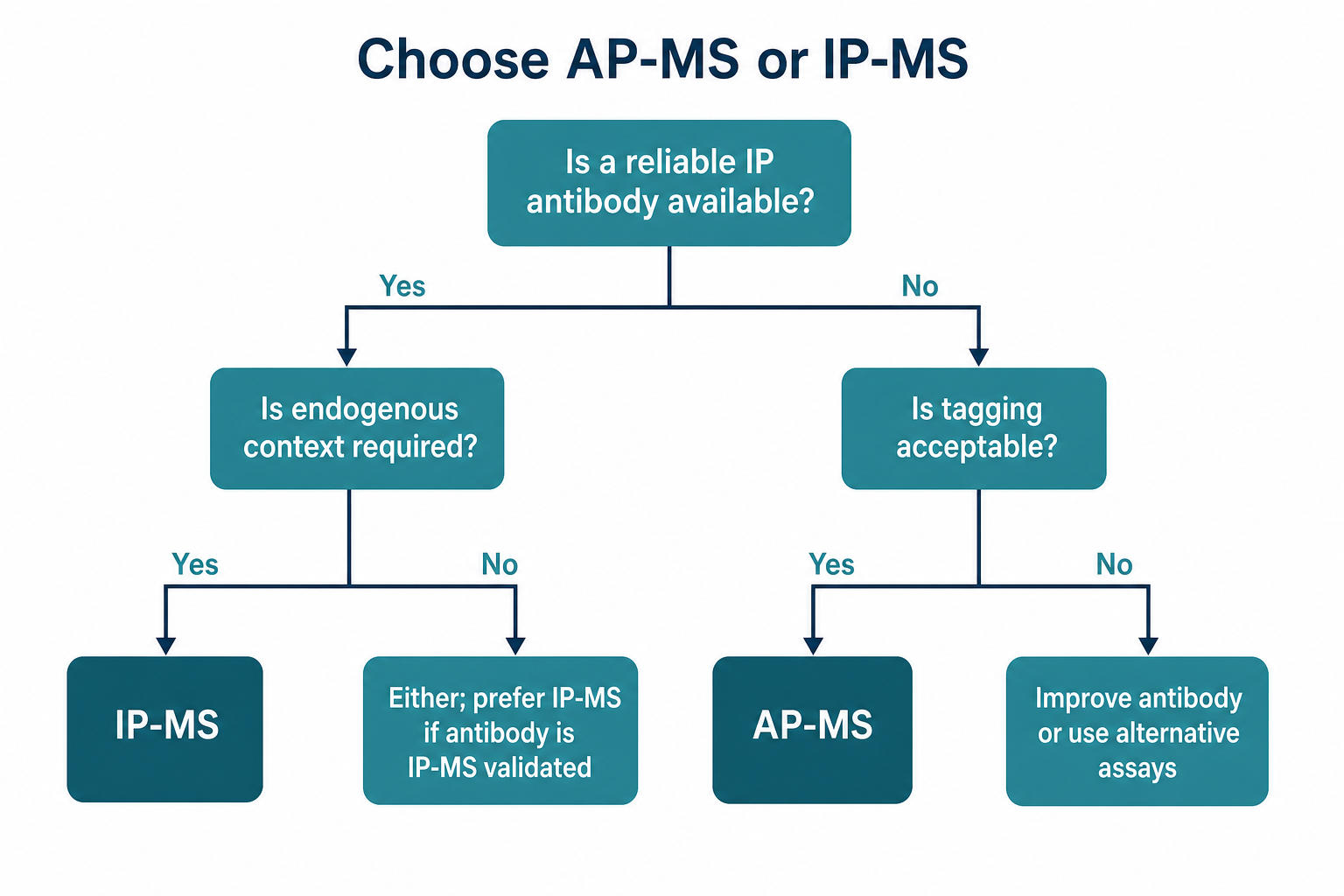
Figure 2. Antibody readiness and tagging acceptability are the primary branch points when choosing between AP-MS and IP-MS.
Related Services
Protein-Protein Interaction Analysis Service
MS-Based Protein-Protein Interaction Analysis Service
Pull Down based Protein Analysis Service with Mass Spectrometry
SILAC Based Co-IP-MS for Protein Interaction Analysis Service
What to Prepare Before Choosing
Assemble the following before requesting a workflow recommendation:
- bait identity and primary interaction question
- whether tagging is allowed in the experimental system
- antibody status: untested, IP-only, or antibody validated for IP-MS
- sample type and approximate amount
- planned contrasts: treatment, genotype, time point, or mutant series
- preferred controls and validation assays for priority candidates
- whether pull-down-MS is needed later for direct binding confirmation
MtoZ Biolabs supports IP-MS, Co-IP-MS, AP-MS, pull-down-MS, and broader protein interaction analysis for teams comparing antibody-based and tag-based discovery routes. The technical team can review antibody evidence, tag options, and control design before enrichment and LC-MS/MS begin.
To discuss AP-MS vs IP-MS selection, contact MtoZ Biolabs with your bait protein, antibody or tag status, sample type, study groups, and the interaction question that must be answered.
Frequently Asked Questions
Is AP-MS always better when no good antibody exists?
AP-MS is often the more productive discovery route when tagging is acceptable. If tagging is not allowed, antibody improvement, alternative enrichment strategies, or non-MS interaction assays may be required instead.
Does IP-MS require an IP-MS validated antibody?
For interpretable discovery work, yes in practical terms. An antibody validated by IP-MS provides evidence that bait enrichment and background are compatible with MS readout. Weak IP antibodies produce weak IP-MS datasets.
Can AP-MS and IP-MS be used in the same project?
Yes. Some programs discover candidates by AP-MS, then confirm endogenous recovery by IP-MS when a suitable antibody becomes available. Others qualify an antibody by IP-MS and later use AP-MS for mutant series.
How is pull-down-MS different from AP-MS?
Pull-down-MS typically uses an immobilized recombinant bait to test binding under controlled conditions. AP-MS usually purifies a tagged bait from a cellular expression system and recovers proteins associated in that context.
Which method is better for disease or tissue samples?
IP-MS is usually closer to the biology when endogenous bait from tissue or primary material must be studied and an antibody validated for IP-MS is available. AP-MS is stronger when engineered models can carry the tagged bait.
Conclusion
AP-MS vs IP-MS is a choice between tag-based and antibody-based bait capture, not a choice between two equivalent MS protocols. IP-MS is the stronger fit for endogenous bait studies when an antibody validated for IP-MS is available. AP-MS is the stronger fit when tagging is acceptable and antibody performance limits discovery.
The highest-value decision is made before enrichment begins: confirm bait format, antibody or tag readiness, controls, and validation plans. Teams comparing these options can review project constraints with MtoZ Biolabs and select the interactome workflow that matches the biological question rather than defaulting to the more familiar method.
How to order?




