






Antibody Sequencing Services: What to Ask Before You Send Samples to a Vendor
Before you ship any material, ask the vendor to tie your exact sample type and downstream goal to a defined sequencing workflow and a defined report. If that link stays vague, the risk is not only project failure. You can also end up with sequence output that looks complete on paper but still does not support sequence confirmation, clone reconstruction, or recombinant re-expression planning.
For most outsourcing decisions, the useful screening questions fall into four areas: sample compatibility, method fit, chain resolution, and deliverables. A solid pre-submission review should tell you whether the vendor expects to recover VH and VL, only partial CDR information, or a broader heavy chain and light chain sequence set; how residue ambiguity will be reported; and whether the final deliverables will support the next technical step your team actually needs.
Where antibody sequencing outsourcing usually breaks down
Teams rarely run into trouble because the shipment itself was handled badly. The bigger problem usually starts earlier, when antibody sequencing services are treated as a generic purchase category instead of a project-specific sequence recovery workflow.
That gap shows up in familiar situations. A biotech group may have a purified antibody, hybridoma supernatant, a hybridoma cell pellet, or an older monoclonal antibody in an archived formulation. The team wants antibody sequence recovery for a practical reason: recover missing records, plan recombinant re-expression, or confirm whether an existing reagent can still be reconstructed. The vendor accepts the sample, but the important questions are still open. Will the workflow separate heavy chain and light chain information with usable confidence? Will the report provide variable region coverage or only CDR calls? How will residue ambiguity, including Leu/Ile uncertainty where relevant, be flagged? Is the consensus sequence backed by evidence that an internal scientist can review?
Those details shape budget approval, timeline planning, and downstream design work. A clean FASTA file can still miss the real use case. If framework region support is thin, chain pairing is uncertain, or unresolved positions are buried in the summary, teams can move into construct design too early and end up reworking the project later.
The root causes worth screening before vendor selection
Most pre-submission risk falls into four categories that directly affect the outsourcing decision.
1. The sample type does not match the sequencing route
Sample origin has a major effect on what is technically realistic. A purified antibody, hybridoma-derived material, serum-derived fraction, and archived formulated reagent do not offer the same path to antibody sequence recovery.
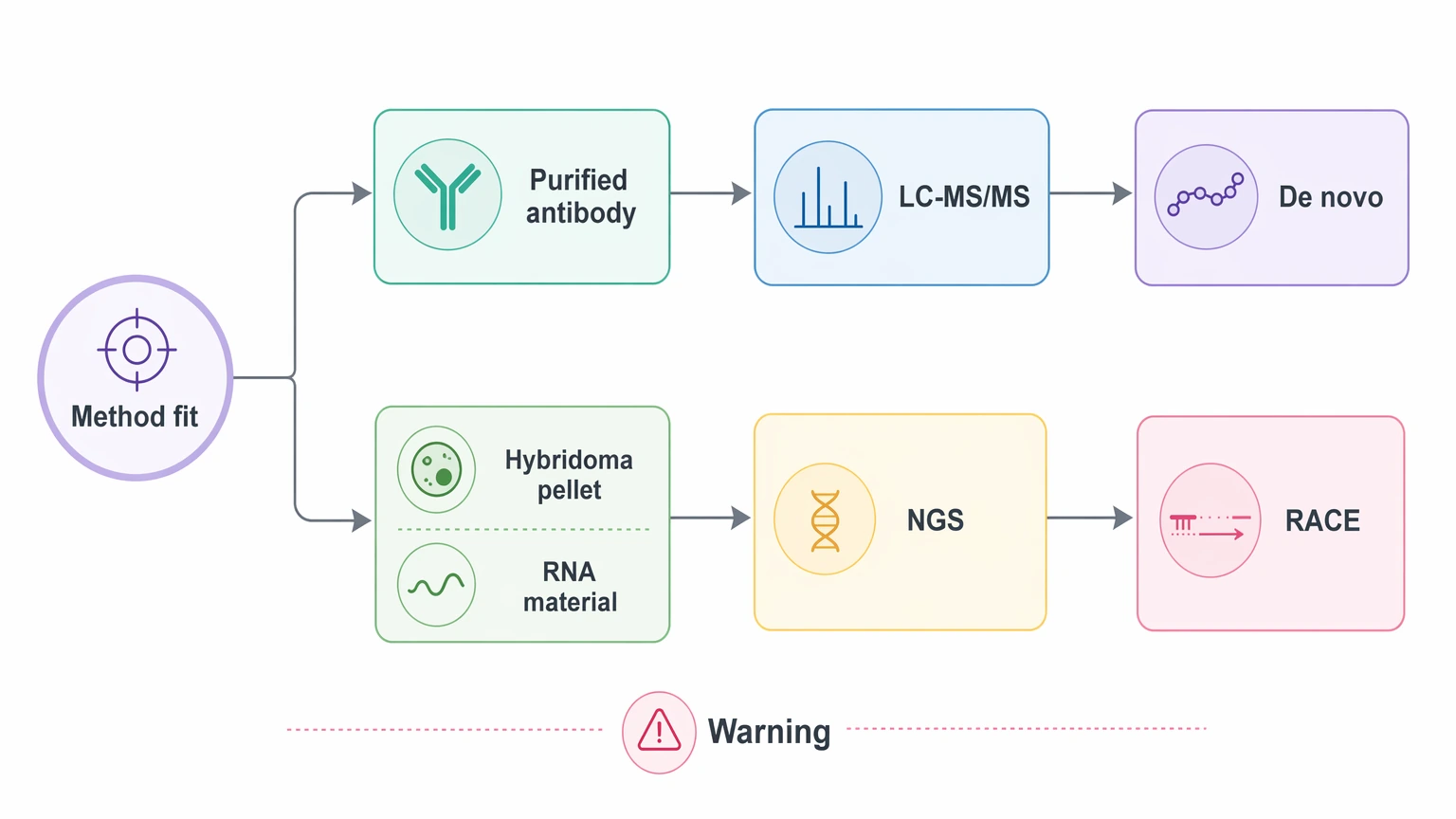
For example, mass spectrometry with LC-MS/MS and de novo peptide sequencing may be a reasonable choice for a purified antibody when no cellular source remains. By contrast, NGS or RACE may fit better when a hybridoma cell pellet or RNA-derived material is available. If a vendor talks about one platform as though it fits every project, treat that as a warning sign.
2. “Sequence obtained” does not guarantee usable chain-level output
A project can generate peptide evidence and still miss the decision your team cares about. The real question is not whether some sequence was detected. It is whether the vendor can recover a usable heavy chain and light chain sequence set, define VH and VL, and explain any limits around chain pairing or kappa/lambda light chain assignment.
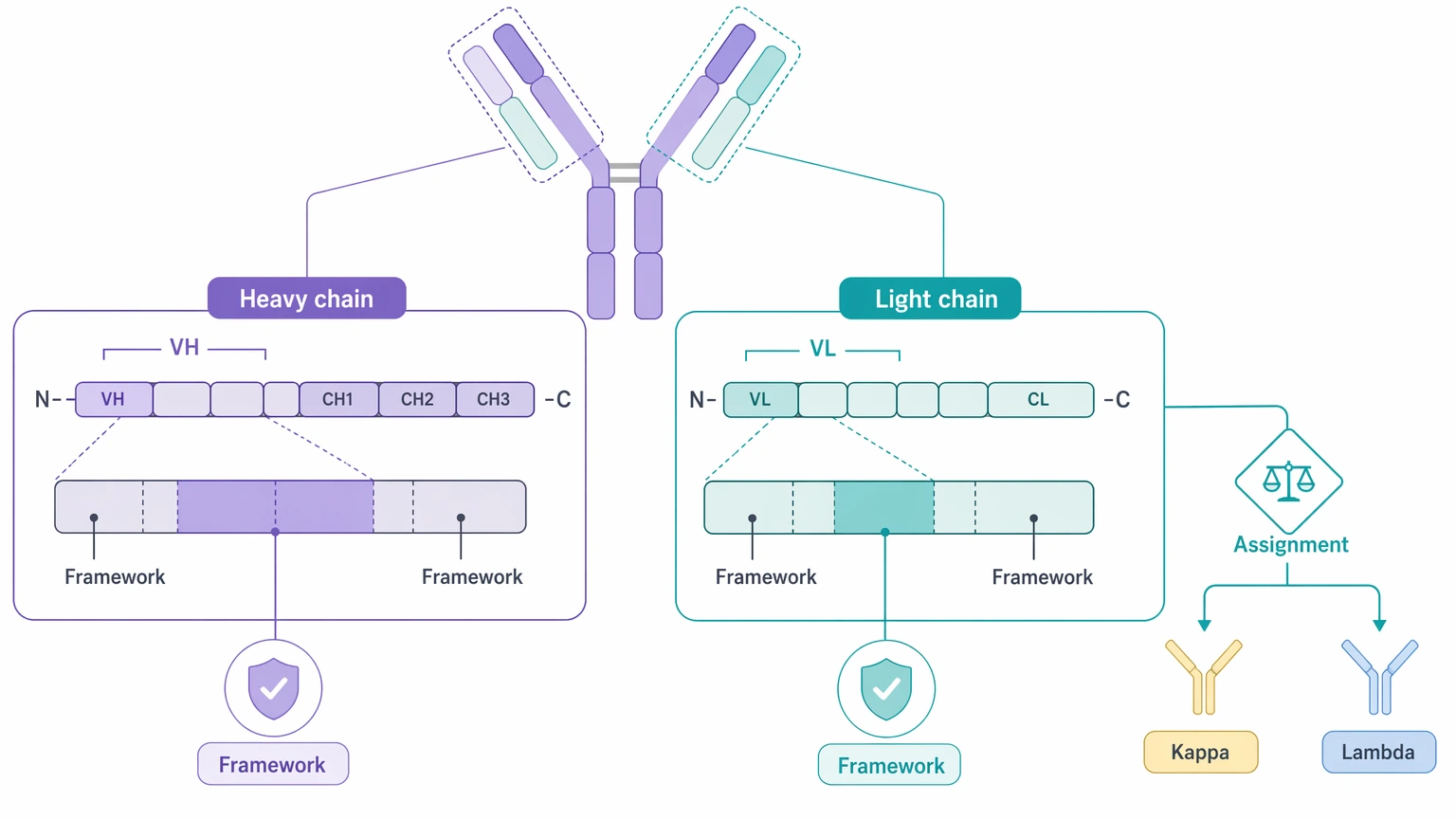
That distinction matters most when the sequence will be used for more than identity checking.
3. The quoted scope does not match the downstream use
Many teams ask for “antibody sequencing” when the real need is more specific: CDR-level identity support, variable region recovery, a broader consensus sequence, or deliverables that can inform recombinant re-expression.
If the quote does not state the expected sequence scope, the report may answer a narrower question than the one your program is actually asking.
4. Report expectations are vague before intake
A final report should do more than provide a FASTA string. It should show how the sequence was inferred, where sequence coverage is strong or incomplete, where residue ambiguity remains, and how much confidence supports each region. Vendors that cannot describe their report structure before intake often leave teams sorting that out after delivery.
A project-planning framework for evaluating vendors before submission
This kind of article works best as a project-planning guide, not generic troubleshooting. The goal is to ask the right questions before a sample is consumed.
Step 1: Define the deliverable before discussing the platform
Start with the downstream use. If the real goal is sequence confirmation only, your minimum useful deliverable may be very different from what you need for validation planning or recombinant reconstruction.
The table below can help frame the first vendor conversation.
| Downstream goal | Minimum useful deliverable | Why it matters |
|---|---|---|
| Identity check against an existing reagent | CDR evidence or peptide-level support with confidence notes | May support comparison, but may not support reconstruction |
| Variable-region recovery | Annotated VH and VL sequence output | Needed when chain-specific design work will follow |
| Recombinant re-expression planning | Heavy chain and light chain FASTA output, region annotation, ambiguity flags | Construct design needs more than a summary sequence |
| Orthogonal follow-up | Consensus sequence plus uncertainty notes and method summary | Supports sequence confirmation and targeted next-step review |
Ask directly: What sequence level will be reported? Will the deliverables include CDR, the full variable region, or broader chain information? If the answer stays promotional or generic, the scope is not ready for approval.
Step 2: Provide a technical sample description, not just a sample name
A useful intake discussion starts with material details. For antibody sequencing services, that means sample origin, approximate amount, concentration, purity, buffer composition, storage history, and known additives.
The vendor should be able to say whether the material is acceptable as received, needs cleanup, or should move to a different workflow. That matters because detergents, stabilizers, carrier proteins, preservatives, and excipients can reduce sample compatibility or complicate interpretation in mass spectrometry-based projects.
The sample categories worth separating include:
- purified antibody
- hybridoma supernatant
- hybridoma cell pellet
- RNA-derived material
- ascites-derived antibody
- serum-derived antibody fraction
- archived or partially degraded formulation
If your team is comparing routes for purified antibody sequencing or hybridoma-derived recovery, submit your requirements to MtoZ Biolabs with the sample form, buffer details, and expected deliverables so the team can evaluate your project before intake.
Step 3: Ask the vendor to justify method fit
A credible vendor should explain why a given method matches your material instead of just naming a platform. That explanation should cover both strengths and limits.
For protein-only inputs, ask how the workflow uses de novo peptide sequencing and how the peptide evidence is assembled into a consensus sequence. For hybridoma-derived inputs, ask whether NGS or RACE is expected to improve recovery of coding sequences. For degraded or mixed samples, ask what extra uncertainty the vendor expects and whether a complementary workflow may be needed.
This conversation usually makes it clear whether the vendor is evaluating project fit or simply receiving samples.
Step 4: Clarify heavy chain, light chain, and chain pairing logic
Chain-level interpretation deserves its own review. Ask the vendor how heavy chain and light chain sequences are identified separately, how framework region calls are supported, and whether kappa/lambda light chain assignment will be stated where applicable.
Other useful questions include:
- How do you distinguish target antibody signal from non-target immunoglobulins?
- How do you recognize mixed antibody populations?
- How will uncertain chain pairing be described in the report?
- Will the report clearly label VH and VL boundaries?
A trustworthy answer does not promise certainty in every case. It explains what can be resolved from the sample you have and how unresolved points will be shown.
Step 5: Review the report format before sending the sample
Ask for a redacted report example or a written outline of the final deliverables. A report that supports downstream work should usually include:
- annotated sequence output
- FASTA files
- region labeling for CDR and framework region
- notes on sequence coverage
- flags for residue ambiguity
- a method summary
- statements about partial regions or unresolved positions
If your downstream goal is recombinant design, also ask what the report does not establish. Initial antibody sequence recovery may still need follow-up sequence confirmation before a team commits to expression constructs.
Step 6: Screen for no-go conditions and resubmission triggers
Before approval, ask what would cause the project to pause or fail. Common issues include low input, poor purity, host-cell background, mixed populations, formulation interference, and incomplete support across the variable region.
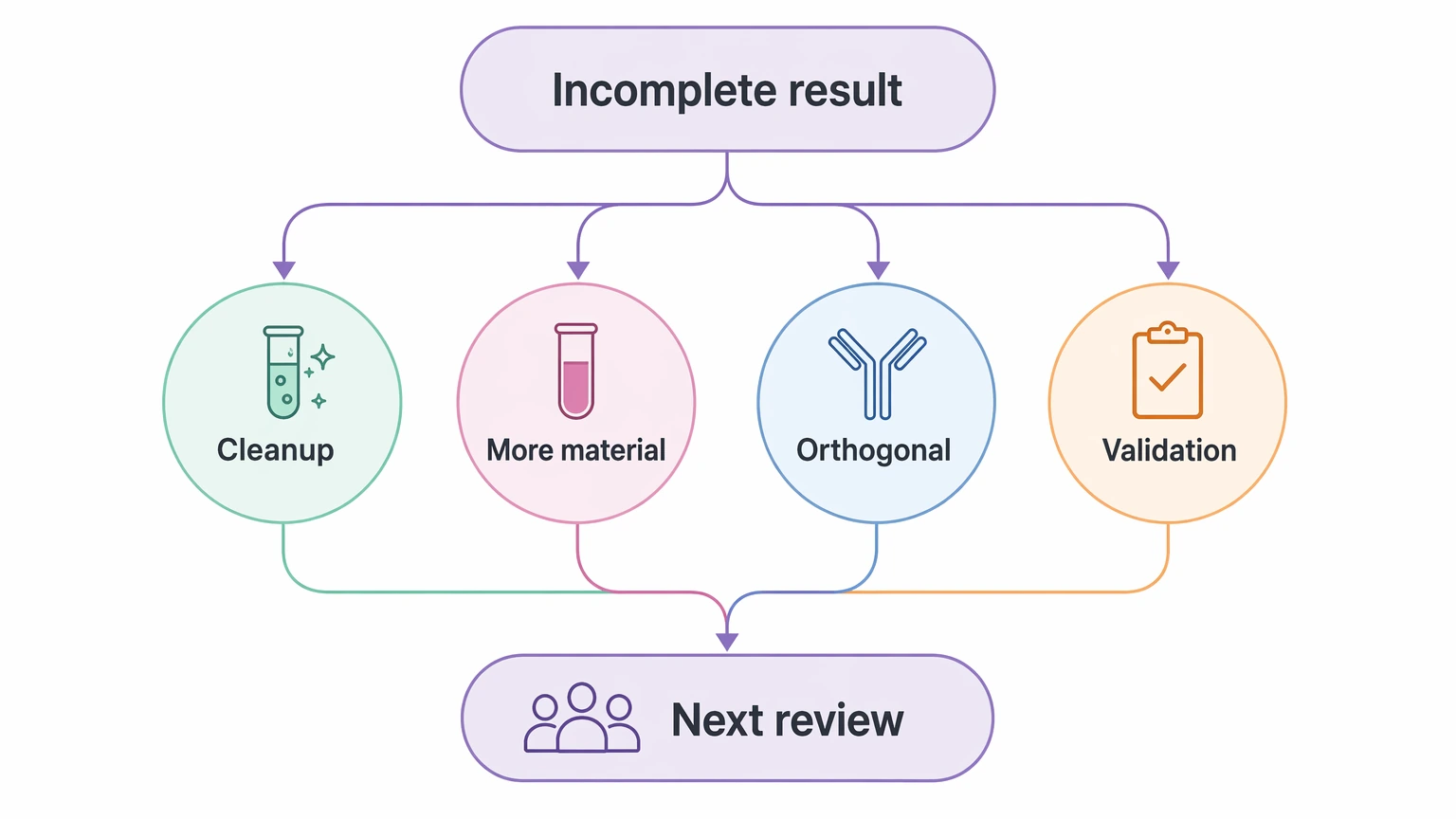
Also ask what happens if the first-pass result is incomplete. A useful answer may involve sample cleanup, additional material, an orthogonal workflow, or staged validation planning rather than forcing an uncertain sequence into immediate downstream use.
How to judge whether a vendor conversation is actually useful
A productive pre-submission call should leave your team with a sharper decision, not just a quote. By the end of that discussion, you should know:
- whether the sample is compatible with the proposed workflow
- what sequence scope is expected
- how chain-specific interpretation will be handled
- where ambiguity may remain
- what the final report will contain
- what conditions could trigger resubmission or method changes
If those points are still undefined, the project is still at the intake stage rather than real technical scoping.
Practical cautions after the report is delivered
Even a good report has limits. Recovered sequence information does not by itself confirm that reconstructed material will express or behave as expected. That is why uncertainty notes matter. Partial framework region support, unresolved residues, or limited evidence for chain pairing should shape follow-up work.
Internal teams should read the report in light of the downstream use. A report can be enough for identity review and still fall short for construct design. When those limits matter, the better next step is usually orthogonal confirmation, targeted follow-up, or a revised recovery strategy rather than assuming the initial output is fully re-expression-ready.
Conclusion
The best way to compare antibody sequencing services is to ask whether the vendor can connect your sample type to a realistic workflow, a defined heavy chain and light chain output, and a report that supports the next decision your team actually needs to make. That matters even more for legacy monoclonal antibody assets, purified antibody samples with no nucleic-acid backup, and hybridoma-linked projects headed toward sequence confirmation or recombinant re-expression. If you want to lower resubmission risk before a purchase decision, contact MtoZ Biolabs to discuss your sample, evaluate your project, and review which deliverables fit your intended use.
FAQ
What should I send before asking for a quote?
Send a short technical summary: sample origin, amount, concentration, estimated purity, buffer or formulation components, storage history, and your intended downstream use. That gives the vendor enough context to judge sample compatibility before intake.
When is a purified antibody a weak starting point for sequence recovery?
It becomes harder when the material is low in quantity, contains carrier proteins or excipients, shows degradation, or may contain more than one antibody species. In those cases, the vendor should explain the expected uncertainty before work begins.
Should I ask for raw data access?
Not always, but you should ask what evidence level will be available for review. Some teams need only an annotated report, while others want enough supporting detail to assess ambiguous residues or partial coverage internally.
Can a vendor confirm chain pairing from any antibody sample?
No. Chain pairing confidence depends on sample type and workflow. Vendors should explain what can be inferred from the available evidence rather than treating chain pairing as automatic.
What is a red flag in the intake process?
A generic response that skips sample condition, method boundaries, and report content. If the vendor is ready to accept the sample without clarifying those points, your team may be carrying more project risk than the quote suggests.
How to order?




