






Antibody Diversity And Specificity Analysis vs Mass Spectrometry: Method Selection and Research Use Cases
Quick Answer
For antibody diversity and specificity analysis vs mass spectrometry, the better choice starts with what your study needs to measure first. Choose antibody diversity and specificity analysis when the main question is about the immune response: which B-cell clones expanded, how broad the antibody diversity is, what V(D)J usage patterns appear, whether lineage analysis suggests affinity maturation, and how antigen specificity or epitope mapping patterns differ across samples. Choose mass spectrometry when the main question is about the analyte itself: what peptide or protein is present, whether a purified antibody or antigen matches the expected molecular identity, which post-translational modifications or proteoforms are present, or whether sequence confirmation and impurity-related molecular characterization are required. Use both when you need to connect immune repertoire profiling with peptide- or protein-level evidence in the same non-clinical research project.
Antibody Diversity and Specificity Analysis vs Mass Spectrometry: Why the Comparison Can Be Confusing
This comparison comes up often because both approaches are used in antibody, immunology, and biomarker research. A team may be working with serum antibody response samples, PBMCs, isolated B cells, hybridoma products, purified antibodies, or target antigens and hear both methods suggested during project planning.
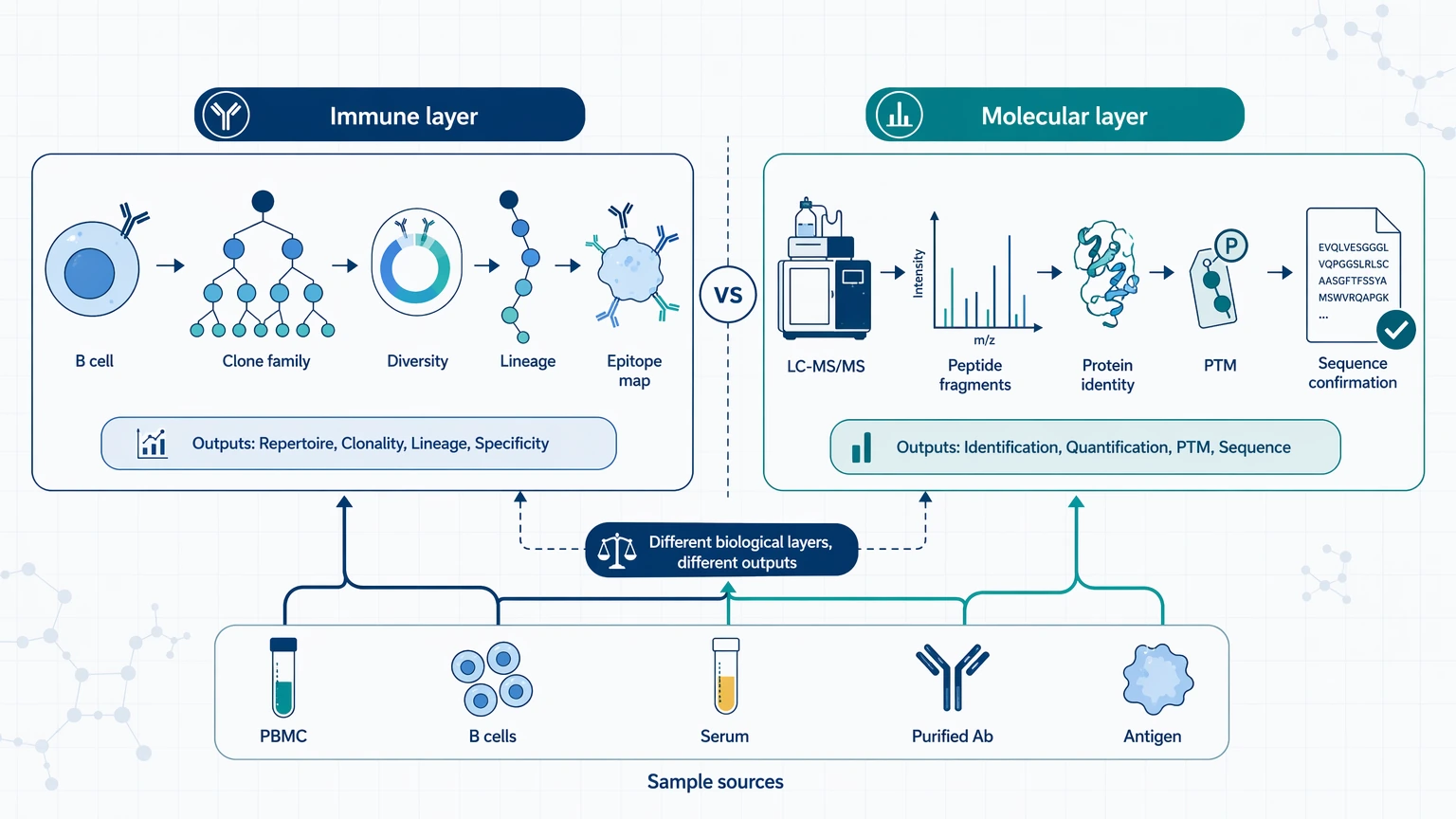
The confusion usually comes from a surface-level overlap: both may be described as “antibody analysis,” but they look at different biological layers.
- Antibody diversity and specificity analysis asks how the immune response is organized.
- LC-MS/MS and tandem mass spectrometry ask what molecules are present and how those molecules are structurally defined.
That distinction matters more than the instrument list. A repertoire-centered study and a molecule-centered study do not produce the same kind of evidence, even when they involve related samples.
What Antibody Diversity and Specificity Analysis Measures
Antibody diversity and specificity analysis focuses on the composition and behavior of antibody populations rather than direct peptide identification or protein identification.
Typical outputs include:
- B-cell repertoire structure
- clonal diversity metrics
- evidence of clonal expansion
- V(D)J usage patterns
- lineage analysis across related clones
- signs of affinity maturation
- antigen specificity trends
- epitope mapping or specificity-associated response patterns
- comparative profiles across timepoints, treatments, or immunization groups
- early antibody candidate characterization for discovery or prioritization
This route usually fits the question, “What did the immune system generate?” rather than, “What is the exact molecular composition of this purified analyte?”
For example, in an immunization study, a team may want to know whether the response is broad or narrowly focused, whether a few clones dominate after boosting, and whether different animals converge on similar sequence motifs. Mass spectrometry does not usually answer those questions directly. It does not reconstruct the B-cell repertoire in the same way, and clone distribution or lineage structure is not its primary deliverable.
Antibody specificity analysis is also useful when the goal is not just binary binding, but pattern-level interpretation: which antigen regions appear to be recognized more often, whether cross-reactive behavior emerges, or how candidate pools differ before more targeted follow-up.
What Mass Spectrometry Measures in Antibody or Immune-Related Research
Mass spectrometry is molecule-centric. In antibody and immune-related research, it characterizes proteins, peptides, and molecular features that repertoire-oriented methods do not usually define directly.
Common readouts include:
- peptide identification
- protein identification
- sequence confirmation
- detection of post-translational modification
- proteoform-related evidence
- impurity or composition assessment
- confirmation of antigen or target protein identity
- molecular characterization of a purified antibody
- targeted or broader analysis of protein mixtures in a defined sample matrix
This makes LC-MS/MS the more direct choice when the study asks:
- Is this purified antibody the expected molecule?
- Does the target protein contain the expected sequence region?
- Are glycation, oxidation, deamidation, truncation, or other modifications present?
- Does the preparation contain extra protein species or peptide evidence inconsistent with expectations?
- Can peptide-level evidence support follow-up work on antigen preparation or candidate confirmation?
In short, mass spectrometry measures analyte composition. It does not replace immune repertoire profiling, and immune repertoire profiling does not replace molecular characterization.
Side-by-Side Comparison Across Research Decision Criteria
The table below summarizes the main planning implications for the method choice.
| Decision criterion | Antibody diversity and specificity analysis | Mass spectrometry |
|---|---|---|
| Primary biological question | How is the antibody response organized? | What molecules are present and how are they characterized? |
| Biological layer measured | Repertoire, clone, lineage, binding-associated patterns | Peptide, protein, proteoform, modification |
| Typical sample types | PBMCs, B cells, serum/plasma antibody populations, hybridoma-derived materials | Purified antibody, antigen, peptide, protein, enriched fractions, complex protein sample matrix |
| Core readout type | Clonal diversity, clonal expansion, V(D)J usage, lineage analysis, antigen specificity patterns | Peptide identification, protein identification, sequence confirmation, PTM profile, molecular composition |
| Resolution target | Population-level and clone-level immune structure | Peptide-level and protein-level analyte evidence |
| Throughput style | Often suited to comparing many immune samples or response states | Often suited to focused molecular characterization or defined analyte panels |
| Strengths | Connects response breadth, immune heterogeneity, and candidate prioritization | Confirms identity, detects modifications, and supports impurity or structural assessment |
| Common limitations | Does not directly provide full molecular composition of the analyte | Does not directly reconstruct the B-cell repertoire or clone lineage architecture |
| Prior knowledge requirement | May use known antigen context for specificity questions | Can be targeted or untargeted depending on the molecular question |
| Typical downstream use | Immune profiling, discovery triage, response tracking, specificity mapping | Orthogonal validation, molecular characterization, follow-up confirmation |
Use these differences to align the analytical method with the biological question and validation plan.
A practical rule is to match the method to the report you need. If the deliverable should read like a clone distribution or specificity-mapping report, start with antibody diversity and specificity analysis. If it should read like a peptide list, sequence confirmation package, or PTM profile, start with mass spectrometry.
If your team is still sorting options, this is a good point to evaluate your project by listing the sample type, target context, and required deliverable before choosing an analytical route.
When Antibody Diversity and Specificity Analysis Is the Better Choice
This route is usually the stronger fit in several common research settings.
Immune repertoire profiling after immunization or challenge
When a team needs to compare response breadth across subjects or timepoints, immune repertoire profiling addresses that question directly. It can show whether the response diversified, converged, or became dominated by a smaller number of expanded clones.
Tracking clonal response patterns
Projects focused on clonal expansion, clonal diversity, and lineage analysis need clone-aware output. This is especially relevant in longitudinal studies, vaccine-model work, and other non-clinical research use settings.
Antigen specificity and epitope-oriented investigations
If the project aims to understand which antigen regions are preferentially recognized, or whether distinct binding patterns emerge across experimental groups, antibody specificity analysis and epitope mapping provide a more relevant framework than analyte-level proteomics alone.
Antibody discovery triage
During early candidate selection, teams may want to identify promising sequence families, recurring motifs, or evidence of affinity maturation before moving into deeper molecular follow-up. That is a different decision point from confirming the exact molecular features of one purified candidate.
Biomarker-oriented immune studies
In studies using serum or cell-derived immune material, the main signal may be the shape of the antibody response rather than the full protein composition of the sample matrix. In that case, repertoire and specificity readouts often align more closely with the decision being made.
When Mass Spectrometry Is the Better Choice
Mass spectrometry becomes the more direct method when the research question shifts from immune architecture to molecular confirmation.
Purified antibody characterization
If you already have a purified antibody and need sequence confirmation, peptide-level evidence, or PTM-focused review, LC-MS/MS is usually the more appropriate starting point.
Antigen or target protein characterization
A team may need to confirm that the antigen preparation itself is correct before interpreting downstream antibody binding data. In that case, protein identification and molecular characterization of the antigen may be more urgent than repertoire analysis.
PTM and proteoform assessment
Questions about post-translational modification or proteoform status fit naturally into a mass spectrometry workflow. Repertoire methods may show that a clone exists, but they do not usually define the analyte’s PTM profile with the same directness.
Composition or impurity review
When a preparation may contain multiple protein species, fragments, or process-related components, tandem mass spectrometry can provide analyte-level evidence that repertoire-based methods are not designed to generate.
Candidate follow-up after discovery
Once candidate antibodies have already been selected, the next need may be molecular characterization rather than another round of repertoire comparison. This is a common handoff point from discovery-oriented immune analysis to LC-MS/MS-based follow-up.
When Combining Both Methods Makes More Sense Than Choosing Only One
Many research teams get more decision value from a staged workflow than from forcing a single-method choice.
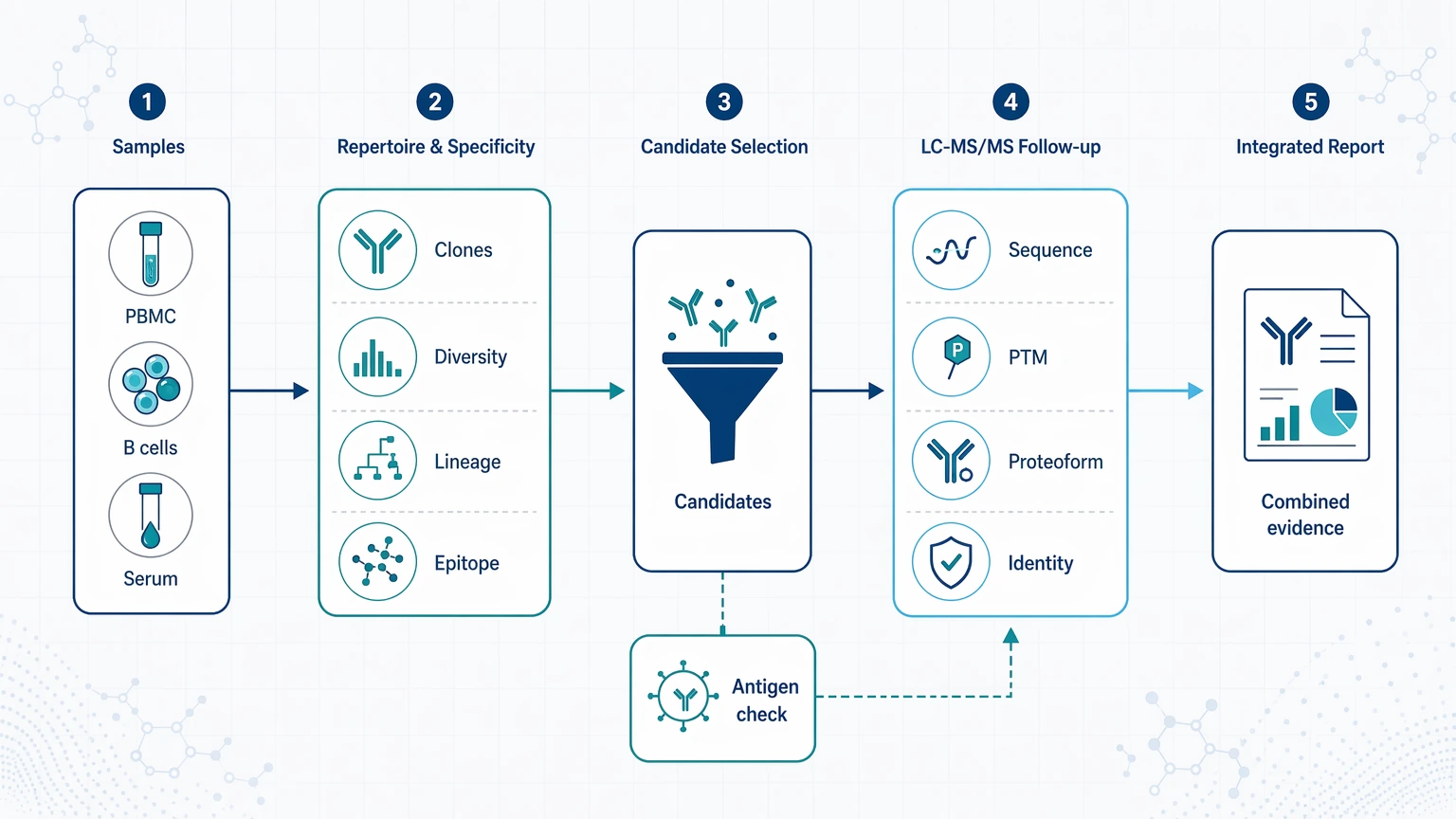
Use case 1: Immunization study with candidate follow-up
First, profile the B-cell repertoire and serum antibody response to identify dominant clone families, diversity shifts, and antigen specificity trends. Then use mass spectrometry to characterize the antigen preparation or selected antibody products at the molecular level.
Use case 2: Antibody discovery with molecular confirmation
Start with antibody diversity and specificity analysis to prioritize candidate groups with favorable clonal behavior or epitope-related patterns. Follow with LC-MS/MS for sequence confirmation, PTM review, or purified-product characterization of shortlisted candidates.
Use case 3: Biomarker-oriented immune study
A translational research group may need to keep two interpretations separate: one for immune-response structure and one for protein-level composition. Repertoire analysis can describe the antibody-side response, while mass spectrometry can characterize target proteins or related analytes in the sample matrix. This prevents one evidence layer from being overread as if it explains the other.
Use case 4: Orthogonal validation
A finding from one analytical layer often benefits from orthogonal validation from another. Clone-level observations can guide what to characterize molecularly, while molecular evidence can support confidence that a candidate or antigen preparation matches the intended study object.
For teams planning this kind of staged design, submit your requirements to MtoZ Biolabs with the sample type, target context, and intended report outputs so the workflow can be scoped around the actual research question rather than a default instrument choice.
Service Routes for Study Planning
For teams moving from method selection into execution, these service paths connect assay design, validation, and interpretation needs.
How to Choose Based on Sample, Question, and Deliverable
A simple selection framework is to answer four planning questions.
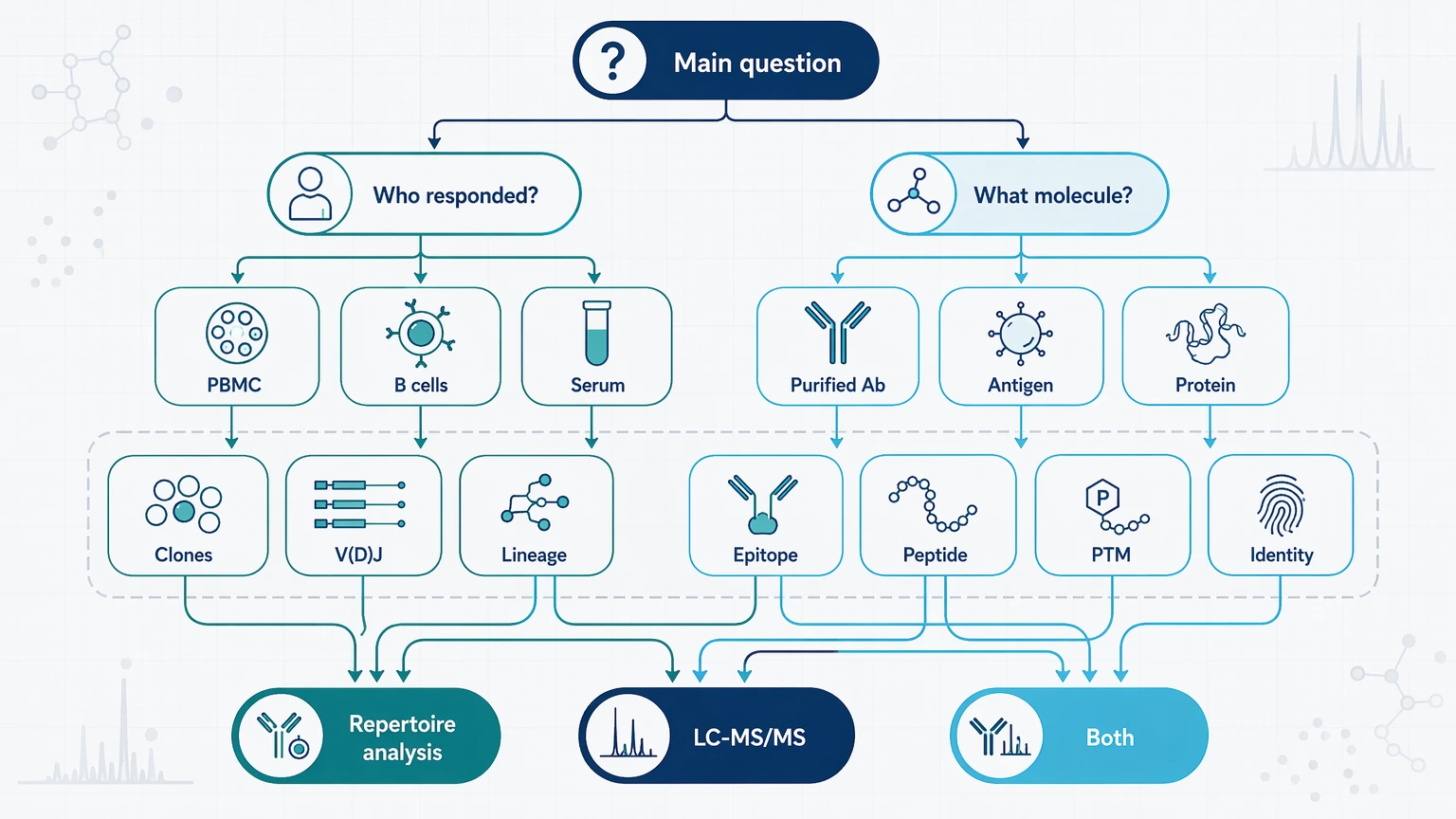
1. What is the main question?
- Choose antibody diversity and specificity analysis if the question is about who responded and how the response is organized.
- Choose mass spectrometry if the question is about what molecule is present and how it is structurally defined.
2. What is the sample entry point?
- PBMCs, B cells, serum antibody response samples: usually a stronger fit for immune repertoire profiling or specificity-oriented analysis
- Purified antibody, antigen, peptide, protein samples: usually a stronger fit for LC-MS/MS and molecular characterization
3. What deliverable do you need at the end?
Ask whether the final report should contain:
- clonal diversity and V(D)J usage patterns
- lineage analysis and antigen specificity summaries
- epitope mapping output
- peptide identification or protein identification tables
- sequence confirmation evidence
- post-translational modification or proteoform findings
The method should match the report you need, not just the sample you happen to have.
4. What is the downstream decision?
- Discovery triage and response comparison usually favor repertoire/specificity analysis.
- Molecular confirmation, impurity review, and analyte-level structural follow-up usually favor mass spectrometry.
- Candidate advancement or cross-method confirmation often favors both.
Service Planning Considerations for External Projects
Before contacting a provider, prepare these details:
- the study goal in one sentence
- sample type and sample matrix
- species and experimental context
- whether the antigen or target is known
- whether the need is discovery screening, confirmation, or orthogonal validation
- expected deliverable format
- number of samples or comparison groups
- whether you already have a purified antibody or only immune-source material
- whether PTM, proteoform, or sequence confirmation questions are in scope
These details reduce back-and-forth and make it easier to align the workflow with the biological question instead of defaulting to a familiar method.
FAQ
If both methods can involve antibodies, where is the actual boundary?
The boundary is the evidence layer. Antibody diversity and specificity analysis describes the response landscape: clone families, repertoire structure, specificity-associated patterns, and lineage relationships. Mass spectrometry describes molecular composition: peptides, proteins, modifications, and proteoforms. A project can include both without those outputs becoming interchangeable.
Can mass spectrometry determine antigen specificity on its own?
Not in the same way as an antibody specificity workflow. Mass spectrometry can characterize antigens, purified antibodies, and molecular features linked to those analytes, but antigen specificity usually requires a binding- or response-oriented design. Asking which antigen regions are recognized is different from asking which peptides are present.
Is serum enough for antibody diversity analysis, or are B cells required?
That depends on the output you need. If the goal is clone-linked repertoire structure or detailed lineage analysis, B-cell-derived material is often the more natural starting point. If the goal is a broader serum antibody response pattern, serum may still be informative. The key decision is to define the intended report first.
When does a purified antibody shift the project toward LC-MS/MS?
Once the project centers on the molecule itself—identity, sequence confirmation, PTMs, fragments, or proteoform-related questions—a purified antibody often becomes a strong starting point for mass spectrometry. If the study still needs to explain how that candidate emerged from a broader immune response, repertoire-linked analysis may still be needed upstream.
Can one method validate the other?
They can contribute to orthogonal validation, but they do not confirm the same claim. Repertoire findings support immune-response interpretation, while mass spectrometry supports molecular confirmation. A clone-level observation and a peptide-level observation are complementary evidence, not duplicate evidence.
What is the most common mistake in method selection?
The most common mistake is choosing based on sample type alone. The same project may include serum, B cells, purified protein, and antigen preparations, yet still require two different analytical paths because the biological questions are different.
Conclusion
For antibody diversity and specificity analysis vs mass spectrometry, the practical question is not which method is stronger in general, but which biological layer your project needs to interrogate first. Choose antibody diversity and specificity analysis when the goal is to map antibody diversity, antibody specificity, clonal expansion, V(D)J usage, or lineage behavior across an immune response. Choose mass spectrometry when the goal is peptide identification, protein identification, sequence confirmation, post-translational modification review, or broader molecular characterization of a defined analyte. Choose a combined workflow when immune-response structure and analyte-level evidence both affect the next project decision.
If your team is comparing these routes for an active study, contact us at MtoZ Biolabs with your samples, target context, and expected deliverables so the project can be scoped around the right analytical question.
How to order?




