






Why Serum or Plasma Proteomics Results Miss Low-Abundance Proteins
Serum or plasma proteomics results miss low-abundance proteins mainly because a few highly abundant circulating proteins occupy much of the analytical space. Albumin, immunoglobulins, and other dominant proteins can suppress signal from scarcer proteins, so a clean LC-MS/MS run can still return an incomplete view of the low-abundance fraction.
That outcome is usually a matrix and dynamic-range problem, not proof that the instrument failed. Reliability improves when the study question, preprocessing choice, and interpretation limits are matched. It does not improve by assuming every low-abundance protein should appear in an undepleted serum or plasma profile.
Why Low-Abundance Proteins Drop Out
Serum and plasma span a very wide protein abundance range. A small set of proteins accounts for most of the protein mass. In discovery proteomics, those dominant proteins generate strong peptide signals and consume a large share of acquisition opportunity. Lower-abundance proteins produce weaker signals and are easier to miss, especially when the sample is analyzed without a strategy aimed at the low-abundance space.
Three mechanisms usually work together.
Signal competition: high-abundance peptides can suppress weaker ions and dominate the measurable signal.
Acquisition limits: scarce peptides may be inconsistently sampled in DDA or remain difficult to resolve and quantify in DIA.
Background noise from sample quality: hemolysis, lipemia, precipitation, or repeated freeze-thaw events can add interfering material and further squeeze weak signals.
CSF is different in protein composition, but blood contamination can push a CSF profile toward a plasma-like high-abundance background. For serum and plasma, the high-abundance barrier is a major reason scarce proteins remain unreported, together with peptide properties, sample preparation, acquisition limits, and reporting thresholds.
A helpful way to reframe the problem is to ask what the project was built to recover. An undepleted discovery screen is built to compare recoverable protein patterns across groups. A low-abundance biomarker hypothesis is built around scarce targets. When those two aims are mixed without a plan, the report looks incomplete even when the analytical path performed as designed.
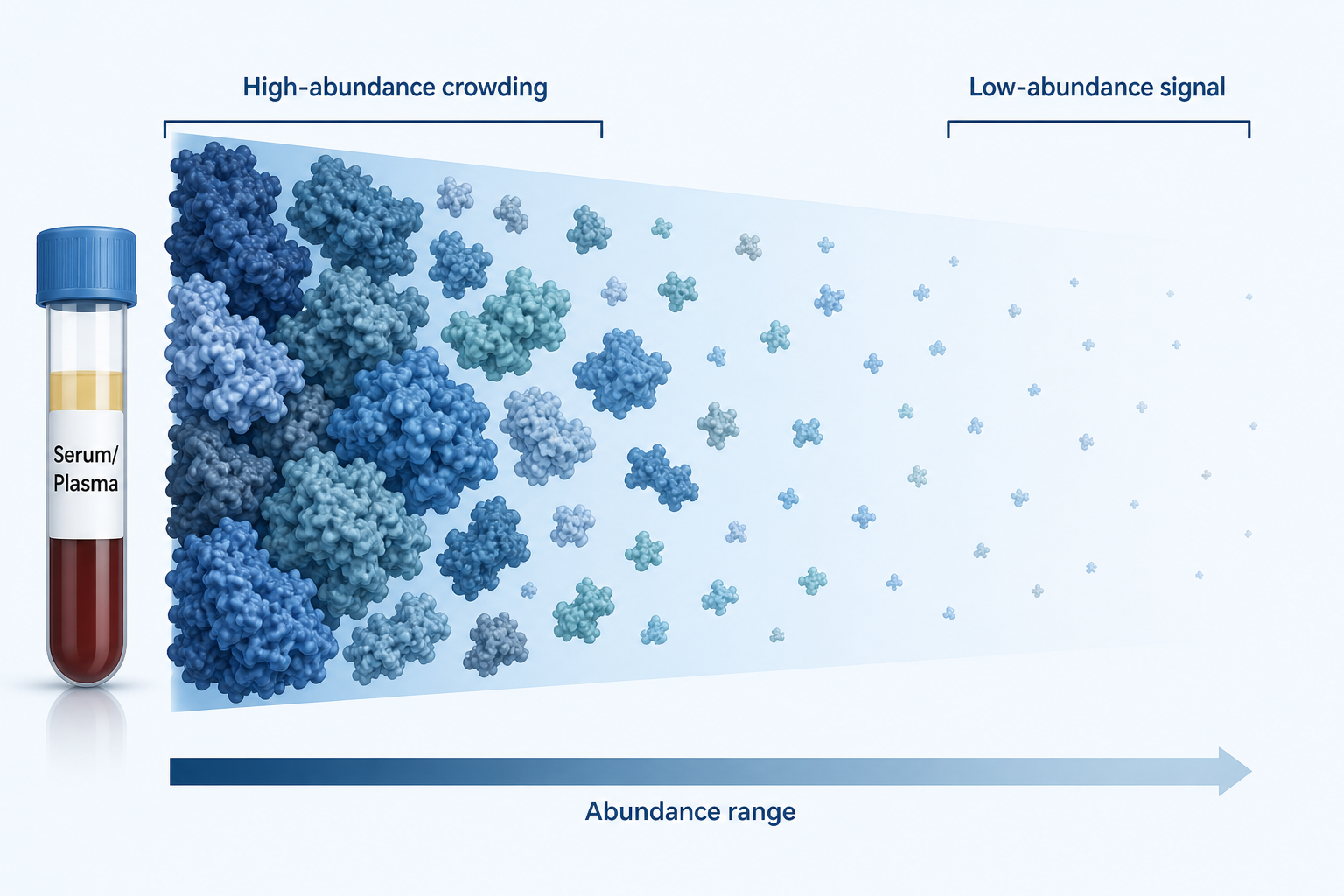
Figure 1. Dominant circulating proteins can occupy much of the detection space and leave low-abundance proteins underrepresented.
Common Reasons Teams Think the Result "Missed" Proteins
Not every missing protein is the same kind of miss. Separating these cases keeps troubleshooting useful.
The protein was never likely to be seen in an undepleted discovery screen. Many low-abundance targets need a depth-focused path, depletion discussion, or targeted follow-up.
The protein may be present, but the peptide evidence is too weak or too inconsistent to pass reporting thresholds. This is common at the edge of detection.
The comparison design reduced its value as a candidate. Mixed matrices, inconsistent anticoagulants, or unequal freeze histories can increase variability and prevent weak protein changes from appearing reproducibly across groups.
The expectation was absolute completeness. Discovery serum or plasma proteomics ranks what the method recovers under the chosen path. It does not promise a full inventory of every circulating protein.
|
Likely cause |
What you observe |
Practical next step |
|---|---|---|
|
High-abundance crowding |
Familiar dominant proteins dominate the list |
Review whether depletion or a depth-focused path fits the claim |
|
Weak peptide evidence |
Target absent or unstable across replicates |
Assess peptide suitability and targeted-method feasibility |
|
Matrix or handling mismatch |
Group differences look noisy |
Align serum vs plasma, anticoagulant, and freeze history |
|
Over-broad expectation |
Long wish list versus discovery output |
Narrow to claim-matched candidates |
What Can Improve Recovery of Low-Abundance Proteins
Improvement starts with the claim, not with a default preprocessing rule.
If the goal is a broad first-pass comparison and dominant proteins are still informative, an undepleted path may be enough. Missing some low-abundance proteins is then an expected limit of that design.
If the goal depends on lower-abundance candidates, discuss high-abundance protein depletion or a depth-focused workflow before thawing the only aliquots. Depletion can free analytical space, but it is not risk-free. Off-target removal and changed protein recovery can affect interpretation, so the same preprocessing path should be kept across all compared groups.
Matrix control still comes first. For plasma, prefer EDTA or citrate and avoid heparin. Keep serum and plasma separate unless the study is intentionally comparing matrices. Samples with severe hemolysis, marked lipemia, visible contamination, substantial precipitation, or excessive or group-imbalanced freeze-thaw histories should be reviewed before analysis. Infectious samples are not accepted. Preprocessing cannot fully compensate for major sample-quality problems or inconsistent handling across study groups.
Acquisition choice also matters after the sample path is set. DDA supports flexible discovery and protein identification workflows, commonly processed with MaxQuant or Proteome Discoverer. DIA often improves data completeness and quantitative consistency across matched samples, commonly using Spectronaut or DIA-NN. Instruments such as Orbitrap Exploris 480, timsTOF Pro, and Orbitrap Astral can be reviewed once the sample plan is clear. The platform helps within the chemical reality of the biofluid. It does not erase dynamic range by itself.
For many projects, a staged path is more productive than repeating the same undepleted screen. Start with a claim-matched discovery comparison. If priority low-abundance proteins remain invisible and still decide the biology, move those proteins into a depth-focused or targeted follow-up rather than expecting one discovery list to satisfy every abundance range. That sequence keeps interpretation honest and protects limited aliquots.
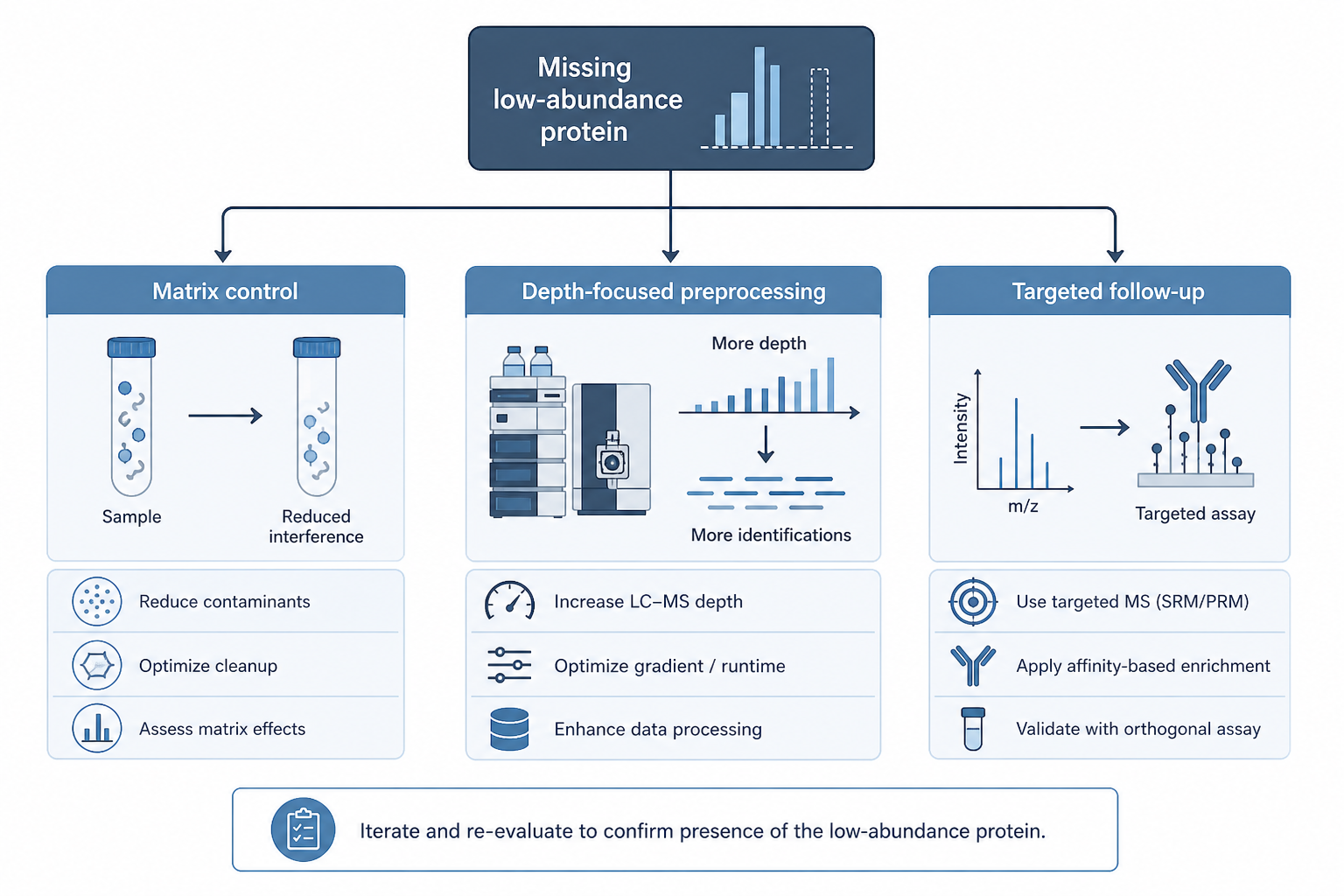
Figure 2. Match the next step to the cause: matrix control, depth-focused preprocessing, or targeted follow-up for priority proteins.
How to Read a Result That Looks Incomplete
A serum or plasma list dominated by high-abundance proteins is not automatically a failed project. It may be an accurate reflection of an undepleted discovery screen.
Read the result in three layers.
First, check whether the missing proteins were realistic targets for the chosen path.
Second, check whether sample quality and matrix consistency were strong enough for weak signals to survive.
Third, decide whether the next experiment should stay discovery-wide or move to a claim-matched follow-up for a short candidate list.
Teams sometimes respond to a missing protein by repeatedly expanding or rerunning the same broad discovery workflow. That rarely resolves a dynamic-range problem without changes to sample preparation or analytical strategy. A shorter candidate list with a matched follow-up path is usually clearer than another broad screen that recovers the same dominant proteins. Do not attribute protein differences to a phenotype or clinical factor unless relevant covariates were collected and appropriately controlled in the study design or analysis.
Annotation layers such as GO/KEGG/COG, protein interaction context, and Reactome analysis where species support exists can help organize detected proteins. They cannot restore proteins that never entered the report. For serum or plasma Reactome support, confirm species coverage before promising that layer. Supported species currently include Bos taurus, Canis familiaris, Gallus gallus, Homo sapiens, Mus musculus, Rattus norvegicus, Sus scrofa, and Xenopus tropicalis.
Practical Checks Before Repeating the Same Screen
Write the low-abundance claim in one sentence. If the claim depends on scarce targets, an undepleted first-pass screen may be the wrong tool.
Confirm matrix consistency across groups, including EDTA or citrate for plasma.
Exclude severely hemolyzed, lipemic, precipitated, repeatedly freeze-thawed, or infectious samples.
Decide whether depletion or a depth-focused path is justified before using the last aliquots.
Keep preprocessing identical across compared groups.
Reserve targeted follow-up for the short list of proteins that truly decide the next biological question.
If these points are still open, settle them before another discovery run. MtoZ Biolabs can review matrix type, anticoagulant, sample quality notes, and whether an undepleted, depletion, or follow-up path fits the low-abundance claim.
Related Services
Blood/Plasma/Serum Proteomics Solutions
High-Depth Blood Proteomics Service
Frequently Asked Questions
1. Why do serum or plasma proteomics results miss low-abundance proteins?
High-abundance circulating proteins occupy much of the detection space. Scarcer proteins produce weaker signals and are easier to miss in undepleted discovery screens.
2. Does a missing protein mean the analysis failed?
Not necessarily. It often means the chosen path was not designed for that abundance range, or the peptide evidence was too weak to report.
3. Can depletion solve the problem?
It can help when the claim depends on lower-abundance proteins, but it should be claim-matched and applied consistently across groups. It is not a universal fix.
4. Which plasma anticoagulants are preferred?
EDTA- or citrate-anticoagulated plasma is preferred, with one anticoagulant used consistently across the study.
5. Should CSF be handled the same way?
CSF has a different protein composition, so plasma-oriented high-abundance protein depletion should not be applied automatically.
6. What should be shared before redesigning the project?
Share matrix type, anticoagulant, sample quality notes, the low-abundance targets or claim, and whether depletion or targeted follow-up is already under consideration.
Conclusion
Serum or plasma proteomics misses low-abundance proteins mainly because of biofluid dynamic range and high-abundance crowding, often made worse by sample-quality or matrix problems. The useful response is to match the next step to the cause: tighten matrix control, consider a depth-focused path when the claim requires it, or move priority proteins into targeted follow-up.
To review a serum or plasma project where low-abundance coverage is the concern, contact MtoZ Biolabs with matrix type, anticoagulant, quality notes, and the specific claim the protein list needs to support.
How to order?




