






Why Polyclonal Antibody Sequencing Is Challenging: Mixture Complexity, Low-Abundance Clones, and CDR Coverage Gaps
Introduction
Polyclonal antibody sequencing is often discussed as if it were a direct extension of monoclonal antibody sequencing with more samples. In practice, the workflow is fundamentally harder. A polyclonal serum may contain dozens or hundreds of clonotypes targeting the same antigen. A purified polyclonal IgG may still include multiple dominant binders with overlapping peptide signatures. A sequencing run may recover strong framework coverage yet miss the CDR regions that define clonotype identity.
These problems are not occasional failures. They reflect the biology and analytical structure of mixed antibody populations. Mixture complexity creates overlapping peptide evidence. Low-abundance clones are easily masked by dominant signals. CDR coverage gaps leave variable regions incomplete even when the sample appears well digested and the LC-MS/MS run is successful.
This article explains why polyclonal antibody sequencing is challenging, with focus on mixture complexity, low-abundance clones, and CDR coverage gaps, and how experienced workflows reduce but do not eliminate these limits.
Why Polyclonal Sequencing Is Not Monoclonal Sequencing at Scale
Monoclonal antibody sequencing starts from one dominant clone with one heavy and one light chain pair. The analytical task is confirmation and assembly of a largely homogeneous sequence.
Polyclonal antibody sequencing starts from a population. Multiple clonotypes contribute peptides simultaneously. Shared framework regions create redundant evidence. CDR regions vary most across clones but are often the hardest to cover completely. Abundance differences mean the most biologically visible clone in an assay is not always the most abundant clone in the MS data, and vice versa.
Treating polyclonal sequencing as simple de novo MS on a mixed sample therefore underestimates the deconvolution problem.
Challenge 1: Mixture Complexity and Peptide Overlap
Mixture complexity is the primary reason polyclonal antibody sequencing is difficult.
Each clonotype contributes peptides across constant and variable regions. Framework peptides from different clones may be identical or nearly identical, making it hard to know which clonotype they support. CDR-proximal peptides may differ, but they can still overlap when clones bind similar epitopes or share germline origins. Bottom-up digestion of a complex mixture can produce thousands of peptides, many of which cannot be assigned confidently to a single clonotype without assembly logic.
Antigen-affinity purification reduces complexity but does not create a monoclonal sample. Several strong binders often remain. Without enrichment, unfractionated serum is usually too complex for high-confidence clonotype resolution.
Mixture complexity therefore affects every downstream step, from peptide identification to sequence-guided contig assembly.
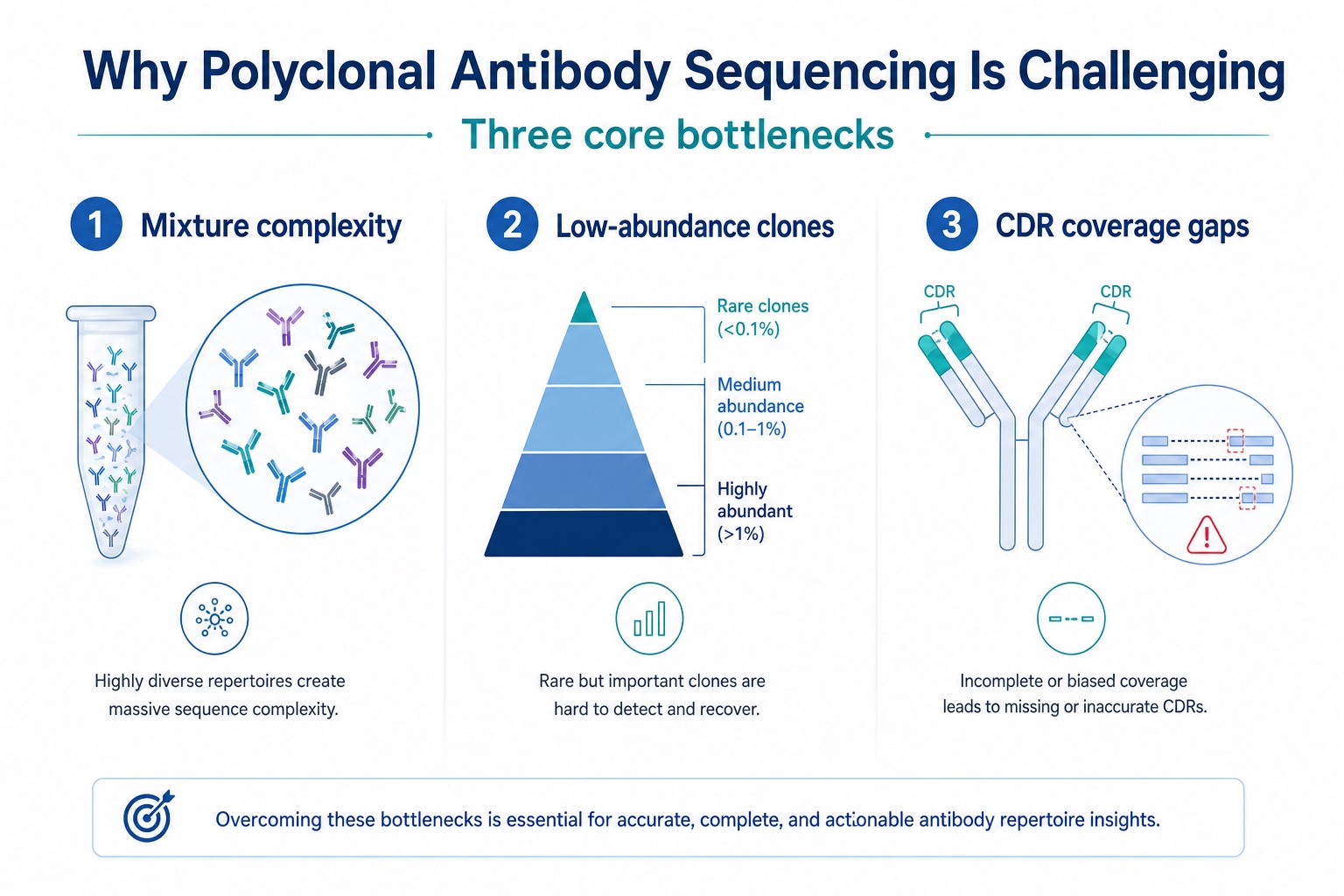
Figure 1. Polyclonal antibody sequencing is challenging because mixture complexity, low-abundance clones, and CDR coverage gaps limit confident clonotype resolution.
Challenge 2: Low-Abundance Clones Are Easily Missed
Low-abundance clones create a second major challenge.
Mass spectrometry sampling is not perfectly proportional to clone frequency in the original mixture. Dominant clonotypes produce more peptides and receive more MS/MS triggers, while low-abundance clones may never generate enough high-quality spectra for de novo assignment. A clone that is functionally important in binding may be underrepresented in the peptide pool because of purification bias, digestion efficiency, ionization preference, or simple statistical undersampling.
This means polyclonal antibody sequencing often resolves dominant clonotypes first. Rare clones may remain invisible unless the project design explicitly targets deeper coverage or alternative enrichment.
Low-abundance clone loss is a practical limit, not merely a software limitation.
Challenge 3: CDR Coverage Gaps Limit Clonotype Identity
CDR coverage gaps are the third core challenge because clonotype identity depends most on variable region sequences.
Framework peptides may assemble easily because they are shared across many immunoglobulins. CDR peptides are clonotype-defining but often harder to recover completely. Digestion strategy may not produce optimal peptides across all CDR lengths. Ionization efficiency may favor some peptides over others. Post-translational modifications or chemical heterogeneity may complicate assignment. Closely related clones may differ by only one or two residues in a CDR, requiring high-quality fragment evidence rather than a single weak peptide match.
A polyclonal sequencing project can therefore produce plausible framework coverage yet still fail to define the exact CDR sequence needed for recombinant redevelopment.
CDR coverage gaps are often the difference between provisional and high-confidence clonotype reporting.
Related Services
Mass Spectrometry Based Antibody Sequencing Service
Antibody De Novo Sequencing Service
Mono Poly Clonal Antibody De Novo Sequencing for Drug R&D
Antibody Sequence Analysis Service
Researchers facing difficult polyclonal mixtures can consult MtoZ Biolabs to review enrichment design, MS depth, and reporting tiers matched to sample complexity.
How These Challenges Interact
The three challenges rarely appear alone.
A complex mixture increases peptide overlap, which makes low-abundance clones harder to detect. Low-abundance clones that do produce peptides may still fail clonotype assignment if CDR coverage is incomplete. CDR coverage gaps are more damaging in complex mixtures because ambiguous framework peptides can be incorrectly merged across clones. Closely related dominant clones can mimic low-abundance noise unless middle-down or mass constraints are used.
Successful polyclonal sequencing workflows therefore treat these challenges as linked rather than independent.
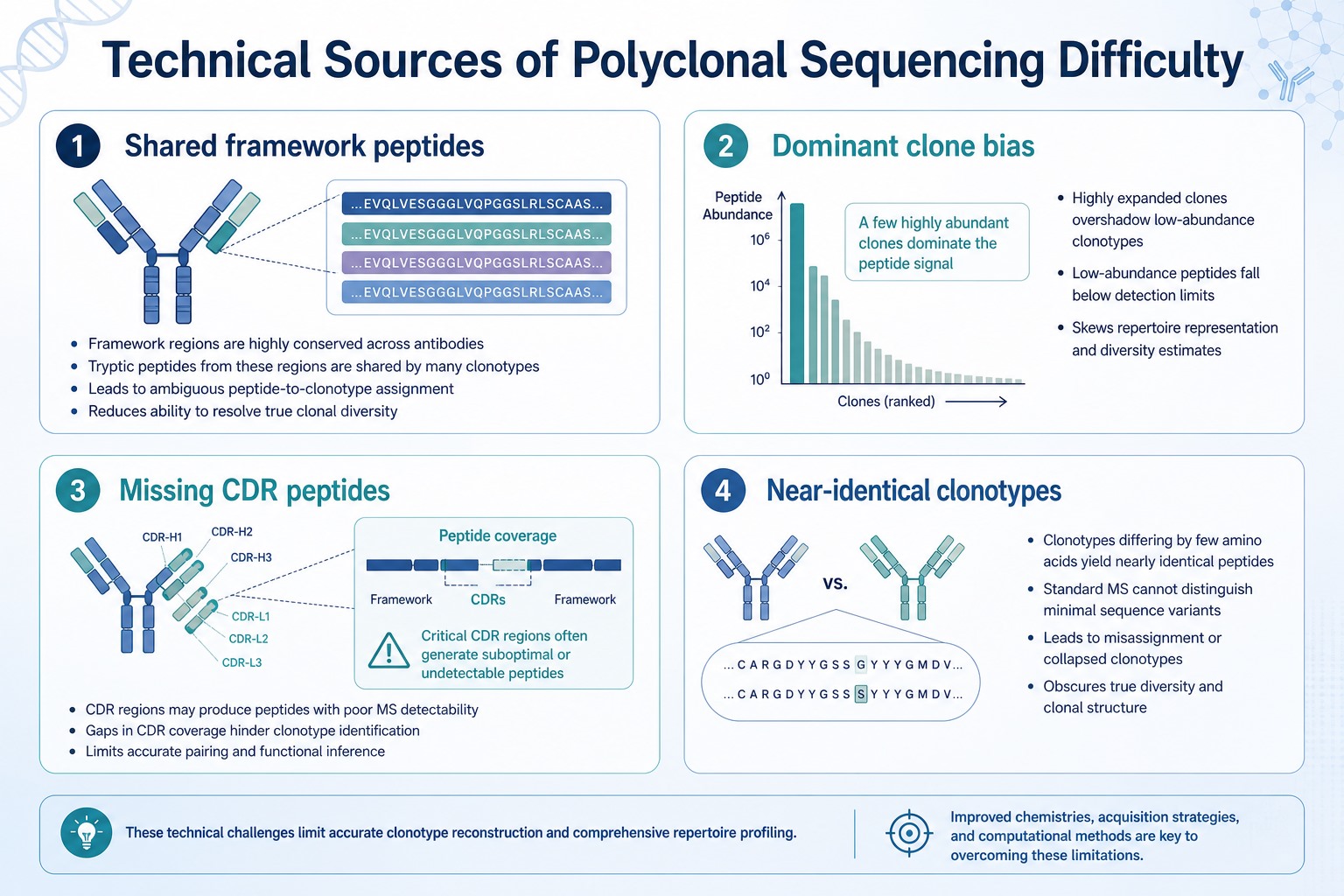
Figure 2. Mixture complexity, dominant clone bias, missing CDR peptides, and near-identical clonotypes combine to make polyclonal sequencing difficult.
Why Standard De Novo MS Alone Is Insufficient
De novo bottom-up LC-MS/MS is necessary but not sufficient for difficult polyclonal samples.
A peptide list alone does not resolve clonotypes. Without enrichment, assembly rules, and expert review, shared peptides can be merged incorrectly. Without middle-down support, complex mixtures may remain analytically congested. Without mass constraints, near-identical contigs may pass initial filtering despite inconsistent subunit masses. Without confidence tiers, provisional CDR gaps may be reported as finished sequences.
Polyclonal antibody sequencing therefore requires a workflow designed for deconvolution, not only peptide generation.
Mitigation Strategies That Improve Resolution
Several strategies reduce the impact of mixture complexity, low-abundance clone loss, and CDR coverage gaps.
Sample enrichment through antigen affinity purification or immunoglobulin class selection reduces mixture complexity before MS. Layered MS combining middle-down and bottom-up analysis improves CDR-proximal coverage while managing peptide overlap. Repeat LC-MS/MS runs increase sampling depth for low-abundance clones when sample amount allows. Sequence-guided assembly with database support and mass filtering reduces incorrect contig merging. Confidence-tier reporting separates high-confidence clonotypes from provisional sequence calls with incomplete CDR coverage.
These strategies improve resolution but do not guarantee full repertoire sequencing.
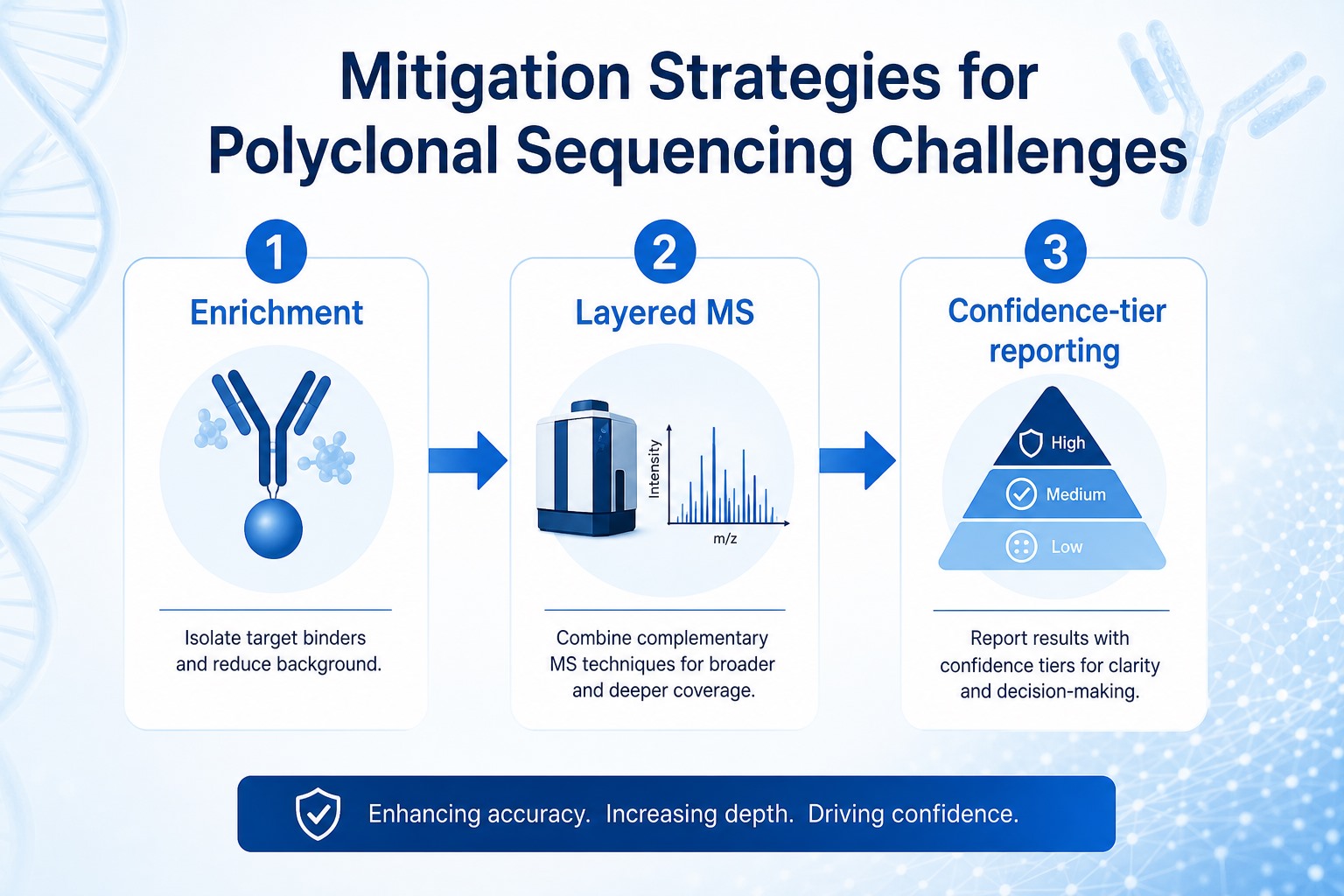
Figure 3. Enrichment, layered MS, and confidence-tier reporting help mitigate polyclonal sequencing challenges without removing them entirely.
Challenge Profile by Sample Type
Different polyclonal sample types face different challenge profiles.
|
Sample Type |
Dominant Challenge |
Typical Outcome Without Mitigation |
|---|---|---|
|
Antigen-purified polyclonal IgG |
Several dominant clones with overlap |
Partial clonotype resolution |
|
Unfractionated immune serum |
High mixture complexity |
Low-confidence peptide lists |
|
Closely related clonotype pool |
CDR coverage gaps and ambiguity |
Risk of over-merged contigs |
|
Low-input custom reagent |
Low-abundance clone loss |
Dominant clone only |
|
Lot comparison pair |
Detecting meaningful drift |
Missed minor sequence change |
Sample type should define expectations before sequencing begins.
What Realistic Deliverables Look Like
Because of these challenges, realistic polyclonal antibody sequencing deliverables are usually tiered.
High-confidence clonotypes have strong CDR support, repeat peptide evidence, and consistent mass context. Provisional clonotypes show partial variable region coverage and require additional MS or review. Exploratory calls may reflect framework evidence without sufficient CDR confirmation. Method summaries should document enrichment, MS layers, and assembly limitations so users understand what was and was not resolved.
Projects that expect complete repertoire sequencing from every polyclonal sample often set unrealistic goals.
Core Technical Limits to Acknowledge
Why Full Resolution Is Often Not Possible
Biological diversity is intrinsic to polyclonal material.
Mixed clonotypes are the sample, not an avoidable artifact.
MS sampling is finite.
Low-abundance clones may never generate enough spectra.
CDR regions are analytically demanding.
Variable region coverage is harder than framework coverage.
Near-identical clones remain difficult to separate.
Single-residue differences require exceptional fragment evidence.
Acknowledging these limits leads to better project design and more credible reporting.
Frequently Asked Questions
1. Why is polyclonal antibody sequencing harder than monoclonal sequencing?
Because mixed clonotypes create peptide overlap, low-abundance clone loss, and incomplete CDR coverage.
2. Can enrichment solve mixture complexity completely?
No. Enrichment helps, but several dominant clonotypes often remain.
3. Why are CDR coverage gaps so common?
CDR peptides vary in digestibility, ionization, and abundance, and they are essential for clonotype identity.
4. Can low-abundance clones be recovered reliably?
Only sometimes. Extra enrichment, repeat runs, or deeper MS may help, but rare clones are often missed.
5. What is the best way to set project expectations?
Define whether the goal is dominant clonotype resolution, lot comparison, or full repertoire coverage, and report results with confidence tiers.
Conclusion
Polyclonal antibody sequencing is challenging because mixed antibody populations generate overlapping peptide evidence, mask low-abundance clones, and often fail to yield complete CDR coverage even when MS data quality appears strong. These are structural challenges rooted in sample biology and analytical limits, not simply matters of insufficient instrument performance. Enrichment, layered MS, sequence-guided assembly, and confidence-tier reporting can improve resolution, but they do not transform polyclonal sequencing into monoclonal sequencing.
Programs that define realistic deliverables and mitigation strategy before analysis obtain more credible sequence evidence and fewer false overcalls. Researchers facing difficult polyclonal mixtures can contact MtoZ Biolabs to review sample complexity, workflow design, and reporting tiers suited to their project. For teams moving from resolved dominant clonotypes toward recombinant redevelopment, MtoZ Biolabs can also help interpret what sequence confidence level the data actually support.
How to order?




