






When to Outsource PhIP-Seq Analysis vs Build It In-House
- Outsource when the project has multiple cohorts, unfamiliar control behavior, limited bioinformatics capacity, or a near-term validation deadline.
- Keep analysis in-house when the team already has a documented PhIP-Seq pipeline, trained reviewers, versioned QC rules, and enough repeat work to maintain the workflow.
- Use a hybrid model when internal scientists should own interpretation but an external team should pressure-test normalization, hit calling, and reporting before the data support downstream experiments.
- FASTQ processing and read mapping to the reference phage-displayed peptide library
- Construction of the peptide count matrix
- QC for sequencing depth, library representation, and replicate concordance
- Use of mock IP control, bead-only control, or another negative control
- Generation of normalized counts across samples and batches
- Background binding correction and nonspecific binder filtering
- Statistical enrichment analysis with false discovery rate or other multiple testing control
- Hit calling for enriched peptides
- Review of sparse counts, low-count peptides, and batch effects
- Limited antigen-level aggregation where rules are explicit
- Reporting that states QC checkpoints, filtering logic, interpretation limits, and candidates for orthogonal validation
- You have a reproducible pipeline from FASTQ files to final report.
- Read mapping to the peptide library has stayed stable across recent projects.
- Analysts routinely review library representation, sequencing depth, and replicate concordance before interpretation.
- The enrichment framework can handle sparse data, low-count peptides, and background binding without improvised fixes.
- Reporting standards already define thresholds, caveats, and reanalysis triggers.
- The same team can maintain the workflow when new batches or revised controls require reruns.
Keep PhIP-Seq analysis in-house only if your team already runs a repeatable FASTQ-to-report workflow, uses defined control logic, and can deliver reviewable results without turning every study into a custom scripting exercise. Outsourcing is usually the lower-risk choice when the process still leans on one analyst, uneven QC review, or manual interpretation of enriched peptides, especially for larger cohorts, multi-batch studies, or programs moving toward validation.
The real test is not whether someone on the team can code. It is whether the group can explain read mapping to the phage-displayed peptide library, justify background correction against mock IP control, bead-only control, or another negative control, document hit calling rules, and produce a report that downstream scientists can actually trust. A small exploratory pilot may fit an internal effort. A translational program under timeline pressure usually does not.
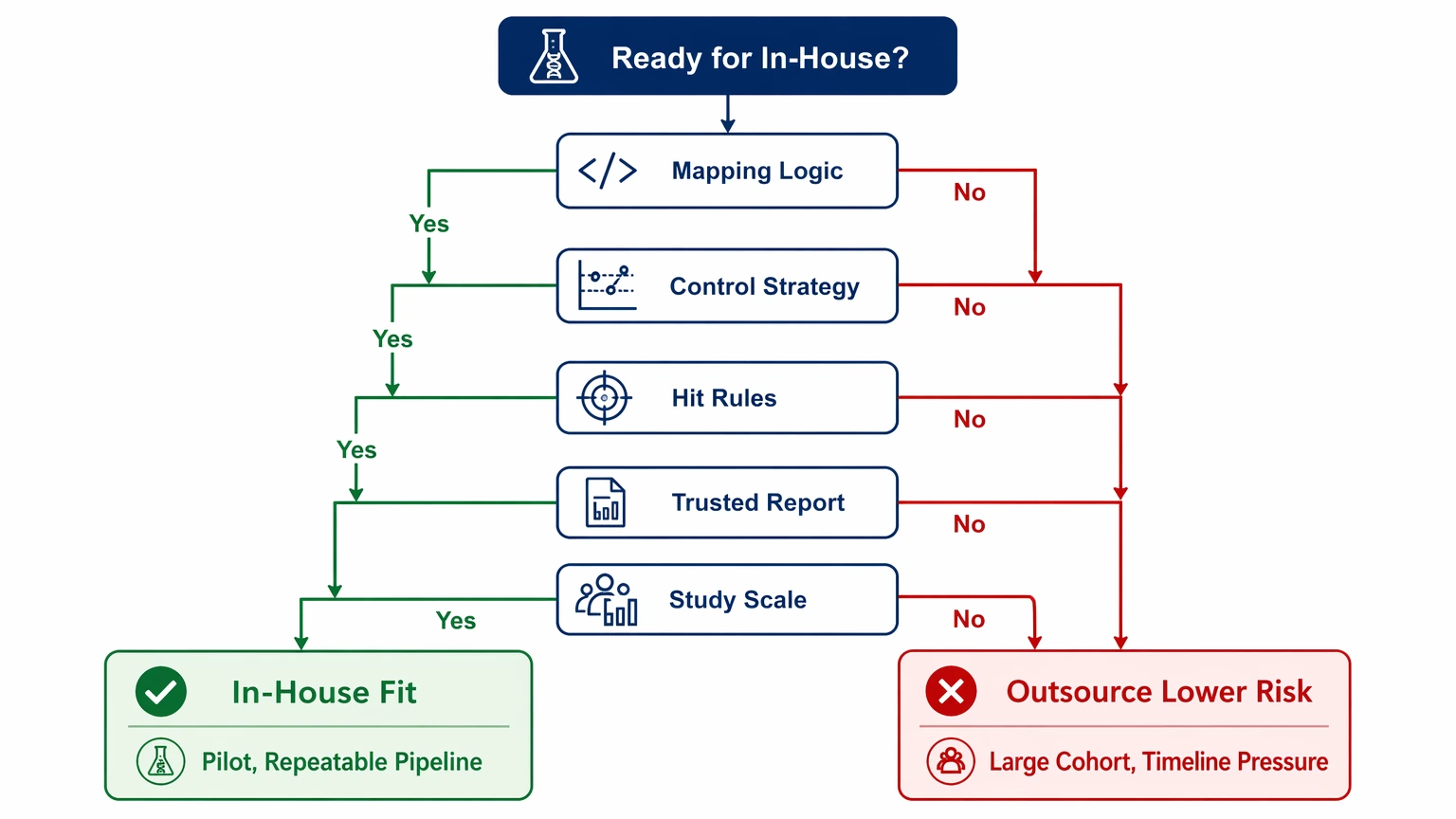
Where This Decision Usually Becomes Urgent
This question usually shows up at one of two points. The first is before a larger sequencing batch arrives, when a platform team realizes wet-lab work is no longer the bottleneck. The second is after a pilot delivered enough signal to justify expansion, but only through ad hoc notebooks or analyst-specific scripts.
PhIP-Seq creates a different analysis burden from a standard sequencing study because the output is not a generic expression matrix. Teams still need routine sequencing QC, but the harder work begins afterward: read mapping to the reference peptide library, building a peptide count matrix, checking library representation, reviewing sequencing depth, normalizing counts across samples, and deciding how controls should shape enrichment analysis. If those rules drift from one batch to the next, comparison and review both get harder.
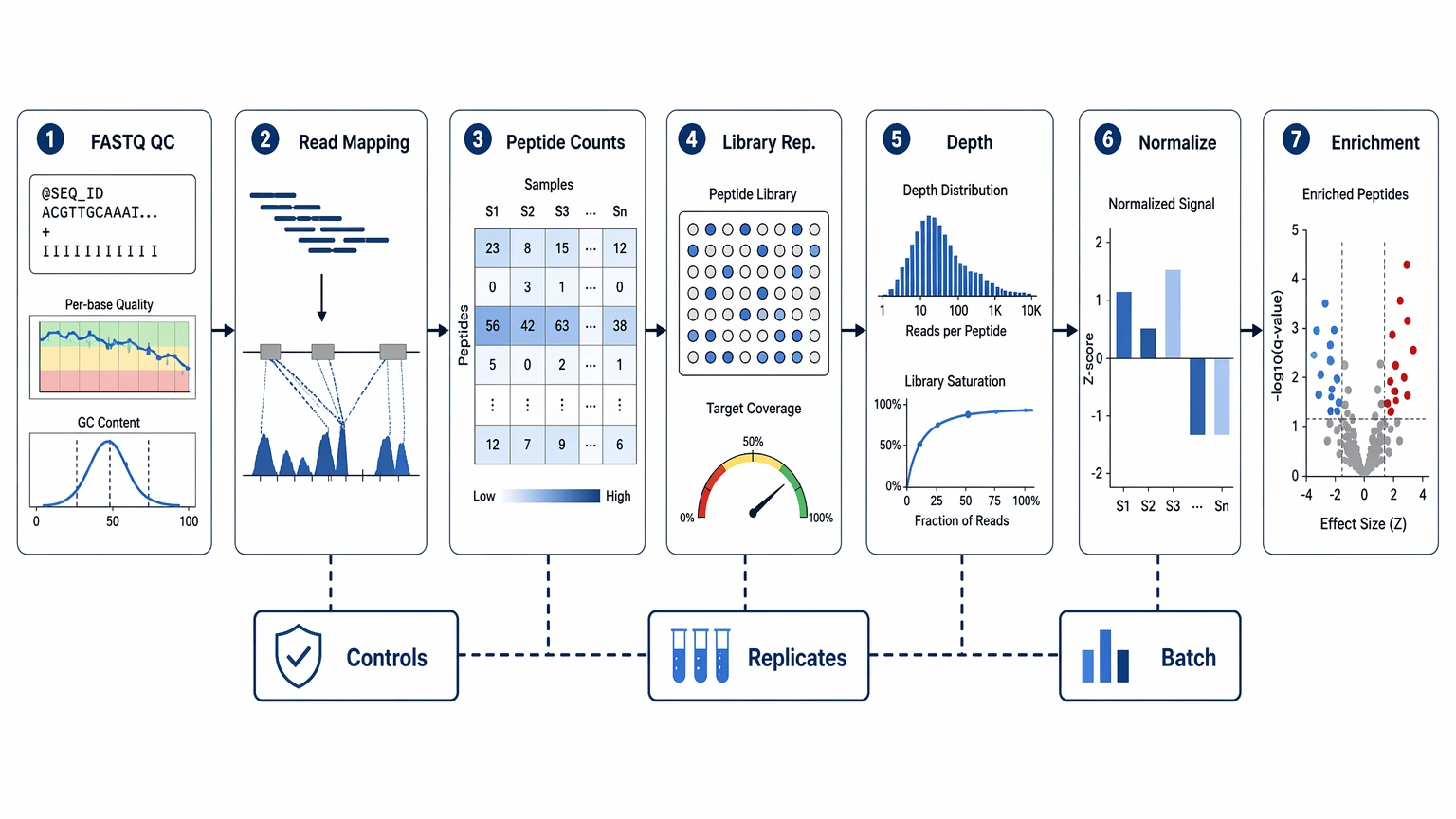
Scientific risk matters too. Weak replicate review can hide unstable signals. Loose filtering can raise false positives. Overstated antigen-level aggregation can make peptide-level findings sound stronger than the data support. Because PhIP-Seq is often most defensible at the level of linear epitopes and enriched peptides, analysis maturity matters more than raw headcount.
Quick Decision Block
What PhIP-Seq Analysis Includes After Sequencing
Before choosing an operating model, define the job clearly. Post-sequencing PhIP-Seq analysis often includes:
That scope explains why a general NGS analyst is not automatically ready for production PhIP-Seq analysis. The workflow has to handle immunoprecipitation-aware controls, sparse peptide counts, and the gap between enriched peptides and broader antigen claims.
The Four Dimensions That Should Drive the Decision
1. Pipeline maturity
In-house work makes sense when the pipeline is already reproducible, not just promising. The same version-controlled workflow should run under another analyst, produce the same peptide count matrix and hit list, and keep a clear record of parameter changes. One strong pilot is useful evidence. It is not the same as a maintained pipeline.
2. Control strategy and QC discipline
Control handling sits at the center of PhIP-Seq. You need a clear plan for how mock IP control, bead-only control, or other negative control samples affect background correction and hit calling. You also need review gates for poor library representation, weak sequencing depth, or low replicate concordance. Many groups can generate counts. Fewer can apply those checks the same way every time.
3. Interpretation and reporting standards
A spreadsheet of enriched peptides is rarely enough for translational work. Decision-ready reporting should explain normalization, control comparison, filtering thresholds, false discovery rate handling, and the line between peptide-level interpretation and antigen-level aggregation. It should also flag when orthogonal validation, such as ELISA or another confirmatory assay, is needed before anyone makes broader claims.
4. Scale and downstream consequence
A one-batch pilot can tolerate more manual work than a cross-cohort or longitudinal study. As datasets grow, every weakness in QC, documentation, and reanalysis gets more expensive. If the output will drive follow-up experiments, clinical-adjacent translational choices, or external review, a fragile internal workflow can slow the study more than outsourcing would.
A useful rule is simple: exploratory pilots can survive analyst-heavy workflows, but translational studies usually need a stable pipeline and review-ready reporting before interpretation starts. If your group is approaching that point, submit your requirements early so the workflow choice is made before the next batch lands.
Related Services
Main Service |
Supporting Service |
Validation Service |
Alternative Service |
Side-by-Side Comparison: In-House vs Outsourced Analysis
| Dimension | Build In-House | Outsource PhIP-Seq Analysis |
|---|---|---|
| Pipeline ownership | Best when a tested FASTQ-to-report workflow already exists | Best when workflow buildout would slow the study |
| QC and controls | Works when control definitions and rerun criteria are documented | Stronger when control interpretation is still inconsistent |
| Enrichment analysis | Appropriate when hit calling and multiple testing control are assay-specific and stable | Lower risk when current methods rely on generic count analysis or exploratory scripts |
| Interpretation | Fits teams that can keep claims aligned with peptide-level evidence | Fits programs that need structured, validation-aware reporting |
| Staffing | Efficient for recurring internal demand with dedicated owners | Efficient for burst demand, scale-up, or thin analyst coverage |
| Maintenance | Requires version control, documentation, and reanalysis support | Shifts more of the maintenance burden outside the internal team |
The tradeoff is straightforward: in-house analysis gives more control once the workflow is mature, while outsourcing cuts execution and interpretation risk when the workflow is still being assembled.
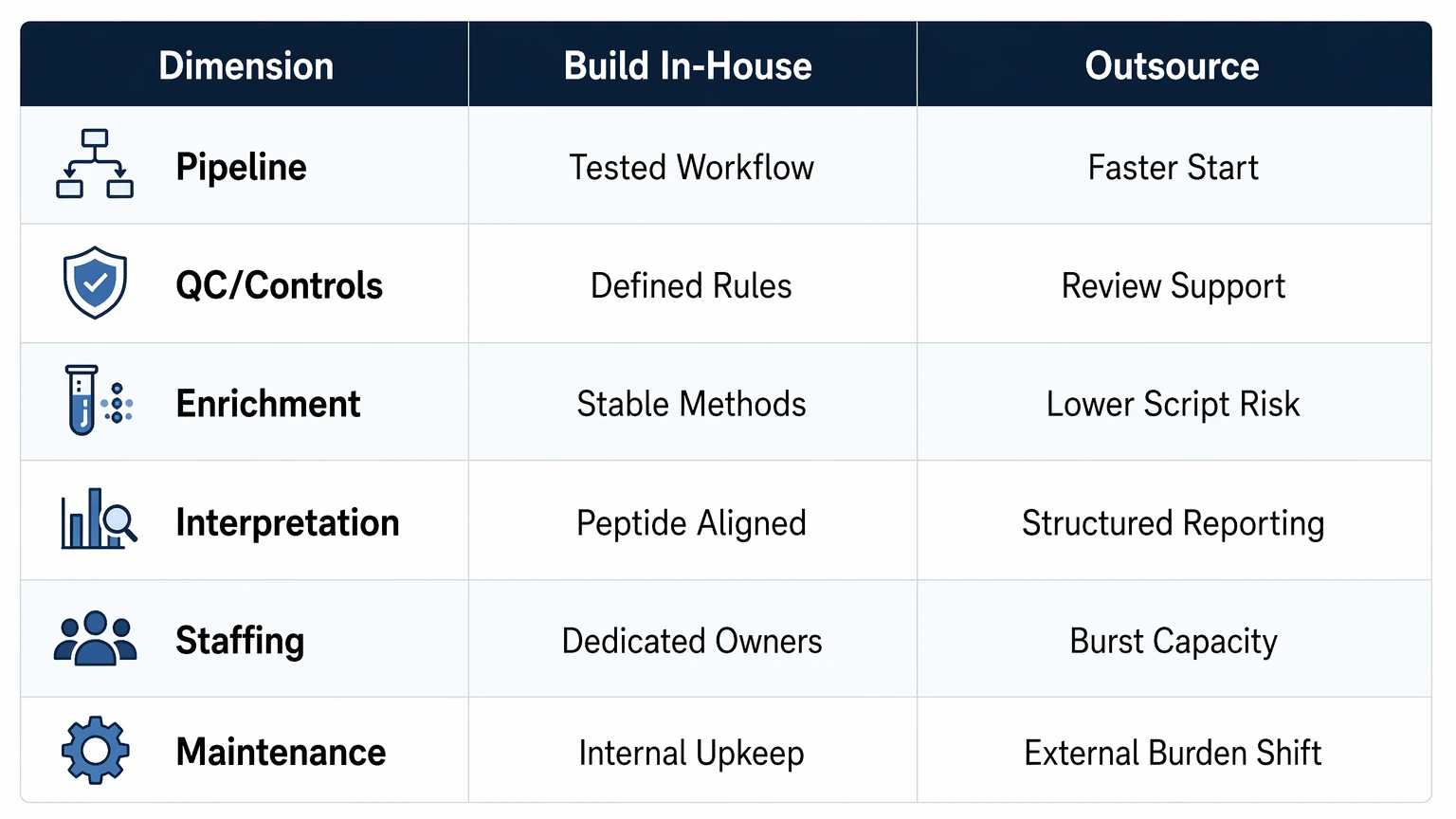
After the comparison table, the lowest-risk choice is outsourcing when the decision depends on controls, cross-cohort comparability, or validation-ready reporting and the internal pipeline has not already been proven on similar PhIP-Seq datasets.
When In-House Analysis Is Reasonable
Keep PhIP-Seq analysis internal when most of these statements are already true:
This model fits platform groups with recurring assay volume and clear bioinformatics ownership. It also fits teams that need close iteration between scientists and analysts, provided the workflow is already standardized rather than rebuilt for each project.
When Outsourcing Is the Lower-Risk Choice
Outsourcing makes more sense when the study has outgrown your current analysis maturity. Common triggers include a pilot that relied on custom scripts, no clear agreement on how controls affect hit calling, limited staff coverage for reruns and documentation, or a downstream plan that depends on clean peptide prioritization for orthogonal validation.
That is also where an external partner can help by adding execution discipline, reviewable reporting, and a cleaner handoff into follow-up assays. If your team is weighing that decision now, contact MtoZ Biolabs to evaluate your project around control design, expected outputs, reanalysis needs, and reporting standards before the next sequencing batch arrives.
Decision Guidance by Study Goal
Rapid pilot exploration
Lean in-house when the dataset is small, the goal is internal hypothesis generation, and the team accepts some manual analysis overhead. Even then, keep the interpretation narrow. Enriched peptides do not automatically establish antigen-level relevance.
Cross-cohort comparison
Lean outsourced unless the internal workflow is already reusable. Cross-cohort studies put more pressure on normalized counts, batch comparability, and stable filtering rules than small pilots do.
Validation planning
Choose the model that gives the clearest path into ELISA or another confirmatory assay. That usually means explicit ranking of enriched peptides, transparent antigen-level aggregation rules, and documentation of what was filtered out.
Long-term platform ownership
Build in-house only after a deliberate validation phase. Define QC gates, control usage, workflow versioning, and report structure before treating the assay as a shared internal service.
Final Comparison Summary and Consultation Guidance
The practical choice depends on sample type, cohort size, internal analysis capacity, reporting timeline, and the deliverables expected after hit calling. Before deciding, list the sample matrix, number of samples, control design, replicate plan, available bioinformatics staff, expected timeline, and whether the output must include peptide-level tables, antigen-level summaries, validation recommendations, or both. If those details are still unsettled, MtoZ Biolabs can review the project scope and help decide whether outsourced PhIP-Seq analysis, an in-house workflow, or a hybrid handoff is the lower-risk route.
FAQ
What is the clearest sign that our internal pipeline is not production-ready?
The strongest warning sign is that another analyst cannot rerun the same dataset and reproduce the same filtered result with the same decision rules. If reproducibility depends on one person’s memory or manual edits, the workflow is not ready for routine use.
Can we outsource only part of the work?
Yes. Some teams keep FASTQ processing and read mapping in-house but outsource enrichment review, peptide prioritization, or final reporting. That hybrid model can work when compute capacity is available internally but statistical review or interpretation bandwidth is limited.
How much antigen-level aggregation is appropriate in a PhIP-Seq report?
Only to the extent that the aggregation rules are explicit and biologically defensible. If multiple enriched peptides support the same antigen, aggregation may help organize the report, but it should not replace the underlying peptide-level evidence or imply more certainty than the data allow.
Should orthogonal validation be planned before the final hit list is complete?
Usually yes. Validation capacity often shapes how many candidates can move forward and what type of confirmatory assay is practical. Planning early also helps the analysis team rank enriched peptides in a way that supports realistic follow-up decisions.
What internal role matters most if we want to keep PhIP-Seq analysis in-house long term?
Ownership matters more than job title. The key need is a responsible analyst or team that can maintain the version-controlled workflow, document changes, review QC consistently, and support reanalysis as study design or controls change.
When should we consider an alternative assay instead of changing the analysis model?
Consider alternatives when the core biological question depends on conformational epitopes, intact protein presentation, or a validation path that does not align well with peptide-based discovery. In that setting, a different assay may answer the question more directly than a different operating model for PhIP-Seq.
How to order?




