






When Is Full Antibody Sequencing Unnecessary? A Practical Decision Guide for CDR-Focused Projects
If the next experiment only requires confident complementarity-determining region (CDR) identity for loop preservation, motif comparison, or paratope-focused redesign, antibody CDR sequencing is often enough. Full antibody sequencing becomes necessary when the next handoff depends on framework region context, confident heavy chain and light chain assignment, chain pairing, or recombinant re-expression readiness.
That distinction matters because “enough sequence” is not just a theoretical question. It is a scope decision tied to what your team plans to do next. A CDR-focused sequencing deliverable can support affinity maturation planning or early CDR grafting discussions. It usually does not provide enough for construct design, full VH and VL reconstruction, or framework liability review.
Where This Decision Usually Becomes Time-Sensitive
This question usually comes up after a candidate has already shown useful binding behavior. The team may have a purified antibody, a hybridoma-derived sample, or older research material with incomplete records. In many cases, the immediate goal is narrow: preserve binding-region features during optimization, compare loop motifs across related leads, or generate redesign hypotheses around the paratope.
At that point, ordering full antibody sequencing by default can expand the project without changing the next experiment. But stopping at CDR-focused sequencing can also create a bottleneck if the team actually needs variable region continuity, chain attribution, or re-expression-ready output. The real decision is not “partial versus complete” in the abstract. It is whether missing non-CDR information would change the next step.
What CDR-Focused Sequencing Gives You, and What It Does Not
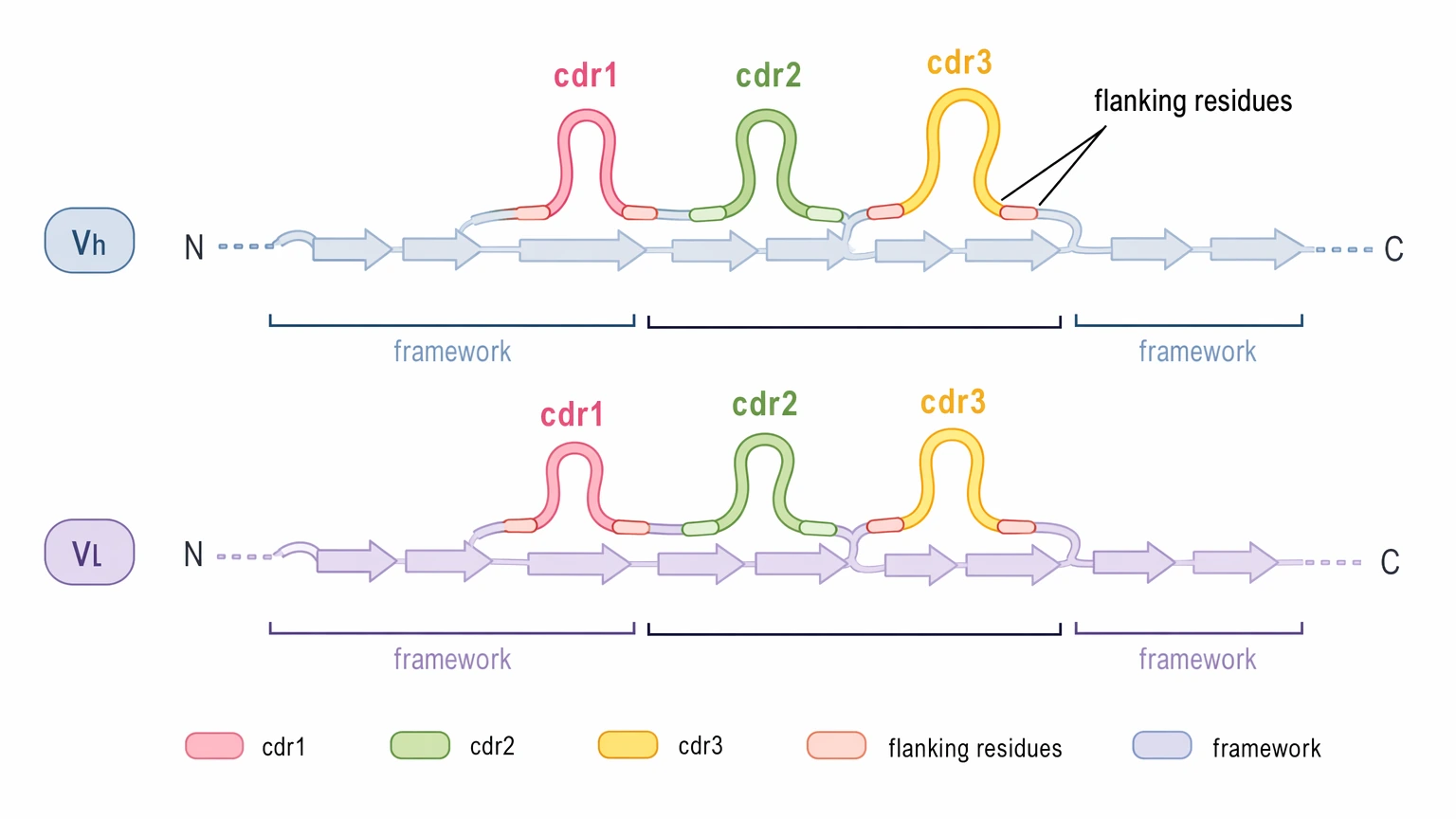
Antibody CDR sequencing is designed to recover the antigen-contacting loops or, in some workflows, the loops plus nearby flanking residues. That level of sequence recovery is often enough when the project needs to:
- compare CDR motifs across lead families
- identify candidate loop positions for affinity maturation
- preserve binding-loop features during redesign
- generate paratope-centered engineering hypotheses
What it does not automatically provide is the broader context needed for:
- full variable region interpretation
- consistent framework region numbering across FR1-FR4
- reliable mapping of residues near CDR boundaries
- re-expression-ready VH and VL sequences
- chain pairing confidence for downstream reconstruction
- framework-dependent reviews such as humanization planning
Put simply, CDR-focused sequencing is mainly a decision-support deliverable. Full antibody sequencing is more often a construct-support or reconstruction-support deliverable.
The Four Main Reasons Teams Choose the Wrong Scope
Most scope mistakes trace back to four recurring issues rather than every possible step in the laboratory workflow.
1. The next deliverable is defined too loosely
Teams often say they “need the sequence” when they actually need one of two very different outputs: a loop-centered report for engineering decisions or a re-expression-ready package for construct generation. Those outputs are not interchangeable.
2. Framework region dependence is noticed too late
A project may begin as a loop-focused effort, then quickly expand into mutation mapping, numbering alignment, boundary review, or humanization discussion. Once those tasks appear, missing framework region context becomes a real limitation, not a minor inconvenience.
3. Heavy chain and light chain attribution is treated as optional
Some projects only need CDR composition. Others need each loop assigned to the correct heavy chain or light chain with usable confidence. If the output will support engineered reconstruction or rescue planning, chain attribution, and sometimes chain pairing, become central.
4. The sample source is matched to a method, but not to the project endpoint
A purified antibody may favor mass spectrometry-based antibody sequencing as the entry route. A hybridoma or cell-derived nucleic acid source may support RACE or NGS and broader sequence continuity. The method can fit the sample and still fall short of the intended deliverable.
A Step-by-Step Selection Guide for Method Selection
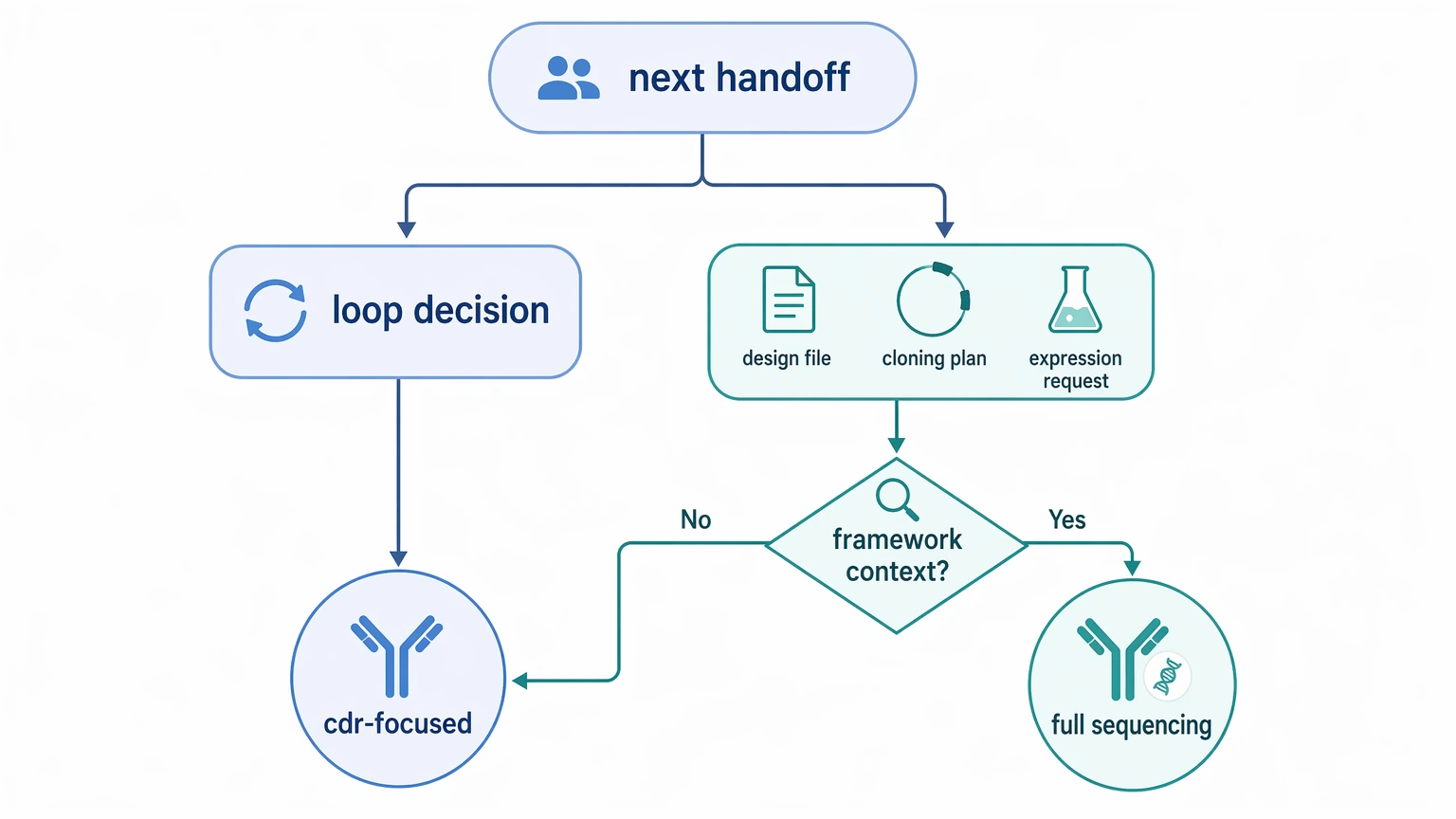
This article addresses a method-selection problem. The clearest way to decide is to define the next experimental handoff first, then test whether CDR-focused sequencing leaves out information that handoff actually needs.
Step 1: Write the next action as a single sentence
If your next action sounds like one of these, antibody CDR sequencing is often a reasonable starting point:
- select loop positions for affinity maturation
- compare CDR motifs across lead antibodies
- preserve the paratope during redesign
- review candidates for early CDR grafting
If your next action sounds like one of these, start broader:
- design expression constructs
- recover full VH and VL sequences
- prepare for recombinant re-expression
- perform framework region review before humanization
A useful shortcut is this: if the next step ends in a design file, cloning plan, or expression request, full antibody sequencing is usually the safer scope.
Step 2: Check whether framework region context affects interpretation
CDRs do not function in isolation during sequence interpretation. Framework region context matters when your team needs stable numbering, loop-boundary confidence, or mutation mapping near the CDR edges.
The table below summarizes where CDR-focused sequencing usually fits.
| Next Project Goal | Is CDR-Focused Sequencing Often Enough? | Main Reason |
|---|---|---|
| CDR motif comparison across leads | Yes, often | Loop identity is the main output |
| Early affinity maturation planning | Yes, often | Initial mutation planning can stay paratope-centered |
| CDR redesign hypothesis generation | Yes, often | Complete CDR coverage may be the minimum actionable output |
| Early CDR grafting review | Sometimes | Donor loop review may work, but acceptor design usually needs framework region context |
| Recombinant re-expression | No, usually not | Requires broader VH and VL continuity |
| Humanization planning | No, usually not | Framework region interpretation is part of the decision |
| Legacy clone reconstruction | No, usually not | Sequence recovery must support broader molecular reconstruction |
Step 3: Decide how much chain information the project needs
Not every project needs the same level of chain information.
- CDR completeness only may be enough for motif comparison or early redesign logic.
- CDR completeness plus heavy chain and light chain attribution is better for focused engineering decisions.
- CDR completeness plus chain pairing matters when the next stage gets close to functional reconstruction.
- Full variable region continuity is the practical minimum for most recombinant re-expression workflows.
This is often the tipping point between CDR-focused sequencing and full antibody sequencing. If the wrong VH-VL combination would affect what you build next, chain pairing is no longer optional.
Step 4: Match the route to the starting material
Sample type shapes what sequence recovery path is realistic and how much context you can expect from the first pass.
| Starting Material | Common Entry Route | Strength | Common Constraint |
|---|---|---|---|
| Purified antibody | Mass spectrometry-based antibody sequencing | Useful when nucleic acid is unavailable | Chain attribution or framework continuity may be less complete |
| Hybridoma material | RACE or targeted PCR recovery | Better access to broader variable region context | Requires usable cellular genetic material |
| B-cell-derived nucleic acid | NGS or targeted amplification | Strong context for sequence continuity | Pairing interpretation may still need planning |
| Mixed or legacy material | Staged sequence recovery strategy | Helps preserve momentum when materials are limited | Deliverable scope may need escalation after first-pass data |
For teams starting from purified antibody and trying to avoid overscoping the project, MtoZ Biolabs can evaluate your project around sample type, desired deliverable interpretation, and escalation triggers before you submit your requirements.
Step 5: Choose a route and define the escalation trigger in advance
There are three practical routes.
Route A: Start with antibody CDR sequencing
Choose this when the next decision is truly loop-centered, framework region analysis is not yet required, and the report will guide engineering discussion rather than final construct generation.
Route B: Start with CDR-focused sequencing and predefine escalation
Choose this when CDR information is likely enough, but one uncertainty remains. Common escalation triggers include:
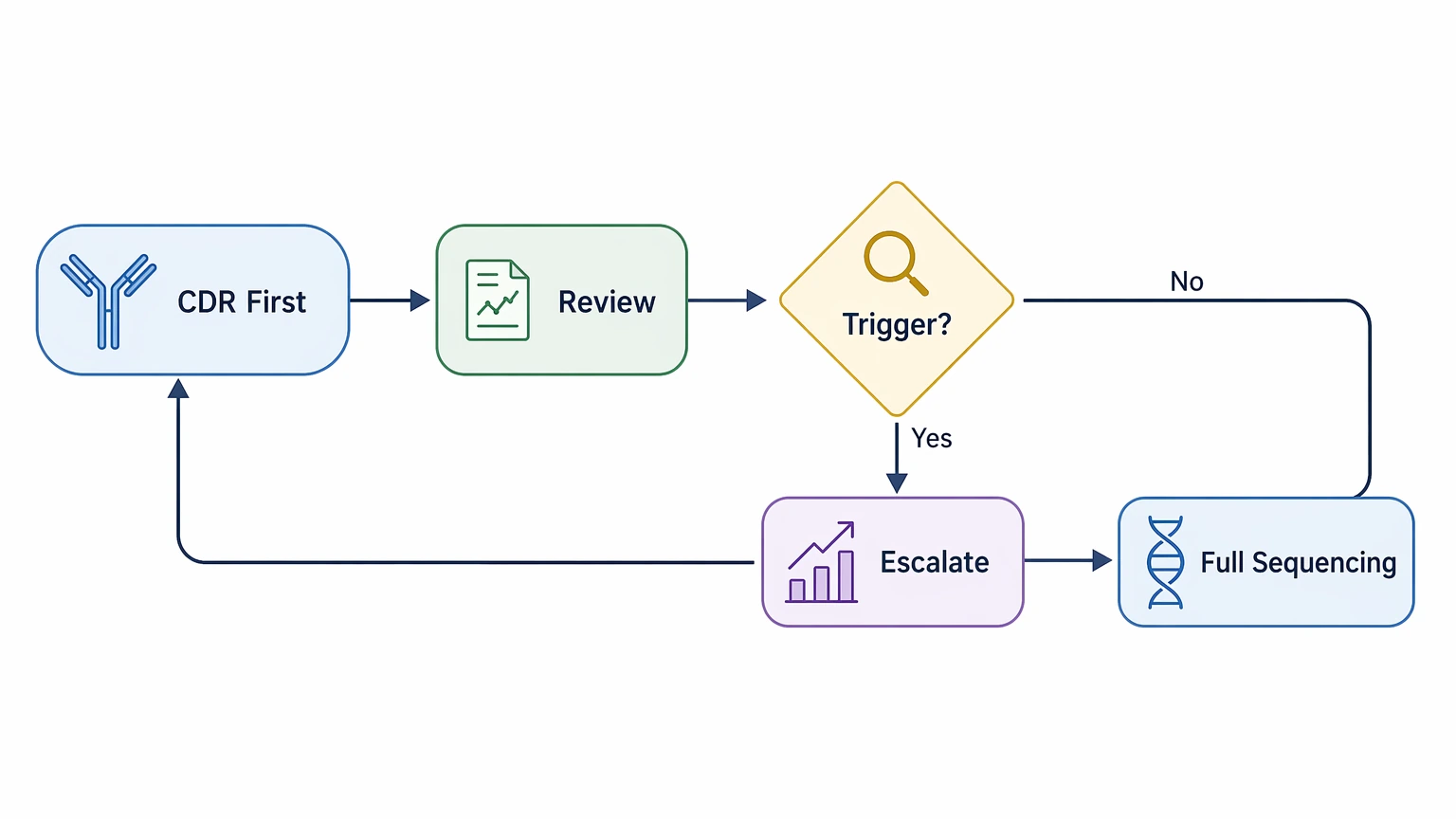
- one or more CDRs are incomplete
- flanking residues are too limited for numbering confidence
- heavy chain or light chain attribution is unclear
- the project expands toward recombinant re-expression
This staged route is often appropriate when timelines are tight but full antibody sequencing may still become necessary. If you want to evaluate that boundary before committing scope, contact MtoZ Biolabs to evaluate your project against sample availability, re-expression readiness, and validation planning.
Route C: Start with full antibody sequencing
Choose this when the next task already depends on framework region review, chain pairing, full variable region reconstruction, or direct construct design. Starting with a narrower scope here often delays the program rather than simplifying it.
What an Actionable Deliverable Should Say
Before acting on CDR-level results, ask for a report that makes the following points explicit:
- whether all heavy-chain and light-chain CDRs were recovered
- whether each CDR has usable sequence continuity
- whether chain attribution is confident enough for the intended use
- whether flanking residues were recovered near CDR boundaries
- where framework region gaps remain
- whether the output supports only decision support, engineering input, or re-expression preparation
- what validation planning is recommended before expensive downstream work
That last point matters. A deliverable should match the project stage. A report that works for early redesign may still be unsuitable for direct recombinant re-expression.
Common Red Flags That Mean You Should Not Stop at CDRs
Escalate to full antibody sequencing when any of these conditions apply:
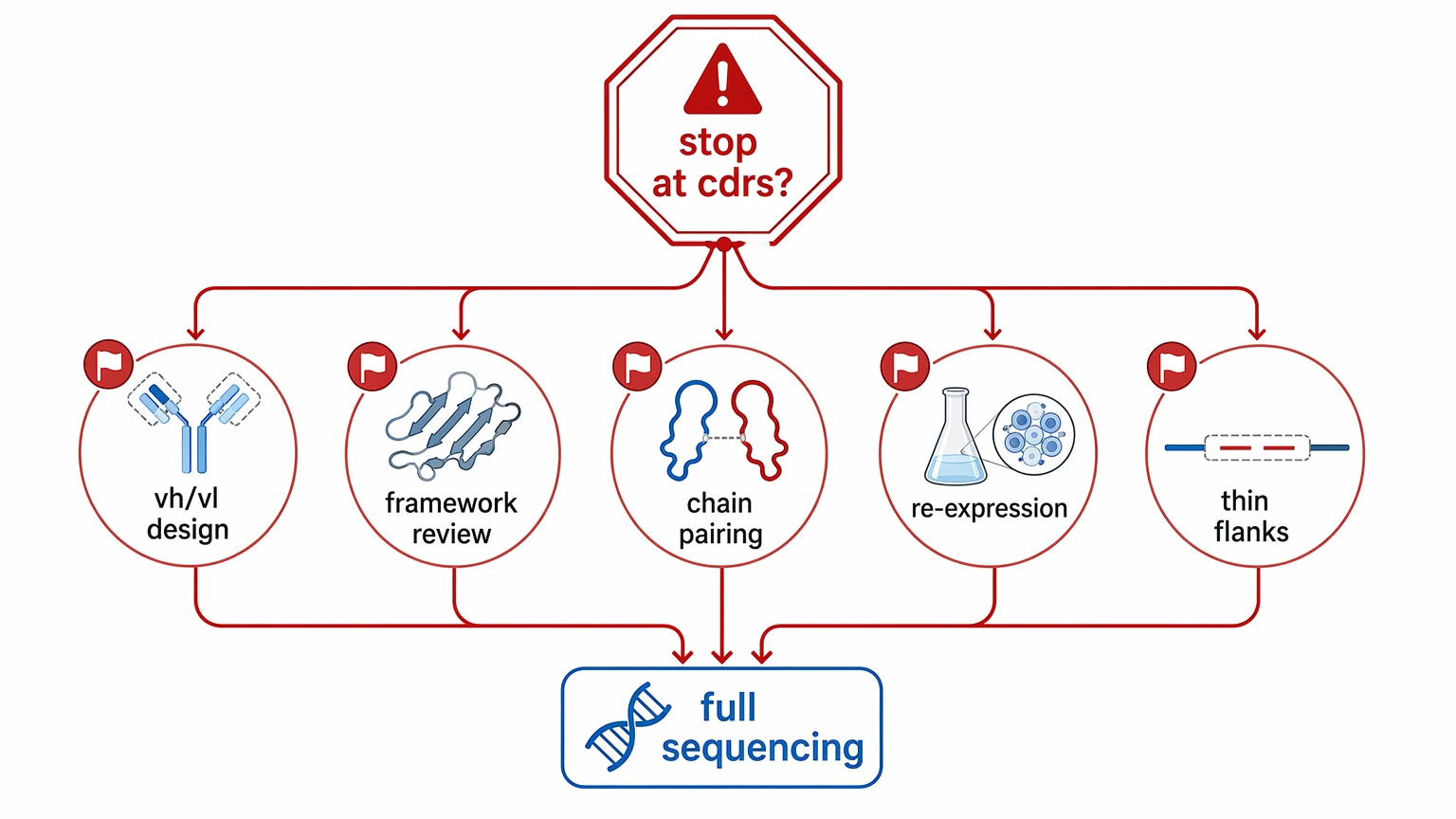
- your next experiment needs uninterrupted VH or VL sequence design
- framework region liabilities must be reviewed before mutations are selected
- chain pairing will affect the construct you build
- you expect to move directly into recombinant re-expression
- CDR calls are present, but flanking context is too thin for confident interpretation
The failure mode here is subtle. Projects usually do not stall because CDRs were irrelevant. They stall because the next step depended on information outside the CDRs, and that dependency was never defined early enough.
Conclusion
Full antibody sequencing is unnecessary when the next project handoff is limited to loop identity, motif comparison, paratope-focused redesign, or early affinity maturation planning. It becomes the better choice when framework region context, heavy chain and light chain assignment, chain pairing, variable region continuity, or recombinant re-expression readiness will influence the next action. For teams working with purified antibody, hybridoma material, or legacy antibody samples, the safest approach is to match sequence scope to the immediate deliverable, define escalation triggers before sequencing starts, and use validation planning to avoid overinterpreting partial recovery. If your program is at that handoff stage, submit your requirements or contact MtoZ Biolabs to discuss the sample source, expected output, and the narrowest sequencing scope that still supports the next decision.
FAQ
Can CDR-focused sequencing still be useful if we expect full reconstruction later?
Yes, if the immediate need is narrow and the team sets clear escalation triggers at the start. That approach can support early design decisions without assuming the first report will also support recombinant re-expression.
Does CDR-focused sequencing need the same validation planning as full antibody sequencing?
Usually not at the same level, but it still needs purpose-matched checks. For example, a loop-centered redesign project may only need boundary confirmation and chain attribution review, while construct generation usually needs broader confirmation of VH and VL continuity.
If we have both purified antibody and hybridoma material, which source should drive the plan?
Start from the deliverable, not the material you happened to receive first. If the near-term need is loop-centered, purified antibody may support an efficient first pass. If re-expression readiness is already in scope, hybridoma-derived genetic material may provide the more direct route.
How much flanking sequence is usually helpful around a CDR?
Enough to support boundary interpretation and stable numbering for the intended engineering task. The exact amount is workflow-dependent, but asking for “CDR plus flanking residues when available” is often more useful than requesting isolated loops alone.
Can CDR-focused sequencing support comparisons across related antibody families?
Yes, especially for motif-level review, paratope comparison, and early ranking discussions. It becomes less sufficient when the comparison also needs framework region differences interpreted in parallel.
What should we provide before asking for sequencing scope advice?
Prepare the sample source, intended next experiment, whether VH/VL attribution or chain pairing is needed, whether recombinant re-expression is planned soon, and what form of report your downstream team expects to receive.
How to order?




