






What Is PhIP-Seq? A Practical Guide to When Research Teams Choose It
PhIP-Seq is usually the better option when a study needs broad exploratory antibody screening across a large peptide library. A targeted assay is usually the better option when the main target is already known and the next step is confirmation or measurement. For first-time evaluators, that is the central choice: do you need discovery-scale peptide screening, or do you need a focused answer for predefined antigens?
PhIP-Seq is often selected for exploratory antibody screening, while ELISA and other targeted assays are more often used to confirm known targets. That difference matters because PhIP-Seq measures sequencing-based enrichment of antibody-bound peptides after immunoprecipitation and next-generation sequencing. It does not report calibrated antibody concentration, and it is better suited to linear epitope discovery than conformational epitope characterization.
Key Takeaways
- PhIP-Seq stands for Phage ImmunoPrecipitation Sequencing and uses a phage-displayed peptide library for large-scale antibody profiling.
- Its readout is sequencing-based enrichment, not absolute antibody concentration.
- The method is best suited to peptide-level reactivity, linear epitope exploration, and broad discovery screening.
- It is less suitable when the project depends mainly on conformational epitopes or a direct quantitative readout for a predefined target.
- Strong study design still depends on control samples, background binding checks, replicate consistency, and a clear plan for orthogonal validation.
What PhIP-Seq Is and What It Measures
PhIP-Seq, or Phage ImmunoPrecipitation Sequencing, is a research workflow that combines a phage-displayed peptide library, immunoprecipitation, and next-generation sequencing to profile antibody binding at scale.
In practice, each phage displays a peptide sequence. When serum, plasma, CSF, or another antibody-containing matrix is incubated with the library, antibodies bind to a subset of displayed peptides. Immunoprecipitation enriches the antibody-bound phage, and sequencing then counts which peptide representations remain after selection. Those counts are interpreted through enrichment analysis rather than read as direct concentration values.
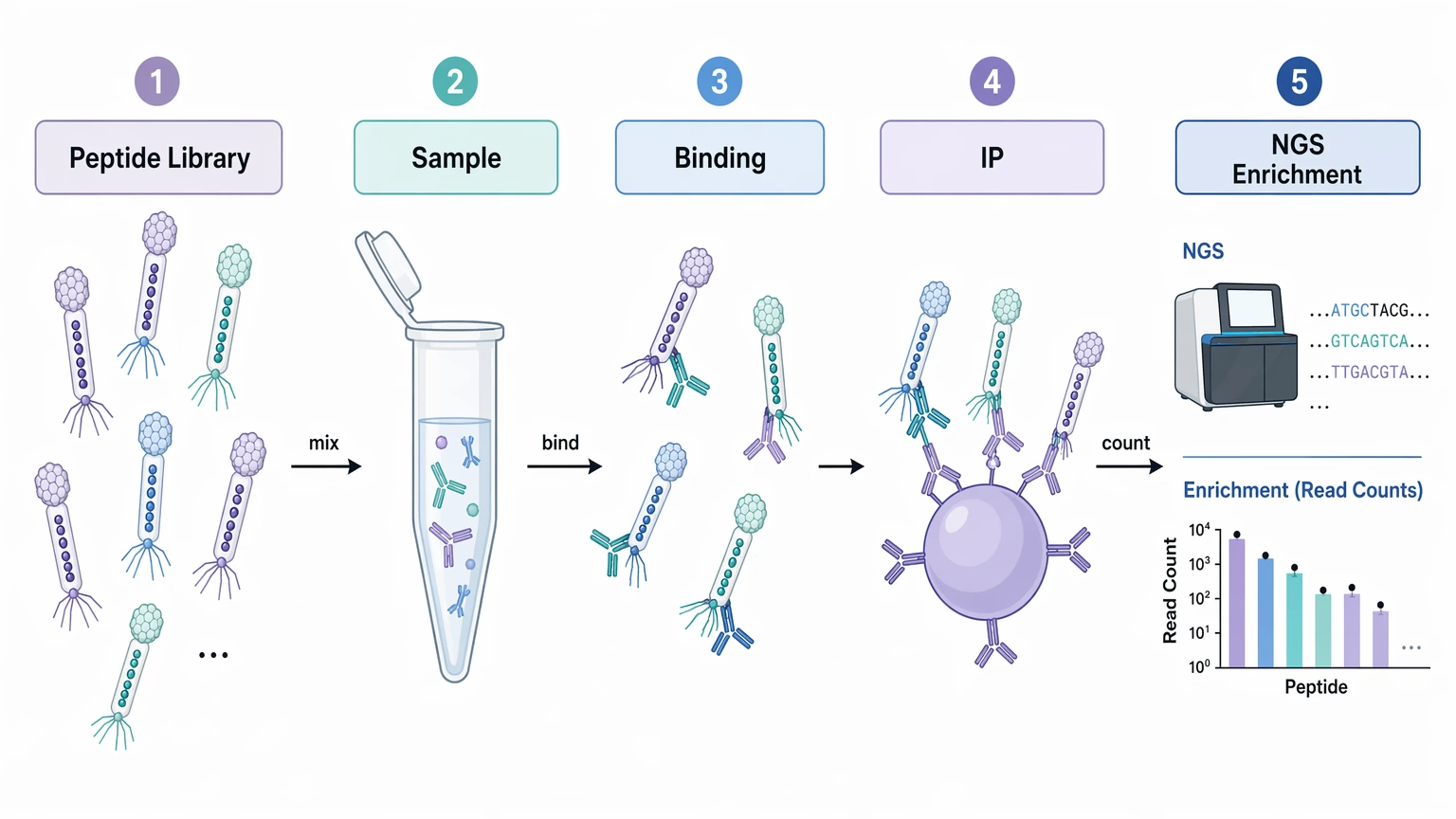
This is the key point for assay selection. PhIP-Seq does not directly measure native whole-protein recognition, and it does not tell you how much antibody is present in calibrated units. Instead, it produces a ranked pattern of enriched peptides that can support antigen mapping, motif discovery, cohort comparison, and hit prioritization.
Library composition shapes what the assay can reveal. A virome library, a human proteome-focused library, or a custom disease-focused library frames the biological question differently. Peptide tiling also matters because peptide length and overlap affect how well a team can localize a linear epitope and judge whether neighboring signals point to one reactive region.
Related Services
Main ServiceSupporting Service |
Validation ServiceAlternative Service |
Why Research Teams Choose PhIP-Seq
Teams usually choose PhIP-Seq for breadth. A targeted assay starts with a short list of predefined antigens. PhIP-Seq starts with a large peptide space and asks which peptide signals are enriched by the sample antibodies. That makes it a strong fit when target identity is still uncertain and the project needs discovery rather than confirmation.
It is also a natural fit for linear epitope questions. If the goal is to screen tiled peptide regions from pathogens, autoantigens, or candidate proteins, PhIP-Seq can reveal recurring peptide patterns that would be difficult to build one assay at a time.
Another reason teams use it is cohort-level interpretation. After enrichment analysis, investigators can compare peptide-level reactivity across cases and controls, identify shared motifs, evaluate recurrence across subjects, and narrow the list for follow-up studies. That output is especially useful in exploratory work in autoimmunity, infectious disease, neuroimmunology, and early biomarker discovery.
PhIP-Seq can also be practical when sample volume is limited but the candidate antigen space is large. Instead of testing one suspected target after another, a single library-scale screen can help rank where the most reproducible peptide signals appear. If your group is at that decision point, submit your requirements to MtoZ Biolabs for a project review focused on sample matrix, library scope, control samples, and downstream validation planning.
Main Limits and Tradeoffs
PhIP-Seq has clear boundaries, and those boundaries should guide interpretation.
First, it is a peptide-based system. That is useful for peptide-level reactivity and linear epitope work, but it limits interpretation when antibody binding depends on tertiary structure, multimeric assembly, glycosylation, or another native protein context. In those cases, a conformational epitope may not be represented well by displayed peptides.
Second, enrichment is not the same as quantitation. Sequencing counts and derived scores support ranking, comparison, and statistical filtering, but they should not be treated as direct antibody concentration measurements. When a project needs a calibrated answer for a known antigen, ELISA or another targeted assay may be the more direct first-line option.
Third, interpretation depends heavily on background handling. Background binding can arise from nonspecific interactions with phage, beads, or the immunoprecipitation system itself. For that reason, control samples and an explicit background model belong at the center of study design.
Fourth, enriched peptides still need careful hit prioritization. A convincing candidate usually combines enrichment strength, replicate consistency, overlapping peptide support, and biological plausibility. Even then, many top-ranked findings still require orthogonal validation before they support a narrower follow-up assay or a mechanistic claim.
When PhIP-Seq Fits Better Than a Targeted Assay
The clearest way to choose between PhIP-Seq and a targeted assay is to match the method to the next decision your study needs to make.
| Study need | PhIP-Seq | Targeted assay |
|---|---|---|
| Broad screening across many candidate peptides | Strong fit | Limited |
| Confirmation of a known antigen | Secondary or follow-up | Strong fit |
| Linear epitope discovery | Strong fit | Depends on format |
| Conformational epitope characterization | Limited | Better with native-protein or structure-aware methods |
| Calibrated quantitative readout | Limited | Better with ELISA or similar assays |
| Hypothesis generation in an exploratory cohort | Strong fit | Narrow |
| Rapid testing of a short predefined list | Less direct | Strong fit |
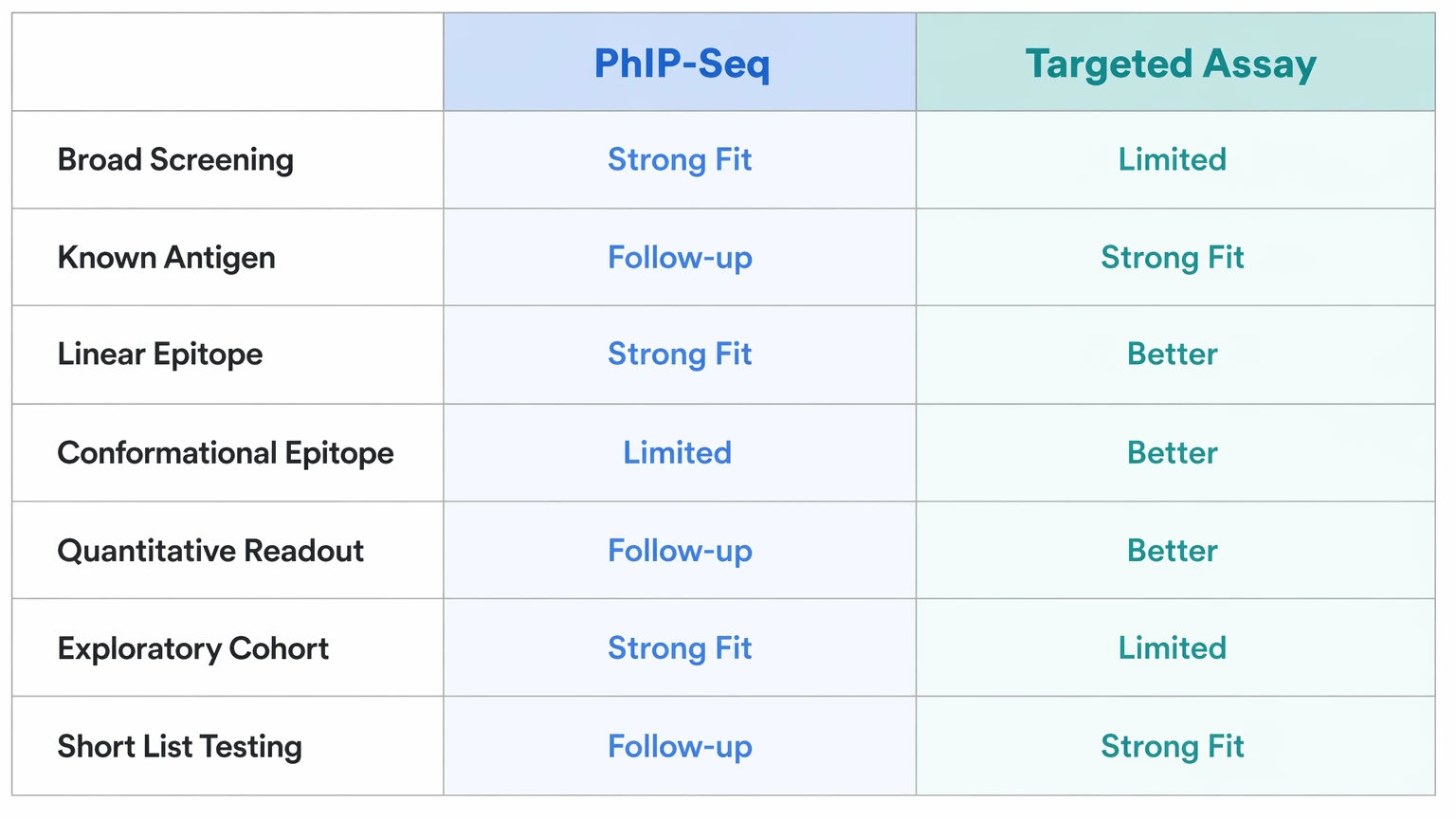
A useful rule is simple: choose PhIP-Seq when the main uncertainty is target identity, and choose a targeted assay when the main uncertainty is confirmation, comparison, or concentration for known targets.
An autoimmune discovery cohort may begin with PhIP-Seq to search for previously unrecognized peptide signals. A biotech program with three defined antigens and a need for direct cross-sample comparison may move straight to ELISA, a peptide array, or another focused format.
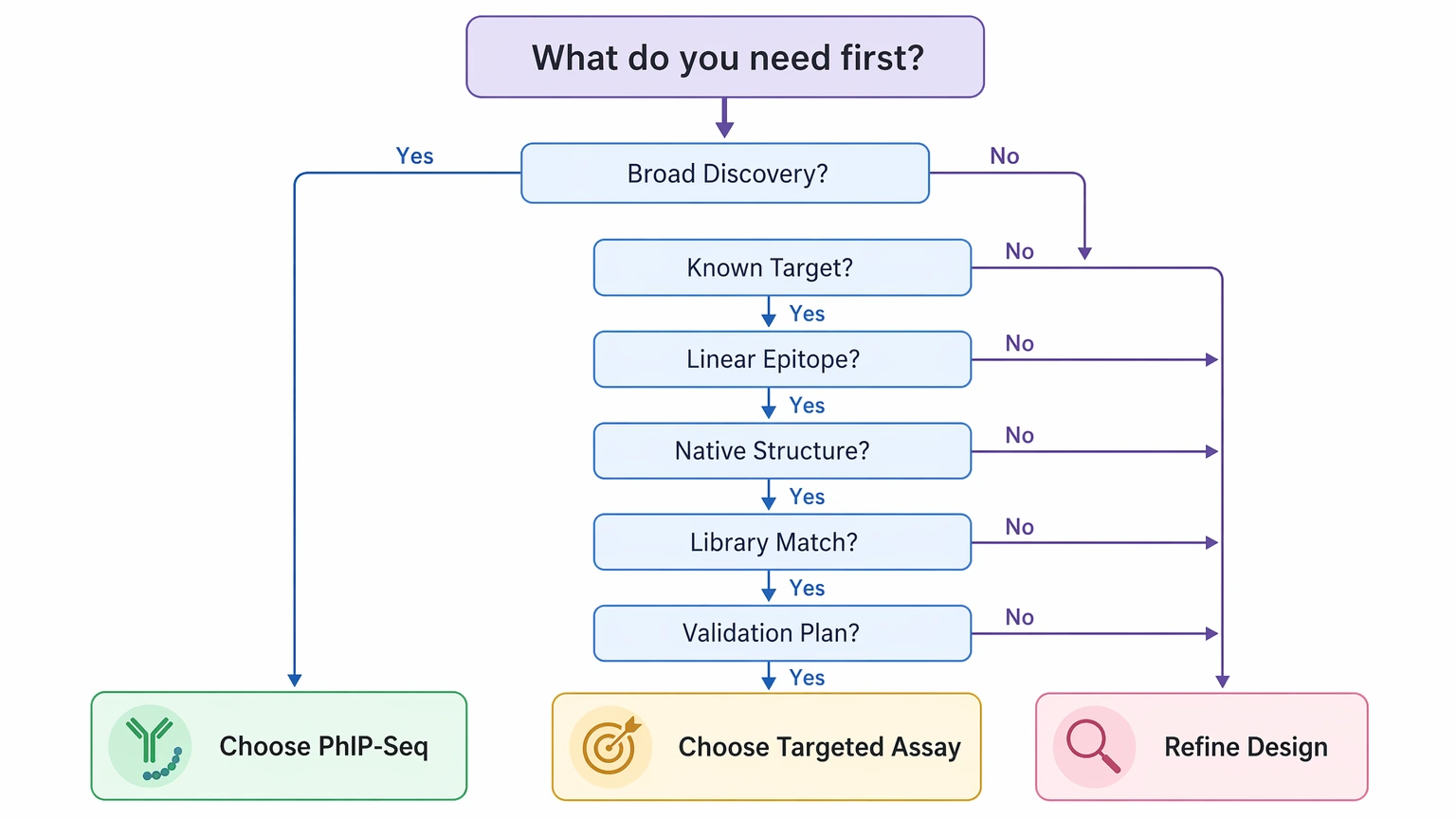
A Practical Selection Checklist
1. What output do you need first?
Choose PhIP-Seq if the immediate goal is broad discovery across many possible peptide targets. Choose a targeted assay if the first deliverable must be straightforward confirmation or calibrated measurement.
2. Is the biology compatible with peptide display?
PhIP-Seq works best when the core biology can be represented at the linear epitope level. If the main hypothesis depends on native folding or intact protein structure, another format may capture the interaction more faithfully.
3. Does the library match the question?
A phage-displayed peptide library defines what can be discovered. Before starting, review peptide tiling, target coverage, and whether a public or custom library is the better match for the study aim.
4. What will happen after the screen?
A discovery assay should lead to a clear next step. Decide in advance how top candidates will be filtered, which signals will move forward, and what orthogonal validation method will test the shortlist.
Conclusion
PhIP-Seq is best understood as a sequencing-based enrichment workflow built around a phage-displayed peptide library. It is most useful when a project needs broad antibody profiling, peptide-level reactivity screening, and linear epitope exploration, while narrower targeted assays remain the better starting point for predefined targets, calibrated measurement, or questions centered on conformational epitopes. For exploratory immunology, infection, autoimmunity, and translational studies, the most practical planning inputs are sample type, library scope, control strategy, and the validation path after screening. If your team is weighing those inputs, contact MtoZ Biolabs to evaluate your project and decide whether PhIP-Seq or a narrower follow-up assay is the better first step.
FAQ
Does PhIP-Seq read out whole proteins or peptide representations?
Its sequencing output tracks enriched peptide representations from the library. That means the assay is best interpreted as antibody-associated peptide enrichment rather than direct measurement of intact native proteins.
Can one enriched peptide identify a single definitive antigen?
Not by itself. A peptide hit may reflect a candidate antigen region, a shared motif, or sequence similarity across related proteins. Antigen mapping usually becomes stronger when several overlapping peptides support the same region.
When is a custom library worth considering?
A custom library becomes attractive when the project focuses on a defined pathogen set, a disease-specific antigen space, or a particular peptide tiling strategy that public libraries do not cover well.
How should teams think about replicates in PhIP-Seq?
Replicates help distinguish persistent peptide signals from isolated events. They are especially useful when you plan to rank borderline hits, compare cohorts, or build a shortlist for downstream validation.
What control samples are useful for background handling?
Useful controls often include mock immunoprecipitation conditions, matrix-matched negative samples, and other reference conditions that show recurring background binding patterns within the assay system.
Why do PhIP-Seq hits often need another assay afterward?
PhIP-Seq is usually the discovery stage. Follow-up methods such as ELISA, a peptide array, or another orthogonal format help test whether the prioritized signal holds up in a narrower and more application-specific setting.
How to order?




