



Quantitative proteomics routes fail when study stage and route are misaligned. Discovery profiling asks which proteins change on an open or semi-open list. Targeted proteomics asks whether predefined peptides quantify reproducibly across many samples on a closed schedule. Label-free quantification (LFQ) on unlabeled liquid chromatography-tandem mass spectrometry (LC-MS/MS) injections is the usual discovery-stage relative route. Multiple reaction monitoring (MRM) and parallel reaction monitoring (PRM) are targeted routes on closed panels (Lange et al. 2008; Peterson et al. 2012). The guide below matches MRM, PRM, and label-free LFQ to study stage with workflow, parameters, limits, and project choice. It is not a platform ranking page, not a biomarker validation promise, and not a substitute for a signed methods appendix.
Stage handoffs need a new analysis record when chemistry, panel version, or processing chain changes. Discovery tables do not become targeted QC evidence without method development and a frozen panel (Bantscheff et al. 2012).
In MtoZ Biolabs offerings, label-free LFQ is scoped for hypothesis-generation cohorts, and MRM or PRM for predefined panels when matrix pilots support the chosen targeted route.
Portfolio context appears in Targeted Proteomics Service. Three-axis framing appears in Protein Quantification Method.
Study Stage Versus Route: Discovery, Narrowing, Targeted Validation
Four study stages belong in the brief.
Hypothesis generation keeps the protein list open. Relative profiling on unlabeled injections is the default chemistry branch.
Candidate narrowing shortlists peptides but has not locked acquisition. Pilots compare detectability and missingness before panel freeze.
Validation-scale targeted measurement requires a closed panel, schedule, and QC pattern across many samples.
Interference-limited follow-up moves selected peptides from MRM to PRM while keeping the program targeted, not back to open discovery.
Study stage selects discovery LFQ versus targeted MRM or PRM before full cohort scale.
Enrollment context appears in Exploring Quantitative Analysis in Proteomics.
Label-Free LFQ as the Discovery-Stage Quantitative Route
Label-free LFQ integrates relative protein quantification from separate unlabeled LC-MS/MS injections (Cox et al. 2014).
Chemistry scope is unlabeled through injection. Each arm follows matched pretreatment to an injection-ready digest.
Acquisition scope is commonly data-dependent acquisition (DDA) MS1 peak-area LFQ or unlabeled data-independent acquisition (DIA) when pilots show high DDA missingness (Gillet et al. 2012).
Informatics scope covers search with false discovery rate (FDR) control, normalization, missing-value policy, and contrast testing on frozen groups only.
LFQ deliverables are relative contrast tables and candidate lists. They do not replace repeat measurement on a closed panel across hundreds of samples without a targeted block.
LFQ limits include batch sensitivity, DDA dropout, and no specification-style amount units without later SIS or targeted calibration (Gerber et al. 2003).
Label-free LFQ is discovery-stage relative quantitation, not targeted proteomics until the peptide list and schedule are locked.
LFQ terms appear in LFQ. Experimental layer appears in Label-Free LC-MS/MS. Service scope appears in Label-Free Quantitative Proteomics Service. Quality gates appear in How to Improve Data Quality and Reproducibility in Label-Free Proteomics?.
Targeted Proteomics With MRM and PRM by Stage
Targeted proteomics measures predefined proteotypic peptides with scheduled acquisition.
MRM on triple quadrupole systems records predefined precursor-product transitions with optimized dwell times. It often fits validation-scale panels when matrix pilots show stable transition ratios.
PRM isolates scheduled precursors and quantifies selected product ions from high-resolution MS/MS spectra. It often fits when MRM interference or unstable ratios persist after optimization in plasma, tissue, or formulation matrix.
Both routes require closed panels, matched prep, and documented QC. Neither route reopens the proteome for hypothesis generation on the same assay record.
PRM versus MRM choice appears in Parallel Reaction Monitoring vs MRM: Which Fits?. PRM principle appears in From Principles to Applications: A Comprehensive Overview of PRM Technology. MRM services appear in SRM-MRM Quantitative Proteomics Services.
End-to-End Workflow From Discovery to Targeted Handoff
Staged programs document each block separately.
Label-free LFQ discovery block.
- Freeze discovery contrast and relative claim.
- Match prep; acquire separate unlabeled injections with interleaved order when possible.
- Search, normalize, and test predefined groups.
- Export versioned candidate list with QC plots.
Targeted MRM or PRM block after panel freeze.
- Select proteotypic peptides; drop targets that fail matrix pilot detectability.
- Build schedule with realistic cycle time for cohort size.
- Optimize transitions or PRM fragment rules on matrix-matched pilot.
- Acquire validation cohort with QC pools; integrate peaks under locked rules.
- Test predefined contrast; archive panel version and methods with deliverables.
Step 4 output feeds step 5. Skipping pilot between blocks causes panel failure at scale.
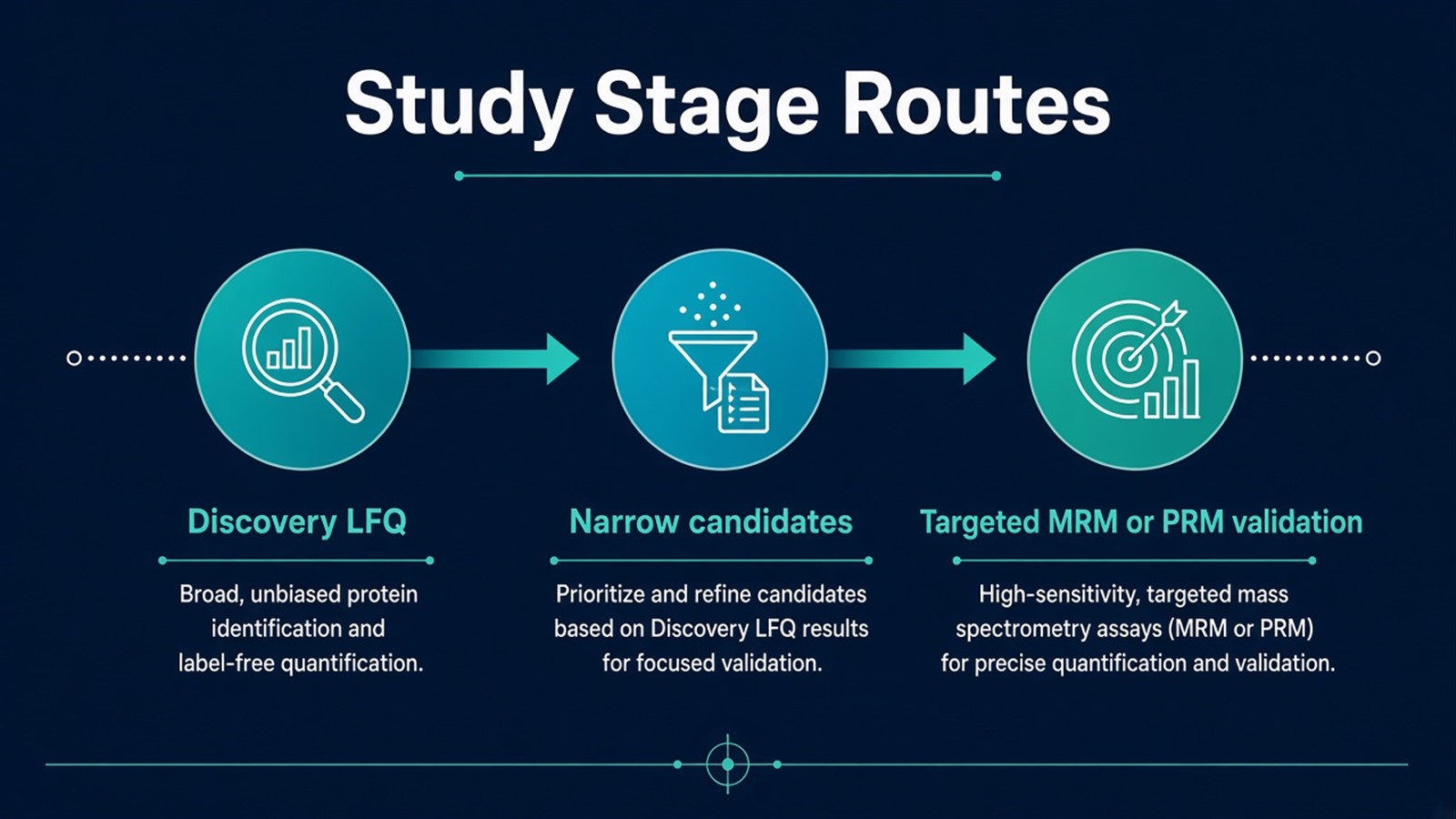
Figure 1. Open-stage work uses label-free LFQ; closed-panel repeat measurement uses targeted MRM or PRM after documented handoff.
DIA-to-targeted context appears in Application of DIA-PRM Proteomics. Validation planning appears in How to Plan a Targeted Proteomics Validation Study.
Parameters Locked by Study Stage and Route
Stage / route |
Parameter that must be declared |
Failure mode if ignored |
|---|---|---|
LFQ discovery |
Contrast, normalization, missing-value policy |
Fishing without frozen groups |
LFQ discovery |
One acquisition template per block |
Mixed DDA and DIA matrices |
Panel freeze |
Peptide list version |
Moving targets mid validation |
MRM targeted |
Transition list and dwell schedule |
Interference read as biology |
PRM targeted |
Isolation width and fragment rules |
Co-isolation bias |
Handoff |
Record linking discovery to panel IDs |
Orphan peptides without trace |
Cohort QC |
Pool or SIS bracket pattern |
Undetected drift |
Statistics |
Contrast frozen before tuning |
Post hoc stage relabeling |
Limits follow the same table. Discovery identification does not prove targeted quantifiability in plasma. Large validation cohorts should not start before matrix pilot on the closed list. Hybrid MRM plus PRM panels need per-peptide route documentation.
Depth expectations for discovery appear in How Many Proteins Can Label-Free Detect?. Processing appears in PRM Proteomics Data Processing Workflow.
How to Match MRM, PRM, and Label-Free LFQ to Your Study Stage
Study stage and signal |
Route that often fits |
Recheck before committing |
|---|---|---|
Open list, moderate n |
Label-free LFQ |
Targeted panel before candidates exist |
Shortlist, matrix untested |
LFQ plus peptide pilot |
Full MRM cohort without pilot |
Large n, stable MRM pilot |
MRM targeted panel |
PRM cost when transitions clean |
MRM ratio drift in matrix |
PRM for affected peptides |
Whole-panel PRM without need |
Biopharm QC peptide set |
Targeted MRM or PRM with QC |
Discovery LFQ as lot release |
Need amount units after discovery |
Targeted plus SIS block |
LFQ ratios as concentration |
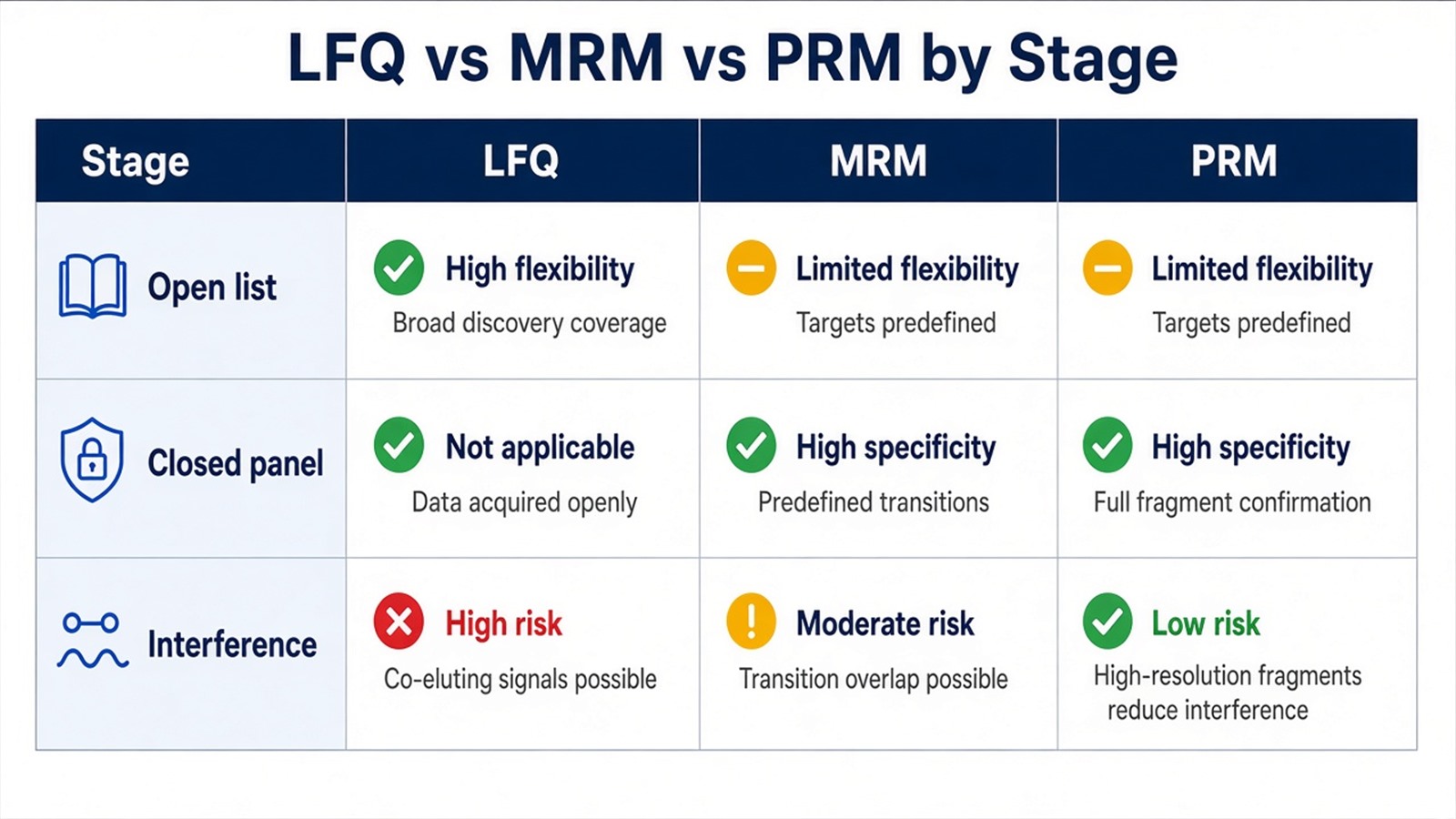
Figure 2. Match LFQ to open discovery stages; match MRM or PRM to closed-panel validation after handoff.
Reporting goals across absolute and relative routes appear in Absolute Protein Quantification or Relative Quantitation? Matching AQUA, MRM/PRM, and Label-Free Routes to Your Reporting Goal. Unlabeled theme appears in Unlabeled Quantitative Proteomics.
Teams with study stage, contrast map, and panel status can review MtoZ Biolabs Label-Free Quantitative Proteomics Service, Parallel Reaction Monitoring (PRM) Service, and Targeted Proteomics Service when routes are declared in the project record.
Frequently Asked Questions
1. Is targeted proteomics the same as MRM?
No. Targeted proteomics is the strategy of measuring a closed peptide panel. MRM and PRM are acquisition routes within that strategy.
2. Should every LFQ discovery project move to PRM?
Only candidates that need large-scale repeat measurement on a frozen panel usually justify targeted development. Many discovery programs stop at relative contrasts.
3. Can discovery and targeted blocks run in one instrument file?
Treat discovery and targeted acquisitions as separate analysis records with documented handoff. Do not mix open search intent with scheduled targeted integration on one claim.
4. When should LFQ use unlabeled DIA instead of DDA?
When pilots show acceptable identification but poor quantifiable coverage near decision thresholds, unlabeled DIA pilots are a common next discovery step before panel freeze.
5. Does study stage alone pick PRM over MRM?
Stage narrows discovery versus targeted. Within targeted work, PRM versus MRM follows matrix pilot on the same closed list.
MtoZ Biolabs can match discovery and targeted routes when study stage, panel status, and matrix pilots are documented.
If further evaluation of LFQ versus targeted timing, MRM versus PRM pilots, or staged handoff design is needed, project details can be submitted for a feasibility review.
Reference
- J. Cox, M.Y. Hein, C.A. Luber, I. Paron, M. Mann (2014). Accurate proteome-wide label-free quantification by delayed normalization and maximal peptide ratio extraction, termed MaxLFQ. Mol. Cell. Proteomics, 13, 2513-2526. https://doi.org/10.1074/mcp.M113.031031
- V. Lange, P. Picotti, B. Domon, R. Aebersold (2008). Selected reaction monitoring for quantitative proteomics: a tutorial. Mol. Syst. Biol., 4, 222. https://doi.org/10.1038/msb.2008.61
- A.C. Peterson, J.D. Russell, A.A. Klammer, P.F. Doubleday, H. Liu, J.N. Anderson, M.J. MacCoss (2012). Parallel reaction monitoring for high resolution and high mass accuracy quantitative, targeted proteomics. Mol. Cell. Proteomics, 11, 1475-1488. https://doi.org/10.1074/mcp.O112.020271
- L.C. Gillet, P. Navarro, S. Tate, H. Rost, N. Selevsek, L. Reiter, R. Bonner, R. Aebersold (2012). Targeted data extraction of the MS/MS spectra generated by data-independent acquisition: a new concept for consistent and accurate proteome analysis. Mol. Cell. Proteomics, 11, O111.016717. https://doi.org/10.1074/mcp.O111.016717
- M. Bantscheff, S. Lemeer, H.U. Haab, B. Kuster (2012). Quantitative mass spectrometry in proteomics: a critical review. Anal. Bioanal. Chem., 404, 939-965. https://doi.org/10.1007/s00216-012-5892-4
