






Starch Particle Size Distribution Determination Service
- Record sample information and physical characteristics
- Disperse starch powder using appropriate solvents to prevent aggregation
- Select laser diffraction or DLS based on sample type
- Acquire microscopic images for morphological analysis
- Obtain particle size distribution curves and calculate D10, D50, D90 parameters
- Verify particle morphology and uniformity with microscopy data
MtoZ Biolabs provides a starch particle size distribution determination service based on advanced platforms such as laser diffraction, dynamic light scattering (DLS), and microscopic image analysis, to achieve high-precision measurement of starch particle size, distribution, and morphology. This service is suitable for starch samples from various sources and treatments, providing reliable structural and performance evaluation data for the food, agricultural, biomaterial, and pharmaceutical industries.
Through multi-technology integrated analysis, we help clients:
● Accurately characterize starch particle size distribution and morphological features
● Evaluate the uniformity and aggregation behavior of native and modified starches
● Support studies on physicochemical properties, digestibility, and processing stability
With reproducible and high-resolution data, MtoZ Biolabs enables researchers to gain a deeper understanding of the relationship between starch microstructure and functional properties.
Principle of Starch Particle Size Distribution Determination
The determination of starch particle size distribution is based on the interaction between particles and light or fluid motion and can be achieved through the following methods:
1. Laser Diffraction
A laser beam passes through dispersed starch particles, and the scattering angle of the light is inversely proportional to particle diameter. By analyzing the intensity distribution of the scattered light and applying the Mie scattering model, parameters such as D10, D50, D90, and the overall particle size distribution can be calculated.
2. Dynamic Light Scattering (DLS)
This method is based on the Brownian motion of particles in solution. By detecting temporal fluctuations in scattered light intensity, the diffusion coefficient is calculated and converted into particle size using the Stokes–Einstein equation. It is suitable for measuring nanoscale starch particles.
3. Microscopic Image Analysis
Using optical or scanning electron microscopy (SEM), starch particle morphology, surface structure, and distribution characteristics are observed. Combined with image analysis, particle morphology and size can be quantitatively evaluated.
MtoZ Biolabs integrates multiple analytical methods to ensure accuracy and representativeness of the data.
Starch Particle Size Distribution Determination Service at MtoZ Biolabs
MtoZ Biolabs provides a comprehensive starch particle size distribution determination service to evaluate starch particle size, distribution, and morphology. Our service includes:
1. Laser Diffraction Particle Size Analysis: Measurement of starch granule size distribution (D10, D50, D90) and volume-based particle distribution.
2. Dynamic Light Scattering (DLS) Measurement: Determination of nanoscale starch particle size and aggregation behavior in suspension.
3. Microscopic Image Analysis: Observation and quantitative assessment of starch morphology using optical or scanning electron microscopy (SEM).
4. Shape and Surface Roughness Evaluation: Characterization of granule roundness, porosity, and surface texture.
5. Particle Uniformity and Aggregation Assessment: Evaluation of dispersion quality and clustering tendencies under various conditions.
6. Comparative Analysis of Native and Modified Starch: Determination of structural changes after chemical, enzymatic, or physical modification.
7. Customized Particle Characterization Solutions: Tailored measurement strategies for starch composites, blends, and industrial formulations.
All analyses are conducted under strict quality control standards to ensure accuracy, reproducibility, and compliance with scientific and industrial requirements.
Workflow of Starch Particle Size Distribution Determination Service
The analytical workflow at MtoZ Biolabs is standardized and quality-controlled to ensure scientific and traceable results.
1. Sample Preparation
2. Instrumental Measurement
3. Data Acquisition and Analysis
4. Result Reporting and Interpretation
Summarize results and generate a complete report including charts and analytical conclusions
Why Choose MtoZ Biolabs
1. Multi-Platform Analytical Capability: Laser diffraction, DLS, and microscopic imaging are combined for comprehensive particle size and morphology determination.
2. Professional Technical Team: Our scientists possess extensive experience in starch structure and material characterization, ensuring accurate interpretation of analytical data.
3. Strict Quality Control System: Standardized workflows ensure accuracy, reproducibility, and traceability of all analytical results.
4. Flexible Customized Solutions: Analytical methods are tailored for different sample types, including native starches, modified starches, and composites.
5. Data Suitable for Research and Industry: We provide standardized reports that can be directly used for academic publication, product development, and process validation.
Applications of Starch Particle Size Distribution Determination
1. Food Science
2. Agricultural and Crop Research
3. Pharmaceutical and Biomaterials
4. Industrial and Environmental Applications
Sample Submission Guidelines

If samples have special properties, MtoZ Biolabs can provide personalized sample preparation and submission guidance.
Deliverables
1. Detailed experimental report
2. Particle size distribution curves and statistical data for D10, D50, and D90
3. Microscopic images and morphological analysis results
4. Data quality control and reproducibility evaluation
5. Optional data visualization charts and research recommendations
FAQs
Q1: What Types of Samples Are Suitable?
A1: Our starch particle size distribution determination service is compatible with a wide range of starch materials, including native starches, chemically or physically modified starches, starch composites or blends, and fermentation-derived starches. Both dry powders and aqueous suspensions are acceptable. For other starch-containing matrices, please consult our technical team for customized evaluation.
Q2: What Is the Service's General Workflow?
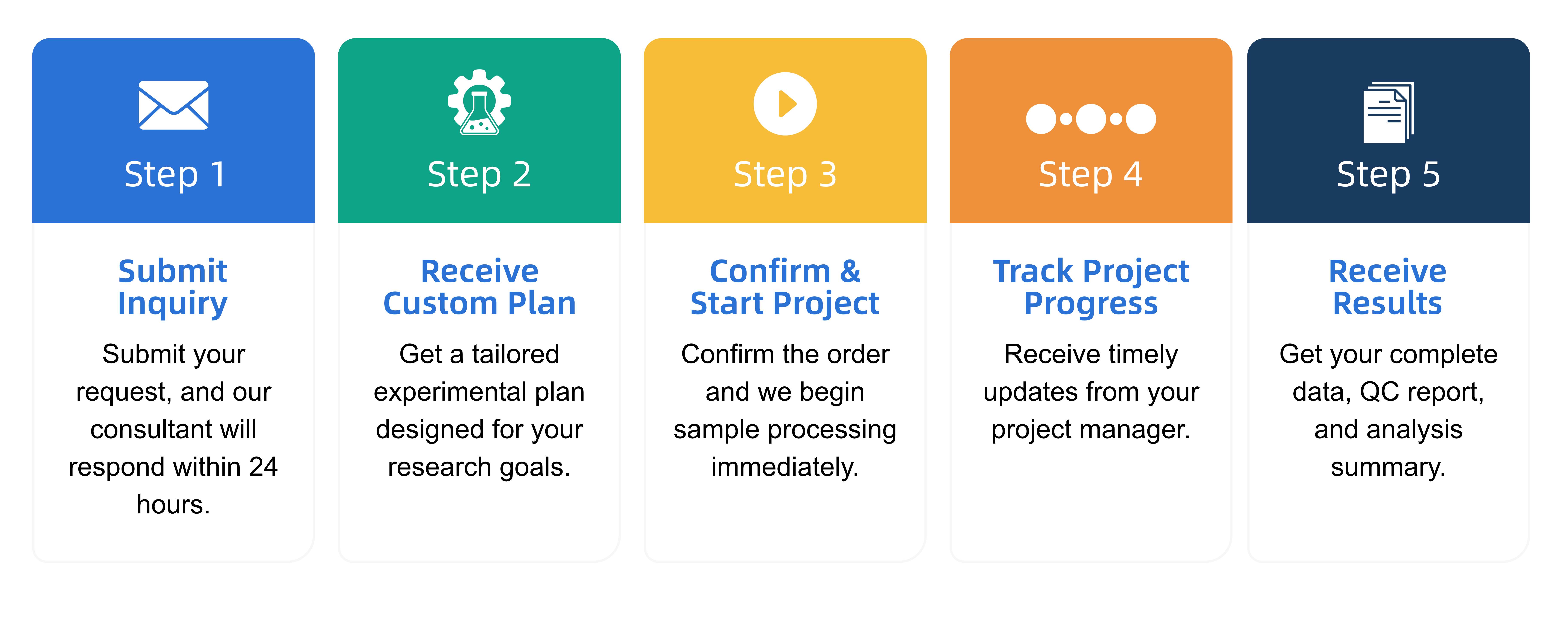
Q3: What Data Formats Are Provided?
A3: Clients receive a complete analytical report that includes particle size distribution curves, D10/D50/D90 values, microscopic images, and data quality assessments. Results are delivered in both editable Excel and PDF formats, with optional visualization figures (e.g., histograms, cumulative distribution plots) for publication or presentation use.
Q4: How Should I Prepare My Samples?
A4: Samples should be well-dried and free of impurities or aggregates. For suspensions, ensure homogeneity before submission. Avoid exposure to moisture or high temperatures during storage and shipping. Detailed sample submission instructions are available in our Sample Submission Guidelines for Proteomics and Sample Submission Guidelines for Metabolomics, or you may contact our technical team for personalized advice.
Start Your Project with MtoZ Biolabs
For more information or to request a customized quotation, please contact us.
How to order?




