






Starch Crystal Structure Assay Service
Starch crystal structure refers to the ordered arrangement of starch molecular chains at the microscopic level, typically classified into different crystalline types such as A-type, B-type, and C-type. The crystalline structure directly affects the thermodynamic properties, mechanical stability, and bioavailability of starch. For example, A-type starch, commonly found in cereals, has a compact molecular packing; B-type starch, mainly found in tubers, exhibits higher hydration levels; while C-type starch is a mixture of the two. Understanding these structural characteristics is of great significance in food science, materials science, and biopharmaceutical research.

Dome, K. et al. Polymers (Basel). 2020.
Figure 1. A Graphical Illustration of Starch Structure
With an advanced X-ray diffraction (XRD) analysis platform and a team of experienced scientists, MtoZ Biolabs provides high-resolution starch crystal structure assay service for research and industrial clients. Our service accurately identifies crystalline types, evaluates crystallinity and molecular ordering, and offers scientific data support for starch modification, processing optimization, and novel material development.
Services at MtoZ Biolabs
The starch crystal structure assay service at MtoZ Biolabs is primarily based on X-ray diffraction (XRD) technology. By measuring the scattering pattern of starch samples under incident X-rays, we analyze the internal molecular arrangement and crystal structure characteristics. Based on parameters such as diffraction peak position, intensity, and full width at half maximum, we determine whether the sample belongs to the A-type, B-type, or C-type crystalline form and quantitatively calculate the ratio of crystalline to amorphous regions to obtain crystallinity information.
Additionally, MtoZ Biolabs can combine Fourier-transform infrared spectroscopy (FT-IR) and differential scanning calorimetry (DSC) for auxiliary analysis to comprehensively assess intermolecular hydrogen bonding, crystalline region stability, and thermal performance. This integrated approach provides a more complete and reliable evaluation suitable for starch samples of different origins and processing conditions, including native starch, modified starch, and starch-based composite materials.
Analysis Workflow
1. Sample Preparation: Samples are dried and ground into a uniform powder to ensure particle size suitability for XRD analysis.
2. XRD Testing: The sample is scanned using Cu Kα radiation, and diffraction intensity as a function of angle is recorded.
3. Data Interpretation: Diffraction peak position, intensity distribution, and peak width are analyzed to determine crystalline type and crystallinity.
4. Auxiliary Verification: FT-IR or DSC data are used to validate the distribution between crystalline and amorphous regions.
5. Report Generation: A complete structural analysis report is provided, including raw spectra, analytical results, and technical notes.
Service Advantages
1. Multi-Technology Integration
MtoZ Biolabs combines XRD, FT-IR, and DSC platforms to achieve multi-dimensional analysis from molecular to macroscopic levels. This integrated approach enhances the reliability of crystal structure determination, especially for composite or modified starch samples, effectively distinguishing between crystalline and amorphous regions.
2. High Sensitivity Detection
Our analytical method is applicable to cereal, tuber, legume, and modified starch samples. Regardless of small sample size or complex origin, we can obtain stable and reliable data. Our starch crystal structure assay service is capable of identifying the proportion of major and minor crystalline types in mixed samples, providing detailed structural information for research.
3. Extensive Starch Structure Research Experience
MtoZ Biolabs has accumulated extensive experience in plant polysaccharide and starch structural characterization. We are familiar with the crystalline features of starch from various species and processing conditions. Our team provides professional advice on analysis, design, and interpretation, helping clients understand the relationship between structural changes and physical properties.
4. One-Time Charge
Our pricing is transparent, with no hidden fees or additional costs.
Applications
☑️ Food Science Research: Evaluation of starch gelatinization, anti-aging properties, and processing stability
☑️ Agricultural and Plant Research: Comparison of starch crystalline structures among species and varieties
☑️ Material Science: Development of biodegradable packaging and starch-based composite materials
☑️ Pharmaceutical and Bioengineering: Investigation of starch structure in drug release systems
☑️ Industrial Applications: Assessment of heat treatment, chemical modification, or enzymatic effects on starch structure
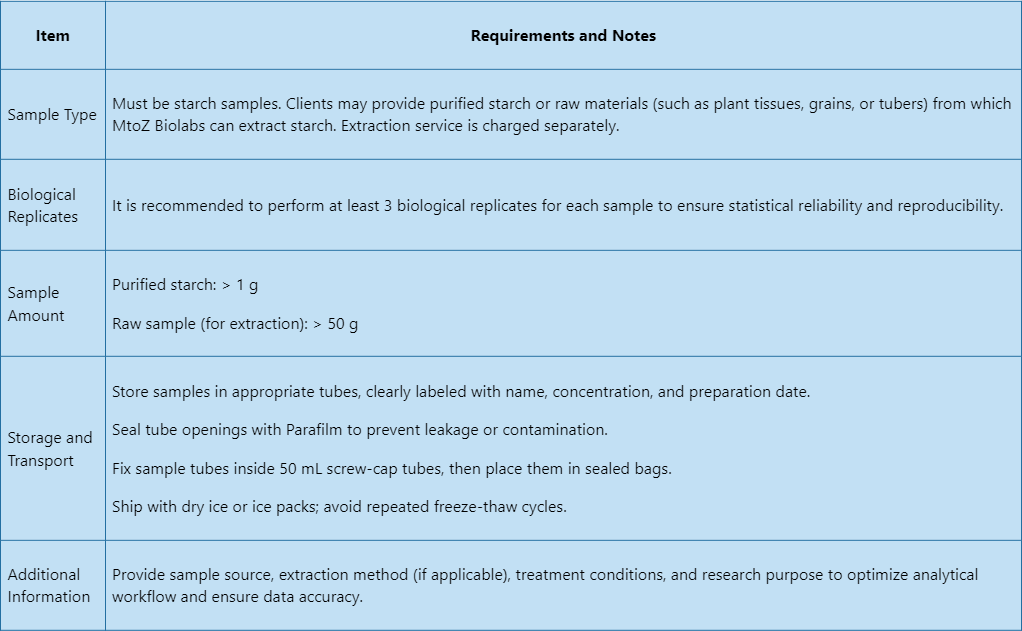
Sample Submission Suggestions
Deliverables
1. Complete XRD diffraction spectra
2. Crystalline type determination and crystallinity analysis results
3. Data processing and fitting report
A detailed understanding of starch crystal structure is essential for studying its physical properties, processing behavior, and functional applications. MtoZ Biolabs provides a reliable and systematic starch crystal structure assay service for research and industrial clients. Contact MtoZ Biolabs today to obtain a customized analysis plan and quotation to make your research more scientifically rigorous and industrially valuable.
How to order?




