






Single-Cell Antibody Sequencing for Rare Antigen-Specific B Cells: A Study Planning Guide for Paired Chain Recovery
Single-cell antibody sequencing can be a sensible option for rare antigen-specific B cells when the study is planned around recoverable target-cell numbers, interpretable antigen staining, and viable single-cell input, not just total sample volume. If the downstream goal is paired chain recovery for clone selection, the first question is simple: can the expected rare-cell frequency and sorting plan produce enough clean singlets to justify single-cell capture?
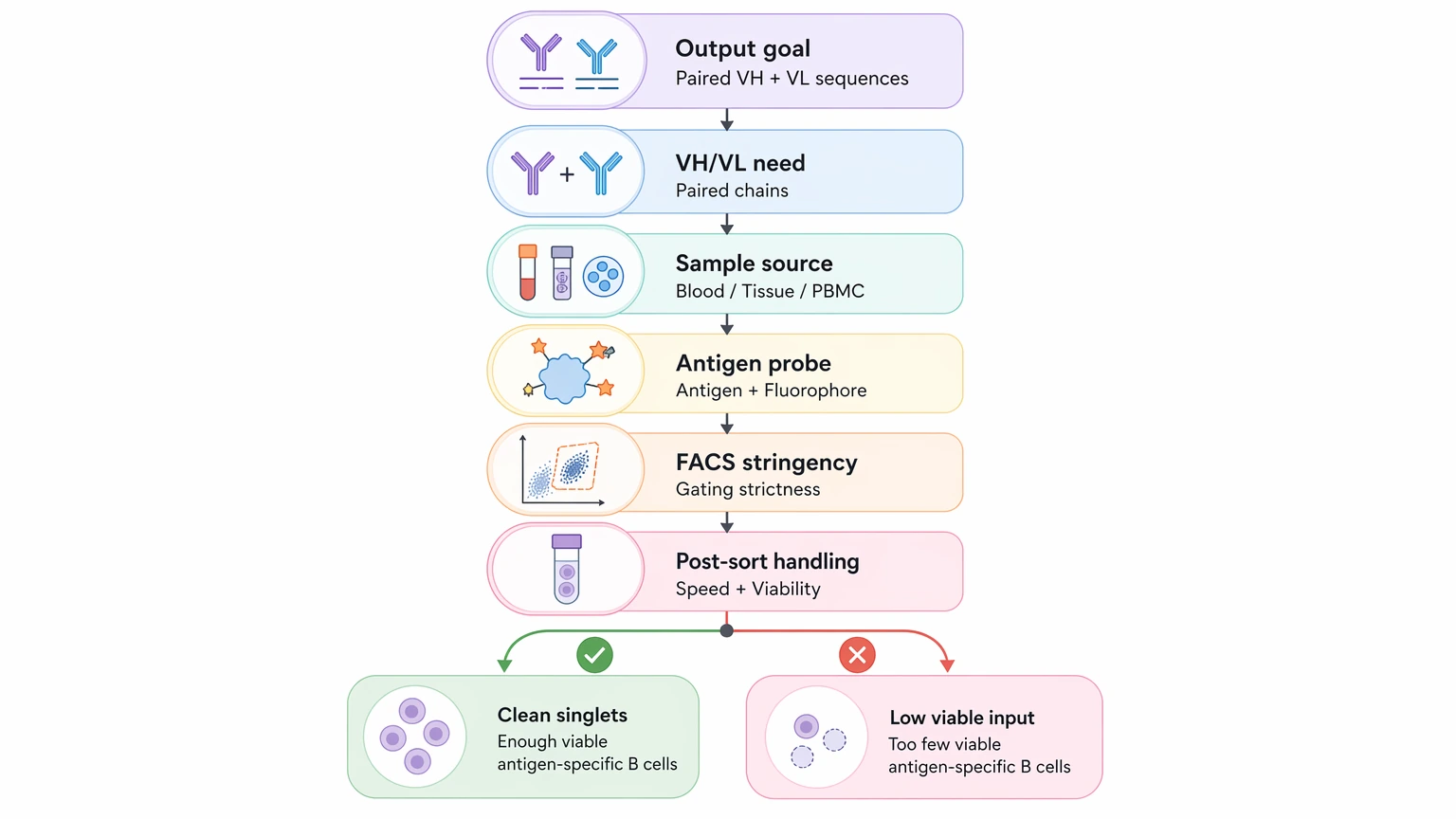
That planning logic should start from the intended output and work backward. Decide what kind of VH and VL information you need, then match the sample source, antigen bait or antigen probe design, flow sorting / FACS stringency, and post-sort handling to that endpoint. Teams that define those checkpoints early usually get more from limited material. Teams that move straight to sequencing often discover that sequencing was not the real bottleneck; too few viable antigen-specific B cells entered the workflow.
Why Paired Chain Recovery Matters More in Rare-Cell Studies
For bulk B-cell receptor (BCR) sequencing, a sparse target population can still support repertoire-level trends. Rare antigen-specific B-cell projects usually ask a tighter question. The team is not only looking for chain abundance or clonotype counts. It needs native heavy chain / light chain pairing from individual cells so candidate antibodies can be reviewed, prioritized, and in some cases moved into recombinant re-expression.
That changes what success looks like. A study may produce BCR data and still miss the mark if too many cells yield only one chain, if immunoglobulin variable region coverage is incomplete, or if the recovered sequence set contains too few distinct candidates for clone ranking. In practice, rare-cell projects often fail through partial recovery, not total data loss.
This is a familiar scenario in post-immunization PBMCs, convalescent donor samples, lymph node cells, or splenocytes where antigen-specific B cells are uncommon and recollection may not be feasible. In that setting, each upstream decision shapes how many biologically relevant cells remain for single-cell capture.
The Four Planning Failures That Usually Limit Usable Recovery
For this decision stage, four cause categories usually deserve the most attention.
1. Rare-cell frequency is lower than the recovery target assumes
A starting sample may look adequate on paper and still contain too few antigen-specific B cells for meaningful paired chain recovery. Losses during thawing, staining, washing, gating, or loading matter much more when the target population is already scarce.
2. Antigen probe staining does not separate true binders from background binding
An antigen bait or antigen probe with weak specificity, unstable labeling, or high nonspecific signal makes gate definition uncertain. That lowers sorting purity and raises the chance that captured cells do not reflect the biology the team is trying to recover.
3. Pre-capture cell quality is too weak for reliable single-cell capture
Low cell viability, excess debris, poor singlet rate, or delayed processing reduce the number of intact cells that reach capture. In a rare-cell study, that is not a minor QC issue. It directly affects sequence recovery.
4. The sequence endpoint is still vague when the study starts
“Paired sequences” can mean different things: CDR-focused ranking, broader immunoglobulin variable region review, clonotype mapping, or re-expression-oriented selection. If that endpoint is not clear, the sorting plan and library expectations tend to drift.
A Project-Planning Framework for Realistic Paired Chain Recovery
This article follows a project-planning subtype of problem-solution structure. The practical question is not how to troubleshoot a failed run after the fact, but whether the planned study is ready to move forward.
Step 1: Define the decision endpoint before estimating input
First decide what the recovered sequence set needs to support. A clonotype discovery study can tolerate more partial recovery than a program that needs recombinant re-expression follow-up. A CDR-centered screen may accept a different level of sequence completeness than a project that needs broader immunoglobulin variable region review.
| Project objective | Minimum useful output | Main implication for planning |
|---|---|---|
| Clonotype mapping | Paired VH and VL from enough cells to identify recurring clonotypes | Broader capture may be acceptable if the antigen-positive gate remains interpretable |
| Candidate discovery | Paired heavy chain / light chain pairing from antigen-positive cells with reviewable variable regions | Sorting purity and cell preservation become higher priorities |
| Recombinant re-expression follow-up | Usable VH and VL with sequence completeness suitable for construct review | Stricter filtering and orthogonal confirmation should be planned early |
| Repertoire interpretation | Cell-level BCR context even if some cells yield partial recovery | Total captured cells matter more than clone-level readiness |
If the team cannot decide which row best fits the program, it is too early to commit precious material.
Step 2: Estimate recoverable antigen-positive events, not just starting cells
The most useful planning number is not total PBMC count. It is the likely number of antigen-specific B cells that will still be viable, sortable, and sequenceable at loading time.
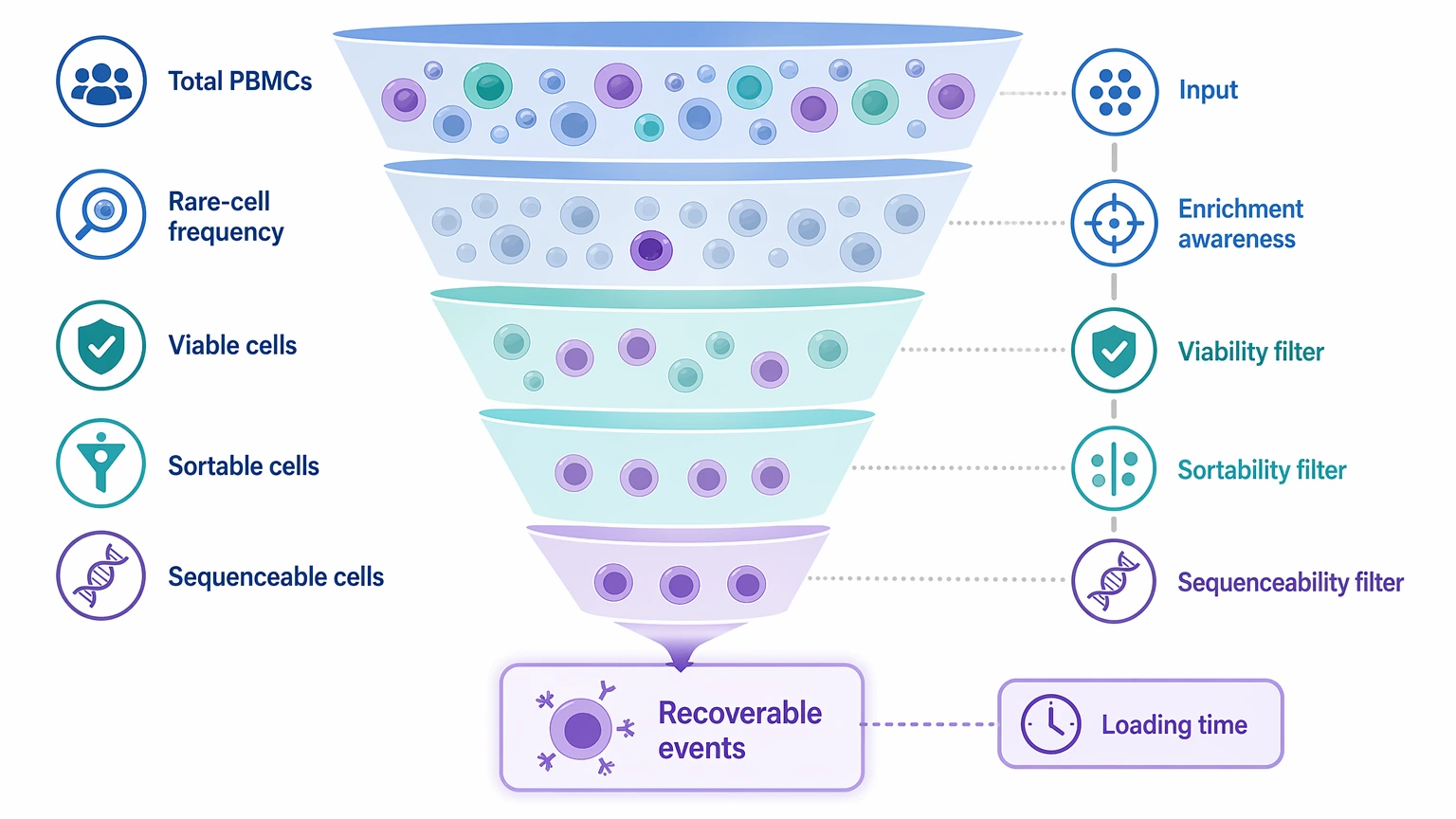
Work backward through a short set of checkpoints:
- expected rare-cell frequency within the starting population
- cell viability after thaw or fresh handling
- singlets remaining after dead-cell and debris exclusion
- expected sorting purity of the antigen-positive gate
- losses between collection and single-cell capture
Use a realistic range rather than a single estimate. If the low end of that range cannot support the intended paired chain recovery endpoint, the study needs a revised design or a different recovery strategy.
At this stage, a decision-focused consultation can prevent avoidable sample loss. If you need to check whether the available input supports the intended recovery goal, you can submit your requirements to MtoZ Biolabs with sample source, expected cell counts, antigen probe concept, and the desired sequence endpoint for pre-study review.
Step 3: Set the sorting strategy around the real tradeoff: breadth versus specificity
Rare antigen-specific B-cell studies are usually constrained by the balance between yield and confidence. A permissive antigen-positive gate can increase event counts but may also bring in more background binding and irrelevant cells. A very strict gate can improve sorting purity while leaving too few cells for meaningful single-cell capture.
| Sorting approach | Main benefit | Main risk | Best fit |
|---|---|---|---|
| Broad antigen-positive gate | More captured events | More off-target cells and background binding | Early exploratory clonotype discovery |
| Strict high-confidence gate | Cleaner antigen-specific population | Lower cell yield | Candidate-focused recovery |
| Pre-enrichment before FACS | Higher target-cell fraction | More handling stress on fragile samples | Very low rare-cell frequency |
| Immediate sort after staining | Better preservation of fresh cells | Less room for repeated optimization | Precious fresh samples |
This is also the point where antigen probe quality should be reviewed directly. Probe valency, fluorophore choice, and control design all influence background binding. If negative or decoy controls do not support clean gating, the recovered sequence set may appear productive while still carrying substantial biological noise.
Step 4: Treat cell viability as a recovery variable, not a side note
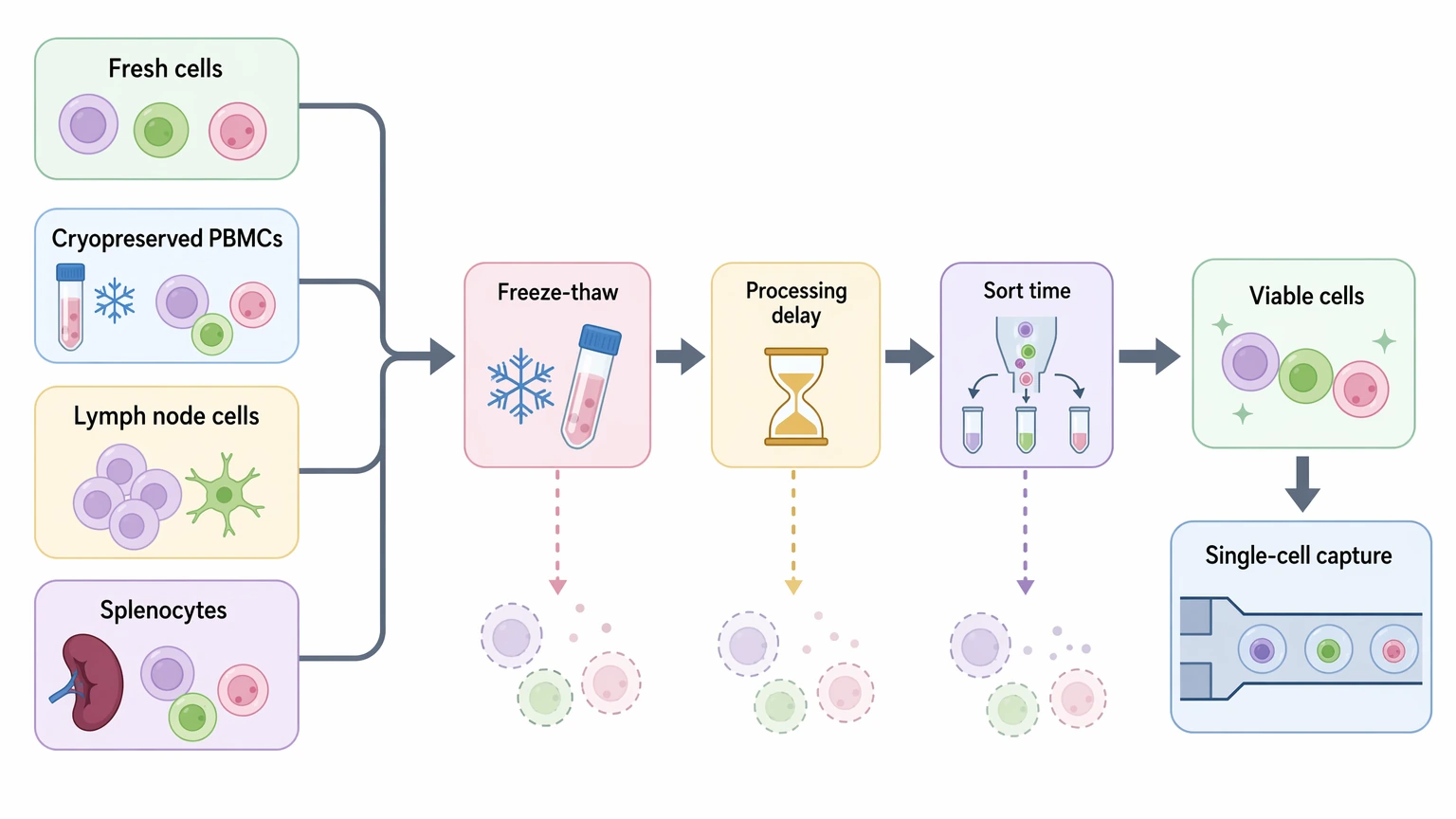
Fresh cells, cryopreserved PBMCs, lymph node cells, and splenocytes can all enter a single-cell antibody sequencing workflow, but they do not all respond the same way to handling. Freeze-thaw stress, long processing intervals, and extended sort time can reduce the pool of viable cells that actually reaches single-cell capture.
Before launch, define:
- whether cells will be processed fresh or after cryopreservation
- acceptable timing between thaw, stain, sort, and loading
- collection conditions that preserve cell viability after FACS
- whether pilot data from similar material already exist
A small pilot is often more useful than a long theoretical discussion. It can show whether the sample type maintains an interpretable antigen-specific gate and whether the singlet fraction stays usable after real handling steps.
Step 5: Match library expectations to the real output need
Single-cell antibody sequencing preserves cell-level heavy chain / light chain pairing, but it does not ensure that every captured cell will yield both chains or that every sequence will be ready for downstream use. That is why the study should define an acceptable level of sequence recovery before any run starts.
Clarify these points early:
- Is paired VH and VL required for every candidate under review?
- Is partial immunoglobulin variable region recovery acceptable for lower-priority cells?
- Does the project prioritize unique clonotype discovery or redundancy within expanded lineages?
- Does recombinant re-expression require broader sequence completeness than simple BCR identification?
Those questions shape how the final dataset will be judged. Without that agreement, the team may receive data that are technically valid but poorly matched to the program.
Step 6: Add an orthogonal path when the input margin is narrow
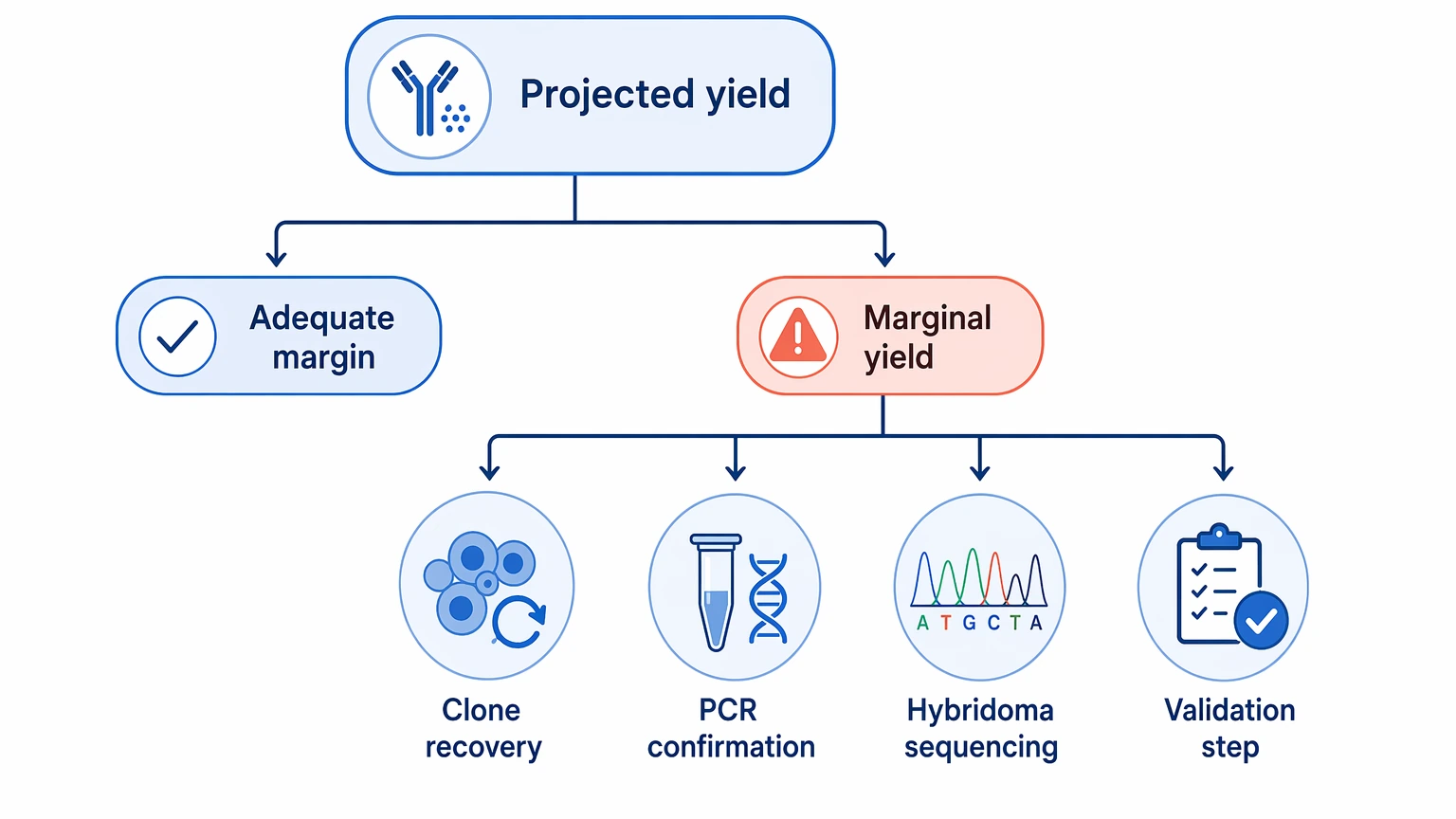
Some rare-cell studies should not rely on a single recovery route. If projected antigen-positive yield is marginal, an orthogonal path can lower decision risk. That could include targeted recovery from prioritized clones, PCR-based sequence confirmation, hybridoma sequencing for compatible programs, or a separate validation step for selected candidates.
That does not mean the single-cell plan is wrong. It means the study should carry a realistic margin for failure modes that are common in low-input campaigns. If your team is deciding whether single-cell capture should stand alone or be paired with another recovery method, contact MtoZ Biolabs to evaluate the workflow fit against your sample constraints and downstream clone-selection goals.
What Good Output Looks Like
A well-planned study should raise the fraction of captured cells that produce interpretable sequence recovery from biologically relevant antigen-specific B cells. The first signals are operational, not promotional:
- a clearer antigen-positive gate with less background binding
- stronger confidence in sorting purity
- better post-sort cell viability and singlet representation
- more usable paired VH and VL assignments in the sequence set
At review time, useful checks include how many cells yield paired chain recovery rather than single-chain output, whether top candidates have full or near-complete variable-region coverage, and whether recovered clonotypes are distinct enough to support prioritization. A lead-finding program will usually need follow-up binding work before candidate advancement, while a repertoire-oriented project may stop at clonotype-level interpretation.
Key Cautions Before You Commit Precious Material
Do not let total sample volume stand in for target-cell math. Low input and low rare-cell frequency compound quickly. Also, do not defer controls. If antigen probe controls are weak, the downstream dataset may be difficult to interpret no matter how well the sequencing run performs.
Batch effects also need planning attention. Differences in thaw day, sort operator, probe lot, or sample source can shift cell viability and sorting purity enough to change the usable sequence set. Finally, sequencing output has clear limits. Sequence recovery can preserve native VH and VL relationships, but it does not by itself confirm binding strength, function, or expression behavior.
Conclusion
For rare antigen-specific B-cell projects, single-cell antibody sequencing is most useful when the study is designed around realistic paired chain recovery goals rather than sample volume alone. The core planning questions are whether rare-cell frequency can support enough viable singlets, whether the antigen bait or antigen probe produces a trustworthy gate, whether flow sorting / FACS can balance yield with sorting purity, and whether the final output must support clonotype mapping, candidate ranking, or recombinant re-expression. For teams working with limited PBMCs, post-immunization samples, or weakly represented antigen-binding populations, a technical review before launch can reduce avoidable sample loss; if you are preparing a study, contact MtoZ Biolabs to evaluate your project and discuss the most suitable sequence recovery path before execution.
FAQ
When is pre-enrichment worth the extra handling?
Pre-enrichment is most useful when the expected antigen-specific B-cell pool is so small that direct sorting would produce too few antigen-positive events. It becomes less attractive when the sample is fragile and each extra manipulation threatens singlet recovery.
Should we optimize for more unique clonotypes or better sequence completeness?
That depends on the program decision, not on a generic sequencing preference. Early discovery screens often value breadth, while re-expression-oriented studies usually benefit more from fewer but better-resolved paired sequences.
How much pilot work is enough before the main study?
A small pilot is usually enough if it answers three points: whether the antigen-positive gate is interpretable, whether post-handling cell viability is acceptable, and whether the expected event count can support the intended paired chain recovery endpoint.
Can cryopreserved samples still support paired chain recovery?
Yes, but only if thaw quality and post-thaw handling preserve enough viable singlets. Cryopreservation does not automatically disqualify a project, but it reduces the margin for low-frequency targets.
What should we prepare before asking for a workflow-fit review?
Bring the sample source, approximate cell counts, expected rare-cell frequency, proposed antigen probe approach, whether single-cell capture follows direct sort or enrichment, and the real downstream goal such as clonotype mapping or recombinant re-expression.
How to order?




