






Serum/Plasma/CSF Proteomics: What Can LC-MS/MS Actually Detect?
LC-MS/MS can detect a substantial set of proteins in serum, plasma, and CSF, but it does not detect every protein present in those fluids. What you usually get is a discovery-scale list of identified proteins or protein groups, or a quantitative comparison shaped by matrix chemistry, abundance range, sample quality, and the selected workflow. High-abundance circulating proteins are easier to observe. lower-abundance proteins may remain difficult to identify or quantify reproducibly unless the study is designed for that goal.
A complete serum/plasma/CSF proteomics report can include protein identifications or quantitative matrices, differential screening when groups are defined, and annotation layers such as GO, KEGG, COG, PPI, and Reactome where species support allows. That is a full research report for the proteins recovered by the workflow. It is not a guarantee of exhaustive proteome coverage or absolute concentration for every target.
If you are unsure whether LC-MS/MS fits your detection claim, share with MtoZ Biolabs the matrix, species, comparison design, and whether the priority is broad profiling or low-abundance targets. That short brief is usually enough to set realistic expectations before samples are thawed.
What “Detect” Means in Biofluid LC-MS/MS
In serum/plasma/CSF protein analysis, detection means that peptide evidence was assigned to a protein or protein group under defined search, confidence, and false-discovery criteria. It does not automatically mean that the protein was quantified in every sample, that its concentration is known in absolute units, or that it is clinically actionable.
Three practical layers matter:
- Identification: peptide evidence supports a protein or protein group under the project’s reporting criteria
- Comparability: the protein can be compared across matched groups when quantification was planned
- Interpretability: annotation and pathway views help organize candidates without turning them into final mechanisms
This framing answers a common trust question directly. LC-MS/MS can provide protein-level evidence. It cannot promise that every circulating or CSF protein of interest will appear in one discovery run.
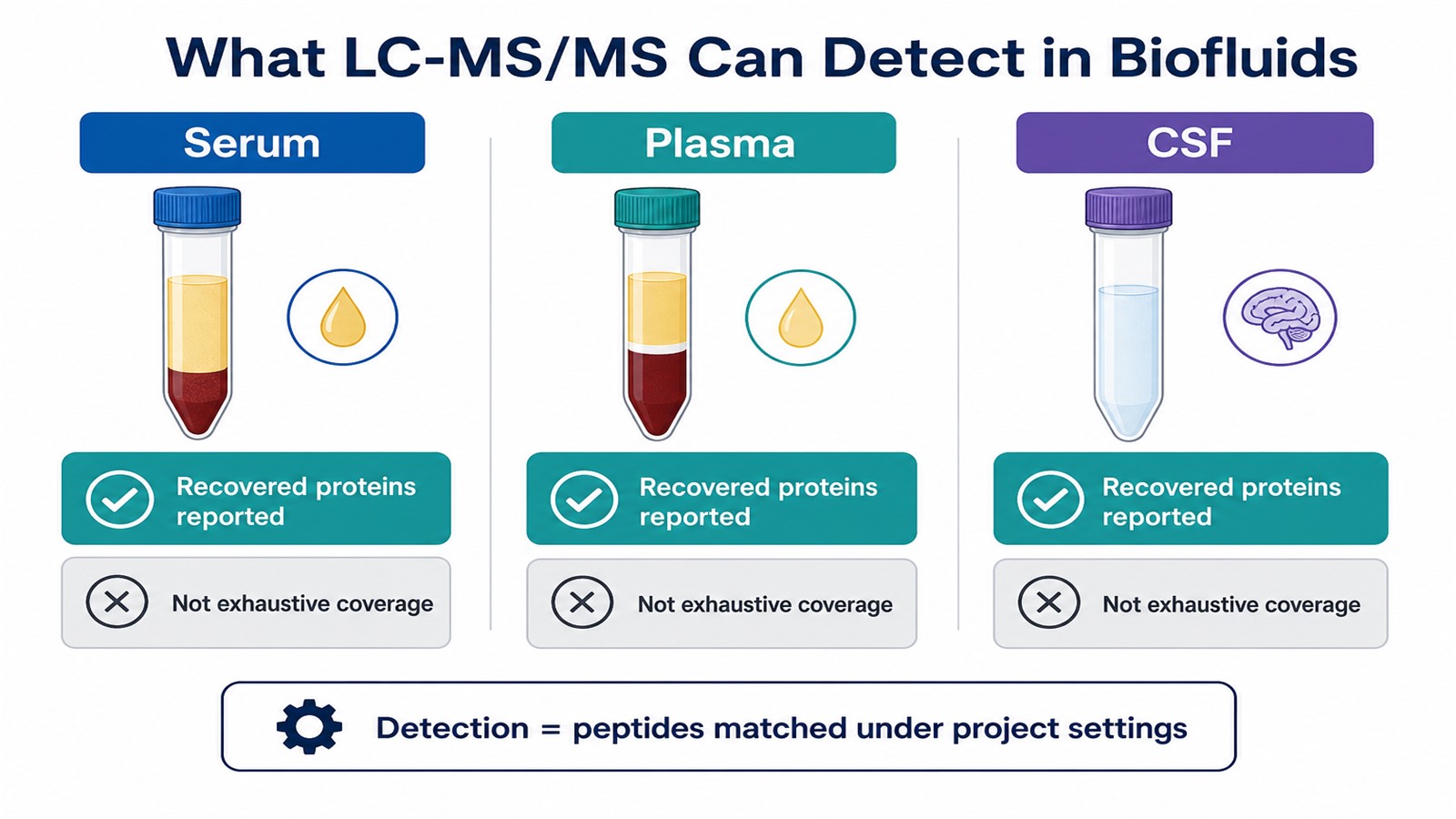
Figure 1. LC-MS/MS reports proteins recovered by the workflow, not an exhaustive catalog of every protein in the biofluid.
What LC-MS/MS Usually Surfaces in Serum, Plasma, and CSF
Serum and plasma have a wide dynamic range. A small number of dominant proteins can occupy much of the analytical signal. As a result, discovery LC-MS/MS often reports many well-represented circulating proteins clearly, while lower-abundance proteins are more variable from project to project. That is a matrix property, not a reason to dismiss the method. It is a reason to match the claim to the expected detection window.
CSF is different. Total protein content is lower than in blood-derived matrices, so detection depends on low-input recovery, adsorption control, timely cell removal, consistent storage, and sufficient analytical sensitivity. Blood contamination can introduce abundant plasma- and blood-cell-derived proteins, obscuring the native CSF profile and its biological interpretation. For CSF work, contamination control belongs in the detection discussion, not only in sample logistics.
Use the table as a scope guide for serum/plasma/CSF proteomics planning.
|
Detection question |
What LC-MS/MS can support |
What it should not be assumed to provide |
|---|---|---|
|
Can major circulating proteins be observed? |
Yes, in serum or plasma discovery workflows |
Not every isoform or proteoform by default |
|
Can group differences be detected? |
Yes, with matched samples and planned quantification |
Reliable biological attribution when groups are confounded |
|
Can low-abundance targets always be seen? |
Sometimes, and more often with a depth-focused plan |
Not guaranteed in a standard first-pass run |
|
Can CSF proteins be profiled? |
Yes, when CSF quality and contamination risk are controlled |
Unbiased results with substantial blood contamination |
|
Does “detected” equal absolute concentration? |
No |
Absolute assays need a separate targeted design |
|
Does one report cover every possible protein? |
No |
Coverage is workflow- and matrix-dependent |
Plasma chemistry also affects what enters the detectable set. Prefer EDTA or citrate as anticoagulant. Heparin is not recommended. Mixing anticoagulants across a cohort can create protein differences that look like biology but come from sample chemistry.
Why “Comprehensive Detection” Is the Wrong Trust Test
Customers often ask whether a service can “fully detect” serum, plasma, and CSF proteomes. In serum/plasma/CSF proteomics, a better trust test is whether the laboratory states what the method is designed to return and what remains outside that window.
A realistic research package for serum/plasma/CSF proteomics can be comprehensive in report structure without being exhaustive in protein coverage. Comprehensive, in this sense, means the project returns:
- Protein identification or quantitative results for the submitted samples
- Differential analysis when the design includes group comparison
- Functional annotation and pathway context for candidate ranking
- Transparent reporting of identification confidence, quantitative completeness, missing values, and workflow-specific detection limits
Reactome can be included as a standard annotation layer for supported serum or plasma species, including Bos taurus, Canis familiaris, Gallus gallus, Homo sapiens, Mus musculus, Rattus norvegicus, Sus scrofa, and Xenopus tropicalis. Outside that set, Reactome should be confirmed before it is promised. Instrument options such as Orbitrap Exploris 480, timsTOF Pro, and Orbitrap Astral can be discussed after the sample plan is clear.
What remains outside a normal discovery claim is equally important. LC-MS/MS discovery does not by itself prove disease diagnosis, deliver absolute quantification for every protein, or guarantee that a specific low-abundance target will be present in every sample. If that target defines the project, say so early so the route can be adjusted toward a depth-focused or targeted follow-up design.
Sample quality still bounds detection. Severely hemolyzed, lipemic, contaminated, precipitated, or repeatedly freeze-thawed samples are not recommended because they change which proteins dominate the spectrum. Infectious samples are not accepted.
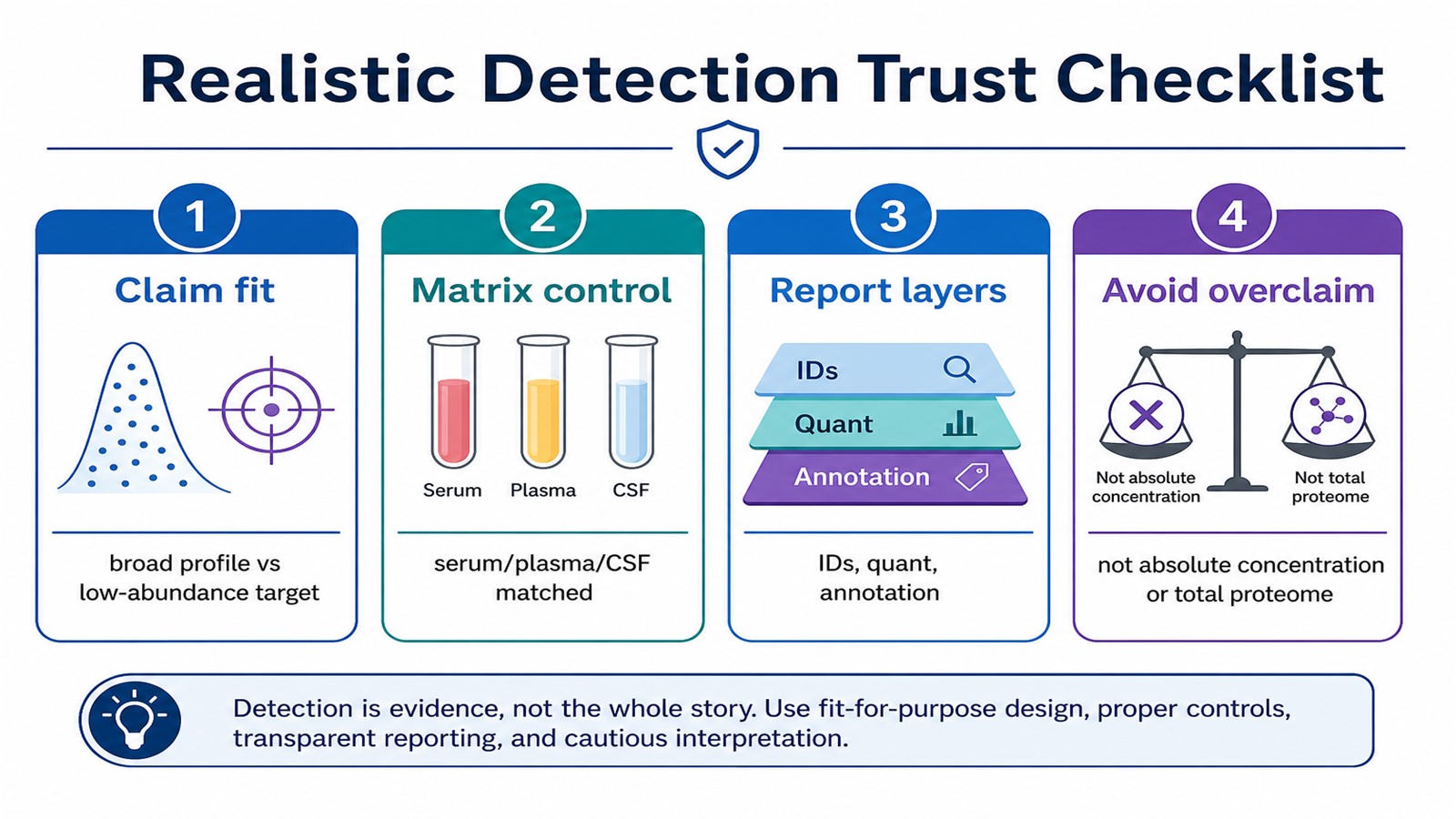
Figure 2. Judge the method by claim fit and report transparency, not by an impossible promise of total proteome coverage.
How to Read a Detection Result Without Overinterpreting It
When a protein appears in the report, treat it as evidence that peptide signals support that protein or protein group under the project’s reporting criteria. Ask three follow-up questions before building a strong biological story.
Was the protein observed consistently across biological replicates in the relevant group?
Could the observed difference still be explained by matrix, handling, batch, or other measured confounders?
Does the claim need abundance comparison only, or does it also need absolute concentration or orthogonal validation?
Pathway enrichment is hypothesis-generating and does not by itself establish pathway activity, causality, or a confirmed biological mechanism. The same caution applies to CSF-specific interpretation: a plasma-like protein set in CSF may reflect contamination rather than central nervous system biology.
If low-abundance detection is the real goal, do not use a first-pass discovery report as proof that the method failed. Use it to review target abundance, peptide suitability, sample preparation, workflow depth, and targeted-method feasibility before selecting the next step. That is usually a planning correction, not a reason to distrust LC-MS/MS as a whole.
Related Services
Blood/Plasma/Serum Proteomics Solutions
Main route for discovery or quantitative protein detection in serum and plasma research cohorts.
Cerebrospinal Fluid (CSF) Protein Quantitative Proteomics Solutions
Complementary when the detection claim is CSF-centered and contamination control is part of study design.
High-Depth Blood Proteomics Service
Next step when standard discovery is not enough for the low-abundance proteins that define the project claim.
Frequently Asked Questions
Can LC-MS/MS detect all proteins in serum, plasma, or CSF?
No. It detects proteins recovered by the chosen workflow under the abundance range and sample conditions of the project. Exhaustive coverage of every protein is not a realistic discovery claim.
Why are low-abundance proteins harder to detect in serum and plasma?
Because high-abundance circulating proteins occupy much of the analytical signal. Low-abundance targets may need a depth-focused design or later targeted work.
Is CSF detection the same as plasma detection?
No. CSF has lower total protein and is highly sensitive to blood contamination. Clean collection and storage are part of what makes CSF detection interpretable.
What does a complete report usually include?
Protein identification or quantitative results, differential analysis when groups are planned, and annotation layers such as GO, KEGG, COG, PPI, and Reactome where species support allows.
What information should be shared before judging detection fit?
Share matrix, species, comparison design, and whether the priority is broad profiling or specific low-abundance targets. MtoZ Biolabs can then align serum/plasma/CSF proteomics expectations with the claim.
Conclusion
LC-MS/MS can provide clear protein-level detection in serum, plasma, and CSF research projects, but detection is always claim- and matrix-dependent. The trustworthy question for serum/plasma/CSF proteomics is not whether every protein can be found. It is whether the workflow, report layers, and sample controls match the proteins you need to observe. Set that expectation early, keep anticoagulant and sample quality under control, and move to a depth-focused path when low-abundance targets define the study.
Researchers who want a detection-fit review can contact MtoZ Biolabs with matrix, species, study contrast, and target class before sample processing begins.
How to order?




