Cerebrospinal Fluid (CSF) Protein Quantitative Proteomics Solutions
MtoZ Biolabs provides Cerebrospinal Fluid (CSF) Protein Quantitative Proteomics Solutions using DIA LC-MS/MS for broad protein profiling and reproducible relative quantification across CSF samples.
Designed for comparative CSF proteomics, the workflow combines controlled sample preparation, DIA acquisition, and quantitative bioinformatics to characterize protein abundance changes across study groups.
- DIA-based relative quantification across multiple CSF samples
- High-resolution LC-MS/MS for complex CSF proteome profiling
- CSF-specific sample handling for limited-volume biofluids
- Quantitative bioinformatics for differential protein analysis
What Is CSF Quantitative Proteomics?
Cerebrospinal fluid contains proteins that can reflect molecular changes associated with the central nervous system, making CSF proteomics valuable for neurological mechanism research, biomarker candidate discovery, and treatment-response studies. Compared with many tissue samples, CSF often provides limited protein input and contains proteins across a wide abundance range, so consistent sample handling and sensitive LC-MS/MS analysis are important.
Data-independent acquisition (DIA) divides the precursor mass range into sequential isolation windows and systematically collects fragment-ion information from peptides within each window. This sampling strategy supports broad protein identification, reproducible relative quantification, and consistent quantitative matrices across multi-sample studies.
When This Service Is a Good Fit
Choose DIA-based CSF proteomics when the main goal is to compare protein abundance across predefined CSF groups and generate a consistent quantitative dataset for downstream interpretation.
Typical study designs include:
- Case-control or phenotype comparisons
- Multi-group neurological research studies
- Treatment-response or pharmacology studies
- Longitudinal or time-course CSF studies
- Biomarker candidate discovery followed by targeted verification
DIA is especially practical for studies with multiple independently measured samples because new samples can be analyzed without fixed labeling channels. If the final objective is verification of a small set of predefined proteins, PRM or MRM may be more appropriate for the follow-up stage.
Cerebrospinal Fluid (CSF) Protein Quantitative Proteomics Solutions at MtoZ Biolabs
MtoZ Biolabs provides Cerebrospinal Fluid (CSF) Protein Quantitative Proteomics Solutions for CSF protein profiling, relative quantification, differential protein analysis, and downstream biological interpretation. Study support can be tailored to sample volume, group structure, biological replicates, planned comparisons, and research objectives.
Service scope can include CSF sample evaluation, DIA LC-MS/MS acquisition, DIA-NN data processing, quantitative quality control, differential protein analysis, data visualization, functional annotation, pathway enrichment, and other database-supported analyses. Results are organized to support candidate prioritization and follow-up research.
Workflow of Cerebrospinal Fluid (CSF) Protein Quantitative Proteomics Solutions
1. CSF Sample Preparation
CSF samples are evaluated and processed under consistent conditions to prepare proteins for downstream analysis.
2. Protein Digestion
Proteins are reduced, alkylated, and enzymatically digested into peptides.
3. LC-MS/MS DIA Acquisition
Peptides are separated by liquid chromatography and analyzed by high-resolution mass spectrometry using DIA acquisition.
4. DIA Data Processing and Quantification
DIA-NN is used for peptide and protein identification, relative quantification, and quantitative quality control.
5. Bioinformatics Analysis
Differential proteins are evaluated through statistical analysis, visualization, functional annotation, and pathway enrichment.
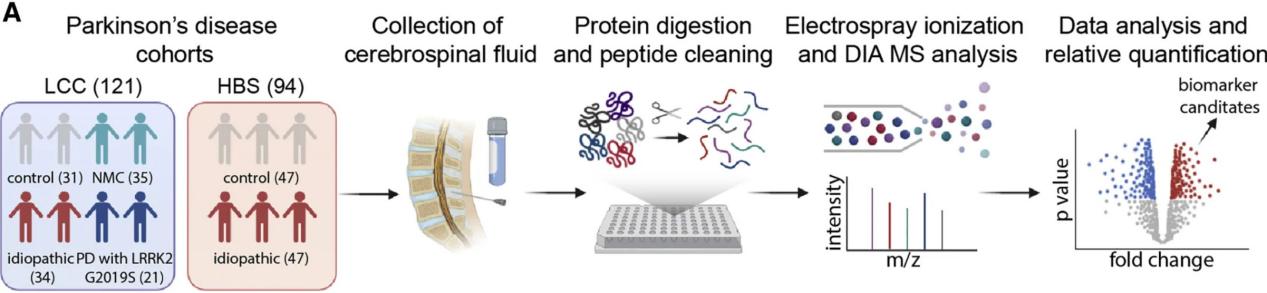
Karayel, O. et al. Cell Rep Med. 2022.
Figure 1. Overview of the Cerebrospinal Fluid (CSF) Protein Quantitative Proteomics Workflow
Why Choose MtoZ Biolabs?
1. CSF-Focused Sample Planning
Sample volume, group design, and available material are reviewed before analysis to support efficient use of limited CSF samples.
2. High-Resolution DIA LC-MS/MS
High-resolution mass spectrometry supports broad CSF protein profiling and reproducible relative quantification.
3. Integrated Bioinformatics
Differential analysis, visualization, GO and KEGG enrichment, and other applicable analyses support biological interpretation.
4. One-Stop Service
MtoZ Biolabs integrates sample evaluation, LC-MS/MS analysis, quantitative processing, and result interpretation within one service workflow.
Applications
1. Alzheimer's Disease Research
Profile CSF protein changes associated with neurodegeneration, amyloid pathology, tau-related processes, and disease progression.
2. Parkinson's Disease Research
Investigate protein abundance changes related to neuronal dysfunction, neuroinflammation, and disease-associated pathways.
3. Multiple Sclerosis Research
Analyze CSF proteins involved in immune activation, inflammation, demyelination, and nervous system injury.
4. Traumatic Brain Injury Research
Evaluate CSF protein changes linked to neuronal damage, inflammation, and recovery processes.
5. Other Neurological Disease Studies
Cerebrospinal Fluid (CSF) Protein Quantitative Proteomics Solutions can also support research on epilepsy, stroke, brain tumors, and other central nervous system disorders.
Sample Submission Suggestions
1. Sample Amount
The following values are general recommendations for DIA-based CSF quantitative proteomics. Actual requirements may be adjusted according to sample quality, available volume, and analytical objectives. Contact MtoZ Biolabs for study-specific submission guidance.
|
Sample Type |
Recommended Quantity |
Minimum Quantity |
|
Cerebrospinal Fluid |
0.1 mL |
0.05 mL |
|
Animal Tissue |
20-100 mg |
10-50 mg |
|
Cell Pellet |
1 × 10⁷ cells |
2 × 10⁶ cells |
|
Extracted Protein Solution |
20 μL |
10 μL |
2. Storage and Shipping
Store CSF samples at -80 C when applicable and ship on dry ice. Avoid repeated freeze-thaw cycles and keep collection, processing, and storage conditions consistent across study groups.
Deliverables
Cerebrospinal Fluid (CSF) Protein Quantitative Proteomics Solutions typically provide:
- Protein and Peptide Identification. Identified proteins, peptides, and supporting identification information.
- Relative Protein Quantification. Protein abundance matrices across submitted CSF samples and study groups.
- Differential Protein Analysis. Statistical comparisons of protein abundance changes between predefined groups.
- Quality Control and Visualization. Quantitative QC, PCA, clustering heatmaps, volcano plots, and other project-relevant figures.
- Functional Analysis. GO annotation, KEGG pathway enrichment, and other database-supported analyses when applicable.
- Raw Data and Final Report. Raw mass spectrometry data, processed result tables, and a structured analysis report.
FAQ
Should I use CSF or blood for my neurological biomarker study?
The choice depends on whether the study prioritizes CNS-specific discovery or large-scale, minimally invasive sampling.
CSF is closer to the brain and spinal cord environment, so protein changes in CSF can more directly reflect neuronal, synaptic, glial, and other CNS-related processes. CSF is therefore well suited to discovery studies focused on neurologically relevant protein changes. The main limitation is sample accessibility, because CSF collection is more invasive and repeated sampling is less practical.
Plasma or serum is easier to collect, more suitable for large cohorts, and better suited to repeated or longitudinal sampling. Blood-based samples can support screening and follow-up validation, but CNS-derived proteins are mixed with a much larger background of circulating proteins and systemic biological signals.
For studies that need to distinguish CNS-associated changes from systemic effects, a paired CSF and plasma/serum design can be especially informative. MtoZ Biolabs also provides plasma and serum proteomics services and can help select an appropriate sample strategy based on your biomarker goals, cohort design, sample availability, and validation plan.
Contact Us
Planning a CSF proteomics study? Share the species, sample number, group design, available CSF volume, planned comparisons, and research objective with MtoZ Biolabs.
MtoZ Biolabs provides a free project consultation for Cerebrospinal Fluid (CSF) Protein Quantitative Proteomics Solutions. We can discuss sample suitability and DIA strategy with you and provide a project quote based on your specific study requirements.
MtoZ Biolabs, an integrated chromatography and mass spectrometry (MS) services provider.
Related Services
Quantitative Proteomics Service
Label-Based Protein Quantitative Service—iTRAQ, TMT, SILAC
