






Serum/Plasma/CSF Proteomics: How Biofluid Samples Are Analyzed by LC-MS/MS
Serum, plasma, and CSF samples are analyzed by LC-MS/MS through a defined protein workflow: confirm the biofluid matrix, recover and digest proteins, separate peptides by liquid chromatography, measure them by mass spectrometry, then convert spectra into protein identifications or quantitative matrices. The instrument does not “scan the fluid” directly. It measures peptides generated from the protein fraction that entered digestion.
For serum/plasma/CSF proteomics, the technical path is similar across the three matrices, but matrix chemistry still matters at intake. Serum and plasma are not interchangeable. For plasma, EDTA or citrate is preferred and heparin is not recommended. CSF needs contamination-aware handling because blood carryover can reshape the detectable protein set before acquisition begins.
If you want the workflow matched to a real cohort, share with MtoZ Biolabs the matrix, species, comparison design, and whether the project needs identification or quantitative comparison. That is enough to align the LC-MS/MS route before samples are processed.
The Analytical Path in Plain Terms
A biofluid proteomics run is a sequence of conversions. Proteins in serum, plasma, or CSF are recovered, concentrated, or cleaned up as needed, digested into peptides, separated by LC, ionized, and measured by mass spectrometry. Software then matches those spectra to peptide and protein sequences and, when planned, builds abundance tables across samples.
That sequence is why serum/plasma/CSF protein analysis reports protein-level evidence rather than a raw clinical chemistry panel. Each step narrows what can be observed later. Poor matrix matching or compromised sample quality can change the peptide mixture before the mass spectrometer starts, so intake control belongs inside the analytical story, not outside it.
Severely hemolyzed, lipemic, contaminated, precipitated, or repeatedly freeze-thawed samples are not recommended for this path. Infectious samples are not accepted.
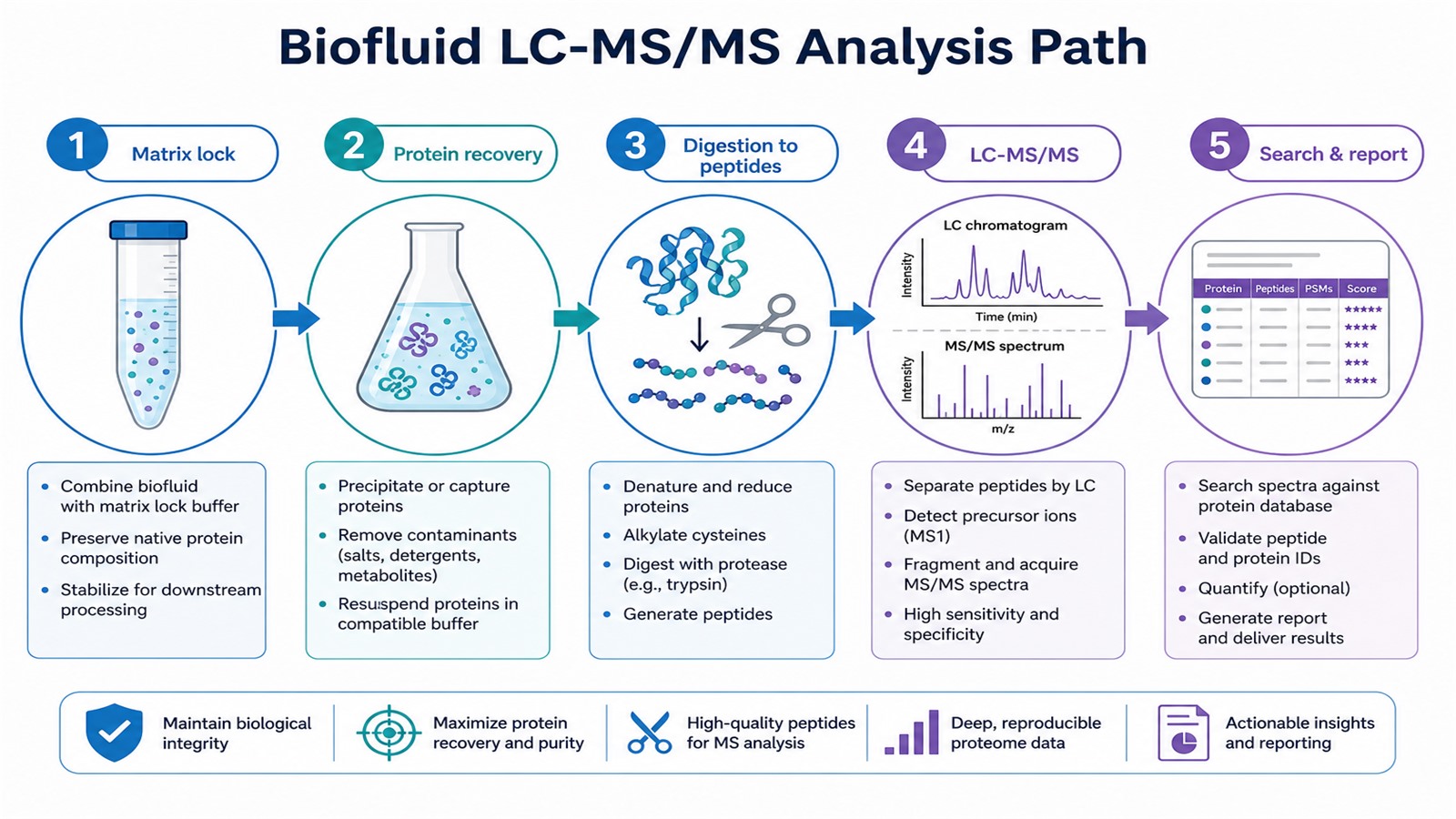
Figure 1. Biofluid proteomics converts proteins to peptides, then uses LC-MS/MS and database searching to return protein-level results.
Step by Step: From Biofluid Vial to Spectrum
1. Matrix lock and sample intake
The first technical decision is confirming what is in the vial. Serum, plasma, and CSF must be labeled as such. Plasma projects should also lock one anticoagulant class across compared samples. Prefer EDTA or citrate. Avoid heparin. A mixed anticoagulant cohort is not a minor paperwork issue; it changes the protein background that later enters LC-MS/MS.
CSF intake adds a contamination check.Blood contamination can introduce abundant blood-derived proteins and obscure the native CSF profile. Record visible discoloration, traumatic collection, red-blood-cell information, and processing history where available. In serum/plasma/CSF proteomics, that intake check is part of the analytical method, not an optional admin step.
2. Protein recovery and optional preprocessing
Proteins are recovered from the biofluid under a consistent protocol across all arms. In serum and plasma, the wide abundance range means a standard discovery path often captures many well-represented circulating proteins, while lower-abundance proteins may remain harder to rank. If the claim depends on those lower-abundance targets, a depth-focused route or other preprocessing strategy should be decided before digestion, not after the first report returns.
CSF usually contains much less total protein than serum or plasma, so low-input recovery, adsorption loss, and contamination control become especially important. Plasma-oriented preprocessing should not be copied automatically.
3. Digestion to peptides
Protein preparation commonly includes denaturation, reduction, alkylation, enzymatic digestion, and peptide cleanup. These steps should remain consistent across samples so preparation efficiency does not become a group-specific source of variation.
4. LC separation and MS acquisition
Peptides are separated by liquid chromatography, then measured by mass spectrometry. In serum/plasma/CSF proteomics, acquisition is commonly planned as DDA or DIA once the cohort and claim are clear.
DDA supports flexible discovery and protein identification, while DIA often improves data completeness and quantitative consistency across matched samples. The choice should follow the study objective, required depth, cohort design, and platform. Samples should be randomized or balanced across acquisition batches, with pooled QC or system-suitability samples used to monitor instrument stability and batch drift. The instrument platform can then be selected for the required depth and acquisition route.
5. Database searching, quantification, and report assembly
Software assigns spectra to peptide sequences under defined confidence and false-discovery controls, then infers proteins or protein groups and builds quantitative matrices where planned. DDA projects are commonly analyzed with MaxQuant or Proteome Discoverer. DIA projects are commonly supported by Spectronaut or DIA-NN. Software versions are not required to understand the workflow. What matters is that the search and quantification settings match the acquisition mode and the comparison the study was designed to make.
A research report for this path can include protein identification tables or quantitative matrices, differential screening when groups were planned, and annotation layers such as GO, KEGG, COG, PPI, and Reactome where species support allows. For serum or plasma projects, Reactome can be delivered for Bos taurus, Canis familiaris, Gallus gallus, Homo sapiens, Mus musculus, Rattus norvegicus, Sus scrofa, and Xenopus tropicalis. Outside that set, Reactome should be confirmed before it is assumed.
|
Workflow stage |
What happens technically |
What this controls in the final result |
|---|---|---|
|
Matrix lock |
Confirm serum, plasma, or CSF and plasma anticoagulant |
Prevents chemistry-driven false differences |
|
Protein recovery |
Prepare a comparable protein fraction from each vial |
Sets which proteins can enter digestion |
|
Digestion |
Convert proteins to peptides |
Creates the molecules actually measured by LC-MS/MS |
|
LC-MS/MS |
Separate and measure peptides |
Generates spectra for identification or quantification |
|
Informatics |
Search, quantify, annotate |
Turns spectra into protein tables and pathway context |
Where Serum, Plasma, and CSF Diverge Inside the Same Workflow
The LC-MS/MS skeleton is shared, but the three matrices do not behave identically.
Serum reflects the fluid after clotting. Plasma retains more clotting-related components, while anticoagulant type and processing conditions can influence the measurable protein profile. CSF sits closer to the central nervous system compartment, but only if blood contamination is controlled. In practice, CSF detection limits may reflect blood contamination, low protein input, sample loss, handling variation, or analytical sensitivity before and during acquisition.
These differences do not require three unrelated instruments. They require the same analytical discipline applied to different biological backgrounds. That is also why serum/plasma/CSF proteomics should keep matrix identity visible in every sample sheet that accompanies the run.
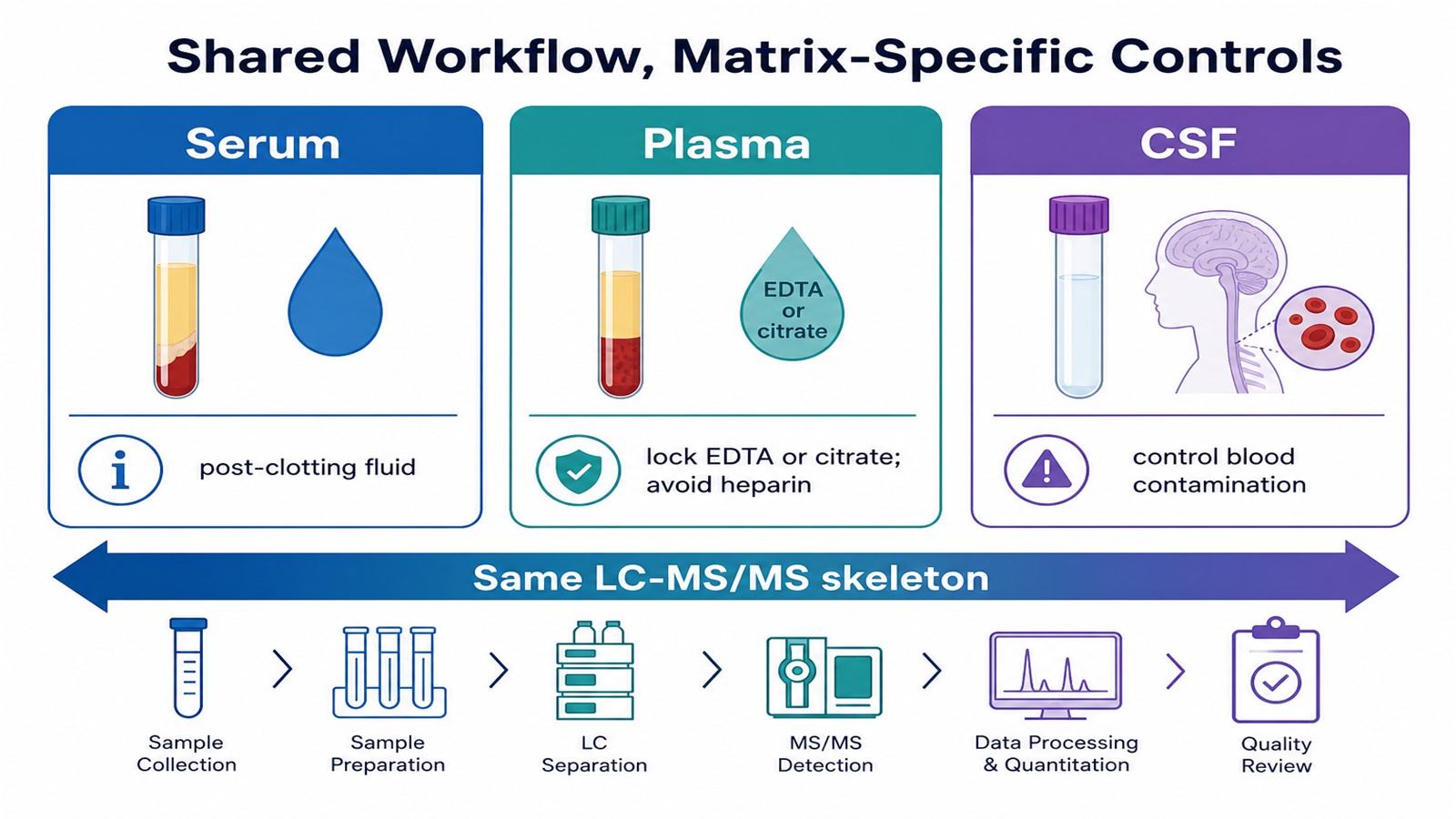
Figure 2. Serum, plasma, and CSF share one LC-MS/MS skeleton, with matrix-specific controls at intake and preparation.
What the Final Protein Result Is and Is Not
After searching and quantification, the report describes proteins recovered and compared under the project conditions. A protein identification means that peptide evidence was assigned to a protein or protein group under the project’s reporting criteria. A quantitative difference indicates a measured abundance change between designed groups under the selected workflow and statistical criteria, subject to technical and biological validation.
The same report should not be read as absolute concentration for every protein, proof of clinical diagnosis, or evidence that every low-abundance target was measurable. Those claims need different study designs. Pathway annotation organizes candidates. It does not finish the biological argument by itself.
When low-abundance detection is the real endpoint, a standard discovery run can still be useful as a first map, then a depth-focused follow-up can be planned once the matrix and cohort are stable.
Related Services
Blood/Plasma/Serum Proteomics Solutions
Main route for LC-MS/MS analysis of serum and plasma research samples through identification or quantitative proteomics.
Cerebrospinal Fluid (CSF) Protein Quantitative Proteomics Solutions
Complementary when the workflow is applied to CSF and contamination-aware design is required.
High-Depth Blood Proteomics Service
Next step when the shared LC-MS/MS path needs a depth-focused route for lower-abundance blood proteins.
Frequently Asked Questions
Does LC-MS/MS measure intact proteins in serum, plasma, or CSF?
In standard discovery proteomics, the measured analytes are usually peptides generated by digestion. Protein results are inferred from matched peptides.
Why must plasma anticoagulant be locked before analysis?
Anticoagulant chemistry changes the protein background. Prefer EDTA or citrate and avoid heparin so group differences are not driven by tube chemistry.
Is the CSF workflow completely different from plasma?
No. The LC-MS/MS skeleton is shared. CSF still needs its own intake and contamination controls because blood carryover can dominate the detectable set.
What software is used after acquisition?
DDA data are commonly processed with MaxQuant or Proteome Discoverer. DIA data are commonly supported by Spectronaut or DIA-NN.
What should be shared before choosing the analytical route?
Share matrix, species, group design, and whether the project needs identification or quantitative comparison. MtoZ Biolabs can then map the cohort to a serum/plasma/CSF proteomics workflow before processing starts, including whether a standard discovery path or a depth-focused follow-up is more realistic.
Conclusion
Biofluid LC-MS/MS analysis is a conversion pipeline: matrix-confirmed sample, protein recovery, peptide digestion, chromatographic separation, mass measurement, and informatics. Serum/plasma/CSF proteomics uses that same skeleton, with matrix-specific controls that decide whether the final protein table reflects biology or handling chemistry. Read the report as protein-level evidence from this path, and plan a depth-focused follow-up when low-abundance targets define the claim.
Teams preparing samples for this workflow can review matrix, anticoagulant, cohort design, and expected output with MtoZ Biolabs before the first vial is thawed.
How to order?




