



Scoping a targeted mass spectrometry project starts before samples leave the bench. Multiple reaction monitoring (MRM) and parallel reaction monitoring (PRM) quantify a predefined peptide or protein panel on liquid chromatography-tandem mass spectrometry (LC-MS/MS) (Lange et al. 2008; Peterson et al. 2012). Feasibility depends on which analytes are locked, which platform can support them in matrix, and which validation deliverables the report must carry. Panel size, sample count, and documentation depth are not interchangeable with project success.
Relative fold-change and absolute amount remain separate claim units on the same cohort. Absolute reporting needs matched stable isotope-labeled internal standard (SIS) peptides or Absolute QUAntification (AQUA) design plus a declared calibration model (Gerber et al. 2003; Carr et al. 2014). Surrogate peptides report the measured sequence under the stated digest and spike timing. They do not invent every isoform or post-translational state (Bantscheff et al. 2012).
In MtoZ Biolabs targeted offerings, project scope is set when analyte priority tiers, matrix notes, MRM or PRM preference, quantitation claim, and report deliverables are written in the brief. Service intake appears in Targeted Proteomics Service.
What Targeted Project Scope Must Cover
Four scoping layers belong in the brief and stay separated.
Panel layer lists proteins or proteotypic peptides with priority tiers so cycle time can protect the decision-critical subset first.
Platform layer chooses MRM for stable scheduled transitions, PRM when high-resolution fragment review is required, or a hybrid panel when both are justified (Peterson et al. 2012).
Quantitation layer states relative normalization or SIS-calibrated absolute units, including whether calibrators and QC levels are in scope.
Deliverable layer names the tables, method notes, QC summaries, failed-target flags, and any validation depth the stakeholder will review.
Scope is defined by panel priority, platform fit, claim unit, and report depth. Sample count alone does not define the assay.
How Panel Size, Platform, and Validation Depth Interact
Panel design and platform choice are one planning object.
A small closed panel in a clean matrix often fits MRM after a matrix-matched transition pilot. Larger pathway panels need retention scheduling and cycle-time review before lock-in. Interference-limited peptides may need PRM fragment confirmation rather than forcing weak unit-resolution transitions. Absolute claims add SIS sourcing, calibration levels, and recovery QC on top of the same panel (Gerber et al. 2003).
Validation deliverables should match the decision. Internal research confirmation may need quantified tables, method notes, and failed-target flags. Biomarker or QC programs may require explicit pilot notes, calibration plots, and acceptance criteria declared before cohort acquisition (Carr et al. 2014). Expanding the panel after method lock usually costs more than tiering targets at quote time.
Discovery nominates candidates. Targeted scope begins only after a shortlist is nameable. Route timing between open profiling and closed-panel remasurement appears in Targeted Mass Spectrometry or Discovery LC-MS/MS? Matching MRM, PRM, and Profiling Routes to Your Analytical Goal. Platform detail between scheduled transitions and fragment spectra appears in Parallel Reaction Monitoring vs MRM: Which Fits?.
End-to-End Workflow to Scope a Targeted Project
A practical scoping spine usually runs as follows.
- Freeze the decision the panel must support: relative group contrast, pathway confirmation, or absolute amount.
- Build analyte priority tiers: decision-critical peptides first, exploratory targets second.
- Document matrix, pretreatment parity, storage, and expected sample plus QC count.
- Declare relative versus absolute claim unit and whether SIS or AQUA standards are available.
- Choose MRM, PRM, or a hybrid design from matrix risk and fragment-review need.
- Run a matrix-matched pilot on priority targets before shipping the full cohort.
- Lock panel version, acquisition method, acceptance criteria, and deliverable list.
- Acquire study samples with interleaved QC, blanks, and calibrators when absolute units are required.
- Deliver tables with method notes, QC summaries, and failed-target flags; archive the locked scope with the report.
Steps 1 through 4 protect the decision and claim. Steps 5 through 9 are the platform, pilot, and deliverable record. PRM service context appears in Parallel Reaction Monitoring (PRM) Service. MRM/SRM service context appears in SRM-MRM Quantitative Proteomics Services. Absolute AQUA intake appears in Absolute Quantitative Analysis (AQUA) Service.
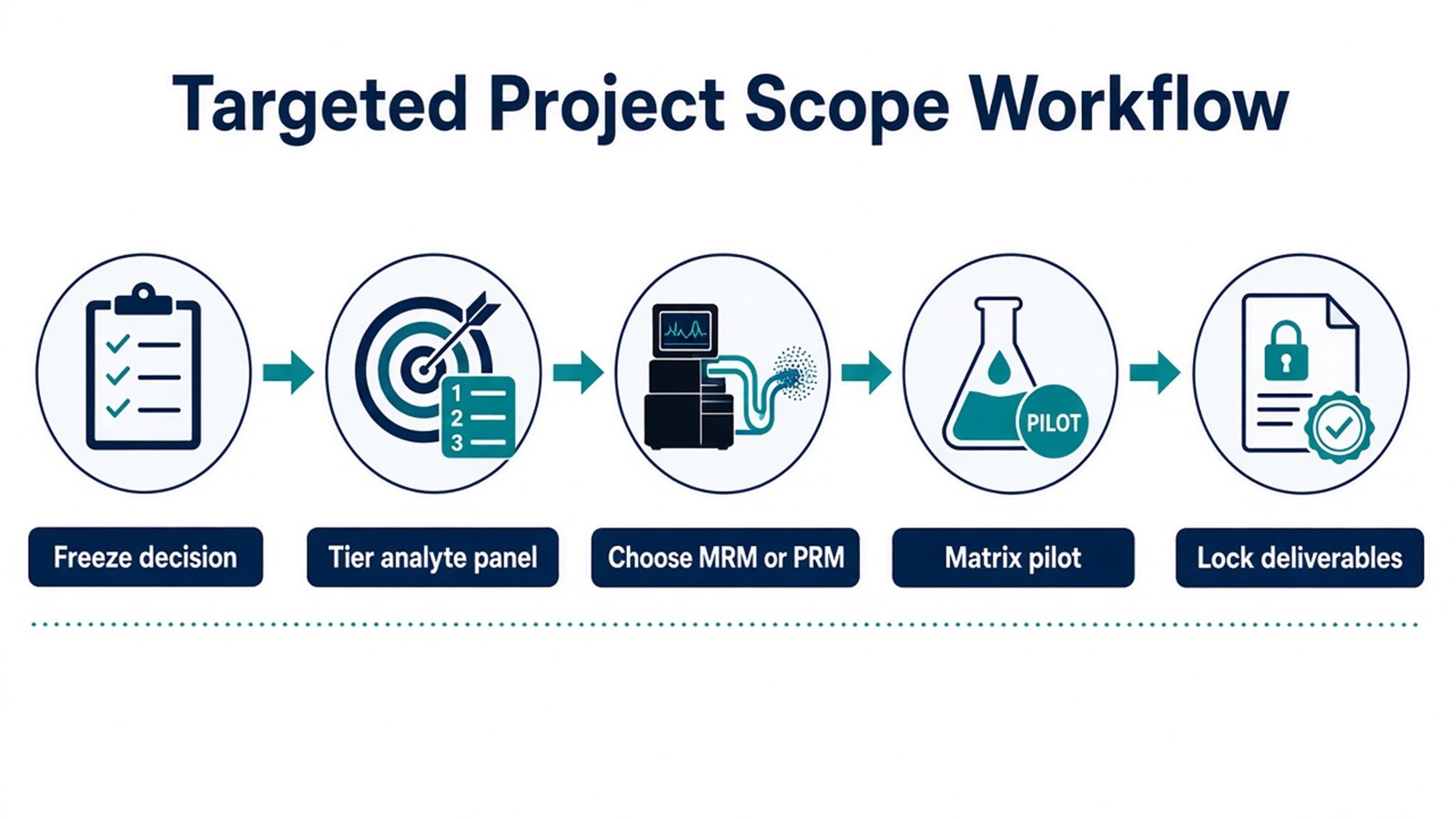
Figure 1. Targeted scope is locked after analyte tiers, platform choice, and a matrix pilot; deliverables are declared before cohort acquisition.
Parameters That Must Be Locked Before Quote and Cohort
Layer |
Parameter that must be declared |
Failure mode if ignored |
|---|---|---|
Decision |
Relative contrast versus absolute unit |
Wrong platform and QC depth selected |
Panel |
Peptide list version and priority tiers |
Late growth breaks cycle time |
Matrix |
Type, storage, pretreatment parity |
Suppression read as biology |
Platform |
MRM, PRM, or hybrid rationale |
Defaulting all targets to one mode |
Cycle time |
Retention windows and dwell schedule |
Dropped transitions on large panels |
SIS or AQUA |
Spike step and assigned amount |
Amount claim without calibration design |
Cohort |
Study n plus blanks, QC, calibrators |
Understated injection load |
Acceptance |
Peak rules, CV limits, range flags |
Report judged only by completion |
Deliverable |
Table, method notes, QC, failed targets |
Rebuild documentation after acquisition |
Archive |
Method and panel version with report |
Untraceable remasurement later |
Limits follow the same table. A large first-pass panel does not guarantee decision-ready data. MRM does not correct unmatched prep. PRM does not replace a closed shortlist. Discovery detectability does not prove targeted response in the study matrix. Absolute units outside a validated interval remain provisional.
What a Scoped Targeted Package Can Support
A locked relative panel supports same-peptide comparison across samples acquired with one method version and declared normalization. A locked absolute panel supports concentration or amount for surrogates inside the calibrated range when SIS design and QC recovery are documented.
Failed or borderline targets support exclusion, redesign, or staged PRM follow-up. They do not support silent zeros in group means. Tier-two exploratory peptides support expansion only after cycle time and matrix pilot confirm capacity. Clinical diagnosis or release language needs a separately validated method beyond a research scoping package.
A scoped package supports the declared decision. It does not convert an open proteome into a validated biomarker cutoff.
How to Choose Panel, Platform, and Deliverable Depth
Use list status, matrix risk, claim unit, and report use together.
Project signal |
Scope that often fits |
Recheck before committing |
|---|---|---|
Named peptides, clean matrix, relative claim |
Small MRM panel after matrix pilot |
Oversized first panel without tiers |
Plasma or tissue with interference history |
Staged panel; PRM on hard subset |
Assume lysate transitions transfer |
Absolute ng/mL or fmol required |
SIS or AQUA design plus calibrators |
Relative-only method for amount claims |
Pathway breadth still exploratory |
Tier-one lock; tier-two after pilot |
Freeze 50-plus targets on day one |
List still open or candidates unnamed |
Discovery profiling first |
Targeted quote on unnamed proteins |
Stakeholder needs method and QC notes |
Deliverables locked at quote |
Add validation docs after acquisition |
Prior MRM transitions unstable in matrix |
PRM review or surrogate redesign |
Scale the same weak transitions |
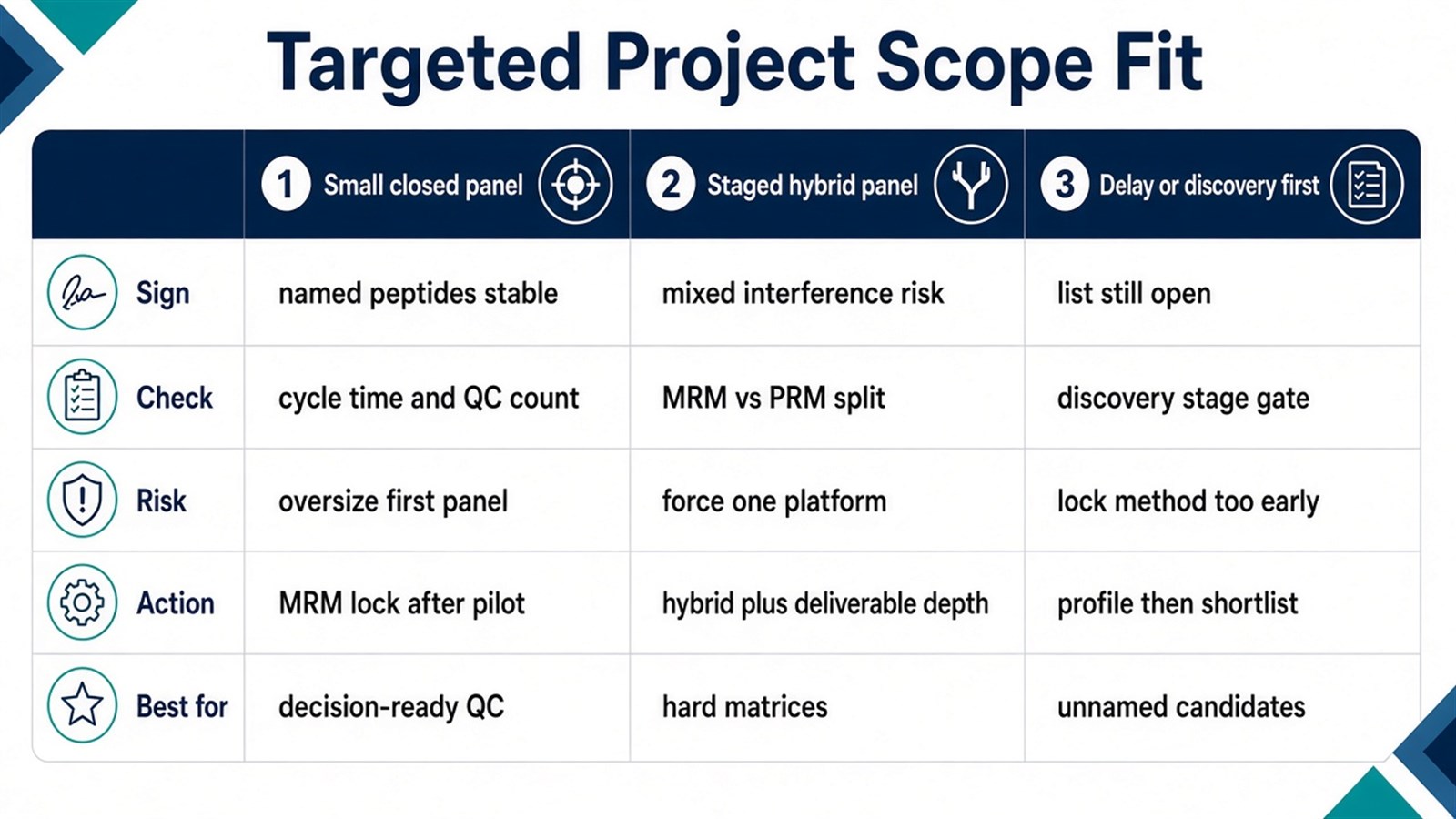
Figure 2. Match panel size and platform to matrix risk and claim unit; lock deliverables before the cohort ships.
Results interpretation after delivery belongs on a dedicated review path in Reading Targeted Mass Spectrometry Results with Confidence. Teams with analyte tiers, matrix notes, platform preference, and deliverable lists can review MtoZ Biolabs Targeted Proteomics Service when those fields are declared in the project record.
Frequently Asked Questions
1. What information should go in a targeted mass spectrometry quote request?
Provide analyte priority tiers, matrix and pretreatment notes, study n plus planned QC, relative versus absolute claim, MRM or PRM preference if any, prior detectability data, and the deliverables required for review.
2. Can a large panel be requested on the first assay?
Only when cycle time and matrix pilot data support it. Staging tier-one targets first usually protects decision-critical performance better than locking a maximal list on day one.
3. How many samples are needed for scoping?
There is no fixed n. Count biological replicates required by the contrast, then add blanks, QC pools, and any calibration or SIS levels. Study n alone understates injection load.
4. When should PRM be scoped instead of MRM?
When matrix-matched pilots show unstable transition ratios, when fragment-level confirmation is required for acceptance, or when a hybrid design keeps stable targets on MRM and hard targets on PRM.
5. What validation deliverables should be locked before acquisition?
At minimum: quantified analyte table, transition or fragment panel summary, normalization or calibration notes, QC summary, and failed-target flags. Add calibration plots and pilot notes when absolute units or formal review are required.
MtoZ Biolabs can provide targeted proteomics analysis using MRM, PRM, and isotope-assisted absolute quantification for predefined protein or peptide panels, including feasibility-aligned scoping when analyte tiers, matrix notes, and deliverables are documented.
If further evaluation of panel staging, MRM versus PRM design, or validation deliverable depth is needed, project details can be submitted for a feasibility review.
Reference
- V. Lange, P. Picotti, B. Domon, R. Aebersold (2008). Selected reaction monitoring for quantitative proteomics: a tutorial. Mol. Syst. Biol., 4, 222. https://doi.org/10.1038/msb.2008.61
- A.C. Peterson, J.D. Russell, A.A. Klammer, P.F. Doubleday, H. Liu, J.N. Anderson, M.J. MacCoss (2012). Parallel reaction monitoring for high resolution and high mass accuracy quantitative, targeted proteomics. Mol. Cell. Proteomics, 11, 1475-1488. https://doi.org/10.1074/mcp.O112.020271
- S.A. Gerber, J. Rush, O. Stemman, M.W. Kirschner, S.P. Gygi (2003). Absolute quantification of proteins and phosphoproteins from cell lysates by tandem MS. Proc. Natl. Acad. Sci. U.S.A., 100, 6940-6945. https://doi.org/10.1073/pnas.0832254100
- S.A. Carr, S.E. Abbatiello, B.L. Ackermann, C. Borchers, B. Domon, E.W. Deutsch, R.P. Grant, A.N. Hoofnagle, R. Huttenhain, J.M. Koomen, D.C. Liebler, T. Liu, B. MacLean, D.R. Mani, E. Mansfield, H. Neubert, A.G. Paulovich, L. Reiter, O. Vitek, R. Aebersold, A.J. Smith, et al. (2014). Targeted peptide measurements in biology and medicine: best practices for sample preparation, assay standardization, and assay validation. Mol. Cell. Proteomics, 13, 907-917. https://doi.org/10.1074/mcp.M113.036095
- M. Bantscheff, S. Lemeer, H.U. Haab, B. Kuster (2012). Quantitative mass spectrometry in proteomics: a critical review. Anal. Bioanal. Chem., 404, 939-965. https://doi.org/10.1007/s00216-012-5892-4
