






Resistant Starch Content Determination Service
- Quantitative determination of resistant starch in various plant materials, food products, and modified starches
- Comprehensive analysis of total starch, amylose, and resistant starch
- Evaluation of RS variation under different processing conditions
- Customized testing protocols and method validation
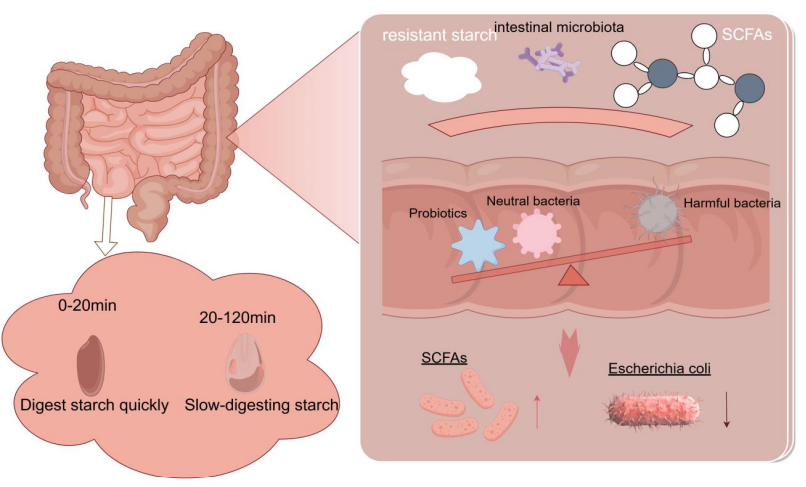
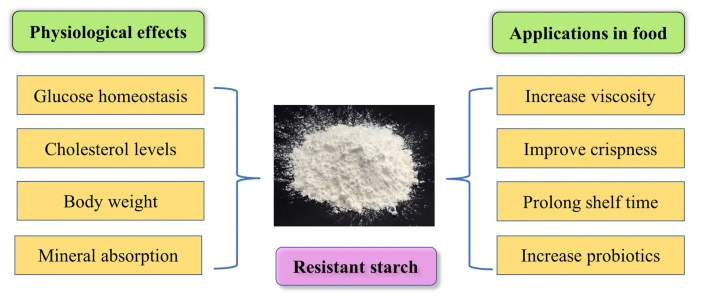
Resistant starch (RS) refers to a type of starch that resists digestion and absorption in the small intestine but can be fermented by microorganisms in the large intestine. Possessing both the physiological functions of dietary fiber and the energetic properties of starch, resistant starch has attracted wide attention in nutritional science and the food industry. Based on its structural characteristics and formation mechanisms, resistant starch is commonly classified into five types (RS1–RS5), derived from physical entrapment, crystalline structure, retrogradation, lipid complex formation, and chemical modification. It plays a vital role in regulating blood glucose levels, improving gut microbiota composition, reducing caloric intake, and enhancing food texture.
Niu, Y. et al. Foods. 2025.
Figure 1. Schematic Diagram of the Intestinal Fermentation of Resistant Starch
Accurate quantification of resistant starch content is essential for studying its nutritional effects, evaluating functional food properties, and guiding industrial processing. Quantitative results reflect the digestion resistance of starch and provide key information for food formulation optimization, raw material selection, processing control, and functional labeling.
Han, J. et al. Food Prod Process and Nutr. 2023.
Figure 2. Physiological Effects of Resistant Starch and Its Applications in Food
With advanced enzymatic analysis platforms and high-precision spectrophotometric systems, MtoZ Biolabs offers a reliable resistant starch content determination service to help researchers and enterprises in food science, agriculture, nutrition, and biomaterials obtain accurate, reproducible data on resistant starch content, providing strong support for product development and quality control. MtoZ Biolabs provides but is not limited to:
Technical Principles
The method in our resistant starch content determination service is based on the combination of specific enzymatic digestion and a glucose oxidase colorimetric reaction. Digestible starch in the sample is hydrolyzed into glucose under simulated intestinal conditions using pancreatic α-amylase and amyloglucosidase, while resistant starch remains undigested in the residue.
After washing to remove soluble sugars, the residue is dissolved in dimethyl sulfoxide (DMSO) and completely hydrolyzed into glucose with amyloglucosidase. Glucose content is then determined using the glucose oxidase/peroxidase (GOPOD) colorimetric method, and resistant starch content is calculated from absorbance data.
Analysis Workflow
1. Sample preparation: Finely grind the sample (1–2 g dry weight) and preheat it in a buffered solution.
2. Enzymatic digestion: Add a mixed enzyme solution containing α-amylase and pancreatic amylase and incubate at 37°C for 16 hours to simulate intestinal digestion.
3. Removal of digestible starch: Centrifuge and discard the supernatant, then wash the residue with ethanol or sodium acetate buffer to eliminate soluble sugars.
4. Dissolution of residue: Dissolve the precipitate in DMSO by heating at 100°C to completely solubilize resistant starch.
5. Second hydrolysis and colorimetric assay: Hydrolyze the solution completely with amyloglucosidase and measure the glucose content at 510 nm using GOPOD reagent.
6. Calculation: Determine the amount of glucose generated from resistant starch based on the glucose standard curve and express the result as a percentage of dry weight.
Service Advantages
1. High-throughput Detection
MtoZ Biolabs is equipped with automated sample handling and parallel analysis systems capable of processing multiple batches simultaneously. By optimizing enzymatic conditions and reaction times, we achieve high-throughput and highly consistent quantification, suitable for both research and industrial applications.
2. High Sensitivity
Using a highly sensitive spectrophotometric platform combined with calibration curves, the method can accurately determine RS content even in low-level or structurally complex samples. Reaction conditions are strictly controlled to ensure linearity and precision.
3. Broad Applicability
Applicable to a wide range of samples including grains, legumes, tubers, processed foods, and functional raw materials. Our experienced team tailors the digestion and colorimetric conditions according to sample characteristics to enhance efficiency and accuracy.
4. Professional Support
We provide detailed data interpretation and technical consultation to help clients understand their results and optimize product development or research workflows, ensuring smooth data-to-application transition.
Applications
✔️ Food Science Research: Evaluate the impact of processing conditions such as heating, cooling, or extrusion on RS content and starch structure.
✔️ Agricultural and Raw Material Screening: Compare resistant starch formation among different plant varieties or storage conditions.
✔️ Nutrition and Health Research: Analyze the role of resistant starch in blood glucose regulation and gut microbiota balance.
✔️ Functional Food Development: Support formulation of high-RS, low-GI, and meal replacement products.
✔️ Quality Control and Standardization: Applied in batch testing and certification of food ingredients, modified starches, and functional additives.
Sample Submission Suggestions
|
Item |
Requirement |
|
Sample Type |
Fresh or dry samples are acceptable; Dry samples are preferred to minimize water-related deviations during enzymatic hydrolysis and quantification. |
|
Biological Replicates |
Each experimental group should include at least three biological replicates to ensure data reliability and statistical validity. |
|
Sample Amount |
Fresh sample ≥ 2 g; Dry sample ≥ 1 g |
|
Sample Preparation |
Clearly define control and experimental groups before sampling, with ≥3 biological replicates per group; Collect samples quickly and consistently to minimize metabolic variation; Avoid extensive pretreatment. Sample processing should be performed by MtoZ Biolabs. Solid dry samples can be submitted directly or lightly ground; Solid fresh samples can be shipped at room temperature or on ice without pretreatment; For dry ice shipping, cut samples into pieces smaller than 1 cm³ for even freezing; |
|
Storage and Shipping |
Place samples in sealed tubes labeled with sample name, concentration, and preparation date; Seal the tube with Parafilm to prevent leakage; Secure the sample tubes within a 50 mL centrifuge tube, then place them in a sealed bag; Ship samples on dry ice or ice packs and avoid repeated freeze-thaw cycles. |
Deliverables
1. Resistant starch content results (percentage on dry weight basis)
2. Corresponding standard curves and calculation sheets
3. Quality control and reproducibility verification data
4. Analytical report including methodology, conditions, and data interpretation
5. Optional comprehensive report including RS, RDS, and SDS composition profiles
Contact us today to learn more about our resistant starch content determination service and accelerate your research on healthy foods and functional carbohydrates.
How to order?




