






Polyclonal Antibody Sequencing Technology and Applications
Introduction
Polyclonal antibodies remain widely used in immunology, diagnostics, and custom reagent production, but their mixed clonal composition creates a persistent characterization challenge. A functional polyclonal reagent may perform consistently in one assay yet lack any sequence record. A new lot may differ in clonal makeup without visible change in titer. A research team may need to move from immune sera to a defined recombinant antibody but lack sequence starting points for engineering.
Polyclonal antibody sequencing technology addresses this challenge by combining sample enrichment, mass spectrometry, de novo peptide sequencing, middle-down analysis, intact mass profiling, and hybrid sequence assembly to extract useful sequence information from heterogeneous antibody mixtures. The technology is not a single assay. It is an integrated platform adapted to mixed samples where monoclonal sequencing workflows do not apply directly.
This article explains the core technology behind polyclonal antibody sequencing and where those technologies are applied across research, diagnostics, and biopharmaceutical workflows.
What Polyclonal Antibody Sequencing Technology Involves
Polyclonal antibody sequencing technology is the set of analytical methods used to recover immunoglobulin sequence information from mixed antibody populations.
The starting material may be serum, antigen-affinity-purified IgG, immune repertoire samples, or other polyclonal reagent formats containing many clonotypes. Because no single hybridoma clone defines the sample, sequencing depends heavily on protein-level analysis rather than straightforward PCR from one clone. Peptides or larger fragments generated from the antibody mixture are analyzed by LC-MS/MS. Sequence tags and assembled peptide chains are grouped into clonotype candidates with confidence scoring.
The technology platform therefore spans sample preparation, enrichment, mass spectrometry acquisition, de novo interpretation, and clonotype assembly rather than one standalone instrument readout.
Core Technology Layers
Polyclonal antibody sequencing technology can be understood as four linked layers.
Sample enrichment concentrates immunoglobulins and reduces background proteins that interfere with peptide assignment. Mass spectrometry acquisition generates high-quality MS/MS data from digested or partially digested antibody material. De novo sequencing interprets fragmentation spectra into peptide sequences without requiring a predefined monoclonal template. Sequence assembly groups peptide evidence into heavy and light chain variable region candidates and assigns confidence tiers for reporting.
Hybrid extensions may add immunoglobulin database comparison, transcriptome support, or iterative refinement when clonotypes are closely related.
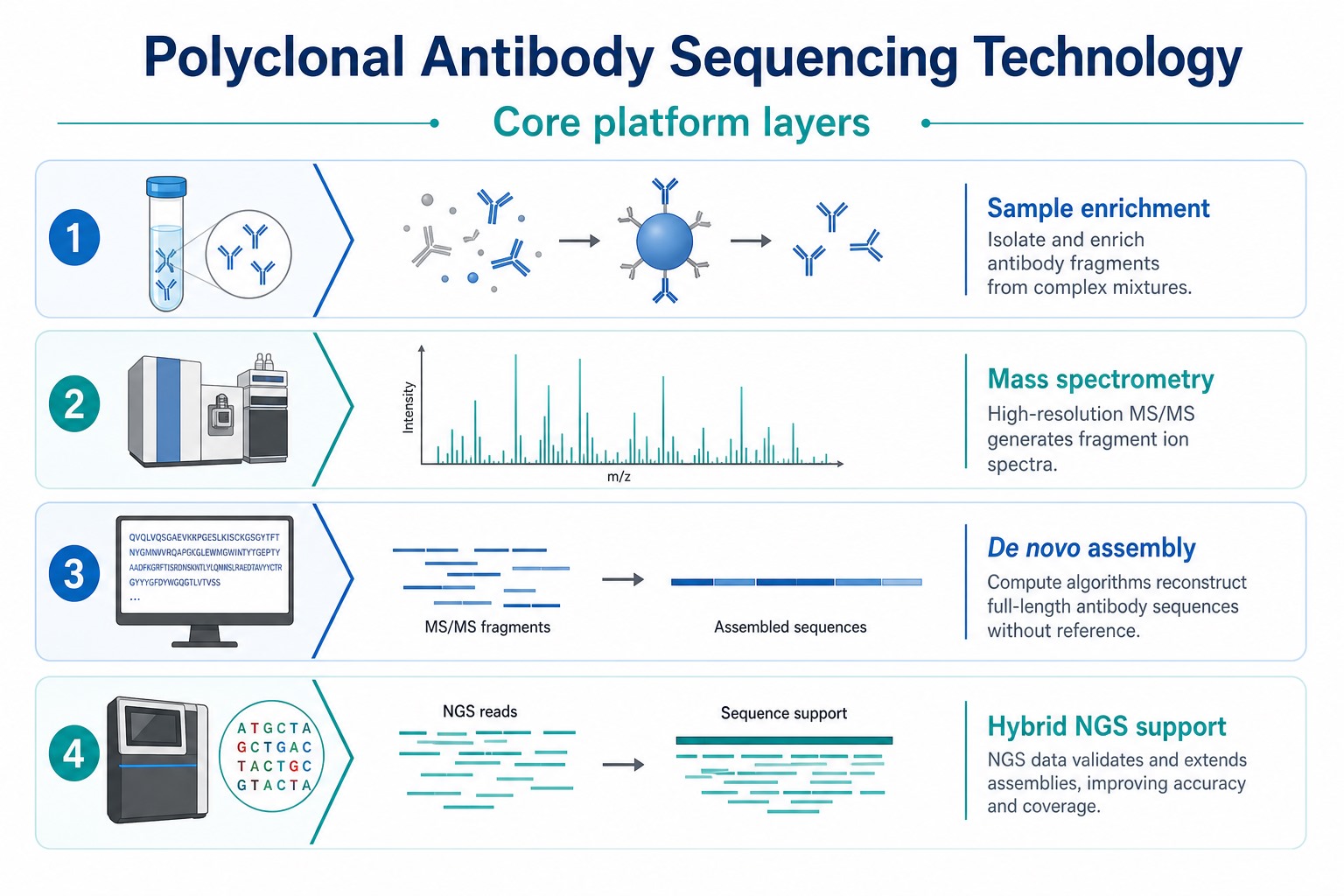
Figure 1. Polyclonal antibody sequencing technology combines enrichment, mass spectrometry, de novo assembly, and optional hybrid sequence support.
Intact Mass Profiling Technology
Intact mass profiling is often the first technology layer in polyclonal antibody analysis.
The method measures molecular weight distributions of intact immunoglobulins or reduced heavy and light chains under denaturing conditions. It does not provide complete variable region sequence, but it supports batch comparison, glycoform review, and identification of major mass components in a polyclonal preparation.
Intact mass technology is valuable when the immediate goal is lot comparability or QC before deeper sequencing investment. It also provides a mass reference layer that can support interpretation of later peptide-level data.
Middle-Down Mass Spectrometry Technology
Middle-down mass spectrometry analyzes larger antibody fragments rather than full bottom-up peptide pools.
Partial reduction or domain-focused digestion produces fragments that retain CDR-proximal sequence information while reducing spectral congestion from thousands of overlapping peptides. LC-MS/MS on these fragments supports clonotype discrimination when several dominant antibodies share similar intact masses.
Middle-down technology is especially useful in polyclonal samples where full bottom-up digestion creates excessive peptide overlap but intact mass alone is insufficient for sequence recovery.
De Novo Bottom-Up LC-MS/MS Technology
De novo bottom-up sequencing is the core sequence inference engine for many polyclonal antibody projects.
Antibodies are digested into peptides, separated by liquid chromatography, and analyzed by tandem mass spectrometry. Fragmentation spectra are interpreted to derive peptide sequences without relying on a known monoclonal template. In polyclonal mixtures, repeated peptide observations and manual or algorithm-assisted review are used to group evidence supporting the same clonotype.
This technology is strongest when enriched polyclonal samples contain one or several dominant clonotypes whose CDR-containing peptides can be resolved from the mixture.
Related Services
Mass Spectrometry Based Antibody Sequencing Service
Antibody De Novo Sequencing Service
Mono Poly Clonal Antibody De Novo Sequencing for Drug R&D
Antibody Sequence Analysis Service
Teams evaluating polyclonal antibody sequencing technology can consult MtoZ Biolabs to review enrichment strategy, MS workflow design, and reporting depth matched to the application.
Hybrid and Sequence-Guided Assembly Technology
Hybrid technology layers improve polyclonal sequencing when peptide overlap creates ambiguity.
MS-derived peptide sequences can be compared against immunoglobulin germline databases to support clonotype grouping. Transcriptome or B-cell repertoire data from the same immunization model can strengthen assignment when available. Iterative assembly merges middle-down and bottom-up evidence into consensus variable region sequences with defined confidence levels.
Hybrid assembly is particularly important when polyclonal samples contain closely related clones that differ by only a few residues in the CDR regions.
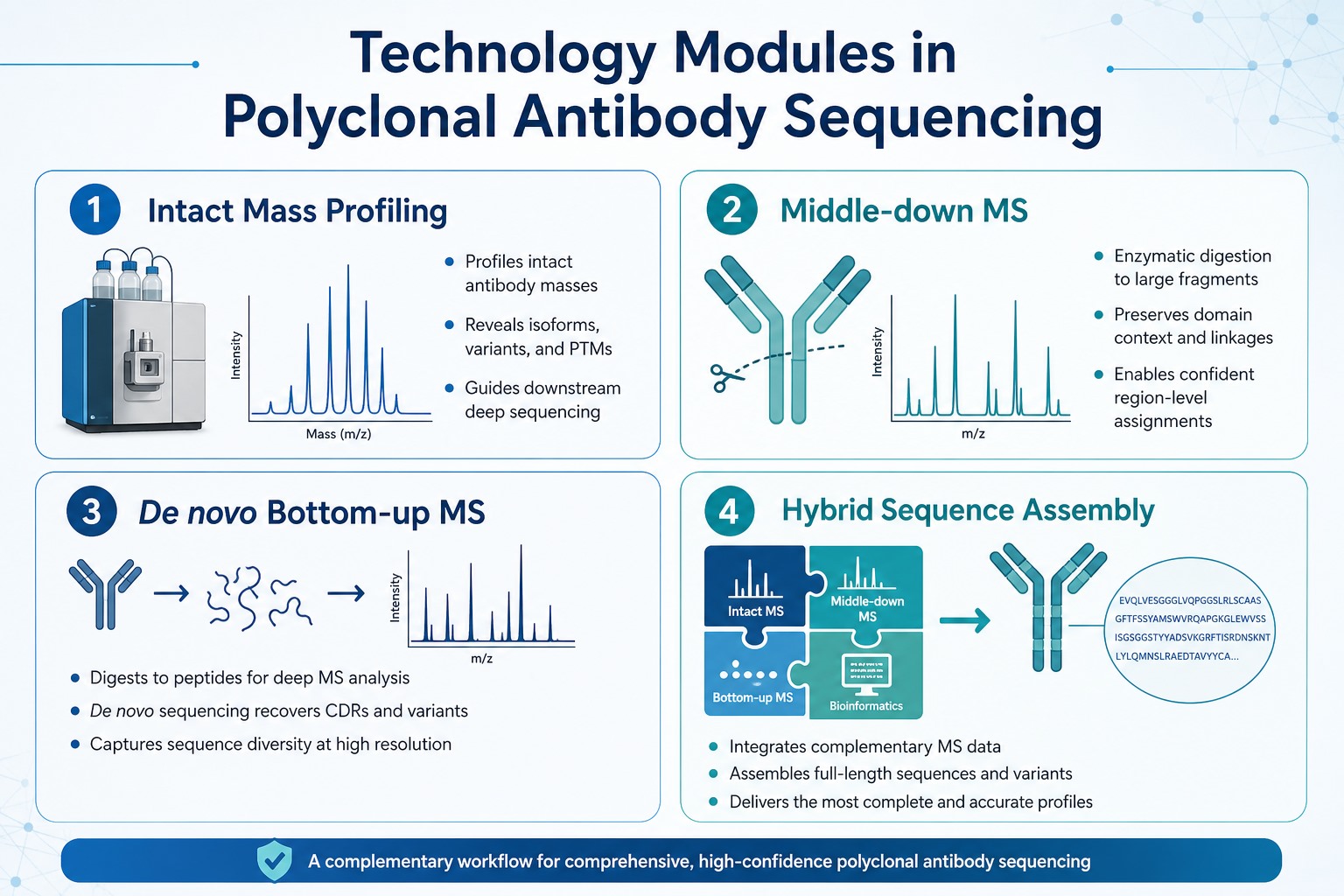
Figure 2. Polyclonal antibody sequencing technology modules include intact mass profiling, middle-down MS, de novo bottom-up MS, and hybrid sequence assembly.
Technology Selection by Project Need
Different project needs favor different technology emphasis within the platform.
|
Project Need |
Primary Technology |
Supporting Technology |
Typical Deliverable |
|---|---|---|---|
|
Lot comparability |
Intact mass profiling |
Middle-down or peptide review |
Mass profile comparison |
|
Dominant clonotype recovery |
De novo bottom-up MS |
Hybrid assembly |
Variable region sequences |
|
Complex mixture resolution |
Enrichment plus middle-down MS |
De novo bottom-up MS |
Ranked clonotype list |
|
Recombinant redevelopment |
Integrated MS workflow |
Intact mass QC |
Lead clonotype sequences |
|
Immune repertoire characterization |
De novo MS plus hybrid support |
Transcriptome if available |
Dominant response sequences |
Technology layers should be selected before sample processing because enrichment and digestion strategy depend on the intended deliverable.
Core Technical Advantages and Current Limitations
Core Technical Advantages
Protein-level sequencing without a monoclonal template.
The technology can recover sequence information directly from polyclonal antibody protein.
Modular platform design.
Intact mass, middle-down, and bottom-up layers can be combined based on project stage.
Support for clonotype discovery in mixed samples.
Dominant binders can be identified when enrichment reduces complexity.
Actionable output for redevelopment and documentation.
Sequence evidence supports recombinant engineering and reagent records.
Current Limitations
Low-abundance clones may remain unresolved.
Technology priority is usually on dominant clonotypes.
Peptide overlap increases ambiguity.
Related clones can share framework peptides and complicate assignment.
Enrichment quality strongly affects outcomes.
Unfractionated sera are harder to sequence confidently than purified antigen-specific IgG.
Functional validation remains required.
Sequence recovery does not replace binding or specificity assays.
Applications in Research, Diagnostics, and Biopharma
Polyclonal antibody sequencing technology supports several application areas.
Immunology research uses the technology to characterize antigen-specific antibody responses when hybridoma generation is not planned or not yet complete. Diagnostic reagent development uses it to document and compare polyclonal antibody lots that affect assay consistency. Custom reagent manufacturers use it to archive sequence information for client-specific polyclonal products. Biopharma discovery teams use it to recover lead clonotypes from immune materials before recombinant candidate engineering. Academic core facilities use it to stabilize long-term reagent identity across changing production lots.
Application value is highest when the polyclonal reagent is custom, critical, or repeatedly used across project phases.
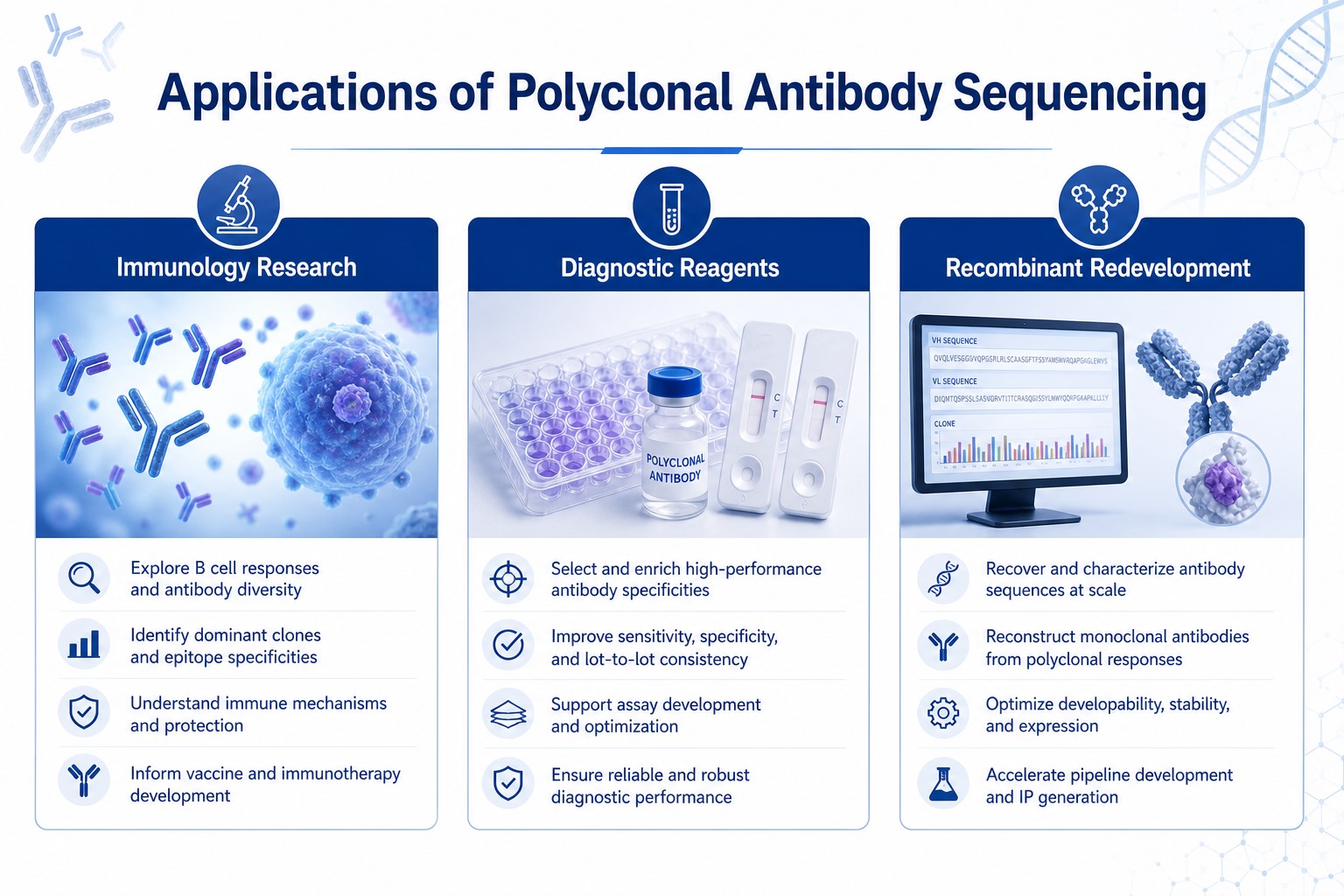
Figure 3. Polyclonal antibody sequencing technology supports immunology research, diagnostic reagent control, and recombinant redevelopment applications.
Application Scenarios in More Detail
Research laboratories apply the technology when immune sera contain valuable binders that should be documented before material is exhausted. Diagnostic manufacturers apply it when lot change control requires stronger molecular evidence than functional QC alone. CRO and CDMO workflows apply it when clients request sequence records for custom polyclonal reagents used in licensed or long-running assays. Biologic discovery groups apply it when polyclonal immune reagents are an intermediate step toward defined monoclonal or oligoclonal products.
In each scenario, the technology converts a mixed reagent into sequence evidence that supports the next project decision.
Expected Deliverables from the Technology Platform
A complete polyclonal antibody sequencing technology project may deliver several outputs.
Dominant clonotype sequences provide the main variable region assignments supported by peptide evidence. Intact mass profiles document major molecular weight components when profiling is included. Batch comparison summaries highlight sequence or mass differences between lots. Confidence-tiered reporting separates high-confidence clonotypes from provisional assignments. Method documentation describes enrichment, digestion, and assembly logic for internal review.
Deliverable depth should match the application, whether documentation, comparability, or redevelopment.
Frequently Asked Questions
1. What technologies are used in polyclonal antibody sequencing?
Common technologies include intact mass profiling, middle-down MS, de novo bottom-up LC-MS/MS, and hybrid sequence assembly.
2. Is polyclonal sequencing technology the same as hybridoma sequencing?
No. Hybridoma sequencing uses genetic material from one clone. Polyclonal sequencing technology is designed for mixed antibody populations.
3. Which technology layer is most important?
De novo bottom-up MS is usually central for sequence recovery, but intact mass and middle-down layers often improve confidence and efficiency.
4. What applications benefit most from this technology?
Custom polyclonal reagents, lot comparability workflows, immune response characterization, and recombinant redevelopment projects benefit most.
5. Can the technology sequence every clone in a polyclonal mixture?
Usually no. It most reliably recovers dominant or most relevant clonotypes rather than the full repertoire.
Conclusion
Polyclonal antibody sequencing technology combines enrichment, mass spectrometry, de novo peptide sequencing, middle-down analysis, intact mass profiling, and hybrid assembly to extract sequence information from mixed antibody populations. The platform is modular rather than single-method, and its application value spans immunology research, diagnostic reagent control, and biopharmaceutical discovery support.
Programs that match technology layers to project need obtain clearer sequence evidence and more efficient use of sample material. Researchers exploring polyclonal antibody sequencing technology can contact MtoZ Biolabs to review workflow design, enrichment options, and application-specific reporting. For teams moving from polyclonal materials toward defined recombinant antibodies, MtoZ Biolabs can also help connect sequencing technology output with downstream development planning.
How to order?




